Bristly, stripy and muscly – the architecture of Poundley and Walker

Several of the architects featured so far in this blog were, for all the distinctiveness of their architecture, specialists in a particular building type, be it churches, country houses or non-conformist chapels. Where 19th century architects were professionally more omnivorous, they tended to cut their stylistic cloth according to the commission. Though we think of ‘Gothic’ as being synonymous with ‘Victorian’, in fact the style was very far from ubiquitous, especially in the first half of the 19th century. Thus it is that Wyatt and Brandon, though usually Goths for ecclesiastical purposes, could pull out of the hat a piece of Greek Revival delivered with total conviction for the Shire Hall in Brecon.

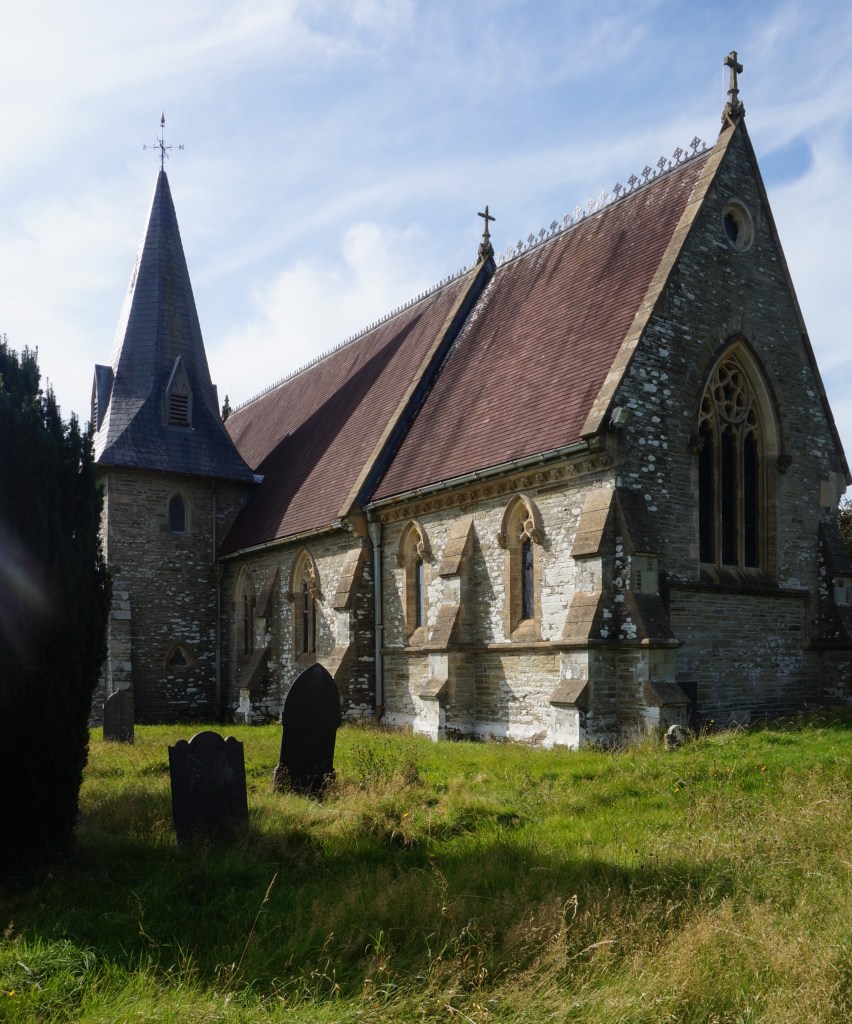
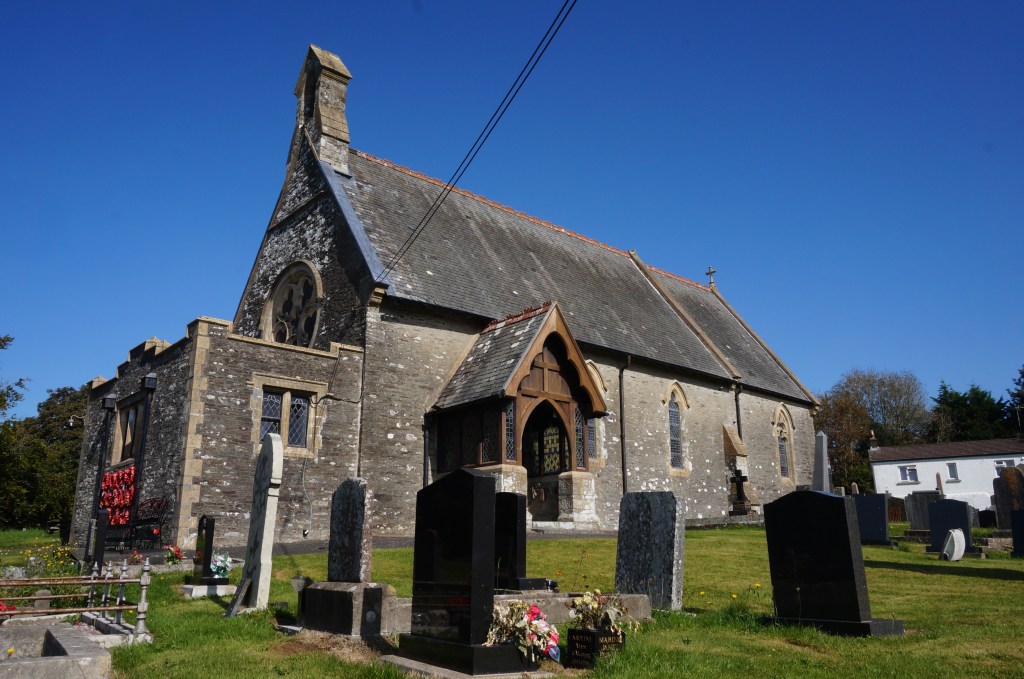
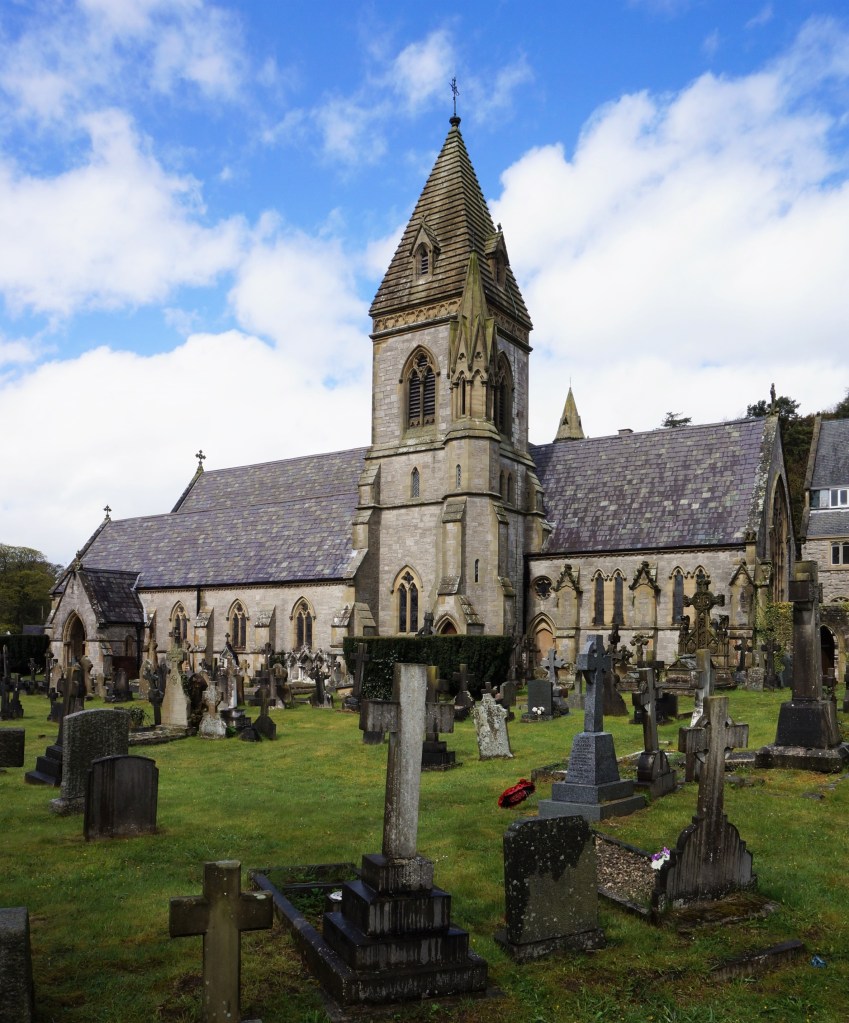
St Mary’s Church, Abbey Cwmhir, Powys (1866): view from west looking towards the Hall, showing the almost Alpine setting

But in this post, I want to look at architects who in many ways are the inverse of that – the joint practice of John Wilkes Poundley (1807-1872) and David Walker (18??-c. 1892). They employed consistently a style that bears such a strongly personal stamp and there is never any mistaking it – get your eye in with two or three of their designs and it’s very easy to recognise anything else by the firm, whatever the function of the building in front of you. They were prolific and this post does not pretend to be an exhaustive survey of their output. Rather, the aim is to show through a selection of works, presented here chronologically, just how deft they were in adapting their style to a wide variety of building types.

Town hall and market hall in Ruthin, Denbighshire (1863-1865): relief on the ground-floor frontage of the town hall block by Edward Griffith of Chester

First, some biographical details, for which I am indebted to J.D.K. Lloyd’s brief but informative article ‘John Wilkes Poundley: A Montgomeryshire Architect’, which originally appeared back in 1977 in issue No 65 of Montgomeryshire Collections. It is, as far as I am currently aware, the only study in print devoted solely to the architect’s life and work. Poundley was a native of Kerry, a village about three miles to the west of Newtown in Montgomeryshire (now Powys). His grandfather, also called John Poundley (1744-1825), had been a schoolmaster in the village of Lydbury North in Shropshire, not far away over the English border. In 1763, Clive of India purchased the Walcot Hall estate in that parish and commissioned Sir William Chambers (1722-1796) to remodel the existing house. Around that time, he appointed Poundley as tutor to his young son Edward (1754-1839). The connection is important as it brought Poundley into the orbit of landed families in the area and this had a major bearing on his grandson’s choice of profession.

St John the Baptist, Carno, Powys (1863): pavement and communion rail in the sanctuary

Poundley’s father, also called John, ran a small academy in Montgomery, but died young in March 1811. His widow passed away nine months later and their only son, aged just four at the time, passed into the guardianship of William Pugh (1748-1823), a lawyer and banker from an old landed county family, who resided on the estate of Brynllywarch in the parish of Kerry. In 1827, Pugh had the young J.W. Poundley apprenticed to Thomas Penson of Oswestry (1790-1859), architect and county surveyor of Montgomeryshire and Denbighshire.
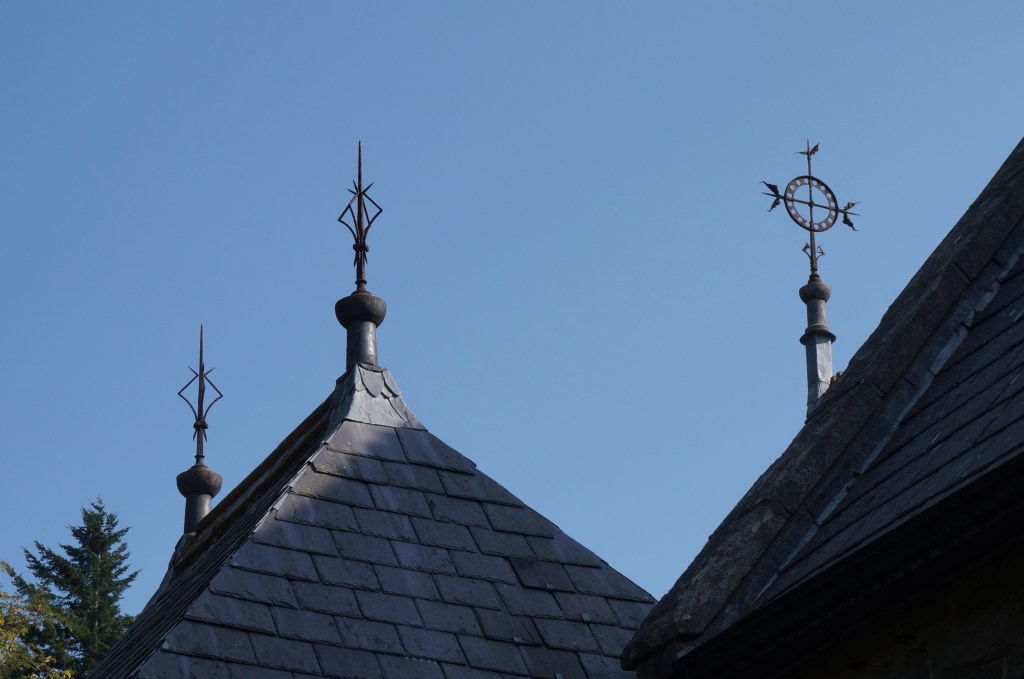
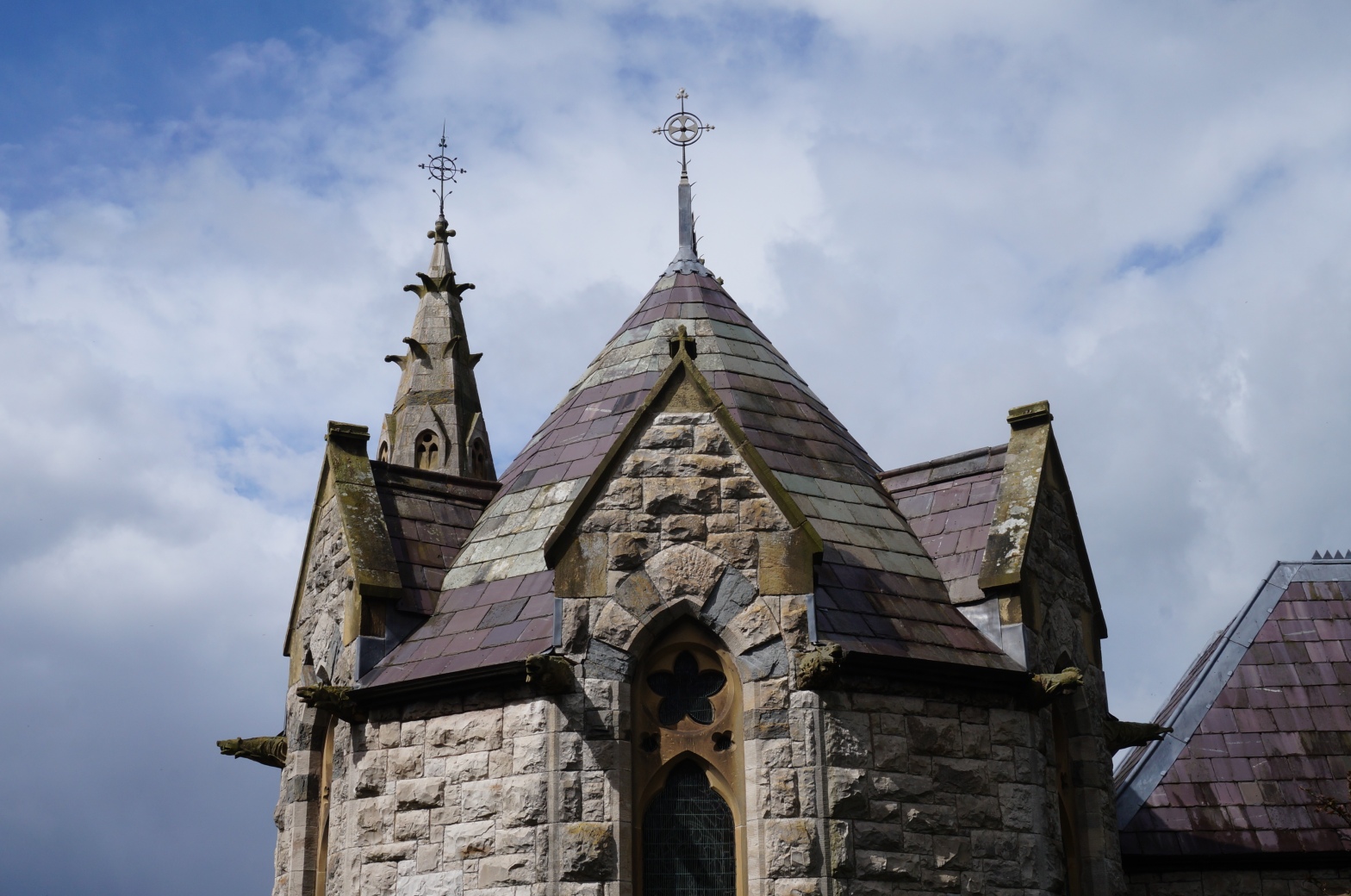
St Mary’s Church, Abbey Cwmhir, Powys (1866): finials to the vestry roof and cross to the chancel, exemplifying the wrought iron ornament that was one of Poundley and Walker’s signature traits

A promising start, one might imagine, but according to family tradition (when carrying out research for his article, Lloyd was able to interview the architect’s last surviving descendant), Poundley disliked working in Penson’s office so intensely that he ran away to Dublin. What happened next is not clear and he does not re-emerge until the mid-1850s, by which point he had set up in partnership with David Walker (18??-c.1892) in a practice engaged in architecture and surveying. Walker had trained in the offices of a Liverpool firm run by John Hay (1811-1861) in partnership with his younger brothers, William Hardie Hay (1813/14-1901) and James Murdoch Hay (1823/24-1915), which was in business from c. 1848 to 1901. The Hays handled a large number of ecclesiastical commissions throughout the country and for all denominations, generally designing in Gothic of a decidedly wilful character. Walker remained in Liverpool and the business address of the partnership was on Lord Street in that city, but Poundley seems to have been based in Kerry, where he resided at Black Hall, and it is not currently clear how commissions were divided up between the two men. Neither ever became a member of the RIBA.
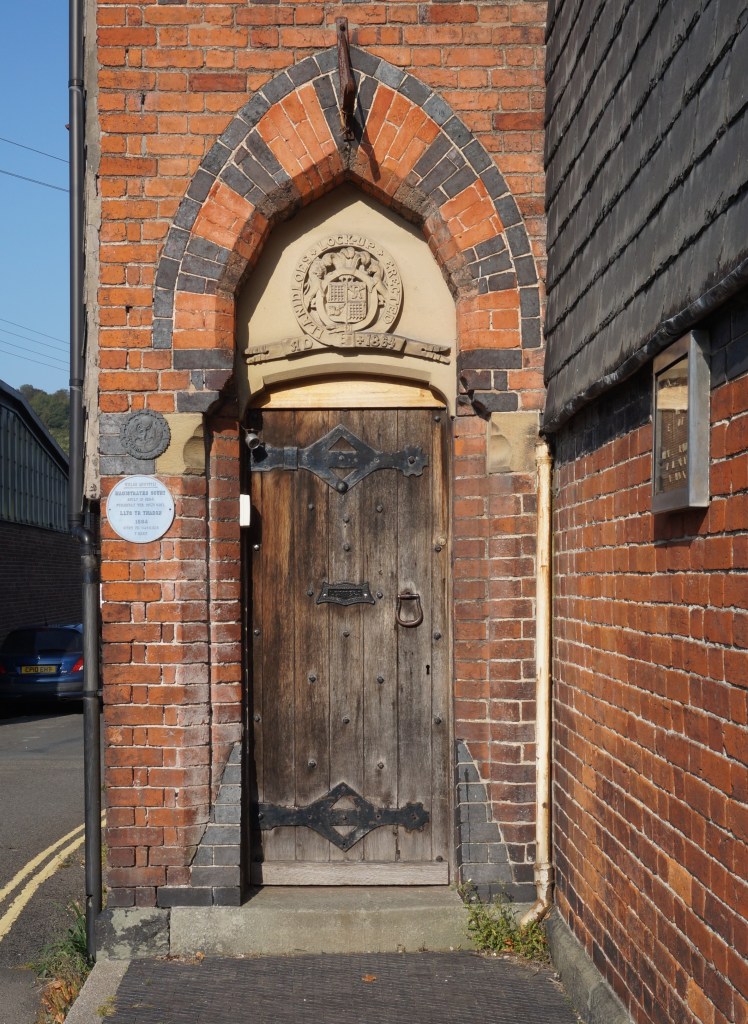
Magistrates’ Court, Llanidloes, Powys (1864): entrance to the courtroom

At some point during this period, Poundley came into contact with the Naylor family, which also had prominent land holdings in the area. John Naylor (1813-1889) was heir to a business empire founded by his great-uncle Thomas Leyland (?1752-1827), merchant and three-time mayor of Liverpool, who had amassed a fortune through international trade and slaving. Following abolition in 1807, Leyland had gone into finance and set up a partnership with his nephew, Richard Bullin, which became the highly lucrative concern of Leyland and Bullin’s Bank. In 1835, Richard Bullin (who later took the surname Leyland) had acquired the Brynllywarch estate at Kerry from William Pugh’s son, William Pugh the younger (1783-1842). This Pugh was a magistrate and entrepreneur who, among other things, actively supported the extension of the Montgomeryshire canal to Newtown in 1815-1819, the macadamizing of the county’s turnpike roads and provision of more direct access to South Wales via Newtown and Builth. But none of these ventures or any of his investments proved successful, forcing him to sell up. Then in 1845, Bullin purchased the 4,000-acre Leighton Hall estate just outside Welshpool to the southeast and gave it to John Naylor as a present to mark his wedding to Georgiana Edwards, following it two years later with a gift of £100,000.
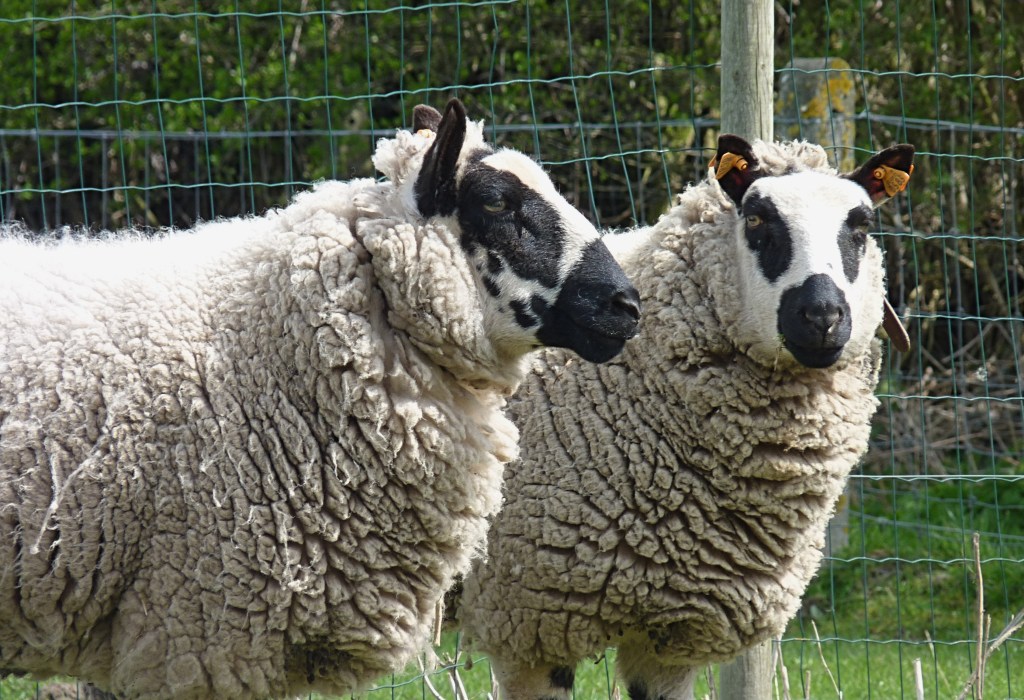
Kerry Hill sheep, the breed developed and farmed by J.W. Poundley (© Copyright Jamain and licensed for reuse under a Creative Commons Licence)

Naylor quickly embarked on an ambitious building programme. In 1850, he began remodelling the existing house and gardens to reflect his wealth and status. The project was conceived on a grandiose scale and work went on until 1856. The finished result sports a tall octagonal tower redolent of Beckford’s Fonthill Abbey, and indeed externally the design was still largely Georgian Gothick in spirit. In 1851-1853, he put up a new church dedicated to the Holy Trinity, a scaled-down cathedral with flying buttresses to support the nave, an octagonal burial chapel like a chapter house and a tall spire visible for miles around. For both of these commissions Naylor engaged the obscure Liverpool architect of William Henry Gee (dates unknown). But his interest in building went a long way beyond trophy projects, and before he had even begun work on the new Hall and church, he embarked on a major programme of reconstructing the estate buildings.

Home Farm on the Leighton Hall estate, Leighton, Powys (c. 1849-early 1860s) aerial view: north is to bottom right, where the circular forms of the piggery and sheep house can be clearly seen. The threshing barn is right in the centre, while to its left, either side of the perimeter road, are the two fodder buildings. The stables are at the top end of the long spine building. (RCHAMW)

As a member of the Royal Agricultural Society from 1849, Naylor had an active interest in agricultural improvements and he was evidently keen to make Leighton Hall a showcase for them. Around that time, he began work on a new complex for the Home Farm, located to the north of the Hall about half way between it and the church. It was a major undertaking, and not completed until the early 1860s. The centrepiece, constructed in the first phase, was a large threshing barn, arranged on an east-west axis and adjoined by a granary and hay barn, with an adjacent, basilica-like fodder building. In the second phase, a stable with a central loading bay appeared at the south end of the main complex, along with enclosed stockyards and houses for the farm workers. In the third phase, completed by 1855, a piggery and sheep house were added at the north end of the main complex, flanking an extension of the main spine building. These are both circular and top-lit by a clerestory, with an open centre extending down into the basement level, through which waste was removed from the building. A feedstuffs mill, powered by small streams channelled to drive a water turbine, was also added.

The roof structure of the piggery at Home Farm (Wikipedia Commons)

In a fourth phase, completed by 1860, a second fodder shed (identical in design to the first) was erected, as well as a shed where sheep were dried off after being dipped and storage space for root crops. Finally, a short distance away a workshop was built with a storage area for ploughing and traction engines, which could also be used when stationary to power ancillary machinery. Goods were transported around the complex by wagons running on a broad gauge tramway. A short distance away, a funicular railway was constructed to transport manure up to a tank on high ground fed by a hydraulic ram located on a specially cut by-pass channel of the River Severn. From here, liquid slurry was distributed around the estate by gravity using a system of copper pipes.

Design for a complex of farm buildings from Poundley’s Cottage Architecture of 1857

As befitted a project intended to demonstrate how technological advances could make agriculture more efficient, the planning is rational and, indeed, thoroughly classical in its axial organisation. Stylistically, the complex is in what would come to be termed the functional tradition – well proportioned and carefully detailed, and (with the exception of the two houses, handled in a loose Tudor Gothic) lacking any historicising garb. Further research is needed to confirm the authorship, but Poundley is a plausible candidate as someone who, in addition to his attested links with Naylor, was clearly making a bid for that niche in the market. In 1857 he published a pattern book entitled Poundley’s Cottage Architecture with designs for agricultural buildings intended to be suitable for hilly areas of Wales. It included a farmyard that has strong affinities with Home Farm and a design for a double cottage of bungalow form based on iron-framed construction. In 1866 he designed a complex of agricultural buildings for Rowston Farm on Lord Cawdor’s Stackpole Estate in Pembrokeshire and, as we shall see, was himself actively involved in farming.

Design for an iron-framed labourers’ bungalow from Poundley’s Cottage Architecture of 1857

Home Farm may have been uncharacteristically plain, but Poundley soon showed himself able to reconcile the design of agricultural buildings with High Victorianism at its most exuberant, most notably at the poultry house of 1861. The exterior incorporates timber-framing, jettying and the deep eaves and decorative bargeboards that were to become one of the firm’s trademarks. That same year, Poundley acceded to his former teacher, Penson’s old post of Montgomeryshire county surveyor. Around the same time, he was involved in overseeing the construction of a 3¾-mile branch line from Abermule on the main line of the Cambrian Railway to his native Kerry. Authorised in May 1861 and opened for traffic in June 1863, it was intended to exploit timber and quarry traffic from the Brynllywarch Estate and Poundley’s own venture in breeding Kerry Hill sheep. The station building (in fact located some way short of the village in the hamlet of Glan-Mule) was probably designed by the Poundley firm and quite grandly appointed for a destination with little passenger traffic.

Kerry railway station with one of the Sharp Stewart 0-4-0 saddle tanks supplied for the opening of the line in 1863 and used until the 1900s at the head of a mixed train for Abermule.

None of these works really justifies the claims that I made at the outset for the firm. But that would soon come with a couple of buildings begun in 1863 in the neighbouring county of Denbighshire. Both of them exhibit a style that seems to have emerged fully formed (unless there are precursors out there waiting to be discovered) and demonstrate a confident handling of the High Victorian muscular Gothic idiom, incorporating the innovations drawn from Italian medieval architecture promoted by John Ruskin and the ‘vigour and go’ of early French Gothic. More research would be needed – assuming it could find the answer at all – to ascertain how the Poundley and Walker firm obtained its mastery of the style. Perhaps David Walker, living in a large, well connected and fast expanding city, was better aware of recent developments in architecture than his business partner, but that for now is speculation.
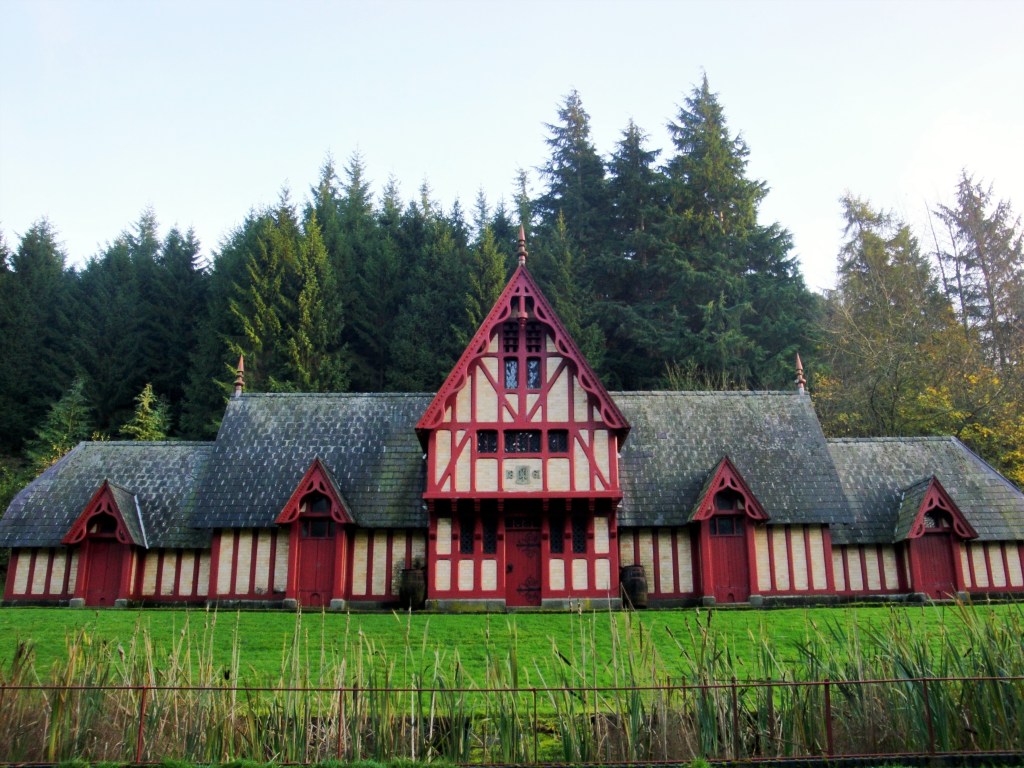
The poultry house on the Leighton Hall estate of 1861 (Steve Edwards)
Town hall and market hall in Ruthin, Denbighshire (1863-1865): view from the junction of Market Street and Wynnstay Road

The first of these projects was a complex of civic buildings on Market Street in Ruthin, Denbighshire – a combined town hall, market hall and fire station. It postdates by only a few years the similar complex by R.J. Withers in Cardigan discussed in a recent post, and the comparison is instructive. Like it, the building is deftly fitted into an awkward sloping site. The main administrative block is located at the lower end, taking advantage of the change in height of the terrain to fit in a monumental elevation and dramatic return to a side street. In the Ruskinian line, the ground floor consists of a boldly expressed arcade resting on sumptuously carved capitals, whose tympana are filled alternately with plate tracery and carved reliefs, executed by Edward Griffith of Chester (dates unknown). A bell tower terminating in a hipped mansard roof marks the junction with the market hall, with cart entrances consisting of curious polygonal arches under crow-stepped transverse gables. Internally, it is spanned by arch-braced trusses of bolted timber construction, reinforced by wrought iron tension rods and supporting a clerestory. Beyond is the fire station with two elliptical arches dressed in brown sandstone for the vehicle entrances. A favourite characteristic of the firm’s style emerges here – play in colour and texture, with the rock facing used for most of the wall surfaces contrasting with the smooth ashlar of the dressings executed in a lighter stone. Note also the prominent use of wrought and cast iron detail, extending even to the finials of the tiny dormers of the bell tower.
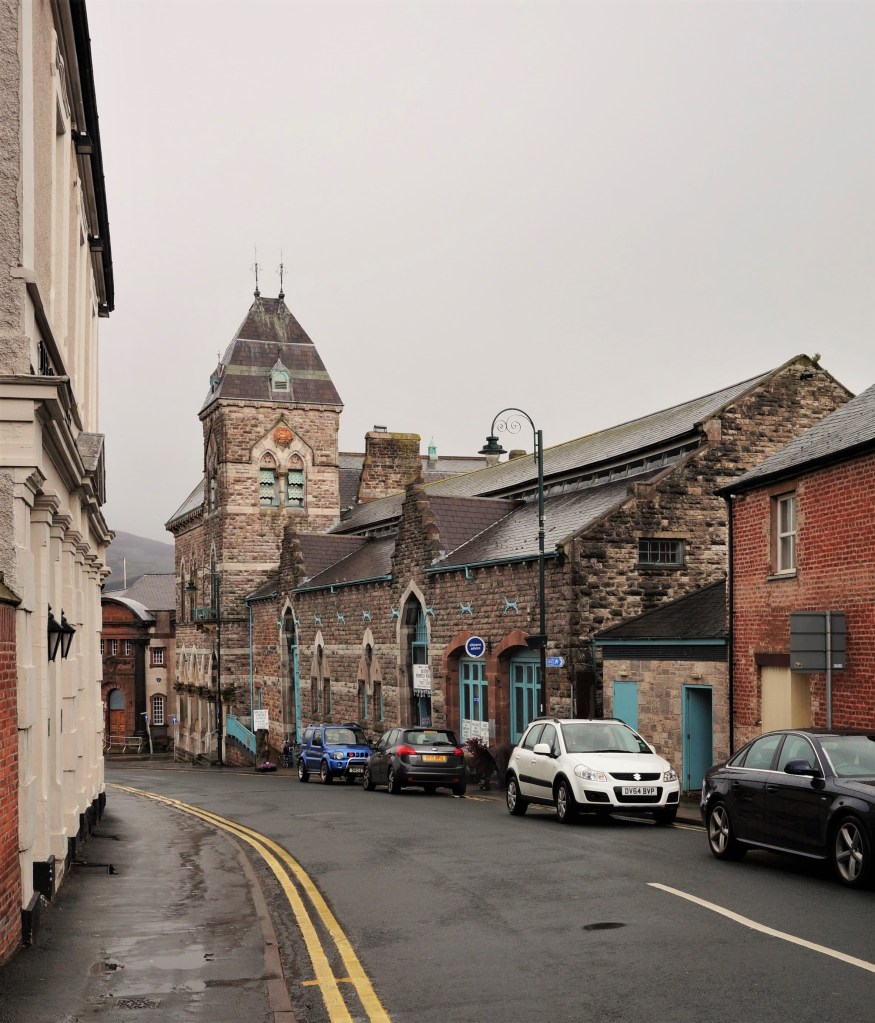
Town hall and market hall in Ruthin, Denbighshire (1863-1865): view looking northeast down Market Street
The interior of the market hall at Ruthin, in use for its original function

That same year, the practice executed a commission for a new church at Llanbedr Dyffryn Clwyd, a village only a couple of miles outside Ruthin to the east on a splendid hillside site with views over the Vale of Clwyd. In 1848 Joseph Ablett, the owner of Llanbedr Hall, died and left the property to his step-nephew John Jesse. Jesse was shocked to discover that the graveyard was so full that new interments disturbed existing burials, and in response gave not only land to allow it to be extended, but also a new church. It stands a short distance away from its medieval predecessor, whose ruins (it was unroofed and abandoned in c. 1896) are still extant.

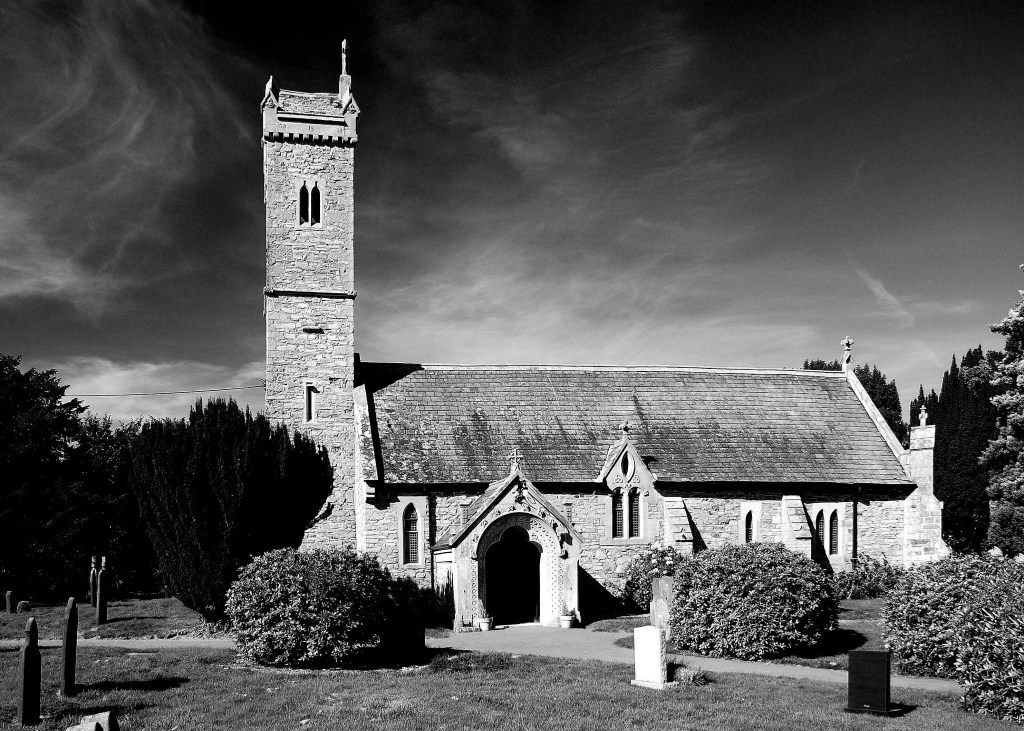
St Peter’s Church, Llanbedr Dyffryn Clwyd, Denbighshire (1863): view from southwest
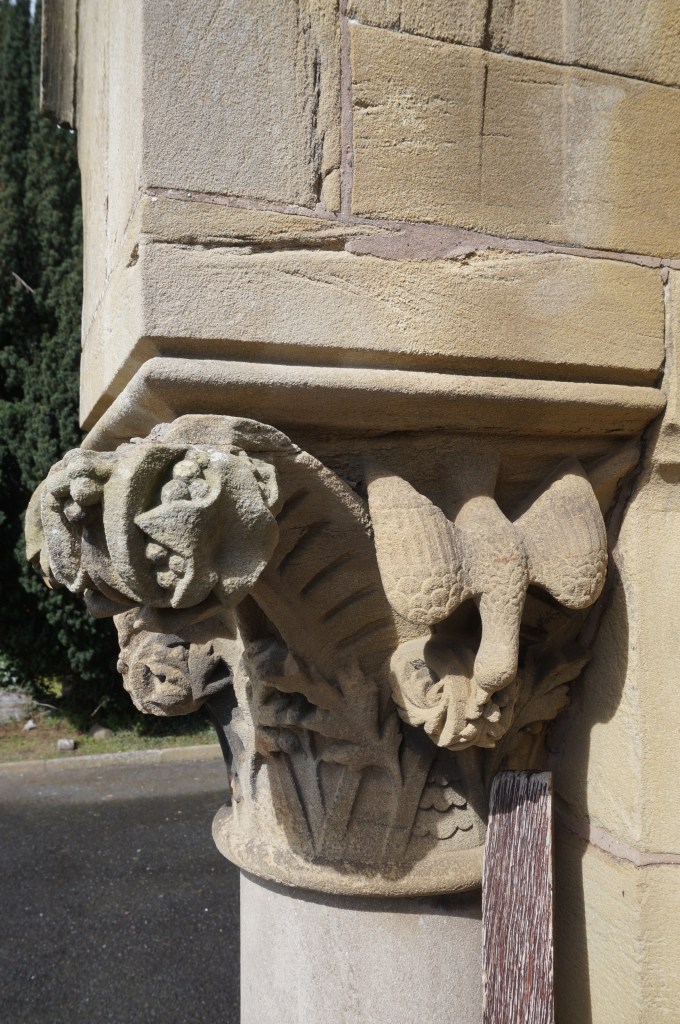
St Peter’s Church, Llanbedr Dyffryn Clwyd, Denighshire (1863): capital of one of the columns supporting the porch

It is a simple, two-cell building of modest proportions – a nave of four bays with an apsidal chancel of two – but the designers exploited every possible opportunity to make it a vehicle for really forceful expression in sculptural form, ornament, colour and texture. The use of rock facing and structural polychromy is already familiar from Ruthin town hall, here augmented by the vividly striped voussoirs and further enhanced by the banding of the slate roof. There is plate tracery throughout, even in single lancets. The windows of the apse break through the eaves into dormers, the upper stages of the towerlet, which starts off as a square and turns hexagonal, goes off on the most extraordinary geometrical excursions. Everything is overscaled and exaggerated to the point where it becomes almost a parody of Gothic, an effect underlined by the huge crockets budding from the steeple, bold ironwork crosses and railing to the ridge of the chancel roof. ‘The funny little thing is so powerful… that I feel its preservation is most important, its unique potency being, in my experience, unmatched in so small a compass’, wrote architect Sir Clough Williams-Ellis (1883-1978) to J.D.K. Lloyd in a letter of 2 May 1977.
St Peter’s Church, Llanbedr Dyffryn Clwyd, Denbighshire (1863): view from southwest
St Peter’s Church, Llanbedr Dyffryn Clwyd, Denbighshire (1863): commemorative inscription over the vestry door

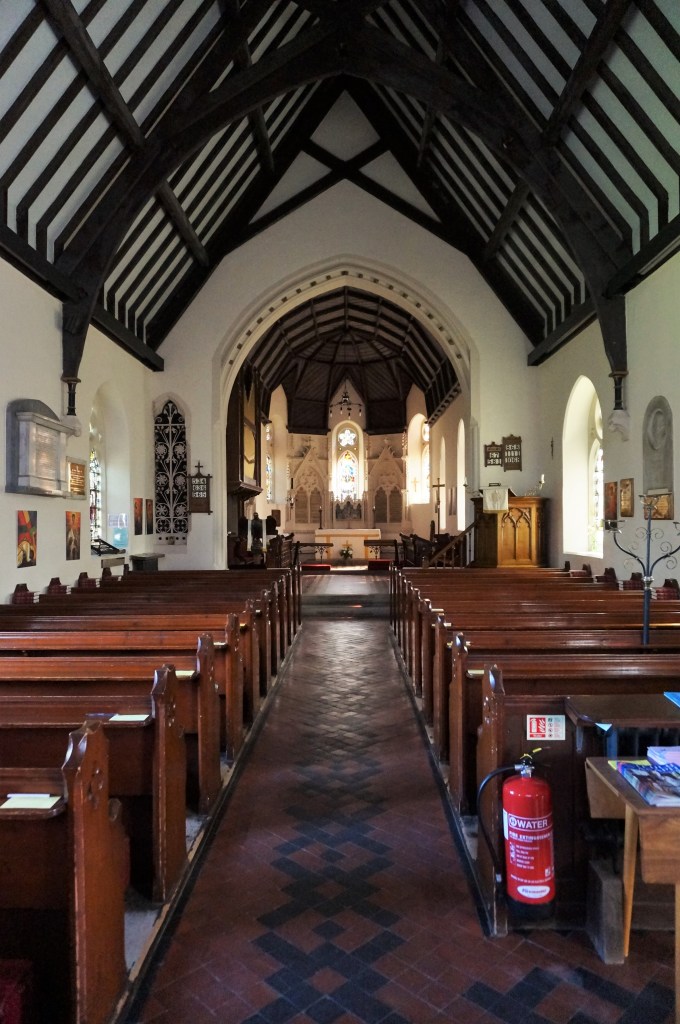
The interior is a little tamer. As usual, the focus is on the east end with the Decalogue boards, Creed and Lord’s Prayer (here all in Welsh) framed in blind openings of cusped tracery with gablets above, all richly adorned with pinnacles and crockets. The pattern of the fenestration means that the reredos squeezed in between them is comically underscaled. Tiles by Maw & Co and stained glass by Clayton and Bell installed at the time of construction (as recorded by an inscription in the tympanum of the vestry doorway) give colour. There is excellent ironwork filling a sound hole through which the organ speaks into the nave and the bold carpentry of the roof structures gives further visual interest.

St Peter’s Church, Llanbedr Dyffryn Clwyd, Denighshire (1863): sanctuary
St John the Baptist, Carno, Powys (1863): view from southeast, showing the original form of the tower

That same year, the firm designed a new church for the village of Carno, located in a river valley northwest of Newtown (formerly in Montgomeryshire, now Powys). The uncompromising stylistic language is by now familiar. Here, the rock facing is varied with dressed red sandstone, which is used for inserts in the spandrels of the plate tracery. The vigorous impression is marred by the loss of the original timber bell turret, which had to be removed in c. 1978 after becoming unsafe and was reinstated in much simplified form. But for all that, it is a highly rational design compared to Llanbedr Dyffryn Clwyd – a single volume with unbroken wall surfaces and roofline externally, and no structural division between the nave and chancel internally, just doubled up roof trusses supported on compound attached colonettes rather than corbels. Again, the carpentry of the roof, here with scissor-braced trusses, is a prominent feature of the interior.

St John the Baptist, Carno, Powys (1863): south porch
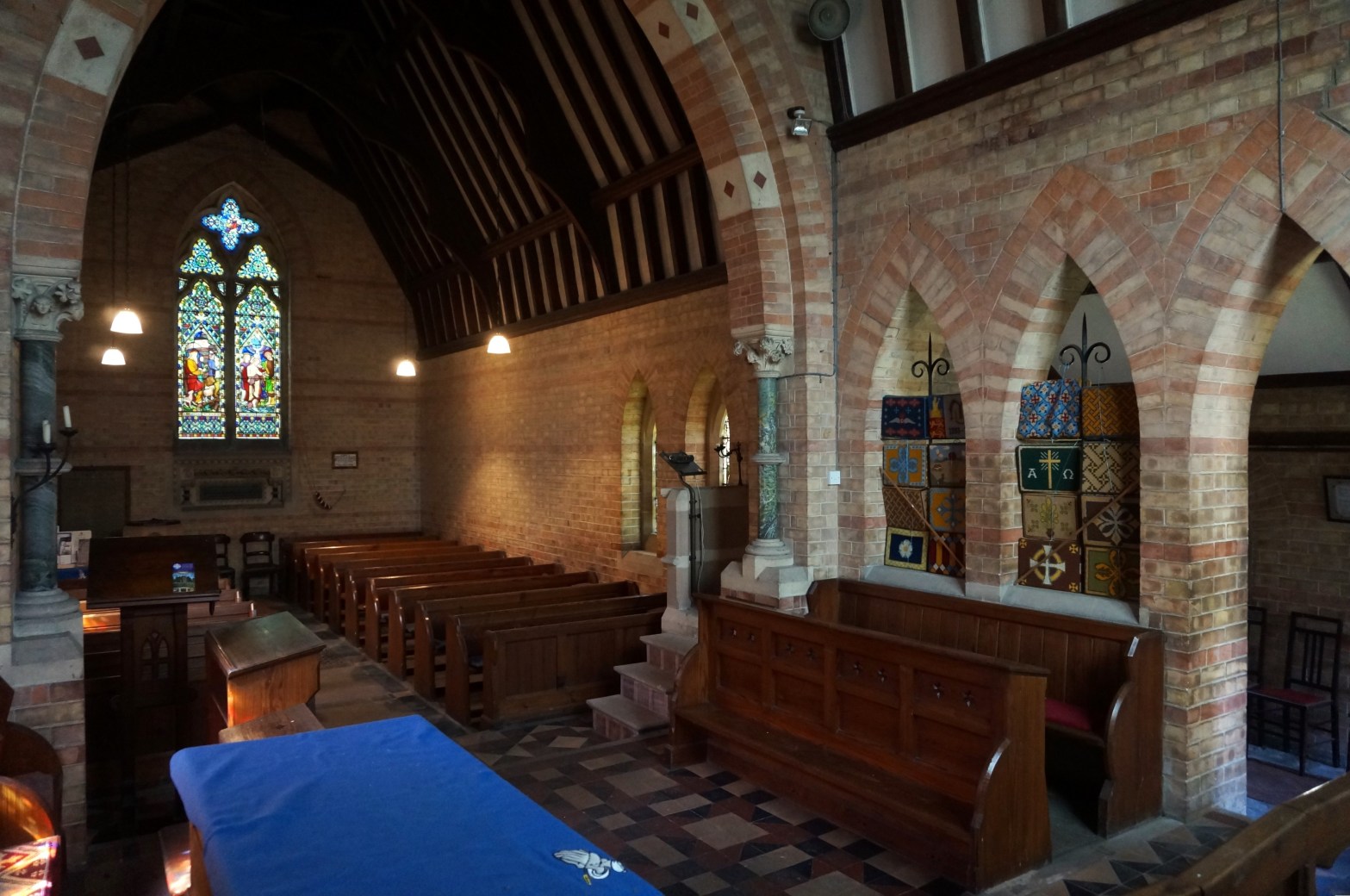
St John the Baptist, Carno, Powys (1863): interior looking east

In 1864, the firm put up a magistrates’ court on High Street in Llanidloes, (formerly Montgomeryshire, now Powys). Here, the material is the red brick that predominates in the town enlivened with copious constructional polychromy, although most of the west elevation is slate-hung in accordance with a local tradition. The window and door jambs are intricately chamfered, sometimes in two orders. The pièce de résistance is the doorway leading to the courtroom at the rear of the building with a polygonal intrados to the arch and chunky wrought iron door furniture. Lloyd speculates that this commission was the work of Poundley alone, acting in his capacity of County Surveyor, but this wants confirmation.

Magistrates’ Court, Llanidloes, Powys (1864)

Around the same time, the firm took on a couple of commissions for country houses. The first is Broneirion at Llandinam in the Severn valley northeast of Llanidloes, now used as the Welsh Training Centre for the Girl Guide Association. It was built for David Davies (1818-1890), a native of Llandinam, whose meteoric career as a contractor had begun in 1846 when he was invited to make the foundations and approaches for an iron bridge over the Severn in the village. This was the work of Thomas Penson (q.v.), the first of three such bridges that he designed in his capacity as Montgomeryshire County Surveyor. Davies’ firm went on to build numerous railway lines in Wales, such as the route from Oswestry through Newton to Machynlleth (for which the Kerry branch was a feeder) and was later heavily involved in the exploitation of the Rhondda coalfield.
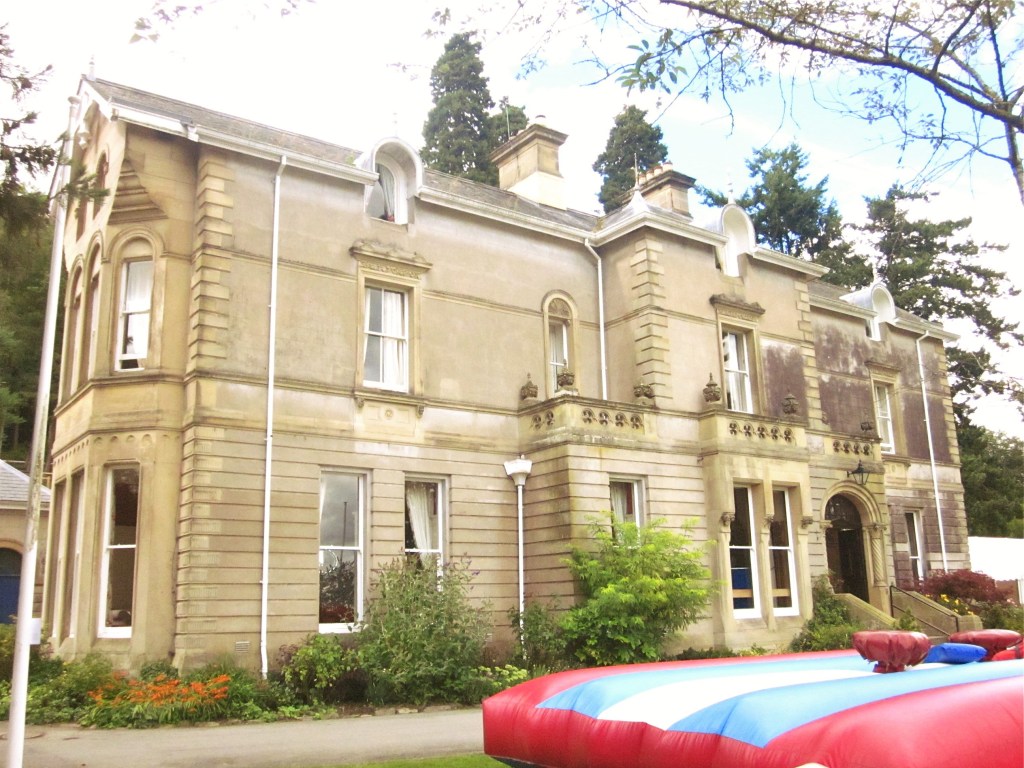
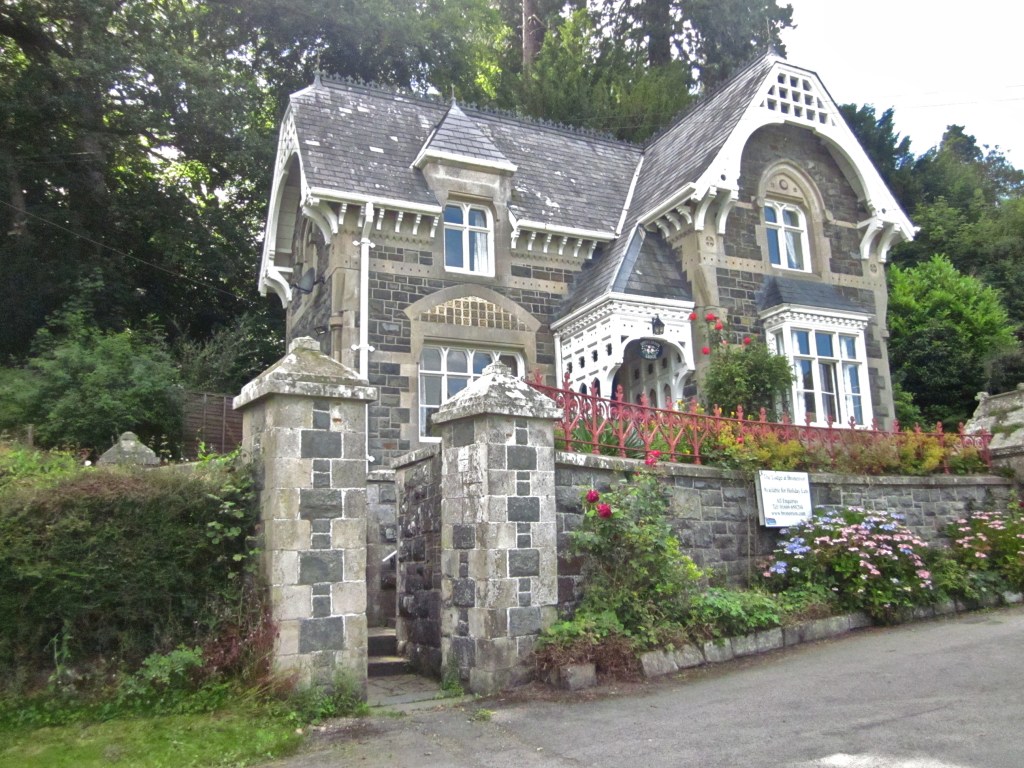
Broneirion, Llandinam, Powys (1864) (Wikipedia Commons)
Entrance lodge at Broneirion, Llandinam, Powys (1864) (Wikipedia Commons)

Broneirion is a curious building in Poundley and Walker’s interpretation of the Italianate style. Finished externally in smooth ashlar masonry and Roman cement render, it lacks the textural variety of their work elsewhere, if not the sculptural interest – witness the ingenious corbelling out of the top of the bay window where it becomes a gable end and the tunnel-like eaves of the top-floor dormers. Still, it feels a little underpowered compared to the splendid entrance lodge. Just like the church at Llanbedr Dyffryn Clwyd, that building packs a huge amount of variety and invention into a relatively small form. Of particular interest here is the fine joinery of the lean-to porch and bargeboards, a feature that will crop up elsewhere. Next comes Llanbedr Hall. John Jesse, who commissioned the new church of St Peter, died the same year that it was completed. The property was inherited by his son, John Fairfax Jesse, who in c. 1866 commissioned Poundley and Walker to remodel it. Work was not completed until 1874, but for a house with such an involved construction history, the result was rather disappointing – recognisably in the firm’s High Victorian manner, but gone rather flaccid and looking like a much smaller house inflated in its proportions to suit the occasion.

Llanbedr Hall in the 1930s, during its period in use as a tuberculosis sanatorium

Far more successful is the remarkable group of buildings at Abbey Cwmhir in Radnorshire (now Powys), north of Llandrindod Wells. As the name implies, the village was once the location of a religious house, founded in c. 1176 by Cistercians who, characteristically, had been drawn to a beautiful and secluded location in the valley of the Clywedog Brook. Following the Dissolution, the abbey buildings were plundered for stone and the lands became a private estate. In 1821, the estate was purchased by an art collector called Thomas Wilson, who put up a house in a neo-Elizabethan style, which was completed by 1833. He positioned it overlooking the site of the abbey on the water meadows, which he landscaped to create a pleasure ground. But the expense of all these works ruined him and in 1837 he sold the estate to Francis Philips (1771-1850), scion of an old Staffordshire family that had made a fortune in the Manchester cotton industry. Philips’ eldest son inherited the estate but outlived his father by only nine years, so it passed to his younger brother, George Henry Philips (1831–1886), who embarked on a major building programme.
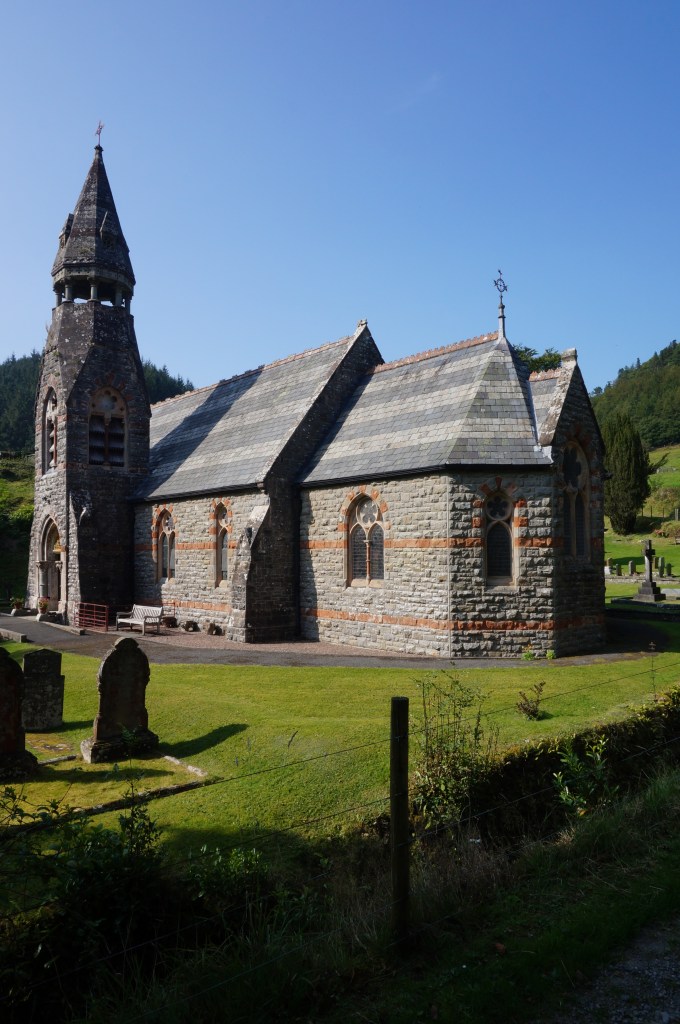
St Mary’s Church, Abbey Cwmhir, Powys (1866): view from southeast
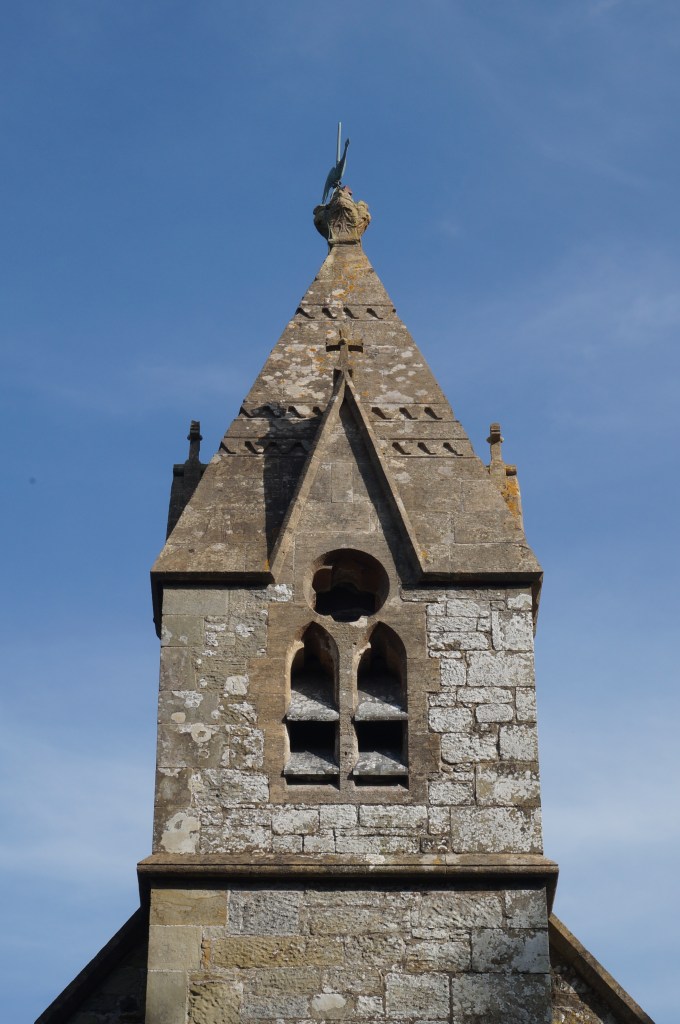
St Mary’s Church, Abbey Cwmhir, Powys (1866): detail of the belfry and spire

Firstly, in 1866, the church of St Mary was rebuilt on the site of a 17th century predecessor. It is a variation on the theme set by Llanbedr Dyffryn Clwyd – again a two-cell structure with a short chancel terminating in a polygonal apse and an east window breaking through the eaves cornice into a dormer. Again, there is rock facing, striped arch heads, plate tracery and banding to the slate roof. Though the tower is more massive, there is the same love of geometric invention in the handling of its transformation into an octagonal spire, whose upward progression is interrupted by a ring of colonettes supporting trabeated openings – almost as though the top had been sliced off and this stage inserted as an afterthought. The tympanum of the main entrance is occupied by a relief of the Ascension, based on one discovered during investigations of the abbey ruins.
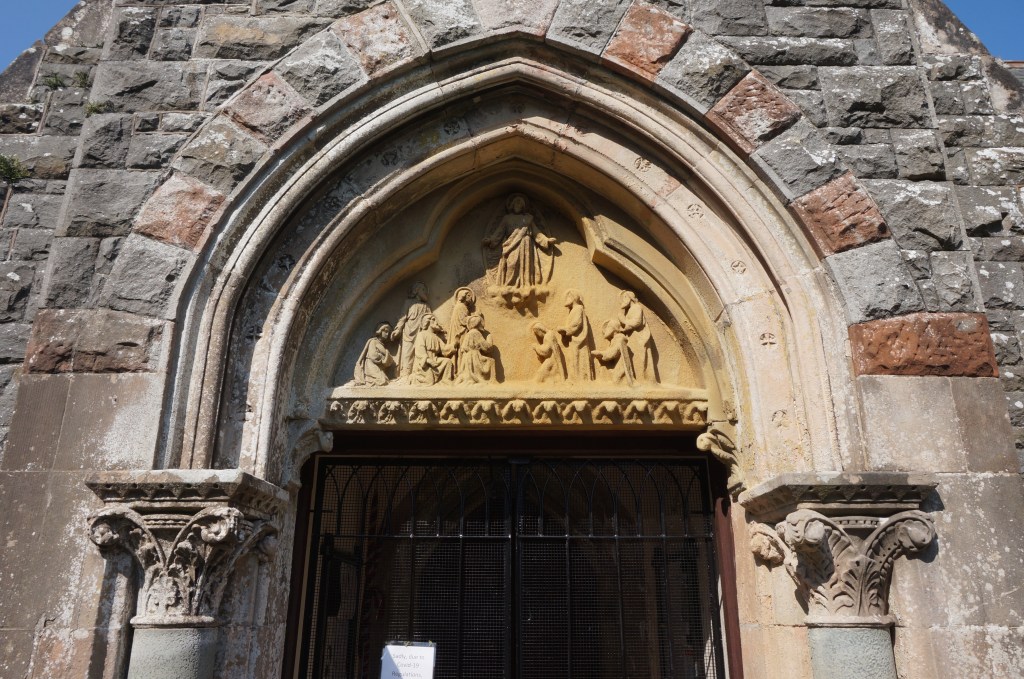
St Mary’s Church, Abbey Cwmhir, Powys (1866): relief of the Ascension above the main entrance
St Mary’s Church, Abbey Cwmhir, Powys (1866): interior looking east (Steve Brodie, reproduced with permission)

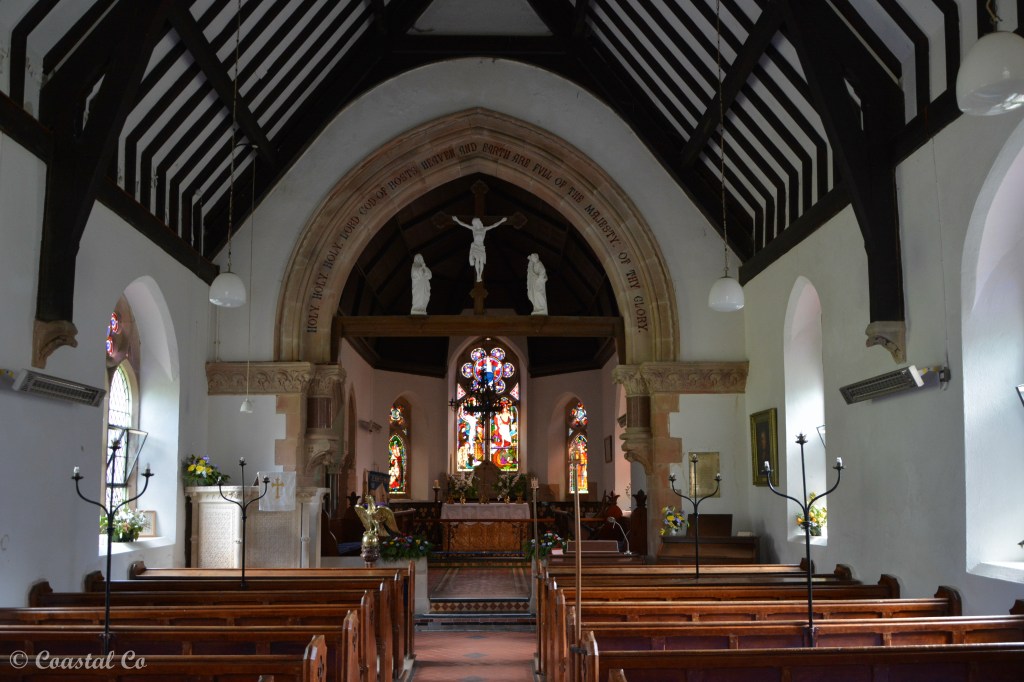
But the interior has more punch than Llanbedr Dyffryn Clwyd, with much superb quality carving – foliate ornament to the capitals and imposts of the chancel arch, diaper work to the panels of the pulpit. There are the polished granite column shafts so beloved of High Victorian Goths and much vividly patterned tilework on the floor of the chancel, rising in the sanctuary to dado height. The fenestration of the apse is resolved much more successfully by making the central window wider than its neighbours. All the windows in the chancel are glazed with excellent quality stained glass by Robert Turnill Bayne (1837–1915) of Heaton, Butler and Bayne. This was installed at the time of construction, as was the glass in the west window by Clayton and Bell. A complete set of original fittings survives and the whole adds up to a confident, strident and colourful period piece that is remarkable for its aesthetic integrity and excellent state of preservation.

St Mary’s Church, Abbey Cwmhir, Powys (1866): interior looking west (Steve Brodie, reproduced with permission)
Abbey Cwmhir Hall, Abbey Cwmhir, Powys (1867-c. 1870): garden front and entrance (Eric Dodd)

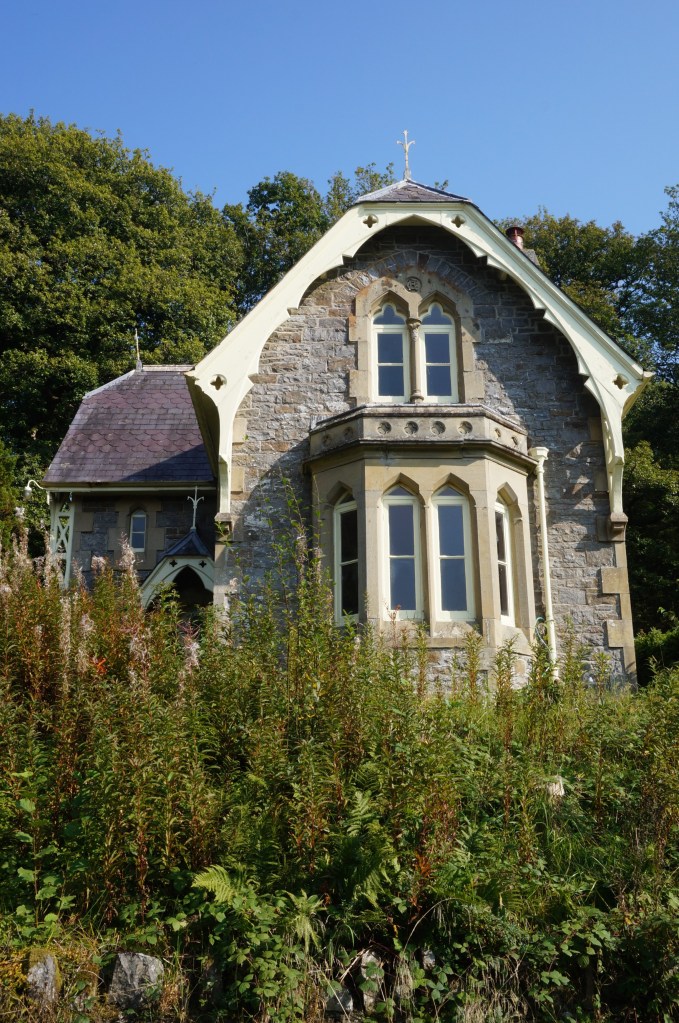
In 1867, work began on remodelling the hall, which lasted until at least 1870. Reputedly it incorporates fabric from its predecessor, but quite how much and to what extent this determined the outcome is impossible to say without further research. There are signature details such as the chunky colonettes with outsize foliate capitals and striped arches and relieving arches, although the walls are all finished in smooth, uniform ashlar rather than rock-faced. The most remarkable feature is the ensemble of three major and three minor gables to the long garden front and J.D.K. Lloyd had good reason to say that ‘This remarkable house gives a first impression of being subsidiary to the bargeboards!’ But for all the ingenious detail, there is a slight sense that the architects’ imagination flagged when dealing with a building on so large a scale, which offered less opportunity for treatment as a discrete sculptural form. This can be checked through comparison with the delightful Keeper’s Lodge a couple of miles down the valley to the east, which must be roughly contemporary with the Hall.

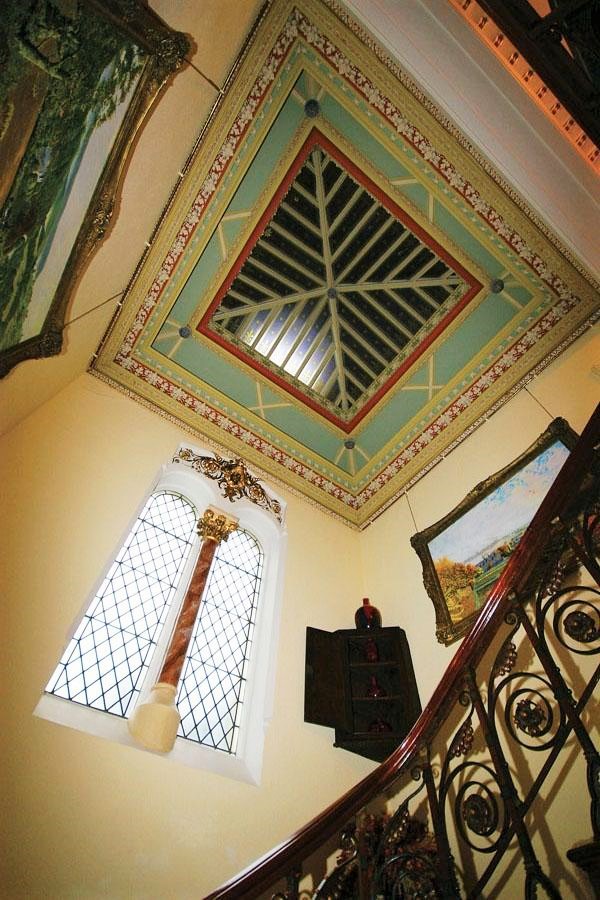
Abbey Cwmhir Hall: the foot of the main stair
Abbey Cwmhir Hall: the upper part of the main stair and skylight for the stairwell

The work at Abbey Cwmhir brought to a close the Poundley and Walker partnership, which was dissolved in 1867. Both men remained in practice, although Poundley, probably the older of the two, was perhaps less active and may have concentrated on surveying work – one deduces as much from the paucity of later commissions, although only further research could confirm the hypothesis. His only son, John Edward Poundley (1839-1917) was agent to the Brynllywarch Estate and several others. Walker seems to have specialised thereafter in ecclesiastical work, designing a number of new churches and restoring several others. He was something of an antiquarian, writing papers for Montgomeryshire Collections on the late medieval rood screens in the churches of Newtown, Llanwnnog (which he restored in 1873) and Llananno (where he reconstructed the entire building in 1877-1878). It is competent, decent architecture, but not on a par with his output of the preceding decade.
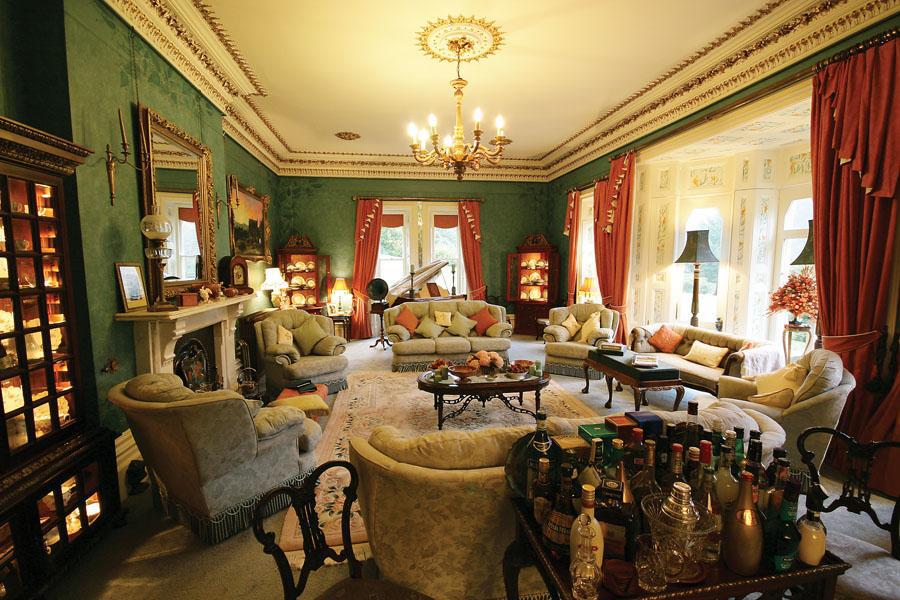
Abbey Cwmhir Hall: one of the principal rooms on the ground floor
The Keeper’s Lodge of Abbey Cwmhir Hall, Abbey Cwmhir, Powys (c. 1867)

Perhaps this was the result of changing tastes and incipient reaction against the High Victorian Manner. Perhaps Poundley was really the driving force in the practice. Or is it that the work of the 1860s was the product of some alchemical symbiosis of their respective talents and temperaments, which could not reach the same heights when they were working in isolation? We cannot know, but we can be glad that whatever it was lasted for long enough to bequeath to us a remarkable architectural legacy whose verve and dynamism bear witness to a vigorous and dynamic age.

Multum in parvo – John Middleton and Llangynllo

There won’t be all that many posts on this blog devoted to individual buildings, but this one is so extraordinary that I have to make an exception. We first encountered Sir Thomas Lloyd (1820-1877) in connection with St Dogfael’s Church in Meline, featured in last week’s post on R.J. Withers. Though Gothic Revival, that is a rational, severe and indeed forward-looking piece of design, which is very difficult to reconcile with the temperament of someone who could put up an outlandish piece of escapist fantasy like the family seat of Bronwydd. For that was a building where the client’s and architect’s imaginations ran away with themselves and a cold-blooded critique of its functional and aesthetic distinctions is pointless – all that mattered was the emotional impact and power to conjure up a vision the Middle Ages (or more specifically, to evoke the Rock of Cashel in Tipperary), albeit one conditioned by High Romanticism.

Bronwydd, Ceredigion as remodelled by Richard Kyrke Penson (1815-1885) in 1853-1856 for Sir Thomas Lloyd: sold in 1937, it was used as a refugee camp and then, during World War II, as a Jewish boarding school before being stripped and abandoned to ruin.
St Cynllo’s Church, Llangynllo, Ceredigion: general view of the interior looking east

But ‘rational’ and ‘severe’ are certainly not charges that could be levelled at the second church with which Lloyd was involved – St Cynllo’s at Llangynllo in Ceredigion. Nominally a village church, it serves a community in remote and beautiful countryside northeast of Newcastle Emlyn, thinly scattered over a wide area with several tiny population centres. It was also one where Welsh-speaking Nonconformism made substantial inroads – St Cynllo’s is still known locally as ‘The English Church’ – and in practice it was effectively the private chapel of two nearby big houses, Lloyd’s Bronwydd and the Tyler family’s Mount Gernos, there being no village centre as such in the vicinity. In the churchyard there are burial vaults for both families.

St Cynllo’s Church, Llangynllo, Ceredigion: general view from southeast
St Cynllo’s Church, Llangynllo, Ceredigion: corbel stop on the south side

It seems likely that Captain Gwinnett Tyler of Mount Gernos was responsible for choosing John Middleton (1820-1885) as designer of St Cynllo’s. Born in York, Middleton trained with James Pritchett (1789-1868), a prolific and successful architect, who handled commissions for a diverse range of building types and worked in a wide variety of styles, as was typical for practitioners of the time. Pritchett designed the palatial classical railway station at Huddersfield in West Yorkshire, built in 1846-1850. On completing his training, Middleton set up in practice in Darlington, taking advantage of the rapid economic growth at the time of the North Riding and County Durham. His office handled commissions for warehouses, banks, workshops, railway stations, workers’ housing and churches. Then in 1859 he left and relocated to Cheltenham, where he began to pursue a very different line of business. Intending to enter the market for country house work, he cultivated links with the gentry, including the Dunraven family in the Forest of Dean. Middleton was initially engaged by the Dowager Countess to remodel the family home of Clearwell Castle. This led to a crop of subsequent commissions – for a new parish church, a village cross, a wellhouse, a cemetery chapel, a cottage hospital and extensions to the village school.

St Cynllo’s Church, Llangynllo, Ceredigion: general view from south – the lean-to vestry to the left of the tower is a later addition of 1897.

Tyler’s sister married into the Dunraven family and it was this that may have brought about a commission in c. 1869 to remodel Mount Gernos. Like Brownydd, the house proved ill-fated – it was abandoned in the 1920s, fell into dereliction, little now survives above ground and it is known only from written descriptions and a few dim photographs. But unlike Bronwydd, it was externally restrained, the elevations being handled in an austerely elegant astylar classical manner, to which Middleton adhered when he reorganised the elevations, creating a new entrance front and adding a number of two-storey bay windows and a conservatory. The display was confined to the interior, which abounded in wood carving and stone ornament, much of it figurative.

St Cynllo’s Church, Llangynllo, Ceredigion: the nave viewed from the chancel – note the large number of memorial tablets, many of them resited from the old church.

At the time of Middleton’s introduction to the Tylers, the reconstruction of the parish church was a more pressing matter. It was an ancient foundation, which by repute stood on the site of the cell of the late 5th/early 6th century saint to which it is dedicated. The building had been remodelled in the 1820s, but only four decades later was again in need of attention and in c. 1866 (some of the surviving drawings are dated March 1867) the decision was made to demolish everything apart from the tower and to rebuild. Work was not completed until 1870. It is not a large church, nor – despite Middleton’s addition of a spire – is it especially prominent in the landscape. The high-quality dressed masonry and thistly Decorated Gothic tracery intrigue, but enough churches of the period hint at riches within only to disappoint through their plainness. Not, here, though – as soon as one enters, one is immersed in an astonishing wealth of colour, decoration and ornament that makes St Cynllo’s truly exceptional and well worth seeking out.

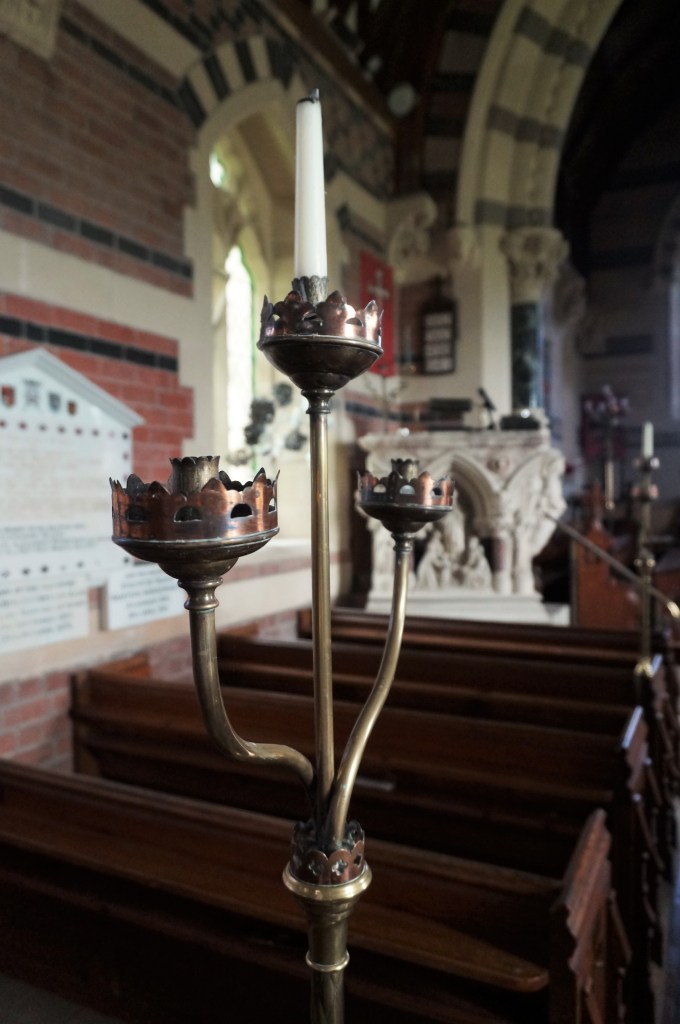
St Cynllo’s Church, Llangynllo, Ceredigion: candelabrum in the nave

The simple, two-cell plan is familiar enough from the far more modest churches by R.J. Withers featured in the previous post. Familiar too is the notion of a progression in richness from west to east, with a relatively plain area of congregational seating and all ornament and colour concentrated at the east end. But here, the nave is already a riot of colour, being faced internally with high quality red brick enlivened with stripes, bands and diaper work executed in black brick and Bath stone. The roof is supported on lush foliate corbels, by the main door a huge and lavishly carved font – commemorating a member of the Tyler family and gifted in 1869 – rests on a ‘a capital of tropical succulence’ (The Buildings of Wales).

St Cynllo’s Church, Llangynllo, Ceredigion: the font

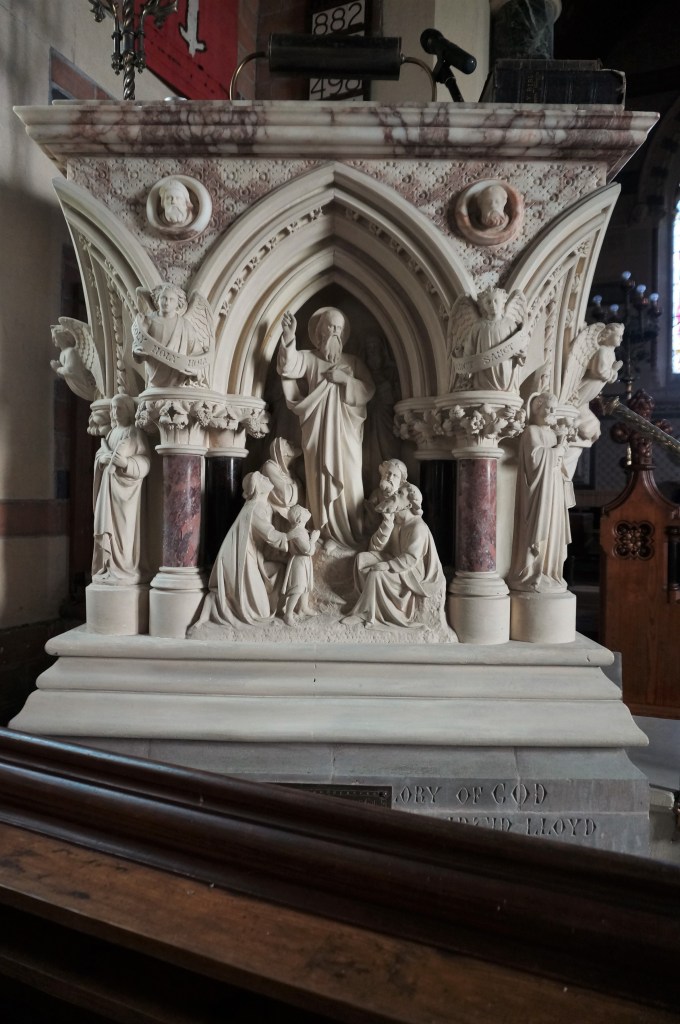
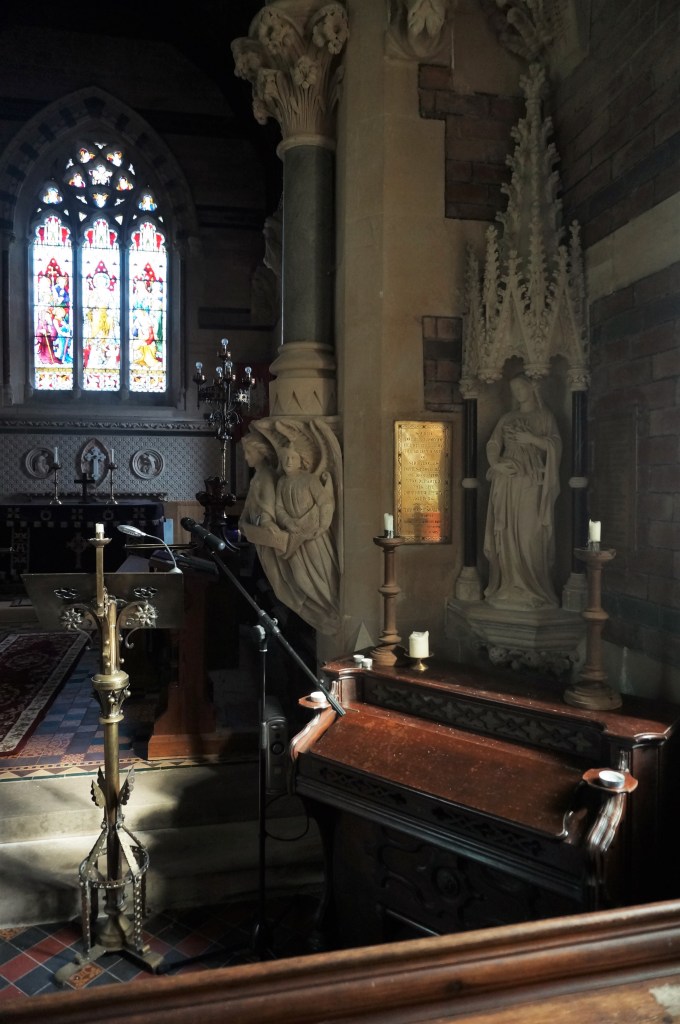
One’s gaze is arrested before it reaches the east end: the striped chancel arch rests on polished shafts of green marble with huge capitals carved with leaves and flowers, and borne on corbels resting on the backs of hovering groups of angels, all depicted full height and in the round. The hood moulds on both sides of the chancel arch have corbel stops depicting the four Evangelists. Underneath the north respond is a richly carved pulpit with a central scene of ‘neurotically animated’ figures (The Buildings of Wales), in which St Paul is depicted preaching to the Gentiles . It was a gift of the Lloyd family to commemorate George Marteine Lloyd (1830-1849). To the south is a statue of a female figure under an intricate canopy with gablets and pinnacles, all richly crocketed – officially Ruth, but perhaps (anticipating charges of crypto-papism) a proxy for the Virgin Mary. It was presented by Sir Thomas Lloyd in 1871 in memory of his wife.

St Cynllo’s Church, Llangynllo, Ceredigion: the pulpit with the central scene of St Paul preaching to the Gentiles is flanked by St John the Evangelist (left) and St Peter (right) with portrait roundels in the spandrels above depicting St David and St Cynllo.
St Cynllo’s Church, Llangynllo, Ceredigion: the figure of Ruth, depicted holding her attribute, a sheaf of wheat gleaned from Boaz’s field.

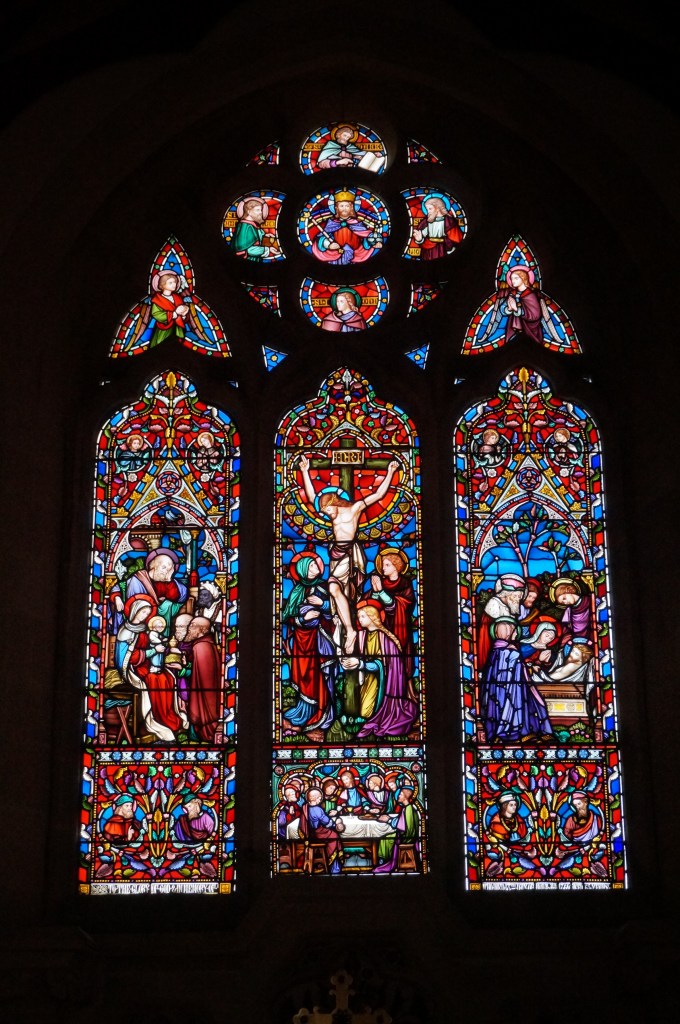
The chancel reaches an almost overwhelming degree of luxuriance. The walls are faced throughout in high quality ashlar masonry with banding of green and purple stone. Corbels with angels playing musical instruments and striking various attitude, supposedly based on prototypes drawn from the work of Fra Angelico, support the roof trusses and arch to the organ chamber (originally a vestry). The roof structure is ceiled with stencilled panels. Above the altar is a diapered altarpiece, gifted by Rosa Tyler shortly after the opening of the church. The east window, again with a banded arch and polished marble shafts, is filled with glass of 1878 by J.H. Powell of Hardman and Co. depicting Christ enthroned flanked by groups of assorted saints. There is a floor of richly coloured and patterned tiles by Minton. The clergy and choir seating is richly carved and fretted, the design incorporating different colour woods, and from it rise brass candelabra (now converted to electricity) sprouting and bristling with ornament. Lloyd and Tyler made a further gift of the church on its completion of a jewelled set of plate in a chest made out of an oak beam taken from the old church.

St Cynllo’s Church, Llangynllo, Ceredigion: the north side of the chancel
St Cynllo’s Church, Llangynllo, Ceredigion: the chancel roof

Among Middleton’s collaborators at Llangynllo, special mention must go to Richard Lockwood Boulton (c. 1832-1905), who executed the architectural sculpture that makes the interior so memorable. Born in Yorkshire, Boulton initially worked with his elder brother in London before setting up on his own in the latter half of the 1850s, initially working out of Birmingham, then relocating to Cheltenham in c. 1870. He worked for leading architects of the period, collaborating with E.W. Godwin (1833-1886), who later claimed to have trained him, on Northampton and Plymouth town halls and with Sir George Gilbert Scott (1811-1878) on the restorations of Lichfield, Worcester and Hereford cathedrals.

St Cynllo’s Church, Llangynllo, Ceredigion: angel corbel supporting the arch to the organ chamber
All Saints, Cheltenham: general view of the interior looking east (Phillip G. Gray Photography)

Middleton cornered the market for ecclesiastical work in his adopted town and surrounding area, carrying out extensive restorations of several medieval buildings and designing five new town churches. All are good, and all of them every bit as characteristic of him as St Cynllo’s, but none makes quite the same impact of what is widely regarding as his masterpiece, the church of All Saints, (1865-1868, with extensive later adornments and fittings, some by different hands). Intended from the outset as a setting for ritualistic worship, it abounds in colour and overflows with vigorous foliate and figure carving, for which Middleton again turned to Boulton. H.S. Goodhart-Rendel called the building ‘a splendid example of what Gilbert Scott was always aiming at but never achieved – complete Gothic self-assurance with Victorian punch’. The sculpture has a good deal to do with that, but what is surprising when one compares the two churches is the lack of concession made to the far smaller proportions of St Cynllo’s. Whereas at All Saints, Boulton’s work augments the grandness of the underlying architectural conception, at Llangynllo, the figures of angels, the corbels and the capitals all give the impression of having been scaled for a much larger building and the hypertrophied effect is overwhelming and almost surreal.

St Cynllo’s Church, Llangynllo, Ceredigion: the east window of 1878 by J.H. Powell of Hardman and Co.
St Cynllo’s Church, Llangynllo, Ceredigion: Minton tiles in the chancel

Middleton’s work for Lloyd and Tyler seems to have led to a crop of other commissions for church work in west Wales, where he restored several medieval buildings and rebuilt wholly or in part a handful of others. His designs are immediately recognisable as products of the period, but not especially memorable or individual. Unlike Withers, he seems to have been unable to make a virtue out of a necessity and to achieve original results on a low budget. St Christiolus in Eglwyswrw in the north of Pembrokeshire is a thorough recasting carried out in 1881-1883 of a church originally put up in 1829, done for the rock-bottom price of £650 (for comparison, St Cynllo’s cost in the region of £2,200). It is perfectly competent, but short on character, and the rose window is oddly derivative of St Dogfael’s in Meline, only a mile or so away to the west. Fair enough, one might say – there were contemporaries of Middleton who, conversely, struggled to change gear upwards. Faced with a commission from a deep-pocketed but perhaps also demanding and opinionated client, the imagination would flag and they would fall back on conventional and formulaic devices. Doing excess well requires a great deal more than an ability to indulge spendthrift inclinations.

St Christiolus, Eglwyswrw, Pembrokeshire, view from southwest – the flat-roofed vestry is a later addition of 1930.
St Cynllo’s Church, Llangynllo, Ceredigion: the altarpiece, the central cross of which was gifted by John Middleton himself.

It is a strange thing that the English are so repulsed by the High Baroque of Central Europe. For, despite the very different human, religious and topographical landscape, what St Cynllo’s displays is exactly the same aesthetic impulse, which has simply come out in a different way. But whereas the pilgrimage churches of Bavaria, say, represent an art which is extrovert and optimistic – ‘religion singing and dancing’, as Ian Nairn called it – this is introspective and melancholic, due in no small part to the dimness of the interior even on a sunny day. Slow decay would be rather in the spirit of the place, especially following the loss of the two houses that brought it into being: but in fact it is (at least for now, thanks to the efforts of a small number of highly dedicated people) well looked after and must be kept going as something too precious to be allowed to fall into desuetude, even if the world that produced it is already as distant and unfamiliar to the 21st century as that of Nineveh or Karnak.

St Cynllo’s Church, Llangynllo, Ceredigion: the credence shelf on the south side of the sanctuary – the overhang is supported by a corbel beneath depicting a bunch of leeks.

Quality in obscurity: the surprising career of R.J. Withers

The subject of today’s post is the sort of architect whose biography explains at a quick glance why he has been largely overlooked by architectural historians. My hope is that a quick glance at his delightful and engaging work will be enough to show why that neglect is undeserved. Robert Jewell Withers (1824-1894) built no cathedrals, stately homes or public buildings in major cities. Based in London for all of his career, he seems to have kept a low profile, not entering the competitions that made the reputations of the most celebrated Victorian architects and contenting himself mainly with a steady stream of commissions from all over the country for restoring country churches and building new ones (according to his obituary in The Building News, the number ran almost to a hundred), along with associated jobs for vicarages and village schools. Consequently, much of his work is in obscure, even remote places. He had pupils, but none achieved any renown, and he produced no school.

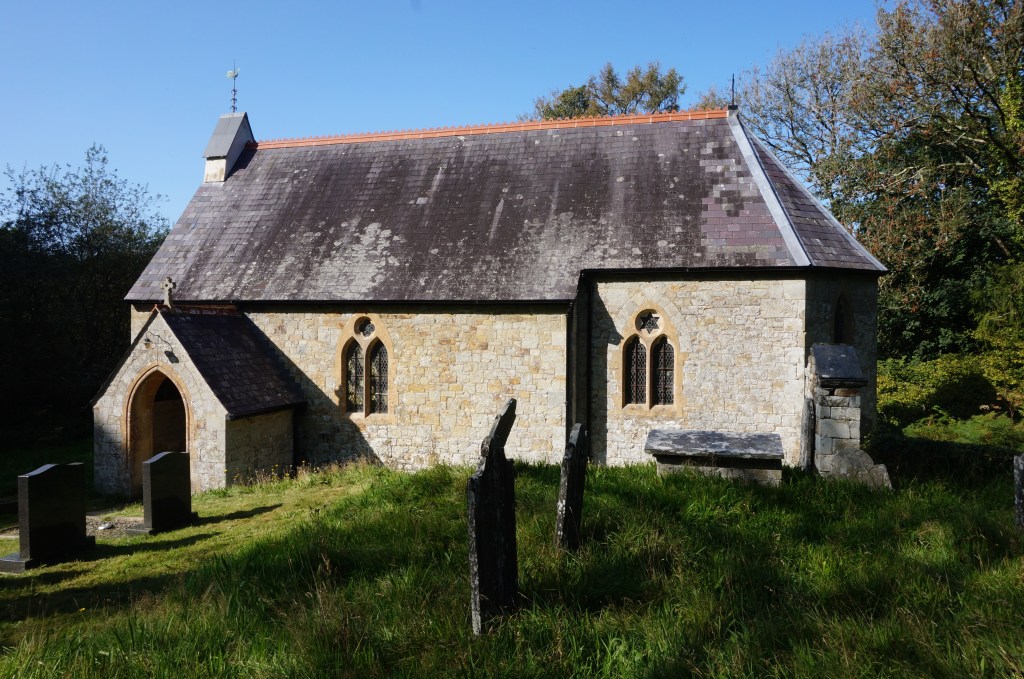
St Dogfael’s, Meline, Pembrokeshire (1864-1865): exterior from southwest
National Schools of St Philip’s, Granville Square in Clerkenwell as illustrated in The Civil Engineer and Architect’s Journal of 1st October 1865: this building, which is no longer extant, stood on the corner of King’s Cross Road and what is now called Gwynne Place. The parish church of St Philip, an early work of E.B. Lamb, is featured in my post of that architect.

So, why bother with him? I owe my interest in Withers to Julian Orbach, who worked on The Buildings of Wales and described him as one of the great discoveries that he made while carrying out fieldwork for the Pembrokeshire volume. More specifically, he brought to my attention the splendid little church at Meline, halfway between Fishguard and Cardigan, which came to prominence (albeit in a modest way) in 2017 when, on being made redundant, it passed into the care of the Friends of Friendless Churches.

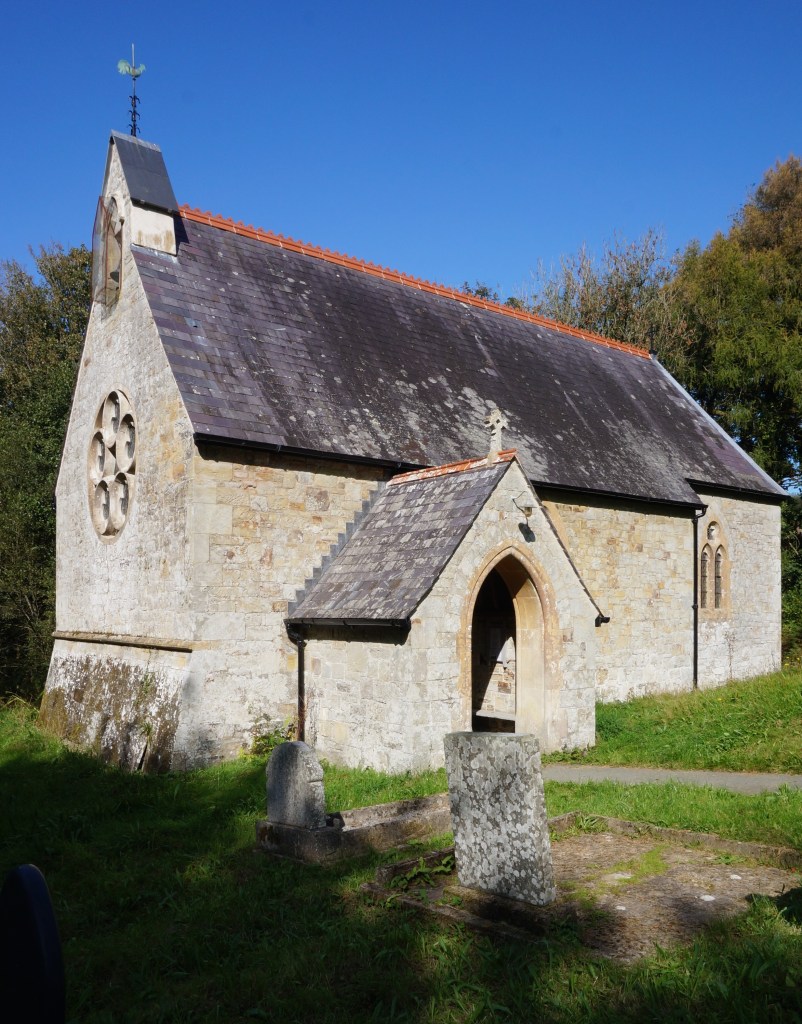
St Mary’s, Llanfair Nant Gwyn, Pembrokeshire (1855-1857): exterior from south
St Mary’s, Llanfair Nant Gwyn, Pembrokeshire (1855-1857): an untouched Withers interior.

I’ll discuss it at greater length below. Suffice it to say for now that it immediately made me curious to find out what else Withers had designed, and it emerged before long that southwest Wales is a very rich hunting ground for anyone interested in his work. Moreover, the very fact that these are tiny rural churches in out-of-the-way places is what makes them worth studying. They testify to his powers of invention and ability to achieve original, memorable results out of the simple formula of a two-cell, towerless church built on a limited budget which, one would think, offered little scope for any creativity. This post will look at a selection of Withers’ designs, arranged in chronological order, with a few glances at his career elsewhere to put them in context.

It seems that during the early part of his career and before the advent of High Victorianism, Withers, like many architects of his generation, designed in a Puginian vein, as evidenced by the former National Schools (now village hall) in Poyntington, Dorset of 1848 (© David Purchase and licensed for reuse under a Creative Commons Licence)
St Llwchaiarn’s Church, New Quay, Ceredigion of 1863-1865 (© David Purchase and licensed for reuse under a Creative Commons Licence)

First, a few words about his training and career: born in Shepton Mallet in Somerset, Withers was articled in 1839 to Thomas Hellyer (1811-1894) in Ryde on the Isle of Wight, who specialised in church work. In 1844 he made a tour of England and the Continent, then returned to Sherbourne in Dorset where he set up practice in 1848. He became an Associate of the RIBA in 1849 and moved the London the following year. He opened an office in 1854 and, barring a brief period from 1855-1859 when he was based on Doughty Street in Holborn, worked out of premises in the Adelphi, the Adam Brothers’ development just off the Strand.

Cardigan Guildhall pictured soon after completion: the stepped gable to the narrow bay linking the main block fronting the High Street (which corresponds to the stairwell on the plan below) and the return to College Row was later removed and replaced with a clock turret.
Longitudinal section and plan of the Guildhall in Cardigan, as published in The Building News of 16th September 1859, showing how, by dint of ingenious planning, Withers managed to fit into a confined and awkward site a corn exchange, a grammar school, a town hall, a library, a market, and even – on the floor beneath the poultry and dairy market – a slaughterhouse. The longitudinal section has been turned into a mirror image of itself to correlate it properly with the plan.
The undercroft beneath the market hall of Cardigan Guildhall, photograph by John Piper originally published in The Shell Guide to Mid Western Wales by Vyvyan Rees.

We get off to a flying start with St Mary at Llanfair Nant Gwyn in the north of Pembrokeshire, a tiny church of 1855-1857 in a remote (there is no village centre to speak of), but very beautiful location. It is an arresting silhouette – the hunched forms of nave and chancel with steeply pitched roofs and a needle-sharp bell turret at the west end. Observe how deftly the transition is handled from the single buttress in the centre of the west wall to the base of the bell turret – from narrow oblong, to half octagon, to narrow oblong again, though a sequence of corbelling and brackets. There was no particular reason to do it like this, other than to express delight in geometrical forms. The fenestration consists mostly of simple lancets, those in the nave paired and with acutely pointed ogee arches, so that the Geometrical Decorated tracery of the east window has real impact as a visual focus. Everything is restless and angular, the very antithesis of a placid rural shrine. Around the same time, Withers was at work on one of his few major secular works, a complex of municipal buildings now known as the Guildhall in Cardigan, built in 1858-1860 and important as an early application of Ruskinian Gothic to a civic commission.

St Helen’s, LIttle Cawthorpe, Lincolnshire (1859-1860): exterior from northeast
St Helen’s, LIttle Cawthorpe, Lincolnshire (1859-1860): interior looking east (Chris Stafford)

But we now leave southwest Wales for Lincolnshire, to look at the building which seems to have established Withers as an architect of rural churches – St Helen’s in Little Cawthorpe, Lincolnshire, just to the southeast of Louth, erected in 1859-1860. Again, this is a replacement for a predecessor on an ancient site, and again a simple two-cell building with a bellcote. Withers makes a virtue out of necessity: nave and chancel are under a continuous roofline and the latter is only slightly narrower than the former, making for a satisfyingly compact form. The roof is steeply pitched and pulled down low. A slate-hung bellcote with a sharply pointed spire straddles the roofline at the west end of the nave, with a vestry chimney of fantastically lopsided, angular form serving as a counterpoint to it. Cheap, pale-pink bricks are used, with much constructional polychromy. Even where mouldings and tracery are inserted, the dressings are set well back into the window openings, emphasising the simple, elemental geometry, so that nothing breaks the plane of the wall surface.

The stained glass works of Lavers and Barraud on Endell Street as illustrated in The Builder of 28th May 1859
St. Mary’s College, Harlow, Essex: bird’s-eye view and scale plan based on a view that originally appeared in The Builder in 1862. As far as can be ascertained, the cloister and chapel were never built. (Wellcome Collection, Attribution 4.0 International (CC BY 4.0))

Internally, all the fittings are rough, tough pieces of design – there is nothing superfluous. Everything builds up to the east end, again with a window of Geometrical Decorated tracery. Brightly patterned tiles are used for the reredos, the east window and chancel arch are carried on shafts of polished green marble. It is a hard, bright, uncompromising aesthetic. Importantly, it impressed The Ecclesiologist – the highly opinionated and dogmatic newsletter of what had begun as the Cambridge Camden Society (which Withers had joined at the age of 20) and promoted its ideals of aesthetic and liturgical propriety. Its reveiwer praised St Helen’s on completion as ‘A truly excellent design… for cheaply rebuilding a small rural church’.

St Peter’s, Lampeter, Ceredigion (1867-1868): exterior from east (© Copyright John Lord and licensed for reuse under a Creative Commons Licence)
The interior of St Peter’s Church in Lampeter (undated postcard, author’s collection)

Two years later, Withers produced a design for St Mary’s College in Harlow, cut from similar cloth to Little Cawthorpe and, with the angular forms of the chimneys and buttresses and strident constructional polychromy in brick, immediately recognisable as the work of the same architect. Large educational buildings by High Victorian architects often sprawled, their designer getting as much mileage as possible out of the articulation of the various functions into distinct volumes. But here what is striking is the compactness. The dining hall and library (the block with traceried windows closest to the nominal viewpoint in the illustration below) form a continuous range. Horizontal circulation seems to be provided by a cloister-like passage, which runs underneath the main quadrangle rather than around its inner perimeter. The gatehouse – something often treated as a vehicle for grand gestures – is almost subsumed into the wing providing access to the chapel, which has study-bedrooms for the boys on the first floor. The college does not survive, having been demolished in the mid-1960s during the construction of Harlow New Town.

Proposed cottage hospital at Ditchingham in Norfolk, bird’s eye view illustrated in The Architect of 3rd August 1872: it was founded by Mother Lavinia of House of Mercy in the same village, described and illustrated in the post on Henry Woodyer.
Ground plan of the proposed cottage hospital at Ditchingham in Norfolk, as published in The Architect of 3rd August 1872. The complex still exists and is now a neuro-rehabilitation centre, but has been extended and altered to an extent that would probably disqualify it were it to be considered for listed status.

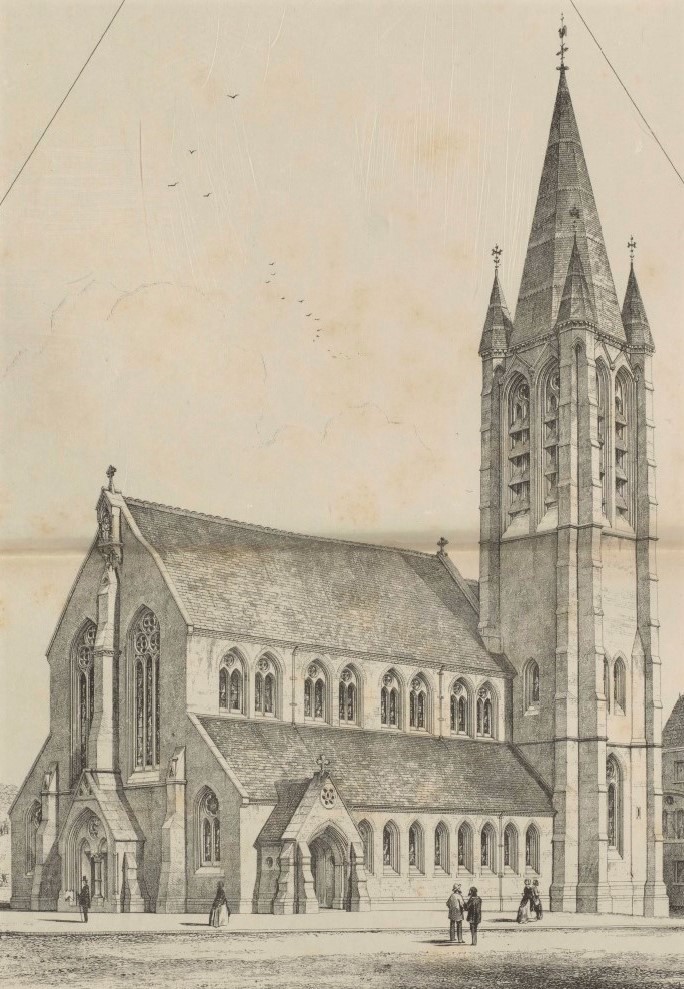
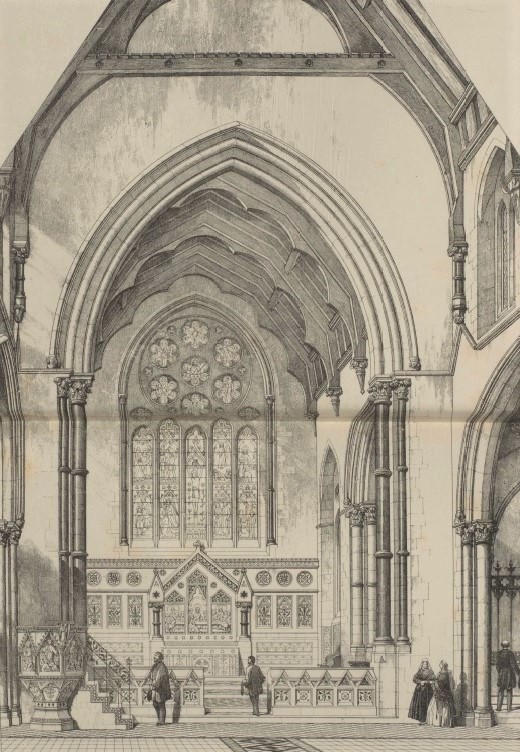
One of the architect’s few ecclesiastical designs on a grand scale was produced in 1864 for the Anglican Church of the Resurrection in Brussels, intended for a site on the corner of the Rue des Drapiers and Boulevard de Waterloo. Like much of Withers’ work, it follows a well-established formula – in this case, the Victorian urban church with lean-to aisles and a lofty clerestory – but treats it with great aplomb to produce original effects. The exterior displays his love of highly sculptural chamfered and angular forms. A boldly emphatic buttress rises out of the west porch (a device perhaps borrowed from Butterfield’s church of St Matthias, Stoke Newington of 1849-1853), only to peter out just before it reaches a corbelled out image niche at the top of the gable. The powerful rhythm of the aisle and clerestory windows is echoed by the belfry windows of the tower, which bears more than a passing resemblance to that of the medieval Sint-Niklaaskerk in Ghent. The stately interior was to rise up to a roof of bold, chunky structural members, with vivid cusping to the trusses in the chancel (a favourite Butterfield device), all focused on a large window of plate tracery and a chancel screen wall and reredos with restless outlines of gablets and much incised decoration. In the event, nothing was built until 1873 and it is unclear what – if anything – that church (redundant since 1958 and now converted to a nightclub) owes to Withers.

Design for the Anglican church of the Resurrection in Brussels (1862), exterior view – as reproduced in Examples of modern architecture ecclesiastical and domestic of 1870
Design for the Anglican church of the Resurrection in Brussels (1862), interior looking towards sanctuary – as reproduced in Examples of modern architecture ecclesiastical and domestic of 1870

Back to southwest Wales and the church that first sparked my interest in Withers – St Dogfael’s in Meline of 1864-1865. It was commissioned by a major local patron of Victorian Gothic, Sir Thomas Lloyd (1820-1877), who had previously engaged Richard Kyrke Penson (1815-1885) first, in 1853-1856, to turn the Georgian family seat of Bronwydd (Ceredigion) into an outlandish fairytale castle and then, in 1859-1860, to remodel the genuine, but ruined 13th-14th century castle at Newport (Pembrokeshire). In 1867, he engaged John Middleton of Cheltenham (1820-1885) to carry out a lavish remodelling of the nearest parish church to Bronwydd, St Cynllo in Llangynllo, to serve in effect as a private chapel for the estate.

Plan and general exterior view of Holy Trinity Church in Wildbad, Baden-Württemberg in Germany as published in The Building News of 17th February 1865
St Dogfael’s, Meline, Pembrokeshire (1864-1865): exterior from southeast

These were all extravagant flights of fantasy by a Romantic medievalist in love with the title of Lord Marcher of Cemaes, which his family had in fact only acquired in the 18th century. But what is surprising about St Dogfael’s is that it could not be mistaken for a product of any century other than the nineteenth: ‘An object lesson in High Victorian solid geometry and minimal extraneous detail’, as it is succinctly and aptly called in the Pembrokeshire volume of The Buildings of Wales. As at Little Cawthorpe, nave and chancel are moulded into a single, compact mass with a continuous roofline and only a slight difference in width to differentiate the two volumes externally. Again, there are no drip mouldings to break the surface of the wall plane, emphasising the subtle balance of solid and void created by the windows. But whereas elsewhere Withers uses the bellcote to provide a vertical emphasis and additional visual interest, here it too is pulled down into the mass, its gable barely rising higher than the ridge.

St Dogfael’s, Meline, Pembrokeshire (1864-1865): interior looking east
St Dogfael’s, Meline, Pembrokeshire (1864-1865): the east window by Lavers and Barraud

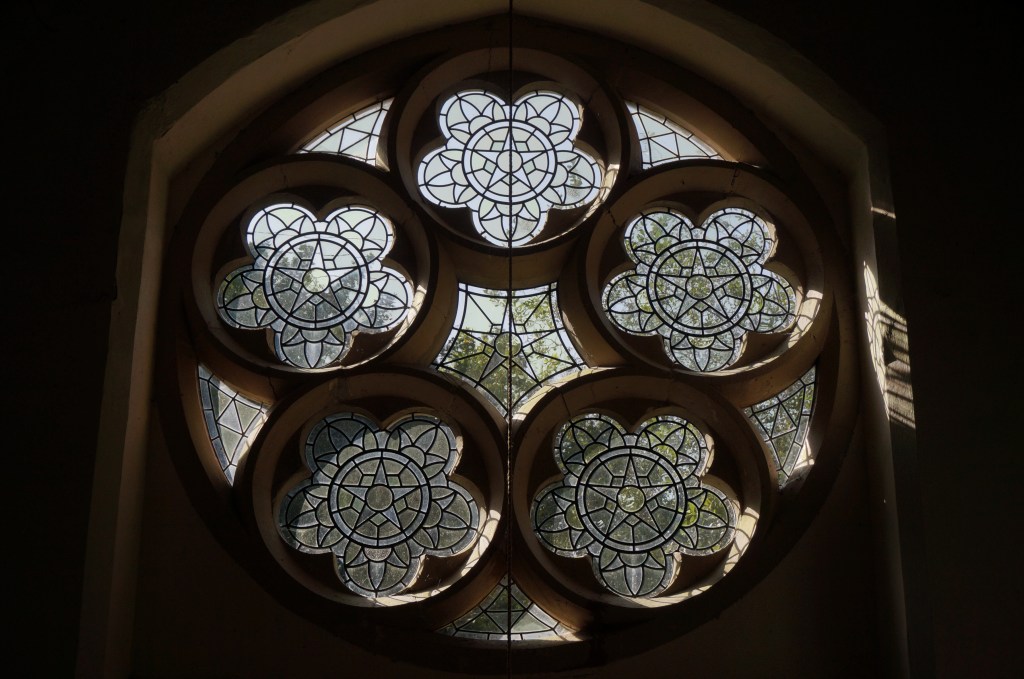
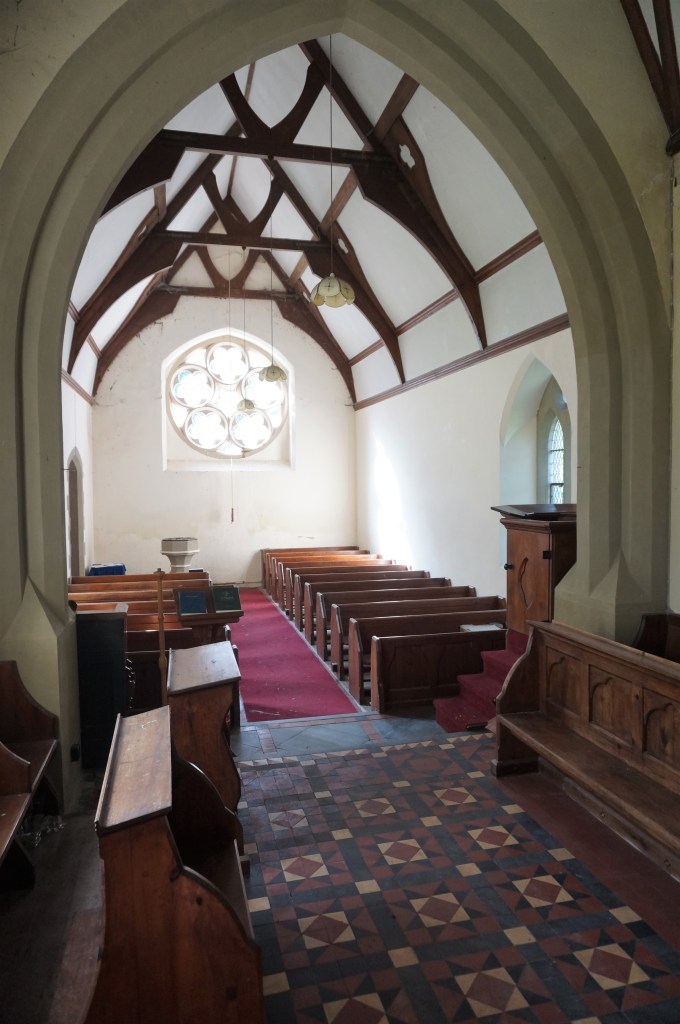
And whereas elsewhere the focus of the interior is a traceried east window, here everything is reversed – the chancel terminates in a polygonal apse, fenestrated with cusped lancets, and the most prominent window instead is at the west end – a striking rose formed of five cinquefoils. The church retains a full complement of original fittings: ‘all simple but original carpentry designs, emphasising structure over decoration’ (The Buildings of Wales, Pembrokeshire). This time, the colour scheme is muted, but this only serves to set off the jewel-like east window by Lavers and Barraud and tile panels of the reredos. The remaining windows are all glazed with plain glass, but incorporate intricate decorative leading.

St Dogfael’s, Meline, Pembrokeshire (1864-1865): the west window
St Dogfael’s, Meline, Pembrokeshire (1864-1865): interior looking west

The next two churches by Withers in these parts are both in villages along the A487 coast road from Fishguard to Aberystwyth. St David’s in Henfynyw (Ceredigion) is a dour little building of 1864-1866, on a site formerly occupied by a medieval predecessor. Probably built on a very tight budget, it nonetheless achieves visual interest thanks to the original treatment by Withers of the west end. He plays with the wall thickness – it is planed away at the base of the gable, and at this point a buttress-like form emerges from it, pierced by a plate-traceried west window. This supports a squat little pepperpot of a bell turret, which halfway up turns from a square to an octagon in plan.

St David’s, Henfynyw, Ceredigion (1864-1866): exterior from southwest
St Sulien’s in Silian just north of Lampeter in Ceredigion, built in 1872-1873 on the foundations of a predecessor of 1838-1840, but standing on an ancient site. The bell turret is identical in form to that of Henfynyw, but corbelled out from the surface of the west wall, which is thickened to provide a frame – one could hardly describe it as a porch – for the west door. A slender attached shaft knits it all together into a single composition. Again, the treatment lends visual interest and gives presence to an otherwise plain and simple two-cell building. (Michael Day)
St David’s, Blaenporth, Ceredigion (1865): the bell turret

Not far out of Cardigan, one passes through Blaenporth, where in 1865 Withers rebuilt the church of St David, which stands in an ancient churchyard with wonderful views out to sea. Here, the handling of Gothic forms is more traditional that at Meline, with kneelered gables and projecting mouldings. What sets this church apart is the splendid little bell turret, an exercise in angular forms with a pyramidal spire terminating in a stiff leaf finial and gablets emerging on all sides above the bell openings. Viewed in isolation from the rest, one could easily believe it was many times bigger, but in fact it must be barely 6 feet square. Again, Withers plays clever games with the wall thickness, with the base of the turret breaking through the plane of the west elevation and producing intriguing spatial effects internally. Inside, everything leads up to the east end with its reredos of inlaid marble and incised decoration, and, above it in the traceried window, gorgeously coloured stained glass by Lavers and Barraud. They seem to have been favoured collaborators and it should be mentioned in passing that Withers designed their premises (still extant) at No. 22 Endell Street in Covent Garden, London, built in 1859.

St David’s, Blaenporth, Ceredigion (1865): detail of the reredos
St David’s, Blaenporth, Ceredigion (1865): exterior from southeast

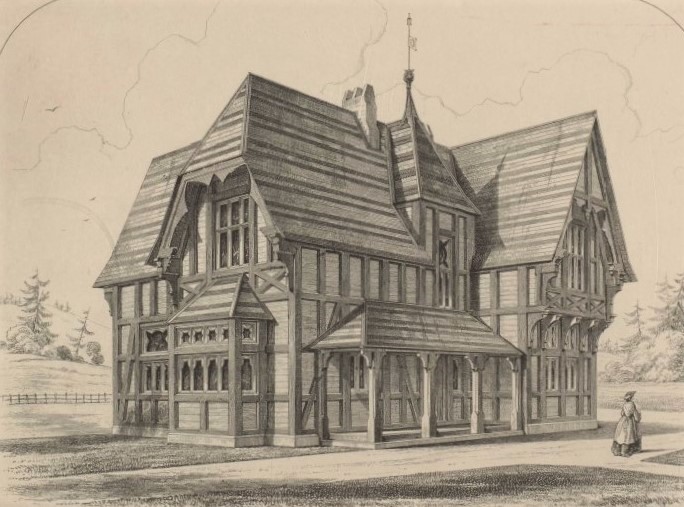
Withers did produce one church on a grand scale in southwest Wales – St Peter’s, the parish church of the town of Lampeter, built in 1867-1868 on an ancient site. It is a big boned design with a commanding tower, which makes the most of its prominent location, and incorporates much of his trademark plate tracery. Around the same time, he designed an Anglican church for the German spa town of Bad Wildbad in Baden-Württemberg. A sleek single volume with a polygonal apse, the wall surfaces almost uninterrupted by buttresses, the only concession to its locality is the use of the local dark-red sandstone. Yet more intriguing is a design for the parsonage in the Newcastle neighbourhood of the town of Miramichi, British Columbia in Canada. Though evidently intended to be timber-framed, the design eschewed the planar forms of North American balloon-frame construction for vigorous, uncompromisingly High Victorian sculptural effects, packing a huge amount of visual interest into a relatively small space. The windows and bargeboards break out into his favourite bold cusping. I have so far been unable to ascertain whether it was ever built.

St David’s, Blaenporth, Ceredigion (1865): east window by Lavers and Barraud
General views and plans of the vicarages at Elmswell in Suffolk (top) and Garton-in-Holderness, East Yorkshire, as published in The Civil Engineer and Architect’s Journal of 1st May 1865.

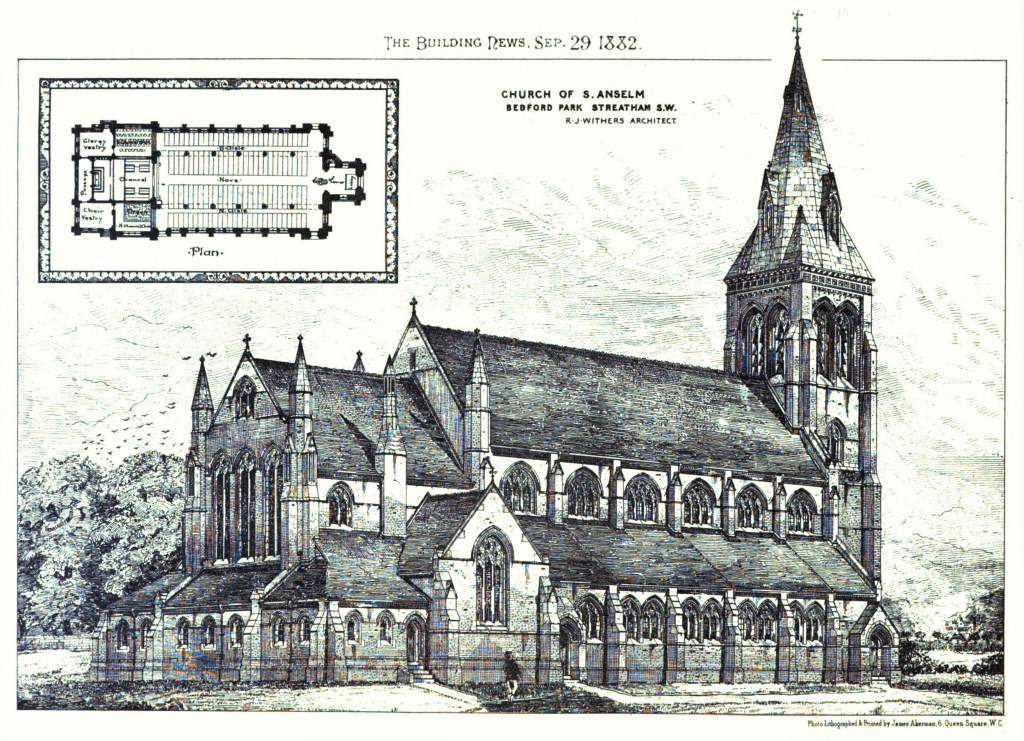
Withers was active in London, taking advantage of the commissions for new church buildings and reorderings that burgeoned throughout his life, yet it is nothing like as rewarding a place to see his work. To some extent, this is the result of sheer bad luck, since two of his new churches proved ill-starred. St Anselm’s in Streatham, begun c. 1882, was a casualty of World War II, while St Gabriel’s, Notting Dale of 1882-1883 lasted for only slightly over half a century before being closed and demolished for redevelopment, and seems to have disappeared unrecorded. St Mary’s, Bourne Street in Belgravia of 1873-1874 is a typical of its date – good quality architecture, but not especially individual in flavour. Withers does not seem to have been able to develop an architectural language for urban churches comparable to that of his rural work in its distinctiveness and ability to make a virtue out of the necessity of a limited budget. He fell back on established models and St Mary’s might easily be mistaken for a design by his contemporary, James Brooks (1825-1901), who specialised in that line of work. What makes it worth a special visit are the later embellishments, which appeared when a church originally intended for local residents in domestic service went on to become a prominent centre of Anglo-Catholicism. Some of these are in the flamboyant Iberian Baroque manner popular in the early 20th century in Anglo-Catholic circles and out of sympathy with the building. But the brilliant west porch and chapel of the Seven Sorrows added in 1924 by Harry Goodhart-Rendel (1887-1959), as discussed in the post on that architect, show a sensitivity to High Victorian architecture rare for the date and are the work of a designer who managed to internalise Withers’ manner to such a degree that he was able to produce something even better than the genuine article.

St Mary’s, Bourne Street, Belgravia, London (1873-1874): the exterior to Graham Terrace – the servers’ sacristy adjoining the adjacent property is a 1920s addition by H.S. Goodhart-Rendel and the aisle windows have been blocked.
St Mary’s, Bourne Street as illustrated in The Building News of 17th July 1874: though the view depicted here remains intact in its essentials, much of Withers’ detailing has been obscured by later reorderings. The pulpit, screen wall and reredos have been removed, and much of the decorative brick coursing has disappeared behind panelling and wall paintings.

Some creative figures are trailblazers who define their age. The aftershocks of their achievements are felt everywhere and impossible to avoid. They are always searching and this drive often leads them to reinvent themselves during the course of their career. Others follow in their wake and, having established a particular artistic idiom, stay within its confines, concentrating on refining and developing their command of it. It would be foolish to make grand claims for the significance of Withers in 19th architecture and he undoubtedly belongs in the latter category. His High Victorian idiom, though individual and fluent, is redolent of the early Butterfield, and, although St Anselm’s hints at something new, does not seem to have changed all that much as his career progressed.

Design for the parsonage in the Newcastle neighbourhood of the town of Miramichi, British Columbia, Canada, as reproduced in Examples of modern architecture ecclesiastical and domestic of 1870.
St Anselm’s Church on Madeira Road in Streatham, illustration published in The Building News of 29th September 1882 based on a view that had been exhibited a short while previously at the Royal Academy. Map evidence and aerial photographs suggest that only three of the projected six bays of the nave were completed, and whatever remained following a hit by a flying bomb was cleared after World War II. A place of worship for an affluent middle-class London suburb, this building was a very different proposition to the churches that Withers designed for remote rural locations in its grand scale (it was intended to seat 1,000 worshippers) and sumptuous detailing. It is very different to his work of the 1850s-1860s in its stylistic treatment as well. The archaeological models are to be found in English Geometrical Decorated Gothic of the late 13th century, and there is a studied awkwardness to the massing and proportions, which seems to be intended to convey a sense of accretive development, as if a tower had been incorporated from an earlier phase. There is not a trace of the stridency of Withers’ earlier manner and the sensibility is already distinctly Late Victorian.

Nonetheless, he was talented and accomplished, and clearly took pains over the kind of commissions for which the major figures of his age, chasing the prestigious jobs, might well have contented themselves with something far more pedestrian, dashed off in a hurry and barely worth a second glance. I would like to flatter myself that it is possible to get a good sense of the quality of Withers’ buildings in remote southwest Wales without having to make the long trek to those parts. But if you do decide to see them for yourself, I don’t think you’ll feel it was a wasted trip.

St David’s, Blaenporth, Ceredigion (1865): window on the south side of the nave

A Celtic nation of shopkeepers

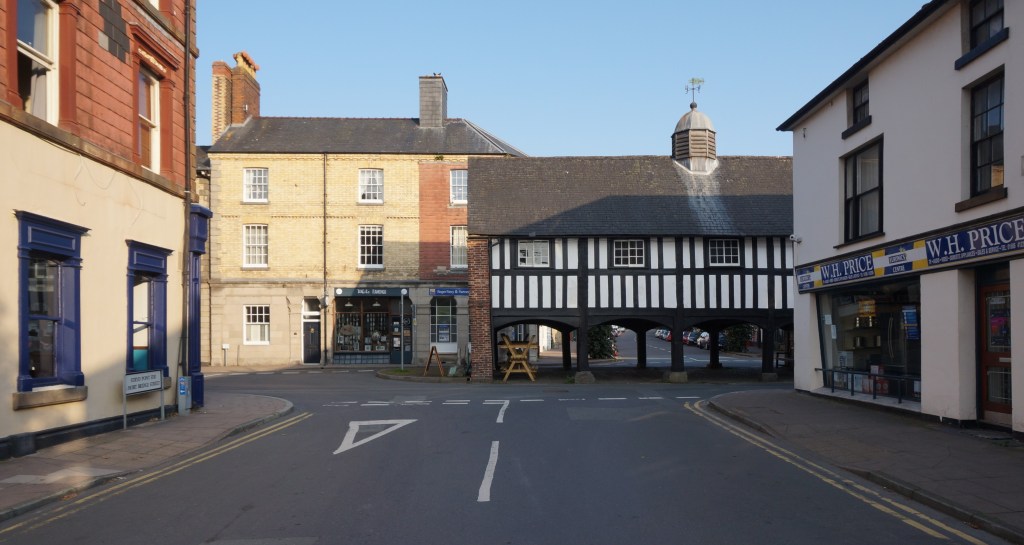
A few weeks ago I wrote about Llanidloes in central Wales (formerly in Montgomeryshire, now in Powys) and featured the splendid nonconformist chapels that are such a prominent feature of its townscape. I now want to turn my attention to another building type that does a great deal to define the character of the place – its commercial architecture. The centrepiece – quite literally, as it stands in the middle of the staggered crossroads where all its main streets converge – is the timber-framed Market Hall of the early C17. But it is upstaged by neighbouring commercial buildings rising to three storeys in height, which give the ensemble unusual grandeur for what is a fairly small town and perhaps this is what led Ian Nairn to dub Llanidloes ‘The Pocket Metropolis’.

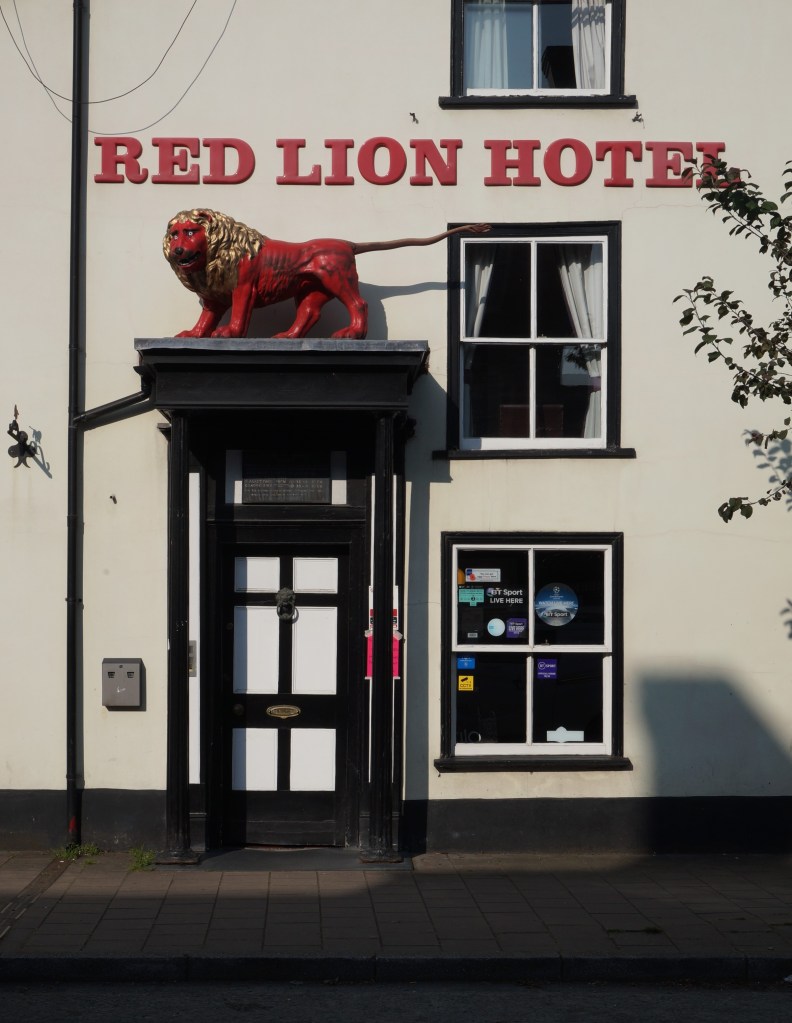
The entrance to the Red Lion Hotel on Longbridge Street

It is probable that much of medieval or pre-modern Llanidloes was timber-framed. That went in two stages – first in the early C19, when the town was experiencing great prosperity thanks to the flannel industry; then from 1865 onwards, when the discovery of lead deposits in the area revived a local economy which began to flag after that first boom had subsided. The buildings that I wish to show you here date from that second period.

The Market Hall seen from Shortbridge Street

These are the sorts of building that beg the question of where one draws the line and decides that the term ‘vernacular architecture’ can no longer appropriately be applied. They are not the work of famous architects or even minor masters (at least, not as far as I currently know, although who knows what a dig in the archives might show?) and show awareness of ideas that were in the air rather than being in the vanguard of stylistic development. Those that are listed have been designated for group value or for individual features. But they are very much products of their time, immediately identifiable as belonging to the latter half of the C19. Moreover, this is an architecture with a very high culture of details, designed with flair and executed with skill – downpipes, railings, consoles, fascias, bay windows, pilasters, joinery, stucco work.

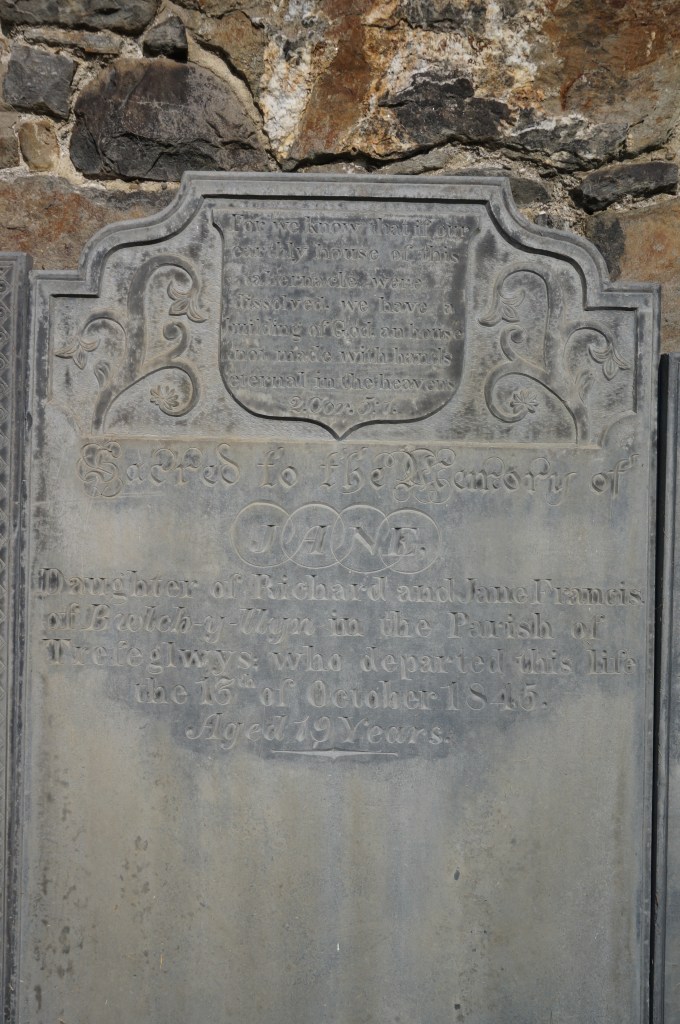
Gravestone commemorating Jane Francis (d. 1845) in the churchyard of the church of St Idloes

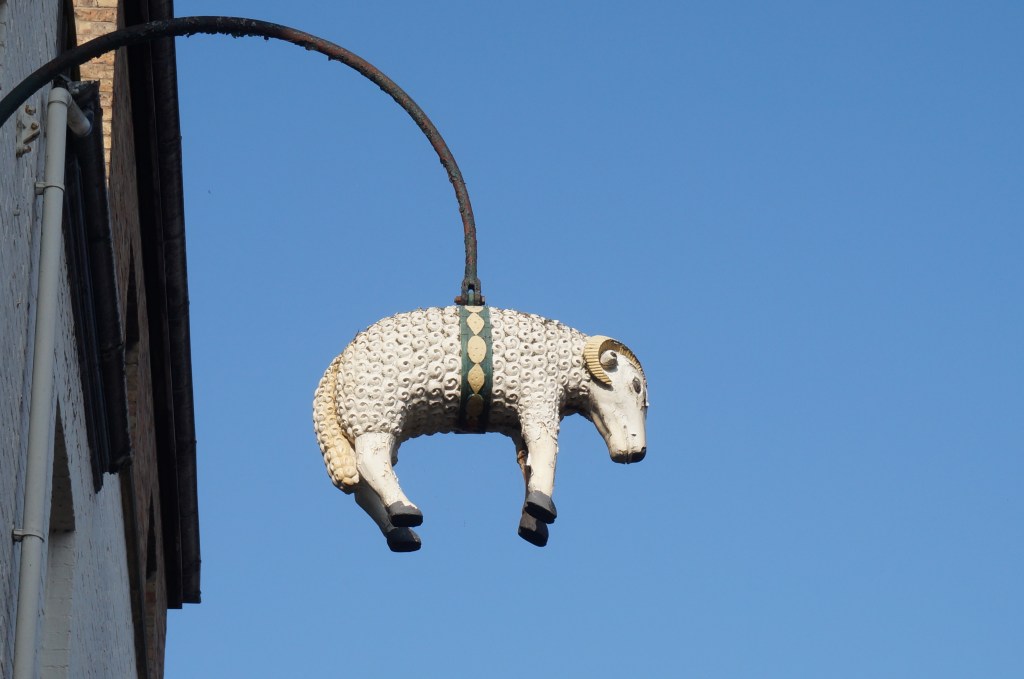
Visiting the town in 1960, Ian Nairn rejoiced that this was all still a living tradition: ‘the decorators and house-painters in Llanidloes have natural taste. They employ their shadow alphabets as elegantly and appropriately as the 19th century would have, and paint buildings with a panache which we are now only fumbling back to in the schemes sponsored by the Civic Trust. There is no need, here, to specify a standard set of alphabets and range of colours, as the Civic Trust do: the right thing happens automatically – and this is indeed a lesson for the rest of Britain, where it sometimes seems that the harder we try, the worse the result becomes’. Nairn traces this pride in good lettering back to the splendid collection of slate headstones in the churchyard of St Idloes, singling out for special praise that to Jane Francis, who died in 1845 at the age of just 19, and whose name ‘is cut in a bold italic face, and in each character one of the serifs is prolonged and looped around the letter next to it, making a tiny sad pavane in slate’. But non-verbal communication is also splendidly expressed – witness the sheep with splendid curly horns and fleece hanging from an elegantly curved wrought iron bracket at No. 29 Great Oak Street (built in 1838, so just Victorian – a complex of public rooms that originally incorporated a wool market) or the beaming red lion on the roof of the porch of the hotel of the same name on Longbridge Street (chronologically probably outside the scope of this blog, but too good to leave out).

Sign advertising the wool market formerly based at No. 29 Great Oak Street

Perhaps it is no longer a living tradition – or at any rate, one no longer absorbed unconsciously from the milieu as opposed to the conscious cultivation of good taste. All the same, the details that make the commercial architecture of Llanidloes such a delight are the sorts of things most quickly eroded by carelessness and insensitivity, and the extent of their survival here – really, there is very little that strikes a discordant note – is the result either of extraordinarily good luck or huge diligence by the local conservation officer. Here is a selection – in no particular order and totally subjective – of the many buildings that caught my eye while I was walking around the town.

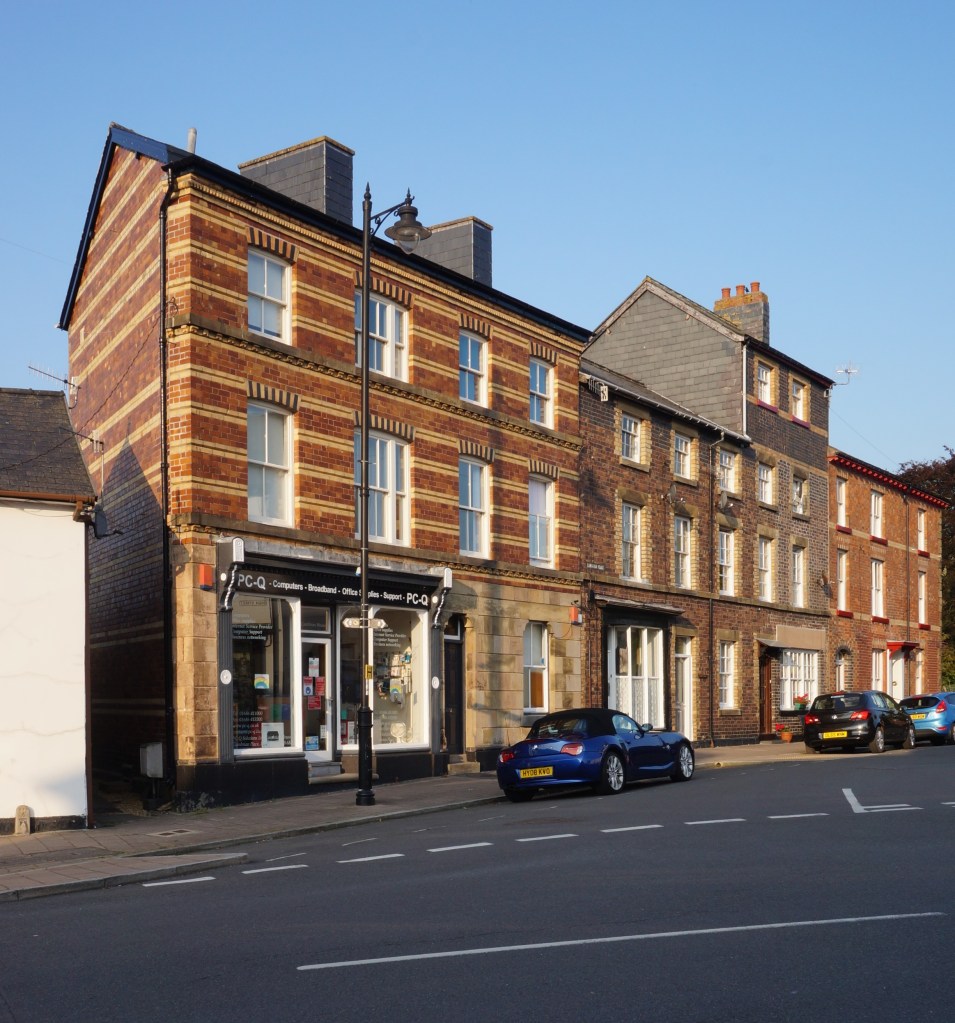
Nos 1-6 Cambrian Place

A splendid range of buildings stands at the top of Cambrian Place where it meets Great Oak Street and the High Street. There are evidently three phases of development here, and the properties in the centre with six-over-six sashes must be the earliest. The building nearest the camera (now occupied by an IT firm) makes a particularly proud display with the rusticated ashlar masonry at ground-floor level and the brown-glazed facing bricks, interspersed every four courses with cream-coloured bricks, laid with their chamfered arisses facing each other to create a V-shaped groove. The corner of the building is chamfered, too, and the coloured brickwork carried round across the flank wall, emphasising the change in alignment here of the street line. Alternating cream- and black-glazed bricks are used for the window heads and the chimneys are slate-hung (a local speciality), as is the end gable of the adjacent property where it has been raised by a storey.

Nos 4-5 High Street

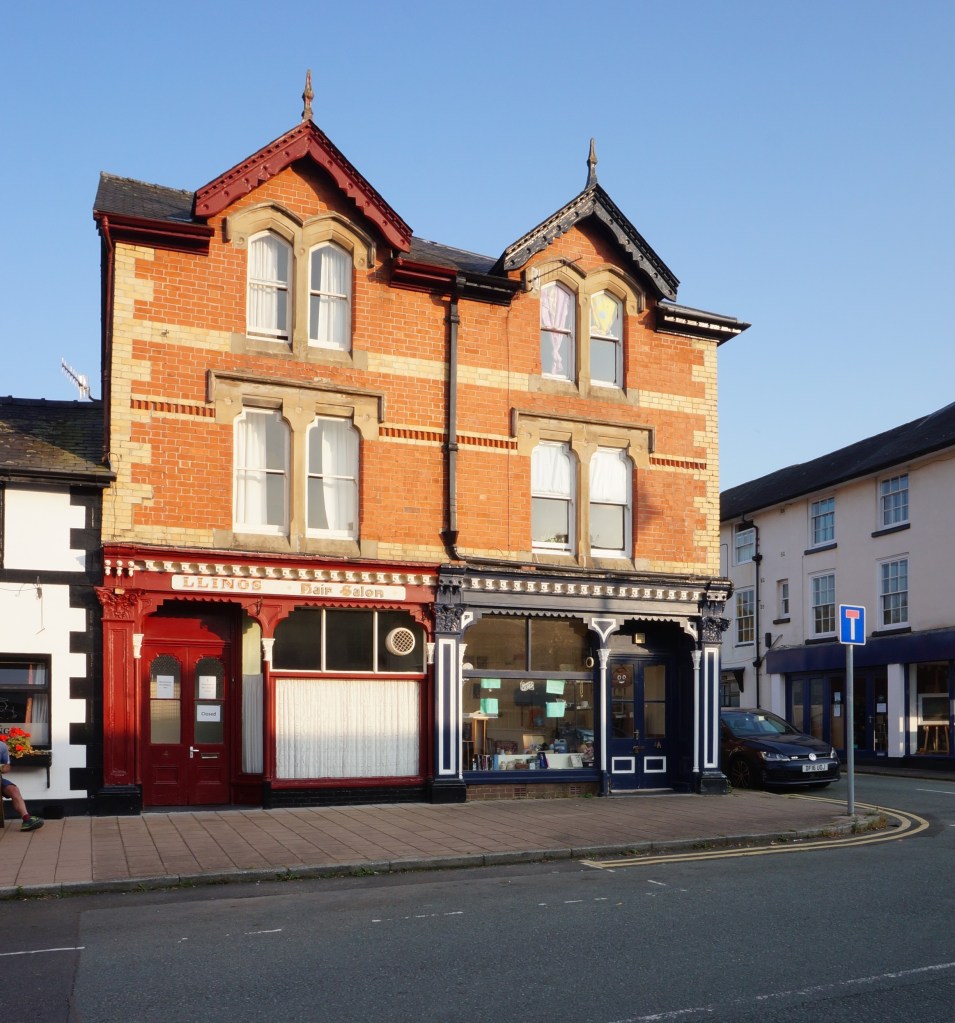
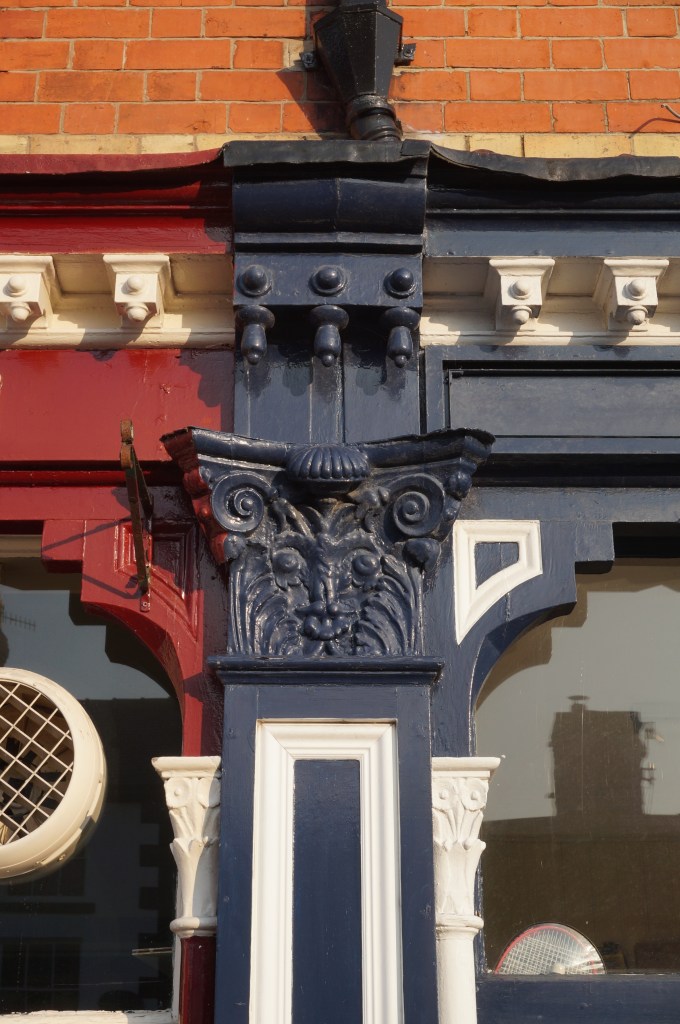
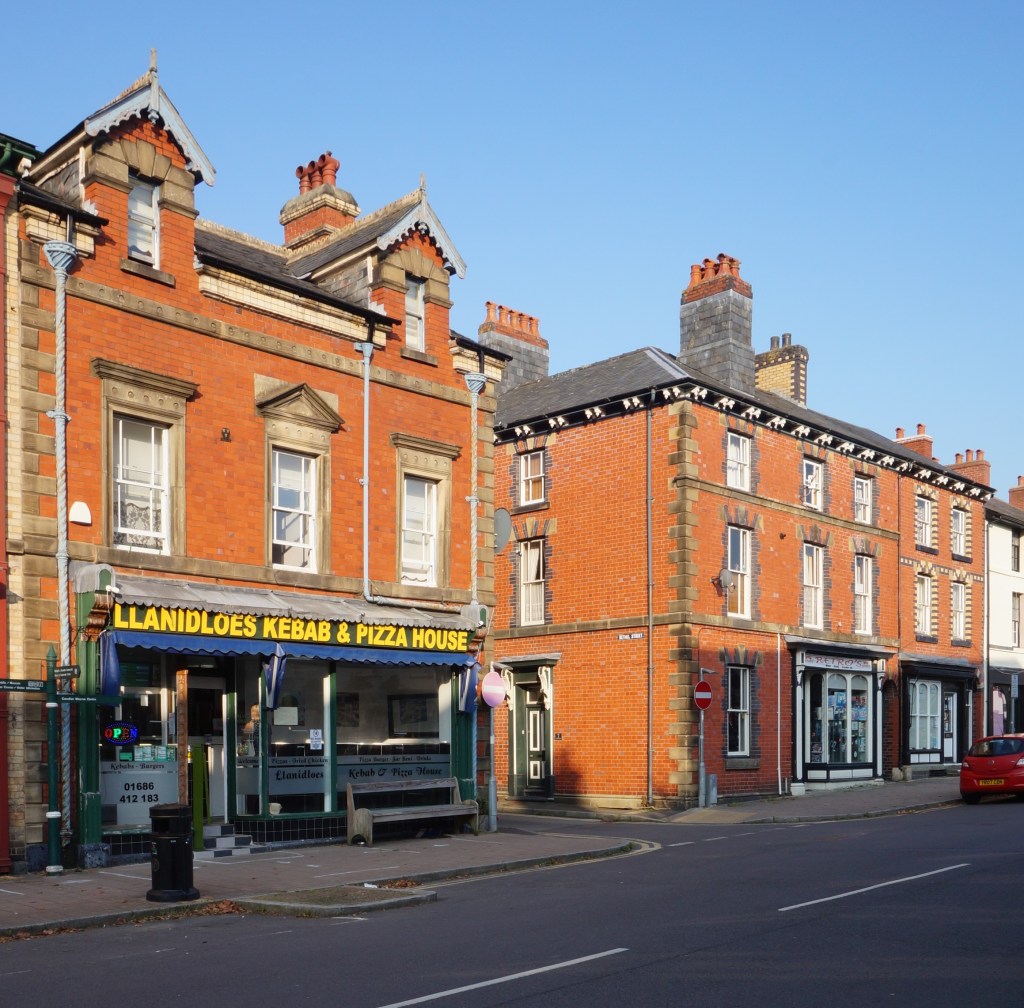
A short distance away at Nos 4-5 High Street (curiously, despite its name, not the main drag of the town) stands this splendid pair on the corner of Cemetery Place. Buildings originally of c. 1840 were refronted in the early 1870s and the two shop fronts are just outstanding. The arches to the openings for the doors and shop windows are shouldered, notched and chamfered in the High Victorian Gothic line, with fine, attenuated capitals to the cast-iron columns that support them, yet with florid, wholly Baroque Composite order capitals to the pilasters that punctuate this elevation.

Detail of the shopfront of Nos 4-5 High Street

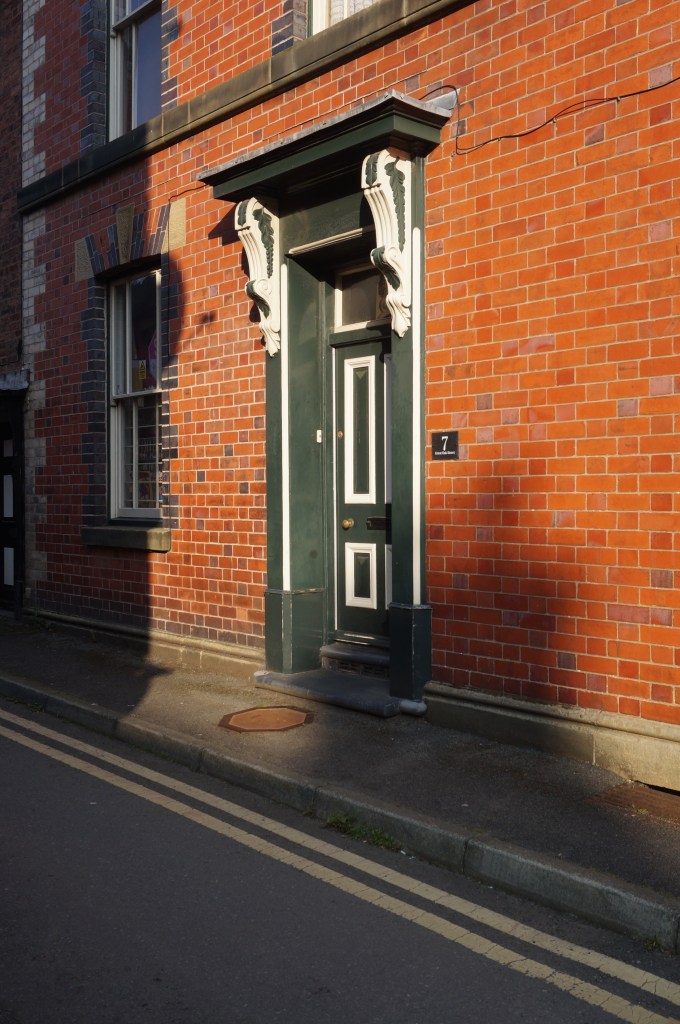
Heading back towards the centre, we encounter Nos 6 and 7 Great Oak Street, flanking the junction with Bethel Street. Both elevations are in the classical, ultimately Georgian tradition, but the bright red pressed facing brick immediately betrays the later date. The splendid rainwater goods of No. 6 with the barley sugar twist to the downpipes and hopper heads are a particular delight, so too its dormers with their blocked and rusticated stonework – dubious in strict classical terms, yet very effective. No. 7 has a good shopfront and also a fine doorcase in its flank wall facing onto Bethel Street. And again, as always in this town, the careful use of colour, both for the constructional polychromy of the brickwork and applied polychromy of the joinery, augmented by the varied palette of natural materials, gives great enjoyment.

Nos 6 and 7 Great Oak Street
Detail of No. 6 Great Oak Street
Doorcase on the Bethel Street elevation of No. 7 Great Oak Street

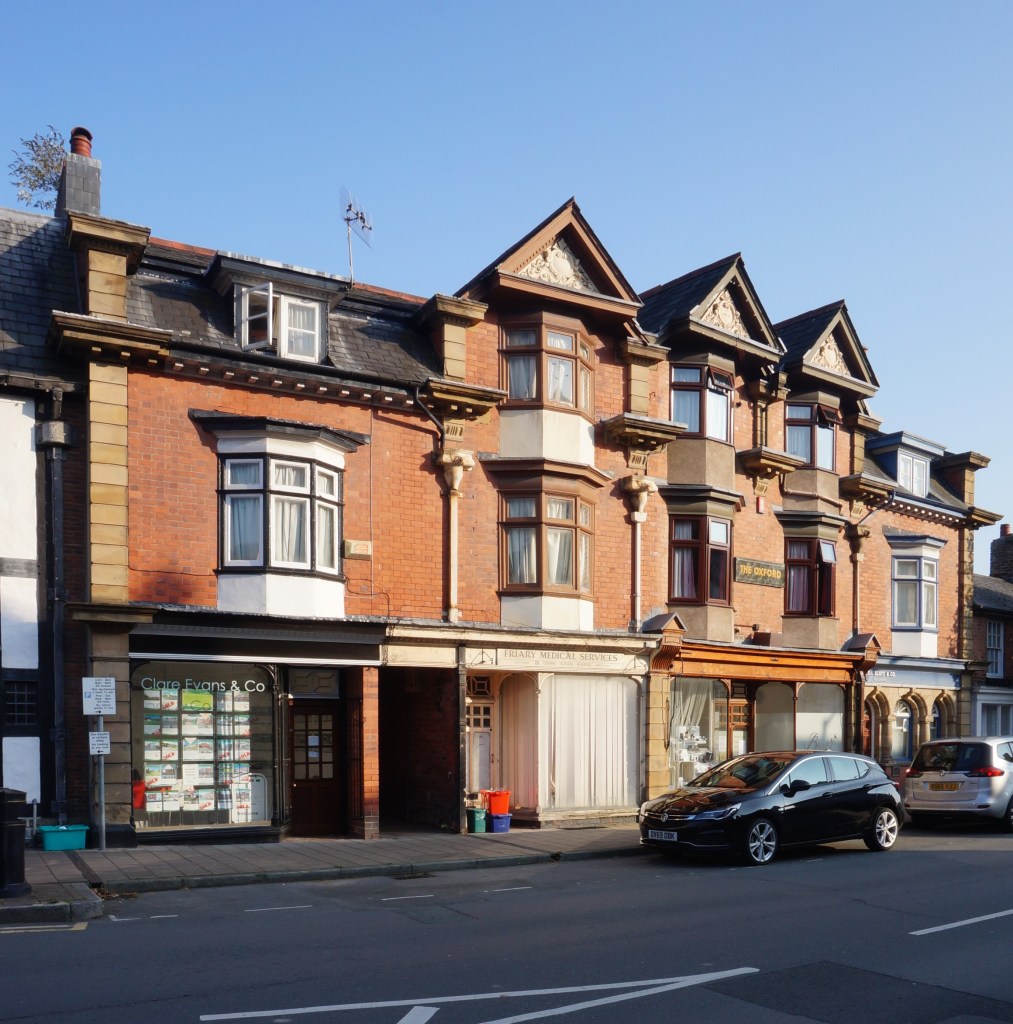
The Arts and Crafts range at Nos 2-4A China Street show that the tradition carried on into the early C20. A splendidly expressive façade takes up the natural change in alignment of the street front and, perhaps suggested by the angularity that that implies, acquired great visual interest through the liberal use of polygonal bay windows, a crop of three miniature pediments and a deep dentilled cornice, although that varies in depth where it is not interrupted altogether. The centres of the pediments are filled with lush baroque cartouches, picking up the sensuous curves of the hopper heads below, apparently adorned with the winged heads of putti. The arched front of what is now the premises of accountants R.D.I. Scott and Co is supported on splendidly bulgy Ionic dwarf columns.

Nos 2-4A (The Oxford) China Street
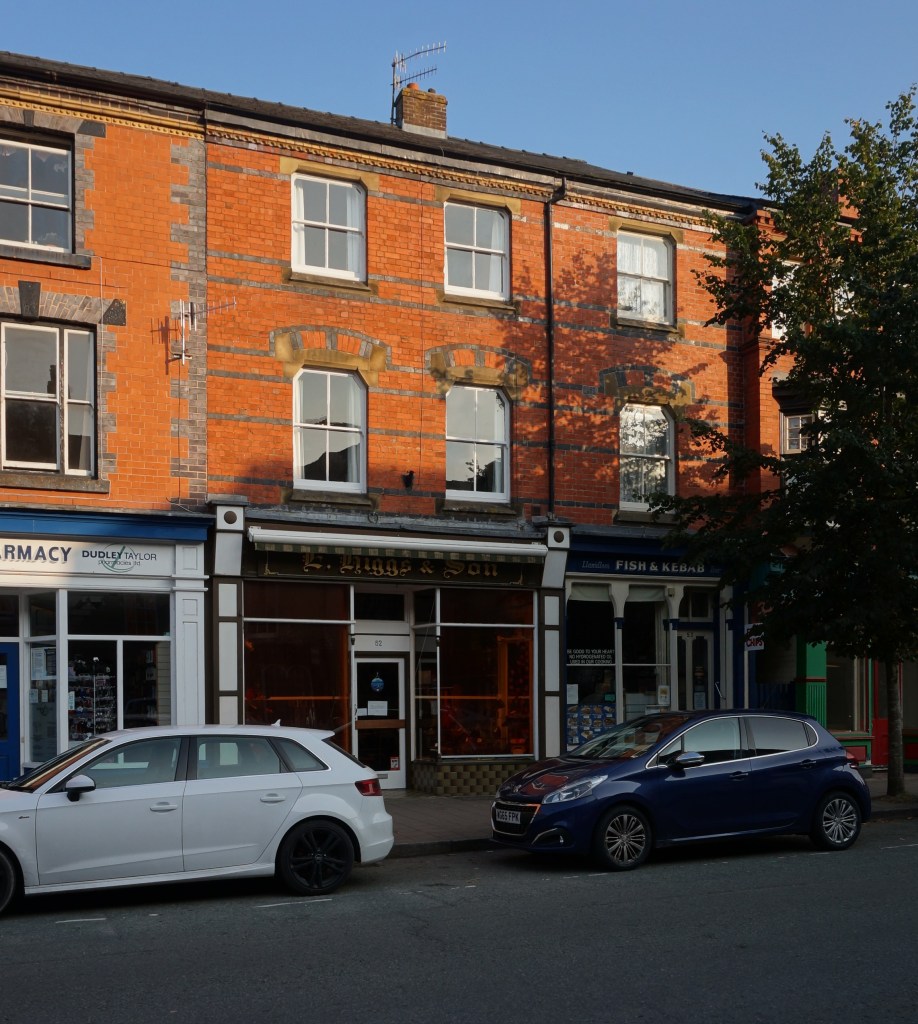
Nos 52-53 Longbridge Street

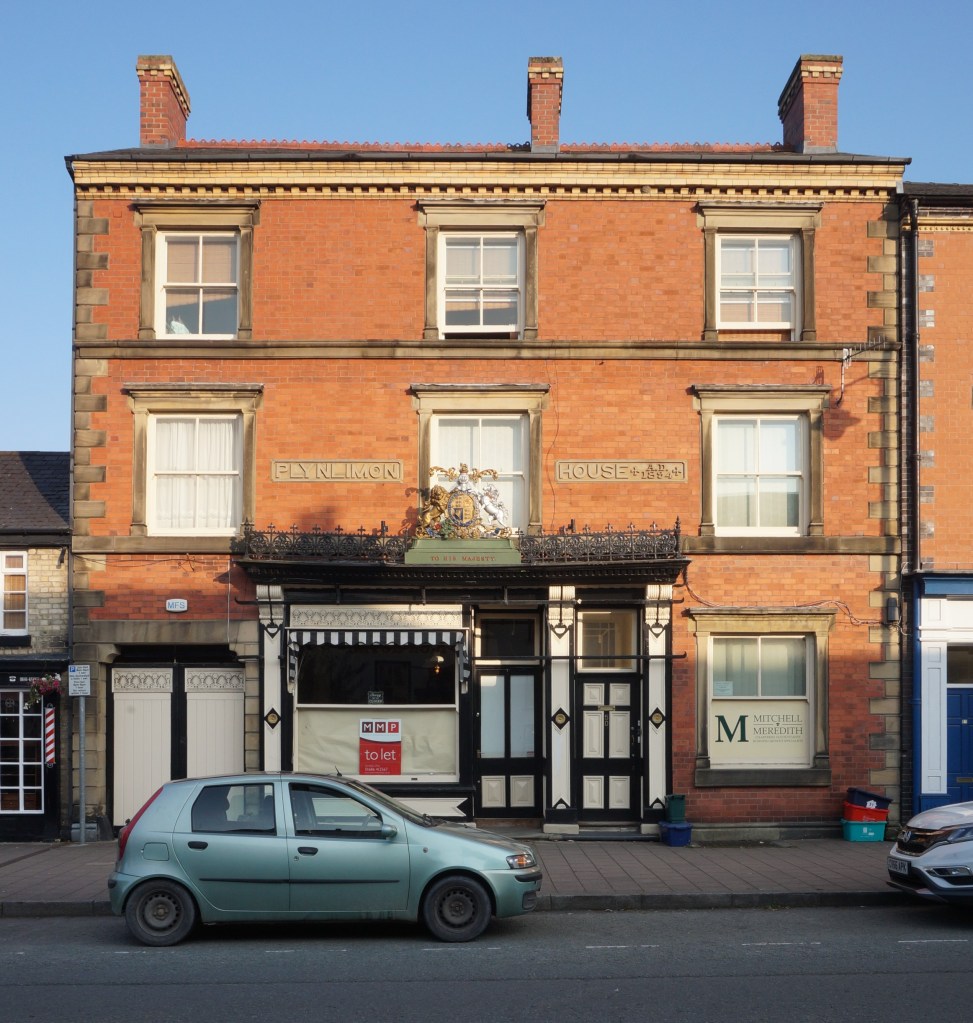
Back on Great Oak Street, there is more constructional polychromy at Nos 52-53 and another shopfront (the most elegant of any chippy in Wales?) with shouldered openings of elongated proportions. Next door but one is Plynlimon House, dated 1894 by the fine carved inscription, yet essentially Georgian in conception – and not merely because of the symmetrical upper storeys, the rusticated quoins and the cornice, but also because of the wonderful cast iron ventilating grilles to the double doors of the vehicle entrance and shopfront with a pattern based on repeated palmette motifs. That is pure Greek Revival, and if one were to date the building on the basis of this detail alone, one might easily put it in the 1830s. This was originally the premises of a butcher named Edward Hamer and The Buildings of Wales notes that the rail connection that Llanidloes acquired in 1859 (and lost, sadly, in 1962) much boosted the mutton trade in which he was engaged. The cornice of the shopfront appears to be sagging under the weight of the enormous coat of arms signifying royal appointment – ‘To His Majesty’, probably Edward VII.

Plynlimon House, former premises of Edward Hamer on Longbridge Street
Plynlimon House – detail of one of the ventilation grilles

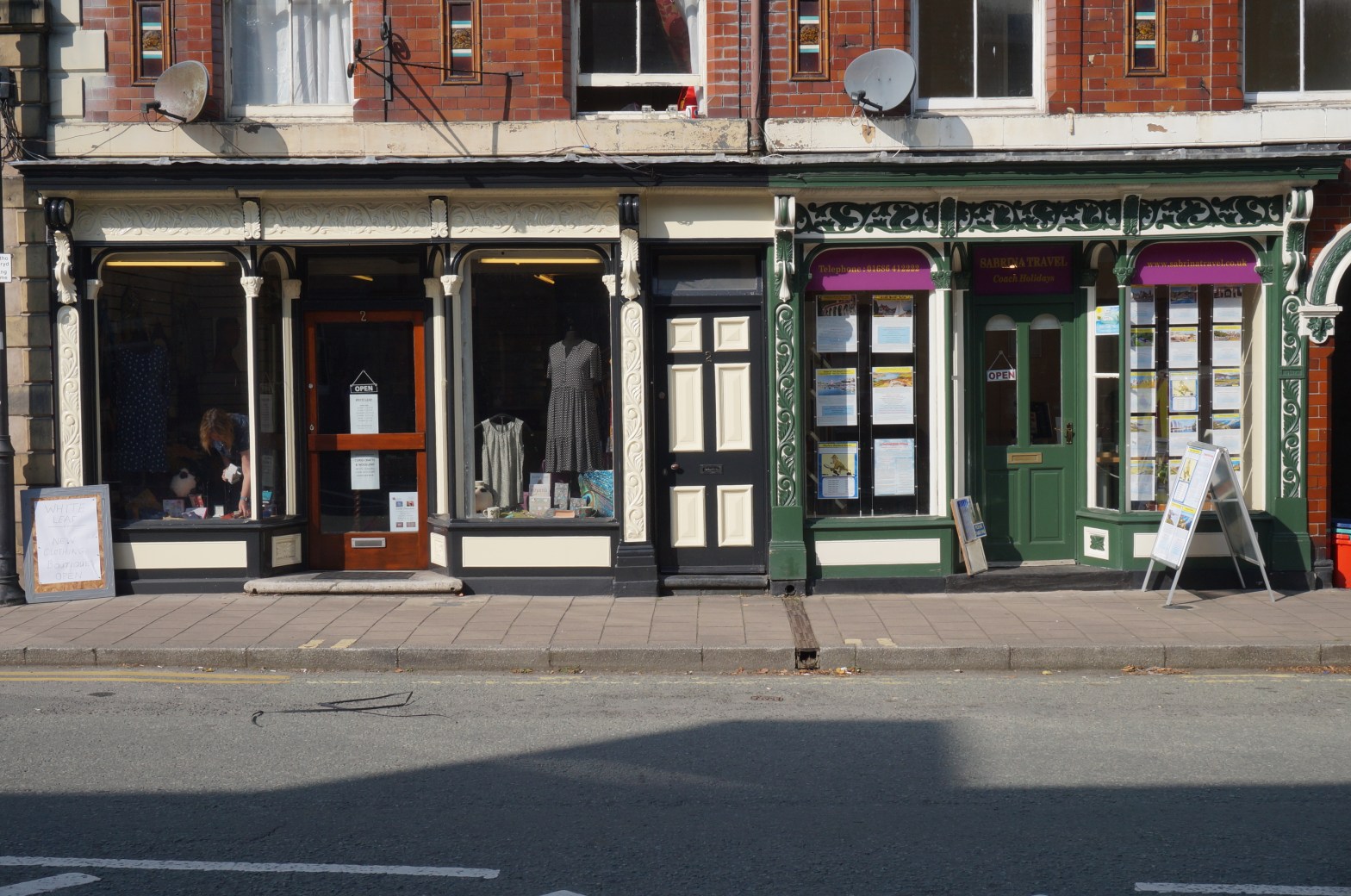
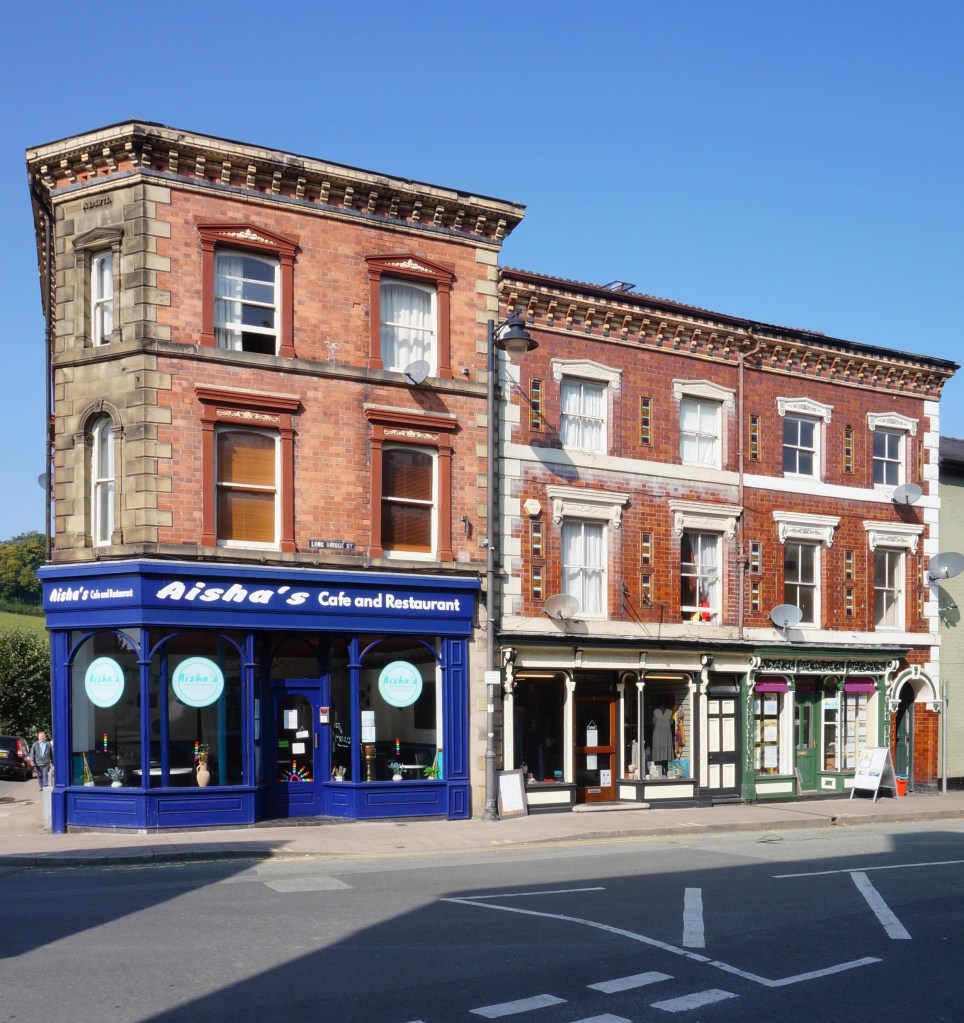
The prize for me, though, is No. 2 Longbridge Street, squeezed in between the late Georgian Unicorn Hotel and a tall block on the corner with Shortbridge Street, the latter (dated 1871) spoiled by the replacement of the shopfront. Again, a façade faced in brown glazed brick, here enlivened by the raised and chamfered window jambs and inserts with coloured tiles. There are good window heads, too, and a fine eaves cornice made of multi-coloured terracotta components. But what steals the show is the shopfronts with vigorously moulded arabesques running not only up the pilaster strips but also across the fascia boards. Luxuriantly foliated consoles support the cornice and even the archway over the entrance to the rear passage is abundantly moulded. The colour scheme of one of the shopfronts is a little too monochrome to bring out all the detail – a slight shame, and it would benefit from being amended.

No. 2 Longbridge Street

What a wonderfully proud display! And what a splendid legacy in a town whose architectural quality is consistently high. Everything about it is a credit to the place and everything about it confirms, I hope, the same thing that is confirmed to me – that is a an uncommonly rewarding town to visit and well worth the effort of going to see, no matter how far you have to travel.

No 2 Longbridge Street – the passage running through to the back yard

Technicolour Roguery: the rise and fall of Bassett Keeling

Enoch Bassett Keeling photographed in c. 1884. By this point, the early phase in his career that forms the focus of this blog was a good two decades behind him and – though one needs to avoid the temptation after the event to read significance into places where it may not be present – the world-weary expression suggests that the strain of professional and personal crises was beginning to tell.

The 19th century was the age of Romanticism. Though its influence was felt in all the arts, many of the impulses driving the Romantic movement were literary in origin and one of their purest expressions is in the archetype of the Romantic hero – fated to be an outcast from society by incomprehension of his brilliance, doomed to tragedy by excessive sensitivity to the brickbats that his daring and originality elicit. Many creative figures of the period embodied these tropes to some degree, both consciously and unconsciously, but in English architecture few, perhaps, to quite the same extent as Enoch Bassett Keeling (1837-1886).

St George’s, Campden Hill, Kensington, London (1864), street front: the copper-covered pyramidal cap to the tower dates from 1949 and replaced a splay-footed stone spire, which had to be dismantled after sustaining bomb damage, while the apse was removed in the later 20th century because of problems with structural movement.
St Mark’s, Notting Hill, London (1862-1863, demolished 1970s): west elevation to St Mark’s Road and east elevation with apse (RIBA Collections)

Unlike some of the architects featured on this blog, Keeling has had the good fortune to have been the subject of academic study. A full account of his life and career is given by James Stevens Curl, whose interest in the architect goes back to the 1970s, in ‘Acrobatic Gothic, freely treated: the rise and fall of Bassett Keeling (1837-86)’, from which most of the information here is drawn. This essay appears in a collection edited by Christopher Webster published under the title of The Practice of Architecture (Reading: Spire Books, 2012) and, since that is still available, I will do no more than outline here Keeling’s professional and personal biography.

St Mark’s, Notting Hill: longitudinal section (RIBA Collections)
St Mark’s, Notting Hill: transverse sections and longitudinal section of west gallery (RIBA Collections)

Keeling was born in Sunderland to the then-minister of the Sans Street Methodist Chapel. Keeling senior led a peripatetic life, which may explain why his son received his architectural training in Leeds. Here, he was articled for five years at the age of 15 to one Christopher Leefe Dresser (c.1808-after 1891), during which period he attended the Leeds School of Practical Art, where he was awarded a medal for drawing in 1856. By December 1857 he had moved to London and set up his own practice. He seems to have disliked his first name and from early on either styled himself E. Bassett Keeling or dropped it altogether to use his middle name instead – Bassett Keeling was not a double-barrelled surname. In January 1860, he was elected an Associate of the Royal Institute of British Architects and in March he married nineteen-year-old Mary Newby Harrison.

General view from liturgical northwest and details of St John, Greenhill in Harrow as illustrated in The Building News of 21st June 1867: at this point only the nave, transepts and northwest porch with its diminutive bell tower above having a saddleback roof had been constructed, and construction of the eastern arm flanked by a vestry (with the larger tower rising above it) and organ chamber had been postponed until funds became available. Map evidence suggests that the church was completed according to Keeling’s design, but no images of it have yet come to light and in any case the building proved to be short-lived. The population of what was then a rapidly expanding suburb outgrew the church, which was demolished in c. 1904 to make way for a much larger replacement designed by J.S. Alder.
Sections and elevations for the nave with the adjoining porch, vestry and bell cote at St John’s in Greenhill – this reflects what had been built at around the date of the report mentioned in the caption to the illustration above. Note the paired cast iron columns and segmental arches to the double openings into the transepts. (RIBA Collections)

Evidently ambitious and dynamic, he quickly came to notice as an architect of ecclesiastical buildings and, still not even 30, won a crop of commissions for new Anglican churches and Nonconformist chapels, mostly in London and the surrounding area. Between 1864 and 1866, Keeling was in partnership with one John Richard Tyrie (1838-?), although the nature of their collaboration is not clear. A brief catalogue – by no means exhaustive – of works from that period is given here:

  • St Mark’s, St Mark’s Road, Notting Hill, London (1862-1863)
  • St Paul’s, Maryland Road, Stratford, London (1862-1864)
  • Wesleyan Chapel, Waterloo Road, Epsom, Surrey (1863)
  • St George’s, Campden Hill, Kensington (1864)
  • St Paul’s, Anerly Road, Upper Norwood (1864-1866)
  • Wesleyan Chapel, Mayfield Terrace, Dalston, London (1864)
  • St Paul’s, Greenhill, Harrow, Middlesex (1864)
  • St Andrew’s, Glengall Road, Peckham, London (1864-1865)
  • Christ Church, Old Kent Road, Camberwell, London (1867-1868)
  • St Andrew and St Philip, Golbourne Gardens, Kensal New Town, London (1869-1870)
  • St John the Evangelist, Killingworth, Northumberland (now North Tyneside) (c. 1869)
St Paul’s, Maryland Road, Stratford, London (1862-1864), north elevation and ground plan: this church was demolished after sustaining war damage. (RIBA Collections)
St Paul’s, Maryland Road, Stratford, London: longitudinal section and roof plan (RIBA Collections)

Keeling’s success seems to have been due mainly to good business practices and diligence. His churches were economical, providing large numbers of sittings for a very competitive price per capita. He kept within budget and his buildings were delivered swiftly and on time. Stylistically, they are immediately identifiable as High Victorian – strident, colourful, vigorous and uncompromising. It is young man’s architecture, boisterous and self-confident. Indeed, it is almost a cartoonish parody of Victorian architecture à la Osbert Lancaster. Keeling’s distortions, sometimes verging on the grotesque, of stock devices of the period – plate tracery, constructional polychromy, restlessly varied wall surfaces, spiky ironwork, chunky and chamfered timberwork, vigorously moulded cast iron columns – take to extremes an already bold aesthetic. Even some of his contemporaries found his work indigestible, dismissing it in terms that prefigure the mid-20th century rejection of High Victorianism as wilful ugliness and a lapse of all the canons of good taste.

St Paul’s, Maryland Road, Stratford, London: west and east elevations (RIBA Collections)
Postcard depicting the only view currently known to exist of St Andrew and St Philip, Golbourne Gardens in Kensal New Town of 1869-1870: the church was demolished in c.1951 after sustaining war damage and seems to have disappeared almost entirely unrecorded. (Collection of D. Fitzgerald)

H.S. Goodhart-Rendel therefore had good reasons to identify Keeling as a worthy for inclusion in his 1949 lecture, ‘Rogue Architects of the Victorian Era’, dedicated to figures with a strongly personal idiom who, he believed, had no counterparts among their peers or followers among later generations. The scope of lecture was broad, but the term ‘rogue architect’ has subsequently come to be used in a much narrower sense to denote practitioners active in the 1850s-1870s who propounded the most idiosyncratic and wilful brands of revived Gothic. Goodhart Rendel identified their work in the ecclesiastical sphere explicitly with ‘low’ Anglican churchmanship. Subsequent commentators have found cause to question this generalisation, yet for all that the modern understanding of the term in the context of High Victorian architecture is founded primarily on the reputation of figures such as Keeling. ‘Rogue’ implies moral censure, not just a maverick nature, and it seems to have been the lack of high seriousness that elicited it. Boldness was permissible, but not whimsy for its own sake: ‘When [William] Butterfield hit what he regarded as a frivolous and self-indulgent age full between the eyes’, said Goodhart-Rendel, ‘he did it of high purpose’. By contrast, he struggled to find any guiding aesthetic principle in Keeling’s churches beyond an intent to ‘try very hard to be amusing’.

An artist’s impression of Keeling’s unexecuted design for The Brighton Club as published in the Building News of 25th September 1863. Keeling’s ecclesiastical buildings are notable for their bold use of structural iron; the tiered verandas depicted in this view show that he was equally aware of the material’s potential for commissions in other spheres.
St Andrew’s, Glengall Road, Peckham (1864-1865), elevation drawings, showing the vertiginously tall spire, which was dismantled in the 20th century and replaced with a pyramidal cap. Another dedication was originally intended and the church is referred to as All Saints, Camberwell in some early accounts. The building was made redundant as an Anglican place of worship in 1978 and since 1980 has been leased by the Celestial Church of Christ.

He deemed the idioms of Keeling and others of his ilk, such as Robert Louis Roumieu and Joseph Peacock, far too disparate to qualify as a school: ‘the general resemblance of their attempts was due not to the similarity of their efforts but to the identity of the victim’. But he does draw an intriguing parallel with broader tastes of the 1860s – ‘Those were the days, in costume, of the longest whiskers, the most spacious crinolines, and the biggest stripes and checks’ – and one whose veracity it would be interesting to see tested by fashion historians.

The pulpit at St Andrew’s, Glengall Road was elaborately modelled and decorated with panels of marquetry work. Recent photographs of the interior suggest that most of the original fittings were removed after the church was made redundant and it is not clear whether this item survives or was removed. If the latter, its fate remains to be clarified. (Historic England)
The interior of St Andrew’s, Glengall Road: this view, which seems to be a black and white reproduction of the watercolour exhibited by the architect at the Royal Academy in 1867, is a valuable record of the building as it appeared when first completed. All other archive illustrations show the interior as it subsequently appeared after suffering the fate common to so many High Victorian churches of being whitewashed internally to tone down the constructional polychromy. (Historic England)

Though remembered chiefly as an architect of churches, Keeling also handled secular commissions. But though these gave rise to no less engaging flights of architectural fancy, this side of his practice was commercially much less successful and, indeed, seems to have precipitated his downfall. In 1863, he won a commission to remodel the Norfolk Hotel in Brighton as a combined hotel and gentlemen’s club and produced for it a wildly eclectic design with a vivid roofline and a striking cast-iron structure of balconies running the entire width of the main front. Alas, it had all the makings of a scam – apparently none of this was built and, following his dismissal from the project, Keeling had to pursue unpaid fees through the courts, eventually being awarded just £500 of the total of £1,300 due to him. Publicity gained, the scheme was eventually executed by another architect to a far cheaper design.

Street front of the Strand Music Hall (1863-1864) as published in The Building News in 1863
Auditorium of the Strand Music Hall (1863-1864) as published in The Building News in 1864

Around the same time, Keeling was engaged to produce a design for the Strand Music Hall and he rose to the occasion, producing what might well deserve to be reckoned his masterpiece. While the street front was every bit as commanding a presence in the streetscape as the Brighton Hotel would have been, the auditorium was sheer phantasmagoria. It amplified all that was most flamboyant and colourful in his architecture – literally so, since the ceiling incorporated stained glass panels and glass prisms, illuminated from behind by gas jets, and the capitals were made of beaten copper. With its galleries, it bore more than a passing resemblance to his ecclesiastical interiors, and this may have been why it was thought a bridge too far. While the churches never entirely wanted for admirers, the Hall was universally lambasted in the architectural press of the time and although Keeling tried, wittily and eloquently, to defend himself, this seems only to have poured oil on the fire.

Methodist Chapel on Waterloo Road in Epsom: the date is unknown, but the pristine condition of the stone dressings and brickwork implies strongly that the view was taken not long after the building was completed in 1863 and this photograph is therefore most valuable as a record of the sort of effects that Keeling intended his vivid structural polychromy to produce. A report in The Builder of 25th September 1863 recorded that the darker bands were composed of black and blue Staffordshire bricks. The transept-like volume visible to the right housed a schoolroom; a smaller extension in a corresponding position on the opposite side housed vestries. The congregation came to outgrow the chapel and, after moving to new premises in 1914, sold it to the Ancient Order of Foresters, who remained there until 1979, when the building was demolished for redevelopment. A photograph taken around that time demonstrates the extent to which the constructional polychromy had dimmed with age. (Reproduced by permission of Surrey History Centre)
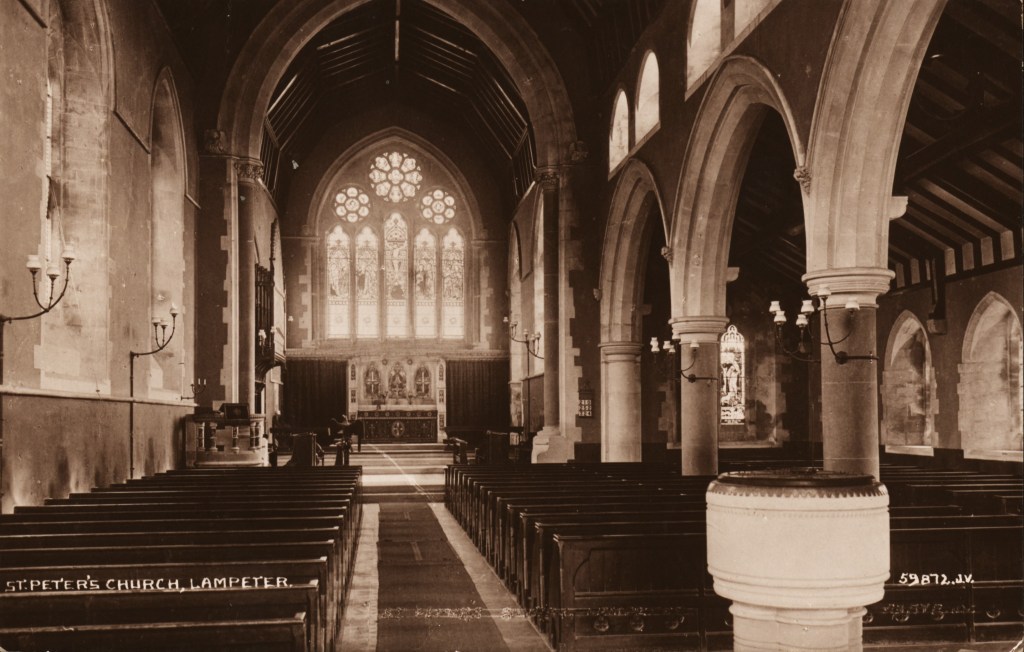
St Paul’s, Upper Norwood (1864-1866), longitudinal section: ‘One remarkable feature in the construction of the church is the total absence of plaster in all parts of the building’ reported The Illustrated London News (20th October 1866), but the constructional polychromy and herringbone coursing visible on this drawing later disappeared under a coat of whitewash applied to serve as a ground for an extensive scheme of stencilled decoration. It is not currently known whether this reflects any intentions on the part of Keeling. The church was made redundant in 1972 and demolished in 1973, although colour photographs taken for a survey by the National Monuments Record, one of which forms the illustration at the top of this page, convey its almost overwhelming effect. (RIBA Collections)

Worse still, the Hall was a commercial failure, operating for just two years. When the venture collapsed, it took with it a considerable sum that Keeling himself had invested in it and on 25th January 1865 he was declared bankrupt. As can be seen from the dates in the list of churches above, he managed to continue in practice until the end of the decade, but then seems to have withdrawn from architecture for several years, and in 1872 he even resigned his membership of the RIBA. When he re-emerged at the end of the 1870s, he was concentrating on commercial and residential work and producing buildings of a very different kind. Though technically innovative – premises at 16 Tokenhouse Yard in the City of London incorporated an ingenious stepped iron and glass structure at the rear to maximise the amount of light and air reaching the interior – they show no trace of the idiosyncrasies of the previous decade.
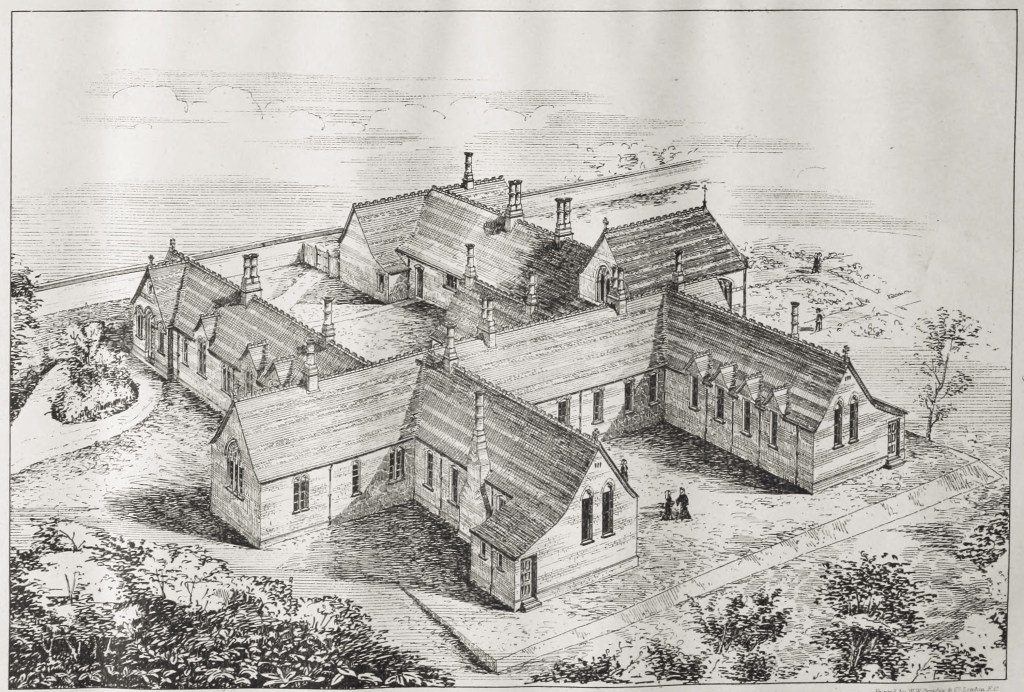
St Paul’s, Upper Norwood: artist’s impression published in The Illustrated London News of 20th October 1866. In fact, at the time of publication, the tower had not yet reached the belfry stage. The upper stages visible in this illustration, which owe something to Senlis Cathedral in northern France, seem to have been based on a version of the design which was not executed and subsequently abandoned.
St Paul’s, Upper Norwood – view from the junction of Hamlet Road and Anerly Road, showing the church as eventually executed: note that it is closely hemmed in on either side by residential properties, something evidently envisaged at the outset, since the flank walls were treated very simply and architectural display was concentrated on the street front. (Historic England)

The revival in Keeling’s fortunes did not last long. In December 1882, his wife died while giving birth to their fourth son, who himself died just one year and five months later. Keeling had always been clubbable and gregarious, but grief evidently pushed him to indulge to an extreme degree and his death at the age of just 49 was the result of cirrhosis of the liver. He was buried with his wife and child at Abney Park Cemetery in Stoke Newington, but no memorial has been found and it seems that the plot was subsequently reused. His second son, Gilbert Thompson Keeling (1862-after 1894), tried to carry on his father’s practice, but after an ill-fated attempt to secure a commission for a National Concert Hall on Vauxhall Bridge Road gave up architecture and ended up earning his living in Ramsgate as a tram driver.

Christ Church, Old Kent Road in Peckham: drawing showing the elevation of the church to the titular thoroughfare as originally proposed. This church was built to replace a plain, lancet-style building which seems to have dated from the 1830s and stood on the opposite side of the Old Kent Road. That had to be demolished to make way for a new plant for the South Metropolitan Gasworks, which funded the cost of the replacement on a new site. Though the composition was undeniably busy, that impression is heightened by the manner in which the drawing collapses a number of receding elevations, such as that of the gallery staircase located half way down the south aisle, into a single plane. (RIBA Collections)
Christ Church, Old Kent Road in Peckham (1867-1868): this is the same elevation shown in the drawing reproduced above. Some of the detailing was apparently simplified in execution, though a tall tower was substituted for the bell turret. This is unique among Keeling’s steeples for its slender proportions and for having a tall, stone-built pyramidal cap rather than a needle-sharp spire. It may represent his interpretation of the Venetian campanile prescribed by Ruskin and popularised by G.E. Street, who used it at St James-the-Less, Pimlico (1859-1861). The spire at Christ Church was taken down to the level of the decorative band running over the belfry windows and replaced by a flat top after sustaining bomb damage in World War II. (Historic England)

Personal tragedy was compounded by the ill fate of much of Keeling’s output. The Strand Music Hall was remodelled as the Gaiety Theatre, surviving only until 1903 when it was demolished for the construction of Aldwych. Bomb damage, post-war redundancy and a lack of recognition did for most of his ecclesiastical commissions. St George’s Campden Hill survives and is still a functioning Anglican church, but was badly mutilated by the removal of the galleries, then the spire and finally the apse. Much of the internal structural polychromy has been painted out. St Andrew’s, Glengall Road is structurally complete, but the fittings have largely been removed and the west gallery enlarged to form a mezzanine floor extending out into the nave. St John’s in Killingworth is also still a functioning Anglican place of worship and the least altered of the surviving churches, but the design is a good deal tamer than its counterparts in London (the interior is finished in plaster rather than polychromatic brickwork, for instance) and in any case lacks its intended south aisle and has no tower. In short, there is no place where one can today feel the full, unimpeded force of Keeling’s distinctive aesthetic.

Wesleyan Chapel, Mayfield Terrace, Dalston, London (1864, demolished after sustaining war damage): flank elevation (RIBA Collections)
Wesleyan Chapel, Mayfield Terrace, Dalston: transverse sections looking towards main entrance and apse (RIBA Collections)

Even more sadly, the only surviving records to give us any sense of what Keeling was really about are, unavoidably, either monochrome woodcuts in contemporary trade publications or else black and white photographs in archives. This badly sells short architecture that was intended to dazzle through its colour and vibrancy. But it is nonetheless possible to recover his intentions, thanks to the Dove Brothers, with whom Keeling worked on numerous occasions in the 1860s. This Islington-based firm of contractors amassed a remarkable collection of contract drawings by a wide range of architects during the course of its long existence, which was subsequently deposited in the RIBA Drawings Collection at the Victoria and Albert Museum. By kind permission of that body, a selection is presented here.

Wesleyan Chapel, Mayfield Terrace, Dalston, London (1864, demolished): elevations of apse and entrance front (RIBA Collections)

Welsh Baroque – Nonconformist swagger in Llanidloes

I was introduced to Ian Nairn by my father, who was a great admirer, owned a copy of Nairn’s London and got me watching the mini-series of his programmes repeated in 1990 with introductions by a very fresh-faced Jonathan Meades. Over the years, my attitude towards him has changed from initial incomprehension in my teens (Nairn’s London is difficult to understand without a good prior knowledge of at least some of the buildings and places discussed) to hero-worship in my 20s and 30s, to carefully conditioned admiration now. He can write wonderfully, with huge feeling, and was enormously erudite – and by no means just about architecture. But there are problems. He cannot look at anything from the dispassionate point of view of an historian, always instead speaking ex cathedra, handing down categorial judgements as the omniscient arbiter of taste and architectural quality. In the large sections of the old Pevsners to Surrey and Sussex that he wrote, he ties himself up in terrible knots trying to square his position as a card-carrying modernist with historicism that he wants to admire but feels he shouldn’t.

Trinity United Reformed and Presbyterian Chapel (formerly Zion Congregational), Short Bridge Street, by John Humphrey, 1878

All the same, were it not for Nairn – or, more precisely, Notting Hill Editions who republished Nairn’s Towns in 2013 and Owen Hatherley, who wrote a foreword and post-postscripts to each entry – I would not have discovered Llanidloes. On the basis of Nairn’s description of the place, I spent two nights there last month and did not regret it. It is an exceptionally attractive, interesting and rewarding town. It is not just individual buildings that make it worth a special visit (although they do), but whole streetscapes, the absence of any major unsympathetic 20th century interventions and a setting in stunning countryside. A place hitherto of no great import, it received a market charter in 1280 and, simultaneously, a regular street plan and earthwork defences. By the late 18th century, it had become a major centre of flannel production, but this was superseded – by the establishment of an iron foundry in 1851 and then lead mining from 1865.

General view of the interior of Trinity United Reformed and Presbyterian Chapel (National Monuments Record of Wales)

Two in particular stand out. The first is Trinity United Reformed and Presbyterian Chapel on Short Bridge Street, formerly Zion Congregational. It was designed by John Humphrey of Mynyddbach (1819-1888), architect of Tabernacl in Morriston outside Swansea, built in 1872 and dubbed ‘The Cathedral of Welsh Nonconformity’. That is a building (which I know only from photographs) that seems to me to have traded far too much on having a great deal of money spent on it – £18,000, an astronomical sum at that date. But its fame spread and that gave rise to subsequent commissions from the same architect – Tabernacl at Llanelli of 1873, Zoar in Swansea of 1878 (demolished) and Zion in Llanidloes, also built in 1878. At all three, Humphrey tries out variations on the tripartite design of Morriston with giant order columns and a huge pediment, and all three are better than the prototype with its gauche unequal openings and gangly columns.

Calvinistic Methodist Chapel on China Street, Richard Owens of Liverpool, 1873: images of the interior are visible here on the website of the National Monuments Record of Wales

Nairn’s appreciative take on Zion Congregational was that ‘however improbable it may seem in time and date, it is a piece of truly Roman architecture, a Congregational chapel as Hawksmoor might have designed it, each part of the classical vocabulary a quintessence. Three great arches support a pediment and frame the entrance doors, and the effect is a bright-eyed triumph’. He hits the nail on the head with his description of chapels of the period as representing an ‘uninhibited shaking-up of classical forms which can only be classed Welsh Baroque’, then undermines himself by dismissing all of them in Llanidloes but Zion with a sweeping value judgement: ‘too conventional, the style has gone lifeless and become fancy dress in the usual 19th century way’.

Tabernacle Chapel in Morriston, Swansea, by John Humphrey, 1872 (Andrew Green)

What on earth is that supposed to mean? Though there is a certain generic quality to the street fronts of a lot of Welsh Nonconformist chapels – not only those of Llanidloes – for sheer splendour and swagger it would be hard to beat the Calvinistic Methodist Chapel on China Street, only a stone’s throw away. Built in 1873, it cost the substantial sum of £4,000 (by contrast, Zion was a snip at £1,550) and was the work of Richard Owens of Liverpool (1831-1891), a native of Pwllheli who moved to Liverpool in his 20s, had his own practice by the age of 30 and designed certainly around 200 and perhaps as many as 300 Nonconformist chapels – and that quite apart from his work on secular commissions and town planning. What really sticks in the memory here is the splendid loggia with its vivid rustication and lush foliate capitals, which have nothing to do with the ostensibly classical language in evidence here, but contribute very successfully to the play of light and shadow. Giulio Romano would have been proud of that.

Wesleyan Methodist Chapel, Longbridge Street, Richard Owens of Liverpool, 1874
Wesleyan Methodist Chapel, Longbridge Street: the interior as depicted in an on-line property listing when it was offered for sale following closure in 2018.

Owens designed no fewer than three more chapels in Llanidloes. The street front of the Wesleyan Methodist Chapel on Longbridge Street of 1874 is rather brittle, stage-set architecture. But the Bethel Calvinistic Chapel on Bethel Street of 1872 is more satisfying thanks to its asymmetrical massing and pleasing, if typical features of the period, such as the alternating bands of rectilinear and fish-scale tiles (adorning what must be a stair tower giving access to the gallery) and spiky decorative ironwork. At any rate, all three buildings demonstrate the fertile imagination of an architect in the curious position of having to compete against himself.

Bethel Calvinistic Chapel, Bethel Street, Richard Owens of Liverpool, 1872: the interior following redundancy and damage by vandals (Liverburd)
Bethel Calvinistic Chapel, Bethel Street, Richard Owens of Liverpool, 1872: the entrance front

Viewing these buildings one way, ostentation gets the upper hand over correctness – and certainly there are frequent grammatical slips and sometimes outright solecisms if they are judged against the canons of strict classicism. Viewing them another, they represent a wholly different tradition that cannot be fairly judged on those criteria. The architects, who generally were in the master-builder tradition rather than being tutored by established practitioners, had an imperative to make them look as different as possible to the products of the Anglican church. They arrest, challenge received expectations, sometimes delight, sometimes baffle, but rarely fail to repay attention and embody a character that is a fundamental determinant of a uniquely Welsh sense of place.

A glimpse of Arcadia in Central Wales

Thomas Henry Wyatt (1807-1880) and David Brandon (1813-1897) have a reputation of being among the also-rans of Victorian architecture. In the earlier part of their careers, the two architects had a professional partnership which lasted from 1838 until 1851, whereupon they went their separate ways. They were commercially successful, taking on the full range of commissions typically handled by architects of the time – from lunatic asylums to railway stations – but have seldom been viewed as more than merely competent. In The Victorian Country House, Mark Girouard notes somewhat sniffily that Brandon was ‘Predominantly a country house architect, and kept undeviatingly to the Jacobean style, which he and Wyatt made only too much their own’.

Thomas Henry Wyatt as depicted by George Landseer (1829-1878) (National Portrait Gallery)

Nor has such an assessment been confined to commentators of our own time. Wyatt’s copious output was more respected for its volume than admired for its quality, and even as august a periodical as The Building News damned it with faint praise in its obituary of him as ‘not distinguished for any marked originality or power of expression’. Perhaps he was felt to have buckled under the weight of expectations – he was, after all, a scion of a famous architectural dynasty (James Wyatt was a cousin, Matthew Digby Wyatt his younger brother) and the risk of unfavourable comparisons was high.

General view looking west of the nave of Wyatt and Brandon’s church of St Mary and St Nicholas in Wilton, Wiltshire: it was built in 1841-1845 for the Russian-born Countess of Pembroke (1783–1856) and her son, Sidney, later Lord Herbert of Lea (1810-1861). The latter was a connoisseur and collector of medieval Italian art, much of which is incorporated in the church, and this no doubt accounts for the choice of style. (Mark Kirby)

But as so often happens with prolific figures in almost any branch of the arts, they have been dismissed on the basis of lazy generalisations. No one who has seen, for example, T.H. Wyatt’s splendid estate churches at Bemerton (1859-1861) and Fonthill Gifford (1866) in Wiltshire could be left in any doubt that he was an architect of real ability. While still in partnership with Brandon, he designed at Wilton in the same county a grand and lavish church in an Italian Romanesque style, built in 1841-1845 and among the finest ecclesiastical works of that decade.

The main entrance front to The Bulwark of the former Shire Hall in Brecon by Wyatt and Brandon of 1839-1843
The Law Courts and County Police Office on Northgate Street in Devizes, Wiltshire, designed by T.H. Wyatt in 1835. Abandoned in the 1980s, it was recently saved from dereliction by a building preservation trust that aims to convert it into premises for the Wiltshire Museum. (Historic England)

And then we have this – the former Shire Hall and Assize Court (now Y Gaer Museum, Art Gallery and Library) in Brecon of 1839-1843. It is an unexpected thing to find in Wyatt and Brandon’s output and indeed unexpected generally for the period, when the Greek Revival was already on the wane. But it is notable for far more than that, as this is a cleverly crafted piece of design and an intelligent response to its site.

Exterior from southwest and the chancel of Wyatt and Brandon’s church of Holy Trinity on Clarence Way in Kentish Town, as pictured in The Illustrated London News of 19th October 1850 shortly after its consecration. The spire, which rose to 160ft (48.7m), was destroyed in World War II and not rebuilt.

The big problem with neo-classicism generally and the Greek Revival in particular is the dominance of the temple front. That is to say, an archaeologically pure motif necessary to declare allegiance to the heritage of antiquity somehow has to be incorporated into building types that have nothing whatsoever to do temples. The result in unimaginative hands is usually a dull symmetrical box with a regular grid of sash windows and a portico in the centre, and there are enough examples up and down the land to prove the point. The need for all openings to be trabeated rather than arched all too often exacerbates the dullness.

St David’s Church, Pantasaph, Flintshire: this church was begun in 1849 and commissioned from T.H. Wyatt (apparently not working in partnership with Brandon on this occasion) by Viscount Feilding, later 8th Earl of Denbigh (1823-1892). The donor’s ample means allowed for an elaborate, generously proportioned essay in Puginian Gothic with some surprisingly wilful touches, such as the buttress to the stair turret rising out of the doorway. Feiding converted to Catholicism in 1850 and changed the denomination, as a result of which churches had to be built in lieu in the nearby villages of Brynford and Gorsedd. A.W.N. Pugin was brought in to fit out the church in a manner suitable for Catholic worship and supplied a scheme of furnishings, including a number of items which had been exhibited in the Medieval Court at the Great Exhibition of 1851. The church eventually opened in 1852. The adjoining Franciscan friary of 1858-1862, which may also by Wyatt’s work, is partly visible in the background.
‘In dealing with [commissions for country houses] he has generally adhered to the late Tudor type of architecture, to which rural squires of the last generation gave a decided preference, and which certainly presents many advantages as to convenience of plan and distribution of window space’, wrote Charles Eastlake, adding that, ‘in Mr. Duckworth’s seat of Orchardleigh, Mr. Wyatt has shown of what artistic treatment the style is capable’. Here is that house of 1855-1858 near Frome in Somerset, as pictured in A History of the Gothic Revival of 1872.

But here the problem has been looked at anew. The main volume of the building is a longitudinal box placed end-on to the street, with taught, elegant proportions and a deep cornice and prominent triglyphs to emphasise the form. The tetrastyle Doric portico is placed on the flank wall – an unconventional solution, but a very effective one, since it creates a grand spreading frontage that commands its location overlooking the junction of two streets. This is locked into place with flanking pavilions, the windows skilfully articulated with pilasters to tie them visually into a grand vertical rhythm of solids and voids controlling the entire composition. To the rear, aligned with the portico, is the former courtroom with its polygonal apse, blind externally but with a grand Ionic exedra internally. The whole is seen against the spectacular backdrop of the Usk Valley. As Julian Orbach has noted, the composition owes more than a little to the Assize Court that Wyatt had designed four years earlier for the Wiltshire town of Devizes while still a sole practitioner, but the use of the Greek Doric rather than Ionic order gives it a great deal more punch.

St Matthias, Bethnal Green, as depicted in The Illustrated London News of 26th February 1848, accompanying a report of its consecration: one of the fruits of the ambitious programme of church-building in this part of the East End initiated by Bishop Blomfield, it was notable for reapplying the planning and stylistic language tried out at Wilton to a large urban church in a poor area. It stood on the corner of Hare Street (now Cheshire Street) and Chilton Street.
The interior of St Matthias, Bethnal Green, looking east: a casualty of the post-war depopulation of the East End, this church was closed in 1954 and demolished in 1958. (Historic England)

Young man’s architecture? Wyatt was in his 30s and Brandon was in his 20s when they designed Shire Hall and just starting out in their professional partnership. By the time of his death, Wyatt’s output stood at 400 works and The Builder concluded in its obituary ‘That one man could have, unaided, designed and superintended so large a number of buildings… is not probable and it was Mr Wyatt’s invariable habit to acknowledge the help rendered to him by his pupils and assistants’. One of these, incidentally, was almost certainly a young Joseph Peacock. Perhaps the variable quality of Wyatt’s work results less from a lack of talent than from circumstances diluting his personal contribution on occasions. If so, one regrets it, but it is some consolation to know that the 19th century practitioners were afflicted by the same ills as the ‘starchitects’ of our own time.

St John’s in Bemerton of 1859-1861 on the western outskirts of Salisbury, one of a crop of estate churches that T.H. Wyatt designed in Wiltshire in the years after the dissolution of his partnership with David Brandon. It was paid for by the Herberts of Wilton House and the foundation stone was laid by Elizabeth, wife of the same Lord Herbert of Lea who had commissioned St Mary and St Nicholas in Wilton. (Michael Day)

Amateur extravagance in the Welsh Marches

I have long fancied that one of the principal drivers of architectural development in Victorian England was boredom. Young men who had come into contact with the ideas of, say, Ruskin or the Tractarian Movement while up at Oxbridge or in the capital then found themselves out in the sticks on inheriting the family estate (in the case of the oldest son) or taking up a living as an Anglican rector (in the case of their younger siblings). With little to occupy them but plenty of private wealth, it is not surprising that the impulse appeared to embark on construction projects to advertise the ideals and preoccupations that they had acquired. This resulted in a steady flow of commissions to architects who had made the right connections as specialists in churches or country houses. But those bold enough to take matters into their own hands went one step further and became amateur architects.

View from southwest of St Michael’s, Church, Llanyblodwel: the octagonal steeple, which rises to a height of 104ft (31.7m) appeared during the final phase of the remodelling.
The Rev’d John Parker (1798-1860), depicted against the backdrop of what seems to be the apse that he added to Holy Trinity in Oswestry, which would date the portrait to the late 1830s. The name of the artist is unknown.

There are numerous such figures and they represent some of the most intriguing minor masters that Victorian Britain produced. Usually their output is small, concentrated in their locality and often idiosyncratic to the point of outright eccentricity. Few people exemplify this phenomenon better than John Parker (1798-1860). He was born the second son of Thomas Netherton Parker (d. 1854) of Sweeney Hall, located a short distance to the south of Oswestry in Shropshire. He received an education at Eton and Oriel College, Oxford, somewhere along the line picking up an interest in Gothic architecture, along with botany and topography. He also revealed himself as a gifted watercolourist and draughtsman, pursuits which went hand in hand with his interests. Some time after receiving his MA in 1825, he was ordained and returned to the Welsh Borders. His first living was that of St Llwchaiarn’s Church in Llanmerewig, a village in Montgomeryshire to the northwest of Newtown, which he occupied from 1827 to 1844.

Lancaster from the south, a view by John Parker from his album of views of the English Lakes of 1825, now held in the National Library of Wales (public domain)
St Llwchaiarn’s Church in Llanmerewig, Powys (Wikipedia Commons)

Beginning in 1833, he remodelled a humble, single-cell, chiefly 13th century church reputedly founded in c. 575 by its patron saint. The results were startlingly original. First, he refurnished the interior, during the course of which he dismantled one of the medieval rood screens that abound in central Wales (all of which he depicted, leaving a valuable record of one of the area’s great glories), using the components to construct an enormous pulpit. In 1838-1839, he added the alarming west tower, crazily tall in relation to its width. This was followed in 1840 by the south porch with its richly moulded portal and then in 1843 by the adjacent semi-dormer with a vesica-shaped opening and reliefs of Celtic knots. Parker’s extravagances were not to the taste of later generations and unfortunately the interior was reordered in 1892 by Sir Aston Webb (1849-1930), when most of his furnishings disappeared. While busy at Llanmerewig, Parker advised on the construction of Holy Trinity Church, Oswestry, incorporating a vaulted apse in this Georgian Gothick preaching box of 1836-1837 by Thomas Penson (1790-1859).

South side of the nave of St Michael’s, Church, Llanyblodwel: the fabric added by Parker is denoted not only by dressed sandstone, but also pale orange brick. Not the striped voussoirs to the windows.
St Michael’s, Church, Llanyblodwel: the roof of the south porch

In 1844, Parker became rector of Llanyblodwel, a village in the picturesque Tanat Valley to the southwest of Oswestry, only a few miles from his childhood home. St Michael’s Church was in a poor condition when he took up the living and he spent most of the time between then and his death comprehensively rebuilding it. The most pressing issue was the south wall of the nave, which threatened to collapse. Parker proposed to a vestry meeting not only rebuilding it but also incorporating an extra aisle to provide additional seating, stipulating that, in return for being given sole oversight of the work, he, Parker, would contribute £100 towards the cost, pay his quota as tithe-owner and indemnify those liable from any further charges. The motion did not pass, nor was – initially, at any rate – another proposal accepted to turn a schoolroom within the church building into additional accommodation in return for putting up a new school building outside the churchyard. But the wall was eventually rebuilt in 1846-1847, and the success of the venture seems to have induced the parishioners to give Parker a free hand from then on.

The west wall of the nave of St Michael’s Church, Llanyblodwel – visible within are the arches supporting the west gallery. Note the curious cusping to the twin lancets.
St Michael’s Church, Llanyblodwel – general view of the interior looking east from under the west gallery

Vestry minutes record the subsequent instalments in this ambitious project only sporadically, but do mention that the work was carried out at Parker’s own expense. He reputedly disbursed a total of £10,000 on the church, school and vicarage. Whether Parker had at the outset a fully worked-out concept for the rebuilding is unknown, but at any rate he obligingly incorporated carved dates into the fabric that he added, which show that the scheme proceeded rapidly. A south porch was added in 1849 with an elaborate timber roof that incorporates prominent cusped wind braces and coloured bosses. This provides access not only to the nave, but also to stairs leading to the west gallery. These are present in a watercolour by Parker showing the church just after the rebuilding of the south wall, but seem to have been comprehensively remodelled by him. The dormers followed in 1850, suggesting that the ceiling of the nave and chancel may have been rebuilt around this time. Parker then turned his attention to the north aisle, adding a porch in 1851 and dormers in 1853.

The ceiling of the nave and chancel at St Michael’s Church, Llanyblodwel
St Michael’s, Church, Llanyblodwel – the Perpendicular north arcade embellished with Parker’s own painted decoration, which incorporates prominently displayed verses from Scripture.

There was then a short break before Parker embarked on the single most ambitious feature – the tower and spire, which replaced a modest timber bell cote. The work was carried out in 1855-1856 and Parker left a detailed chronicle of the work. The tower is free-standing and aligned with the arcade separating the nave and north aisle, to which it is connected by a short vestibule bearing the carved imprecation ‘FROM LIGHTNING AND TEMPEST / FROM EARTHQUAKE AND FIRE / GOOD LORD DELIVER US’. The ground rises to the west of the church, there are numerous burials and Parker claimed that it was this lack of space that had prompted him to opt for an octagonal rather than square plan. The spire is conceived as a very attenuated dome rather than a cone, which Parker claimed was the principle that his close inspection of it had revealed to be the constructional basis of the spire of the minster at Freiburg-im-Breisgau in southwest Germany. His ‘Memorandums’ record his protracted attempts to create formwork for the construction. Striking a curve of the necessary radius of 230ft (70.1m) caused him considerable difficulty, but he persevered, concerned that ‘The spires of Shrewsbury and Coventry, and, more especially, St Andrew’s, Worcester, all seem to me dangerous slight and thin at their upper extremities; a fault which a small degree of convexity would have remedied… Our Gothic of the nineteenth century must not perpetuate this error’. The lowermost stage is battered and the fenestration is treated as staggered tiers of lancets and lucarnes, making it more like a continuous pattern. Parker was pleased with the finished result: ‘the convex outline of the spire has, I think, a certain degree of scientific and geometrical grandeur; and it also appears to me far more beautiful than the ordinary form’. It is a revealing insight into his aesthetics: his Gothic was informed by wide-ranging antiquarian study, yet he viewed historical prototypes as an anthology of forms and devices to be picked and combined at will – the overriding consideration being not archaeological accuracy, but visual effect. Nor did he treat the heritage of the Middle Ages with complete deference – modern science could and should be applied to improve it where possible.

St Michael’s Church, Llanyblodwel – the stone columns and complex timberwork supporting the west gallery of the nave.
The reredos and sanctuary at St Michael’s in Llanybodwel, reputedly carved by Parker himself. If not genuine ancient fabric, the traceried panels of the communion rail have at any rate been closely informed by Parker’s study of medieval Welsh rood screens.

The retention of the medieval fabric of much of the body of the church provided less opportunity for such bold experiments in form, but Parker’s distinctive aesthetic nonetheless dominates through the imposing and distinctive roof, the tour de force of the west gallery and the vibrant scheme of painted decoration (whitewashed around 1900 and not uncovered and restored until 1958-1960). The nave and chancel are not structurally differentiated, and so Parker marked the division by inserting a large openwork timber arch, supported on hammerbeams and running down to enormous carved and gilt pendants. These may have been inspired by the late 15th/early 16th century nave roof at St Davids Cathedral. Certainly the benches with poppyheads were Parker’s work and the configuration of the interior was, as left by him, apparently that of a Georgian auditory church, with the seating arranged in the manner of a collegiate chapel and focused on a double-decker pulpit on the south side of the nave rather than the altar. This was reordered in 1937-1945 to provide a more conventional arrangement, although Parker’s benches were retained.

St Michael’s Church, Llanyblodwel – the gallery in the north aisle. The National Pipe Organ Register describes the instrument visible here, a product of Bevington & Sons, as being ‘sweet-toned’ and ‘of much charm, visually suited to this exhuberantly decorated church’, but it probably postdates Parker’s remodelling. The enormous wall monument visible in the background is of 1752, commemorates Sir John Bridgeman (d.1747) and is the work of J.M. Rysbrack (1694-1770). The screen is late medieval. Note the slender cast iron columns supporting the gallery.
The font of St Michael’s in Llanyblodwel, ‘rewrought in Normanesque’ by Parker.

No less a distinctive statement of Parker’s unique aesthetic is the parish school and adjacent schoolmaster’s house that he designed in c. 1858 according to the Oxford Dictionary of National Biography. The schoolhouse is an elongated, hall-like form built of the local red sandstone, with an extraordinary bellcote at the east end, taking the form of a skinny tower rising out of a break in the wall surface, corbelled out in its upper stage and terminating in a form like a Rhenish helm spire. It is offset in a curious fashion, cutting through the gable to one side of the apex. All around, gables break through the eaves, the corners are clasped by outside buttresses and large chimneys form counterpoints to the bellcote. The schoolmaster’s house (subsequently a post office, now like the school a private house) is set at an angle to its neighbour and is an assemblage of tower-like forms, again with prominent clasping buttresses and again with dormers breaking through the eaves line. A cluster of funnel-like chimneys completes the effect, while a crenellated boundary wall is thrown around the whole site. The design exploits the picturesque location on a steep river valley to create a picturesque accent in the landscape.

Detail of the nave roof, showing the pendant marking the springing of the timber chancel arch.
Llanyblodwel, the former schoolmaster’s house (left) and former school (right), located a short distance to the east of St Michael’s Church. They are pictured from the angle that most effectively omits some unsympathetic late 20th and 21st century additions and alterations.

‘[Parker’s] work looks dotty, but he was clearly quite sane’, writes Peter Howell in The Faber Guide to Victorian Churches; ‘it must have been his artist’s eye that led to such picturesque results’. ‘Picturesque’ is the operative word, and this kind of quirky, almost cartoonish but ultimately winsome playfulness is still squarely in the Georgian tradition, persisting at a time when it was being superseded by the muscularity and seriousness of High Victorianism. There is only so much mileage in that approach and, for all his inventiveness, a quick review of his work is enough to demonstrate that Parker’s repertory of forms was limited. The same devices crop up again and again – restless rooflines, the grotesque attenuation of vertical accents, exaggerated cusping, overscaled ornament and so on. The first impression is arresting; examined at leisure, it begins to pall. What little he built is enough. But as a brief, vivid excursion into the strongly personal vision of an industrious gentleman amateur, it is entertaining and compelling stuff.

The monument in the churchyard at Llanyblodwel marking the burial of the Rev’d John Parker, almost certainly his own design.

Ghastly good taste in the Weald

Again rural Kent and again a residential property – very different in scale and style to the cottages in Leeds featured a few weeks ago, but, like them inasmuch as it is the sort of architecture that slips below the radar of historians because it is neither ‘properly’ vernacular nor (at any rate, as far as I know) the work of a nationally important architect. Crownfield is a large residential property on the A28 between Bethersden and High Halden, located in the former parish. The earliest part of it stands front-on to the main road and looks like it is probably C18, although conceivably of more ancient origins behind a later brick front – this area is very rich in timber-framed houses. At some point between the first edition of the Ordnance Survey in 1871 and the second edition in 1898, an enormous new south-facing chamber block with a formal entrance was butted onto one end of it at a right-angle, exploiting its location on a sharp bend. Probably at that point the older part of the building was relegated to the function of a service wing. The disparity between the two phases, which are of very different proportions, is awkward to the point of being comic, but the chamber block is a very splendid thing, embodying the full panoply of picturesque devices that an architect-builder of the day could throw at it – constructional polychromy, textured terracotta facing, foliate capitals, cast-iron balustrades to the first-floor sills, decorative bargeboards, cast- and wrought-iron finials, decorative ridge crests and ornamental glazing bars. This sort of detailing often gets eroded (and the older portion of the house has already fallen to the double-glazing salesmen), but here it has survived very well. With the half-hipping and deep eaves, it has a slightly Gallic air and a conservation architect friend described its look aptly as ‘very Nord Pas de Calais minor railway station’. Its lively, vigorous ornament is a good antidote to the frightfully good taste of the Wealden villages and it deserves protection – being neither statutorily listed not in a conservation area, it currently has none.

A High Street extravaganza

An awful lot of towns in the Home Counties were badly sinned against in the post-war years by planners, developers, traffic engineers and architects, but few quite as grievously as Maidstone. While I can’t feel too upset about the destruction visited on certain places, where there may well never have been anything terribly interesting, Maidstone is a real dagger to the guts because the raw ingredients of the place are so good – a picturesque setting in the Medway Valley, interesting topography and a varied and distinguished architectural heritage, with much of considerable antiquity. Far too much of this has been and continues to be squandered (the idiotic decision to cut off the town centre from the river front with a dual carriageway has to be one of the most oafish and insensitive things inflicted on it) and the result is that much of the town feels more like a large collection of interesting buildings than a coherent historic townscape.

Nos. 93-95 High Street in Maidstone, Kent by Whichcord and Ashpitel of 1855

But there are some exceptions and the High Street – at least in part – is one of them. It is, I would guess, one of those instances where in medieval times construction encroached on the Market Place, which in this instance is much longer than it is broad. Part of the space is occupied by a strip of buildings on an island site, which has a street much narrower than the main thoroughfare running behind it. This strip is pierced by transverse alleys, and it all creates an exciting urban landscape that is full of surprises. The narrower street (now pedestrianised) is called Bank Street and where it emerges from behind the town hall stands the subject of this post, officially Nos. 93-95 High Street.

Nos. 93-95 High Street, perhaps around the time the building was listed in 1974: the shopfronts were unlikely to be original and the detailing suggests a date in the 1920s, but they fitted better than the current plate glazing and fascias. There are no signs of any tilework and it is unclear whether what is visible now had been painted over at the time or whether it dates entirely from in the intervening period. (Historic England)
Detail of the street elevation at first-floor level

It is, to borrow one of Sir John Summerson’s favourite verdicts, a most extraordinary performance. It went up in 1855, at a time when many town-centre commercial buildings were still essentially in the Georgian tradition, even if they were sometimes decked out in decorative trimmings that conveyed the new age’s growing preoccupation with style. But here the proportions are decidedly un-classical, and the fenestration of the second and third floors disrupts the regular grid on which one would expect such an elevation to be based. Stylistically, it is difficult to pin down. There are classical devices, such as the modillions to the eaves cornice and scrolly brackets at the top of pilaster strips, but they most certainly do not add up to a classical composition. The back-to-back scrolls looking like pediments to the third-floor windows (but placed above the eaves cornice and on a different plane, thus disrupting any suggestion of an aedicule) are downright perverse. There are faint suggestions of gothic at first floor level, but not a single pointed arch. In any case, the tall, spindly shafts with their spiral mouldings serve more to advertise the iron-founder’s art than any historicising effect. Whether their function is anything other than aesthetic is unclear. Even more strikingly, the entire frontage is clad in tiles, yet only in the blind openings of the first floor are pattern and colour introduced – unless, of course, there was once something more elaborate at ground level when the original shopfronts were intact.

Newel post and balustrade on one of the upper-floor landings of Nos. 93-95 High Street (Historic England)
The Wellington Testimonial Clock Tower in Southwark, as pictured in The Illustrated London News of 17th June 1854: this structure was commenced that year to the design of Ashpitel in order to commemorate belatedly the Great Exhibition of 1851 and the Duke of Wellington, who had died two years previously (a proposal to put up an equestrian statue of him here eventually materialised at Hyde Park Corner). In fact, the statue of the Duke intended to occupy the tabernacle-like structure was never executed because of a lack of funds. The tower occupied a position at the southern end of London Bridge near Southwark Cathedral, the east end of which is visible in the background. The clock had transparent dials, which were illuminated from within, and the room on the ground floor housed a telegraph office. It quickly proved to be a nuisance, obstructing traffic at an increasingly busy interchange, and was dismantled in 1867. The stonework was purchased by Swanage-born building contractor George Burt (1816-1894), who transported it as ballast in empty freight barges to his home town. Burt presented it to fellow-contractor Thomas Docwra (1814-1882), who re-erected the tower, minus the clock, in the grounds of his house at Peveril Point above Swanage harbour.

The building was designed by a native of Maidstone, John Whichcord Junior (1823-1885), who at that point was in a partnership with Arthur Ashpitel (1807-1869), which lasted from c. 1850 to 1858. Both men were the sons of architects. Indeed, Whichcord’s father, John Whichcord Senior (1790-1860) also occupied the role of Surveyor to the County of Kent, hence the large number of commissions that the two men executed both in partnership and independently in that county. Both were worthy figures, rising to the post of president and vice-president of the RIBA respectively. Ashpitel was a fellow of the Society of Antiquaries, whose prolific writings include numerous works on architecture of past centuries, from Ancient Rome to Vanburgh, while Whichcord published a study of Maidstone’s magnificent former collegiate church of All Saints. Both were also staunch Tories, Whichcord unsuccessfully contesting the seat of Barnstaple in 1865.

View from the east of St Mary the Virgin in Ripple, east Kent – a medieval building almost completely reconstructed in 1861 by Arthur Ashpitel
St Mary the Virgin in Ripple – the north respond of the chancel arch and pulpit

In London, Whichcord designed the premises of St Stephen’s Club, built in 1872-1875 (work was protracted by the difficult nature of the site) directly opposite Big Ben at the western end of Westminster Bridge. The club had been established in 1870 to cater for the expanding membership of the Tory Party, and was intended as a more inclusive alternative to the Carlton Club, where MPs and their associates had previously socialised. Benjamin Disraeli was among its founders. The Club was a success, not least thanks to its far more convenient location, which provided the opportunity to lay on direct access via subterranean passages from the basement storey to the Palace of Westminster, a pier on Victoria Embankment and Westminster station on the District Line. Whichcord’s building was handled externally in a rather stolid French Renaissance manner and finished opulently within. It is no longer extant – it was vacated in the early 1960s when the Club moved to new premises and sold to the government so that the site could be redeveloped as offices for MPs. In the event this did not happen until 1994, when it was cleared for the construction of what became Portcullis House, thus making it among the last major Victorian buildings to be demolished in central London.

The main front to King’s Road of the Grand Hotel in Brighton by John Whichcord Jr. of 1862-1864 (Mark Casarotto)

Whichcord designed another building which came to occupy a prominent, if not notorious place in the British political history – the Grand Hotel in Brighton, targeted by the IRA when delegates from that year’s Conservative Party conference were staying there in 1984. When completed in 1864, with 150 rooms it was the largest hotel in the city, and indeed among the first on such an ambitious scale in any seaside resort. This time, Whichcord employed an Italianate style, although this only comes into its own on the top floors; the most prominent feature of the main front is the tiers of balconies, intended to exploit its location on the seafront. Following the dissolution of the partnership with Whichcord, Ashpitel was active catering to the almost insatiable need of the period for the construction of new churches and restoration of ancient ones. At Ripple, a small village south of Deal in east Kent, he rebuilt a diminutive medieval structure almost from the ground up, adding a west tower and splay-footed spire to make it a picturesque accent in the landscape. Perhaps in deference to its predecessor, it is an essay in neo-Norman, somewhat passé for its date of 1861, although with considerable verve in some of the detailing.

Artist’s impression of the new premises designed by John Whichcord Jr for St Stephen’s Club in Westminster, as published in The Builder of 11th April 1874: the exterior was finished in Portland stone, with polished granite being used for the shafts of the columns.
Floor plans of the new premises of St Stephen’s Club, as published in The Builder of 11th April 1874

In short, both the architects of Nos. 93-95 High Street were typical figures of their age. Pillars of the establishment, consummate professionals and able to turn their hand with assurance to whatever style the client or circumstances required, but neither trailblazers nor given to flights of fancy. They were men whose work typified rather than defined their age and, in short, are to be counted among the plodders, just like Wyatt and Brandon or Joseph Clarke. As is so often the case with architects of that ilk, generalisations are confounded as soon as one takes a closer look. Even if they ultimately prove to be anomalies, there are nonetheless buildings in their output that defy expectations and suggest a far more creative mind than their reputation might lead one to believe. This appears to be the building that proves the point where Whichcord and Ashpitel are concerned.