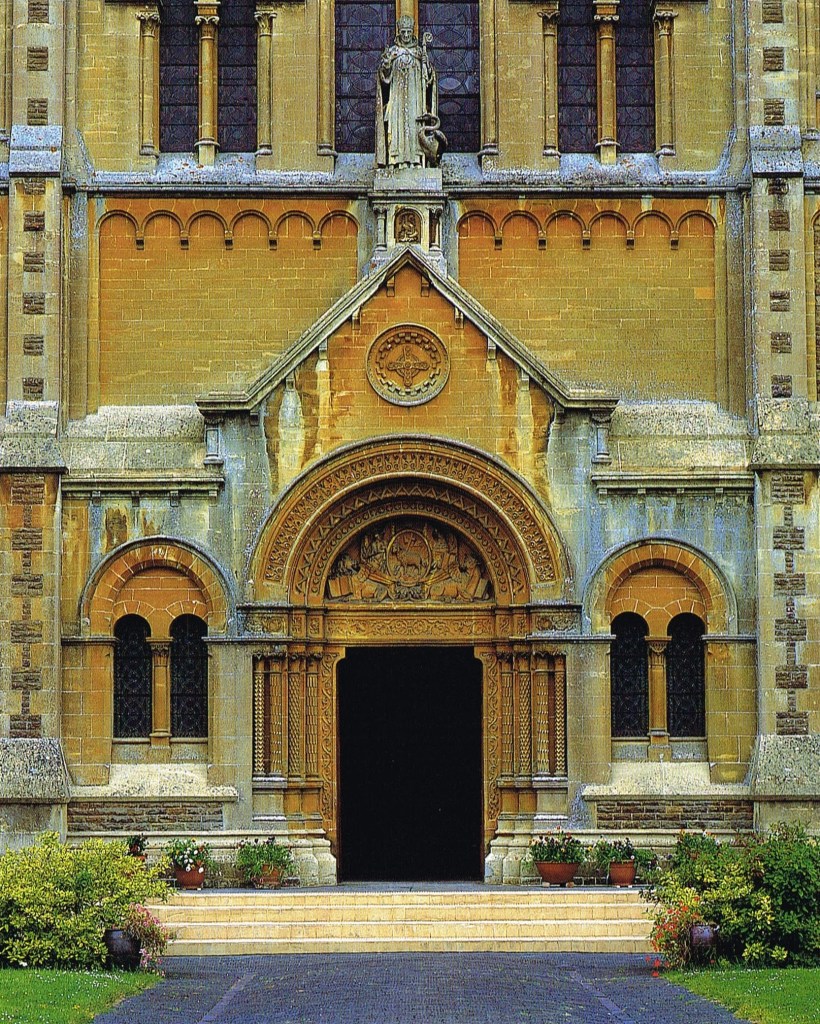
Robert Lewis Roumieu: progressive or prankster?

One is the former London office of a firm that produced vinegar and fortified wines. The other is a speculative development of townhouses aimed at the affluent middle classes. Fairly mundane projects typical of the 19th century, one might think; typical, indeed, of hundreds such up and down the country, brought into being by the commercial and demographic expansion of the period. Yet little Victorian architecture elicits such strong reactions or has prompted quite so much speculation about the intentions and moral qualities of the designer as Nos. 33-35 Eastcheap in the City of London and Milner Square in Islington. It would, I think, be fair to say that the reputation of both works precedes that of their creators. Indeed, judgements pronounced on both works by 20th century commentators stick in the mind more firmly than the names of the architects. For Ian Nairn, the former was ‘truly demoniac, an Edgar Allan Poe of a building’, and ‘the scream you wake on at the end of a nightmare’. For John Summerson writing in Georgian London, the latter invited similar metaphors. The architecture had ‘an unreal and tortured quality’, and ‘It is possible to visit Milner Square many times and still not be absolutely certain that you have seen it anywhere but in an unhappy dream’.
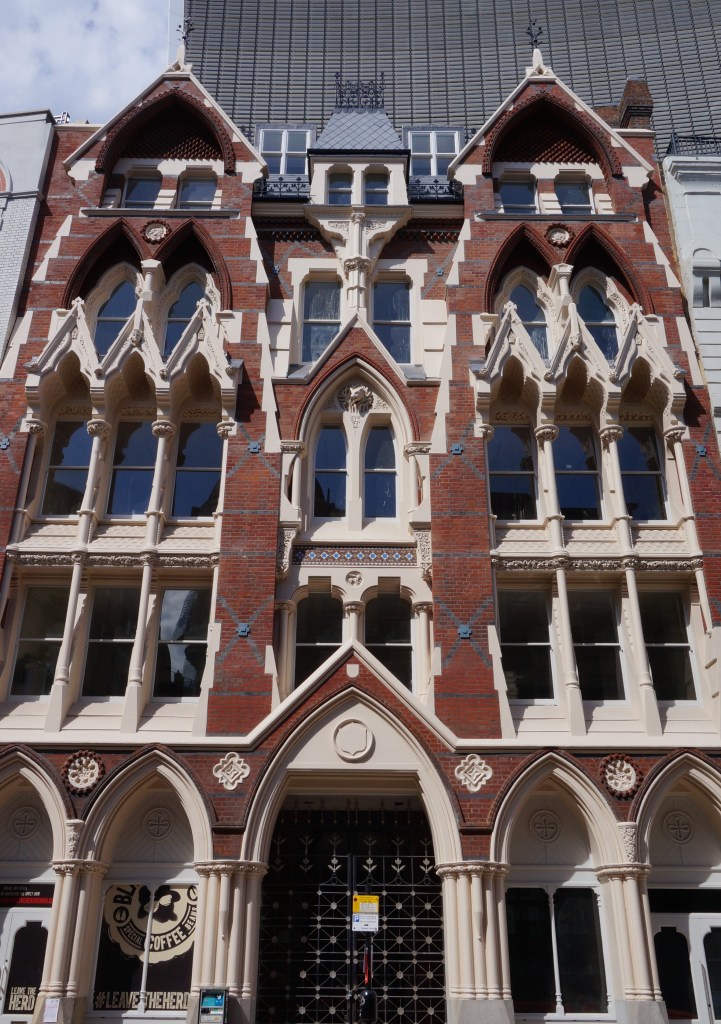
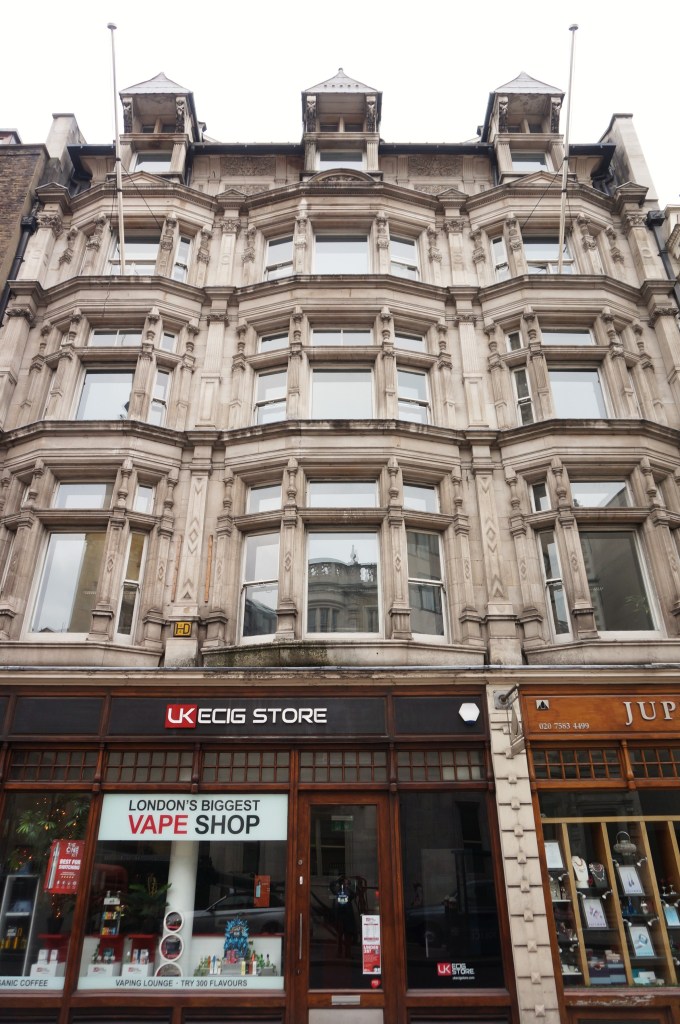
Nos. 33-35 Eastcheap, City of London, formerly Boar’s Head Chambers and built as the London office and warehouse of Hill, Evans & Co

It should come as no surprise that the architect of both buildings, Robert Lewis Roumieu (1814-1877), was included by H.S. Goodhart-Rendel in his lecture of 1949, Rogue Architects of the Victorian Era. Yet in contrast to the astonishment and admiration expressed towards other architects whose work he surveyed in it, he viewed Roumieu and his sometime collaborator Gough with sniffy disdain. ‘In any serious history of English architecture Roumieu would be a negligible figure… his aesthetic rakishness for all its violence is eventually dull’. For him, both men’s work was less the stuff of nightmares than puerile attention-seeking: ‘in general either singly or together, they seldom fail to be vulgar without being either funny or interesting’. In my post on the buildings of the Foxwarren Estate, I pondered the motives imputed to certain Victorian architects and cautioned on the need when assessing their work to withhold reactions conditioned by extra-architectural associations, which sometimes arise from 20th century popular culture.
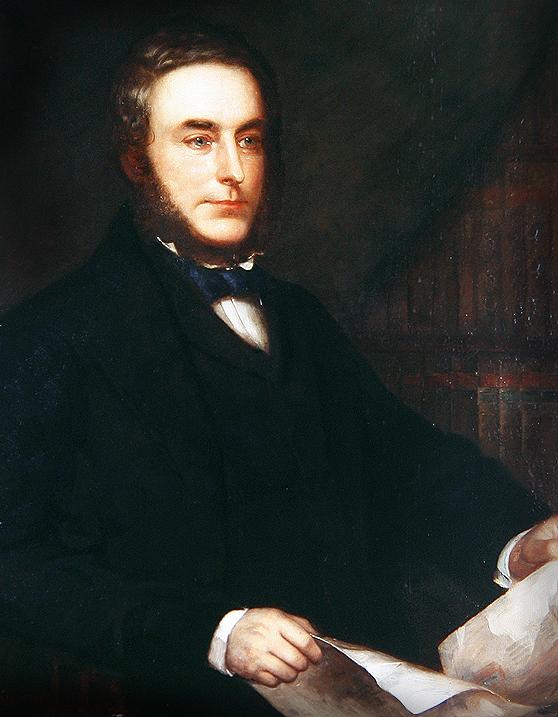
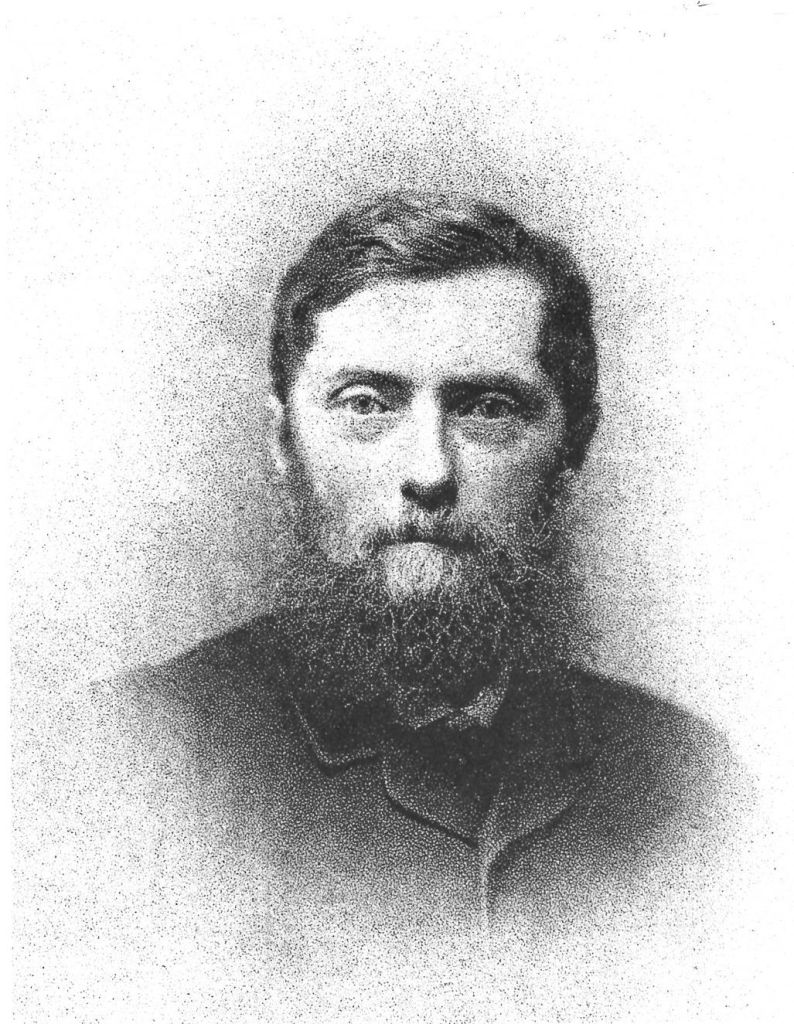
Robert Lewis Roumieu (oil on canvas) by J. Desanois from the collections of The French Hospital in Rochester, Kent

Contemporary accounts are often far more revealing, and so it is in the case of Nos. 33-35 Eastcheap. The Building News of 25th September 1868 praised the building as an authentic expression of its time. It was ‘English Gothic of the middle of the nineteenth century, and not bad Gothic at that. […] We are far from saying it is perfect, or, indeed, any great way on the road to perfection, but it is an honest and earnest effort’. While the anonymous commentator felt that the architect was guilty of indulging his client’s extravagance, criticism was aimed more at the indiscriminate juxtaposition of devices that he ought to have recognised belonged exclusively to the domain either of timber-framed or masonry architecture of the Middle Ages. But though ‘[we] do not care to see the principles mixed’, the author conceded that ‘we should be glad to see three or four dozen buildings designed with as much care and carried out with as much skill’. The construction was praised as ‘scientific’ and the hand crane with an extendable jib for lowering casks into the basement storeroom was viewed with as much admiration as any architectural feature.

The east side of Milner Square, Islington, viewed from the northern end

Rhetoric and conjecture can sometimes lead the architectural historian astray. So too can assessing a building in isolation from its architect’s career. For all the ink spilt about Nos. 33-35 Eastcheap and Milner Square, comparatively little attention has been paid to the remainder of Roumieu and Gough’s output. Whatever the inferences made about their creators’ underlying temperament, these two works are sufficiently different stylistically to suggest considerable variety in expression, and they make one curious about their context. Where did such alarmingly original architecture spring from? What else did Roumieu and Gough design? Were they Goths, Classicists, or both? And do Nos. 33-35 Eastcheap and Milner Square – or did they ever – have counterparts elsewhere? The aim of this post is to provide answers to some of these questions.

Detail of the west elevation of the tower of St Mark’s, Broadwater Down in Tunbridge Wells

Background and training

Roumieu was born into a family of Huguenot extraction, which reputedly originated from Languedoc and had settled in Britain as part of the first wave of Protestant emigration following the revocation of the Edict of Nantes by Louis XIV. His grandfather Abraham Roumieu (1734-1780) was an architect, who in 1748 served part of his apprenticeship with Isaac Ware (1704-1766). In 1766-1767 Abraham Roumieu produced a scheme jointly with John Adam (1721-1792), commissioned by the 4th Duke of Gordon, for remodelling the medieval Gordon Castle in Morayshire, Scotland. This survives in the National Archives of Scotland, but was never carried out and indeed no executed works by Abraham Roumieu have so far been identified. Robert Roumieu’s architectural training seems to have begun in 1831, when he was articled to the eldest son of James Wyatt, Benjamin Dean Wyatt (1755-1855), who in the 1810s-1820s had a flourishing practice in London. This had begun with the Theatre Royal in Drury Lane: a competition was held in 1811 to find a design for a rebuilding following the destruction of the previous theatre by fire in 1809, and Wyatt emerged victorious. Two years later, he succeeded his father as surveyor to the fabric of Westminster Abbey, a post which he held until 1827, but, with this exception, he did not involve himself in ecclesiastical architecture, specialising mainly in country house work. In London, he handled a number of commissions for townhouses and club buildings. He produced an unexecuted design for a palace for the Duke of Wellington and, jointly with his younger brother Philip, in 1828-1829 remodelled Apsley House on Piccadilly, the Duke’s London home. When Roumieu was serving his articles, Wyatt was working on the Duke of York’s column in Carlton Gardens.
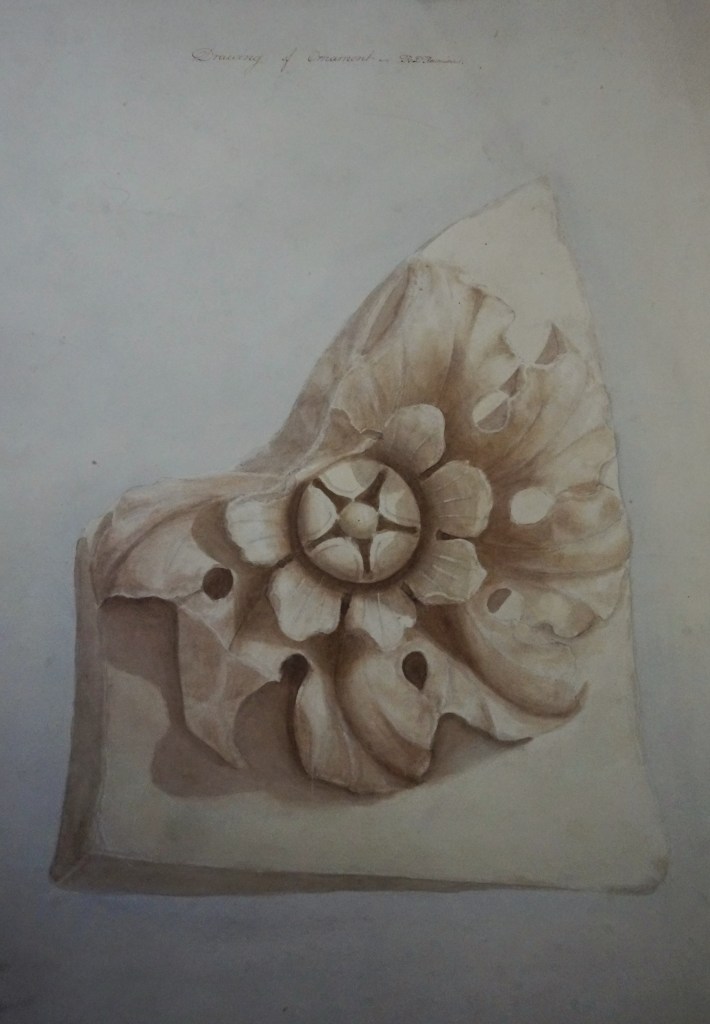
An undated colour sketch, labelled ‘Drawing of Ornament’ and, at the bottom ‘Robert Louis Roumieu for Students Ticket’, which exemplifies the architect’s superb draughtsmanship. (RIBA Collections)
Elevation of what is described in the caption as a ‘Design for New Houses of British Legislature’, part of a series of drawings showing a proposal for rebuilding the Palace of Westminster following the fire of 1834. Much remains to be elucidated about this scheme – whether it was Roumieu’s work alone, or a joint project by him and Gough, and whether it was actually entered in the competition of 1836, which the Royal Commission tasked with the rebuilding project had stipulated should be in a Gothic or Elizabethan style.

In 1836, Roumieu set up a partnership with Alexander Dick Gough (1804-1871), who had also been a pupil of Wyatt, rising to sufficient prominence in the office to be entrusted with superintending several of the practice’s more important works, including Apsley House and the Duke of York’s column. The new firm was based on Regent Square in St Pancras and most of its commissions were for sites within a fairly narrow radius of this address. Wyatt was a practitioner of a grand but not especially adventurous brand of neo-classicism. By contrast, his former pupils quickly revealed themselves to have idiosyncratic and strongly individual architectural personalities.

Roumieu and Gough the classicists

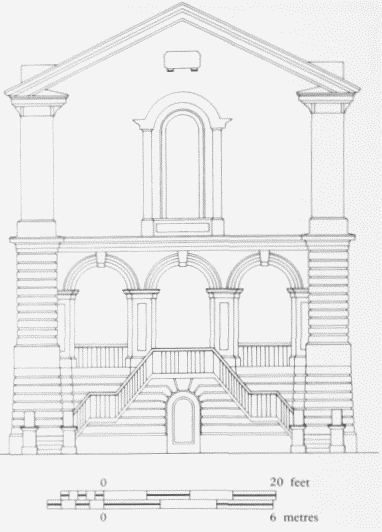
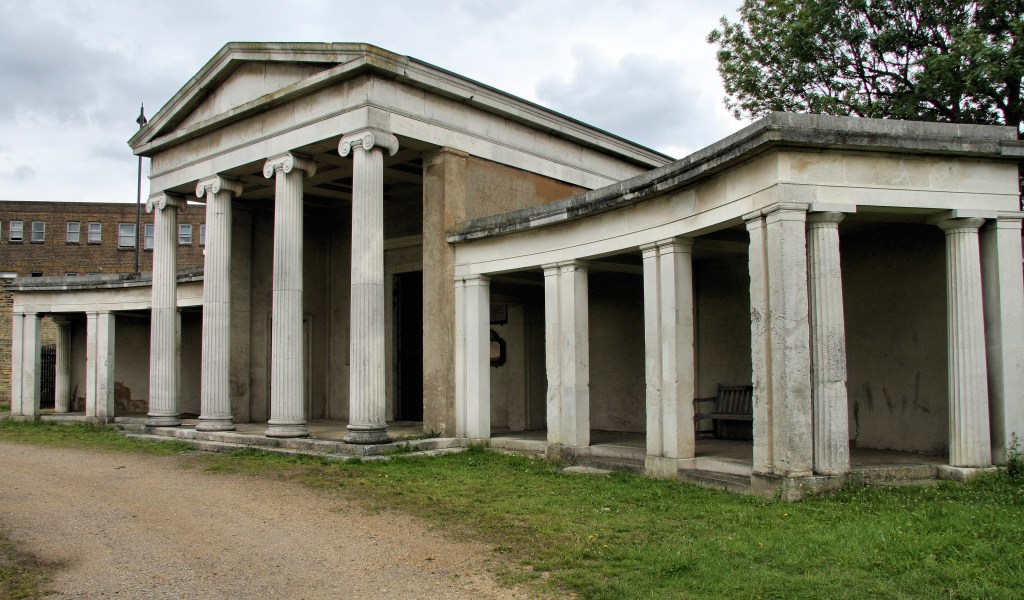
The earliest building to be executed by the partnership was built in c. 1837 on a site just off Upper Street in the centre of what at that date was in the process of rapid transformation from a village to an inner suburb of London. It was the premises of the Islington Literary and Scientific Society, which had been established four years previously to spread knowledge through lectures, discussions, and experiments. The project was the first major commission of William Spencer Dove (1793-1869), an Islington builder whose sons in 1852 formed the Dove Brothers partnership, a prolific contractor which worked with numerous prominent 19th century architects, including, as we have seen, Bassett Keeling. The Institute’s facilities comprised an extensive library, a reading room, a museum, a laboratory and a lecture theatre. The street front was symmetrical and handled in a stripped classical manner. To modern eyes, this prefigures much official architecture of the 1930-1950s, but it had been born out of the Greek Revival and prototypes such as the Choragic Monument of Thrasyllus, which had been illustrated in Nicholas Stuart and James Revett’s The Antiquities of Athens.

Presentation drawing showing the street front of the Islington Literary and Scientific Institution as originally designed (RIBA Collections)
The auditorium of the Islington Literary and Scientific Institution as built – it extended downwards to basement level and the two Ionic columns marked the far end of the spine corridor running back from the street entrance.

The street front is a nervous and restless composition, which packs a great deal into a small amount of space. The openings – doors, windows, even blind openings – all of them trabeated, are deeply recessed and unusually narrow in relation to their height, often being only slightly greater in width than the pilaster strips that divide them. It seems that this architectural language was continued into the auditorium, which seated 500. The walls were blind and the space was lit directly only by an elegant oval roof lantern very much in the manner of Soane, although borrowed light also reached it from the first-floor library, which communicated with the auditorium through a double screen. This incorporated a pair of Ionic columns on the inward-facing side, the visual impact of their sculptural forms much amplified by the severely rectilinear modelling of the wall surfaces and ceiling. Now listed at Grade II, the building survives and since the early 1980s has been home to the Almeida Theatre, but it has been considerably altered internally. It ceased to be used for its original purpose in 1874 and subsequently went through a variety of uses, including a spell lasting from 1890 until 1955 when it was a citadel of the Salvation Army, which turned around the auditorium by 180 degrees so that the seating was focused on the end of the building furthest from the street.

Ground floor plan of the Islington Literary and Scientific Institution as built (RIBA Collections)

The active development of the rural northern fringes of London with new suburbs of housing aimed at middle-class buyers provided extensive opportunities for architects, which Roumieu and Gough were evidently quick to exploit. In c. 1839, work began on a development at Nos. 96-108 Tollington Park in Holloway. Going by what can be deduced from map evidence and what survives on the ground, it seems that the concept was based on a symmetrical plan with a central detached villa flanked by two pairs of semi-detached villas. Although they appear at first glance to constitute a group of discrete masses, the villas in fact form a continuous range, being joined to each other by lower service wings on semi-basements. None is listed and they have been subjected over the years to numerous unsympathetic alterations, which have eroded much of the original detail, while the northernmost pair has been completely lost. But the architectural language, based on breaking up the façade into narrow subdivisions through the liberal use of pilaster strips to form a pattern of deep blind and glazed recesses (the effect is underscored by the use in the latter of sashes with margin lights) can be appreciated at No. 104, the centrepiece of the composition, which appears still to reflect well the architects’ intentions. Here, the triplets of arched windows that are one of the signature traits of Victorian Italianate put in an appearance at first-floor level.

Nos. 102-106 Tollington Park

The already idiosyncratic architectural language in evidence in these two commissions was taken to an extreme when Roumieu and Gough embarked on Milner Square in Islington. This was the final stage in the development of an estate on the west side of Upper Street belonging to Thomas Milner Gibson, which occupied an area enclosed by Theberton Street to the south, Barnsbury Street to the north and Liverpool Road to the west. Development began in the 1820s, but proceeded slowly. Milner Square seems to have been laid out in c. 1827, but the sites on the east side were not leased to builders for development until the 1840s and the ensemble was only completed in the 1850s. The holdings of the lessees were scattered and development correspondingly piecemeal and uncoordinated, with the exception of William Spencer Dove, who had 44 houses – the only unbroken run anywhere on the estate – some workshops and building land on Milner Square. The square is positioned on a north-south axis and elongated in plan, its length being roughly twice that of its width. There is access from Barnsbury Street to the north and Gibson Square to the south.

The east side of Milner Square

Whatever emotional reactions Milner Square provokes, it unquestionably marks a very radical departure from the architectural treatment of terraced townhouses that had prevailed in London for most of the long 18th century. The most striking feature is the way in which individual dwellings are subsumed into the whole. Whereas designers of a previous generation might have adopted such a tactic for the sake of a grand overall controlling composition – say, a portico embracing the properties at the centre of a long symmetrical façade – here the treatment of the elevations is based on repeated units and indeed, above ground-floor level the bays are all identical. The architectural language is familiar from the former Literary and Scientific Institute (located only a stone’s throw to the west) and again has a strongly vertical emphasis, with the elevations at first-floor and second-floor level divided up into strips that are dizzyingly tall in relation to their width. All the openings are trabeated, with the exception of the attic windows, which are arched, but these are so narrow and the curves of the arches so subsidiary to the effect as a whole that they provide little relief. With the exception of the continuous frieze and cornice marking off the attic storey and blocking course above, every part of the elevation is in continual restless movement as an endless series of advancing and receding planes. Though one might opt for the term ‘neo-classical’ if pushed to affix a stylistic tag, conventional terminology for parsing such designs is of little help in rationally analysing the visual impact. It is perhaps this, together with the sense that it is all too easy to imagine how the vertical units might appear if repeated ad infinitum, which explains why Milner Square has provoked such extreme reactions. ‘It is as near to expressing evil as a design can be’, wrote Ian Nairn.

General view of Milner Square looking north towards Barnsbury Street

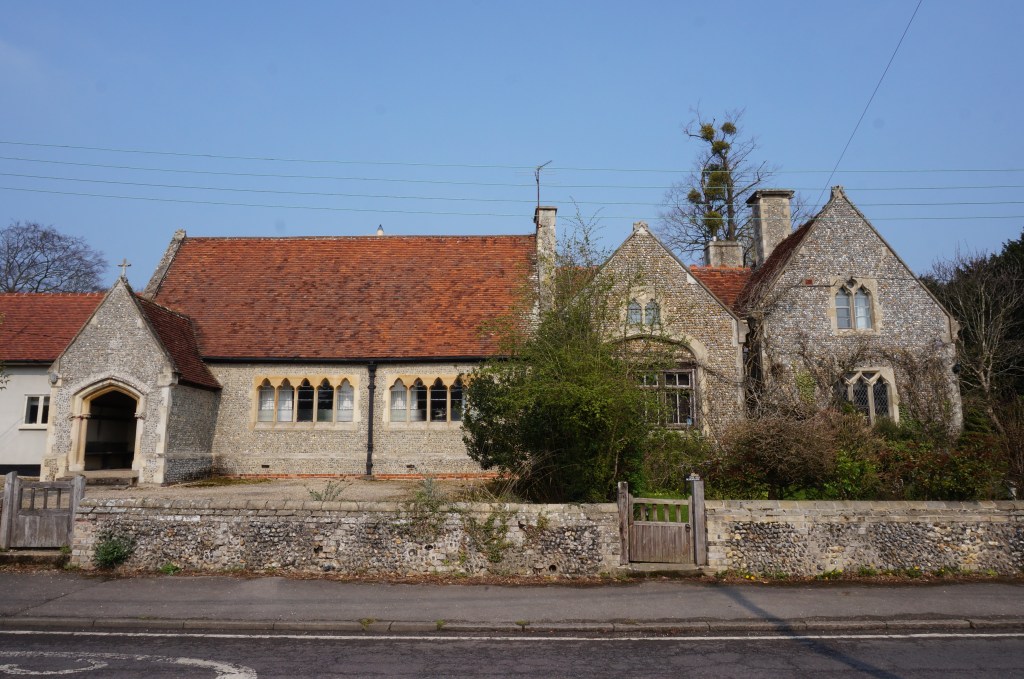
Yet conceivably, this is to some extent the result of accident as much as design. It was common at the period for major new residential developments to have their own place of worship and the Gibson Estate was no exception, with a proprietary chapel and a school built in c. 1830 flanking the entrance to Milner Square from Barnsbury Street to the west and east respectively. Aerial photographs show that the chapel was an unassuming, box-like structure that did not rise above the parapet of the adjacent houses. The school, which was designed by John Newman (1786-1859), was a plain classical design with Georgian Gothick fenestration that was subsequently much enlarged. Neither was a major architectural statement and both have been demolished. It seems that when the western side of Milner Square was at the planning stage, a new church was mooted to supersede the existing proprietary chapel. A perspective drawing of the street front in the collection of the RIBA depicts a florid Greek Revival design, which would have given the square an imposing focus and challenged the monotony of the elevations. An inscription on the drawing records that it was intended to be built in the middle of the west side, to occupy a site 60 ft (18.3m) in breadth and 90ft (27.4m) in depth, and to provide seating for 1,000 worshippers. The design is undated, but Roumieu gives his address as Lancaster Place, which means that it cannot be earlier than 1845 when the practice moved there from Regent Square. This was, coincidentally, the same year that he became a fellow of the RIBA.

The street front of St Mark’s, North Audley Street in Mayfair, pictured soon after completion

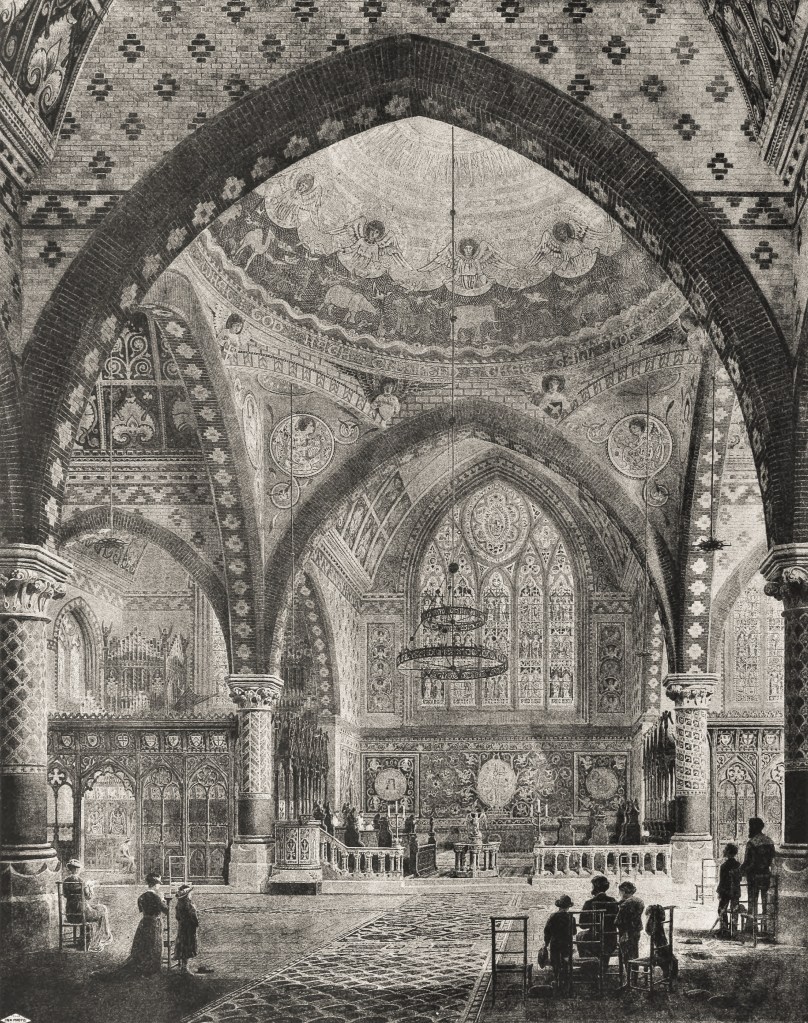
The street front seems to have been influenced by that of St Mark’s, North Audley Street in Mayfair, built in 1825-1828 to the design of J.P. Gandy (1787-1850), although the model is much elaborated. The whole portico in antis is brought forward, the columns are Composite rather than Ionic, and above there is a small pediment with antefixae, while the debt of the bell turret to the Tower of the Winds is more pronounced. Again, there is a patent mania for breaking up every part of the elevation into tall and narrow subdivisions and a fascination with layered surfaces and spaces. This same fascination is in evidence in the view of the interior, also held in the RIBA collection, where similar devices are used to create a mysterious, somewhat indeterminate space behind the pulpit, which forms the visual focus of an otherwise austerely rational and severely rectilinear design. Why the Milner Square church was never executed is currently unknown, but several elements of the street front were recycled in an even more florid design forming part of an apparently unexecuted scheme for a Protestant church in Versailles. This was perhaps the Anglican church on rue Hoche, established in 1821 in a chapel originally built for Catholic worship, and shared from 1828 onwards with French Protestants. The design of the neighbouring buildings, which (assuming this is the same site) are entirely the result of artistic licence. suggests a date a good 10-20 years after the Milner Square scheme, but nothing of the circumstances of this commission is currently known.

Undated scheme by Roumieu for a Protestant church in Versailles, monochrome reproduction of a colour presentation drawing: the RIBA Collection holds another version of the scheme, showing an identical frontage, but with a very English-looking townhouse to the right. The relation to each other of the two deigns has yet to be elucidated.

The rapid development of the northern fringes of London at the time when the Roumieu and Gough practice was active in the area makes it at plausible that there is more residential work by them awaiting discovery, attribution and study. The National Heritage List for England ascribes to Roumieu Nos. 13-19 Craven Road and Nos 1-18 Spring Street in the vicinity of Paddington Station – conjecturally and on the basis of the treatment of the elevations, which have slight affinities with Milner Square. The dating is uncertain, which leaves open the question of whether (assuming the attribution is accurate) the design was the work of the partnership or Roumieu on his own. We are on firmer ground with the alterations carried out in 1840-1841 to The Priory in Roehampton, the Georgian Gothick mansion which at that date was the residence of the barrister, judge and MP Sir James Lewis Knight-Bruce (1791-1866), now better known as a private hospital treating mental illness and substance abuse. The partnership carried out extensions to the existing building and a design for a fireplace combined with bookcases is held in the RIBA collection.

Roumieu and Gough do Norman, Gothic and Tudor

The choice of Gothic for the additions to The Priory was presumably conditioned by the style of the existing fabric. But it was in any case rare in the 1830s-1840s for any practitioner to be exclusively a classicist, and Roumieu and Gough designed in the wide range of styles of which architects at the time were expected to have a command. They showed themselves to be every bit as outlandish in their interpretation of the architectural language of the Middle Ages as they were with that of Classical Antiquity. In 1842, they were engaged to carry out alterations to St Peter’s Church in Islington, built in 1834-1835 on a site about half way between Islington Green and the Regent’s Canal as a chapel-of-ease to the old parish church of St Mary. It was the work of Sir Charles Barry (1795-1860) and evidently built on a rock-bottom budget, for even by the standards of the time it was starkly plain – a stock-brick preaching box in a lancet style with minimal gothic detailing. Roumieu and Gough added a new entrance front to Devonia Road with a bell tower, transepts and a short chancel, perhaps aimed at giving greater dignity to what in 1839 had become a parish church in its own right.

Former church of St Peter, Islington, viewed from the junction of St Peter’s Street and Devonia Road

The additions to the main body of the building were similar to Barry’s original fabric and barely any more elaborate, although the triple lancets in the east wall were handsomely shafted internally, along with the chancel arch, and the chancel ceiling was vaulted in plaster. But the additions to the west end were downright startling. The entrance front of Barry’s chapel had had a tall, cavernous arch. Perhaps it was this that suggested the addition of an outer screen wall to give the triple lancets (which were not present in the original design) exaggerated depth. Then again, this may equally well have been a product of the fascination with layered space and openings that we have already seen in the scheme for the Milner Square church. What looks at first sight like a porch is in fact yet another screen wall, with cusped details and shafting to the main portal and triple openings either side to create a visual focus. The central arch is filled with what must be cast iron tracery, which descends to a hanging pendant. This is still Georgian Gothick in spirit, and, as such, not wholly unexpected for the date. But the extraordinary steeple shows free invention taken to an alarming extreme. A tall, thin narrow core rises to a spire in the form of an obelisk with chamfered corners, the upward flow unchecked by any cornices or string courses. Enormous cruciform buttresses extend from each corner, rising in the upper stages to turrets, from which flying buttresses spring inwards as if to stop the crazily attenuated belfry and spire from tottering over. On Grantbridge Street at the rear of the site, Roumieu and Gough added a school building. What survives today is plain, stylistically rather nondescript and appears to have been much altered (the church was declared redundant in 1982 and the complex turned over to other uses). But a drawing in the RIBA collection depicts an imposing essay in neo-Elizabethan, delivered with enough concern for archaeological accuracy to give it a conviction rare for the date and manner. The view also shows the chancel as more elaborate than what was eventually built, with pretty Geometrical Decorated tracery in the east window. This suggests that the design represents an earlier version of the scheme, which had to be simplified in execution, perhaps on grounds of cost, but the precise sequence of events awaits elucidation.

The chancel of St Peter’s, Islington, pictured before the church was made redundant and the interior subdivided – the fittings visible in this shot dated from a reordering of 1884. (Historic England)

Drawings in the RIBA collection show experiments with neo-Norman that are every bit as outlandish as Roumieu and Gough’s flight of fancy with Early English. One of them is the usual early-Victorian preaching box, but adorned with an attenuated tower and spire to one side of the main front, with a tall, arched central entrance leading into a lofty vestibule, through which an impressive portal can be seen with a wheel window above. The surroundings suggest that the design was envisaged for a rural location. The other is for a larger building in what appears to be a suburban setting. The tower is more substantial and crowned by a cupola instead of a spire, while close inspection of the view suggests that a separate, perhaps apsidal chancel was intended. Again, the entrance takes the form of an tall arched recess in the main front. Individual motifs, such as the portals of several orders, shafted wall arcading with cushion capitals and the corbel tables, have good archaeological precedent, but they are composed with great freedom and applied to forms which at the period were equally likely to be translated into Classical or Gothic. The dates of these designs remain unknown (those suggested in the on-line catalogue entries are clearly spurious) and it is unclear whether they ever got off the drawing board.  
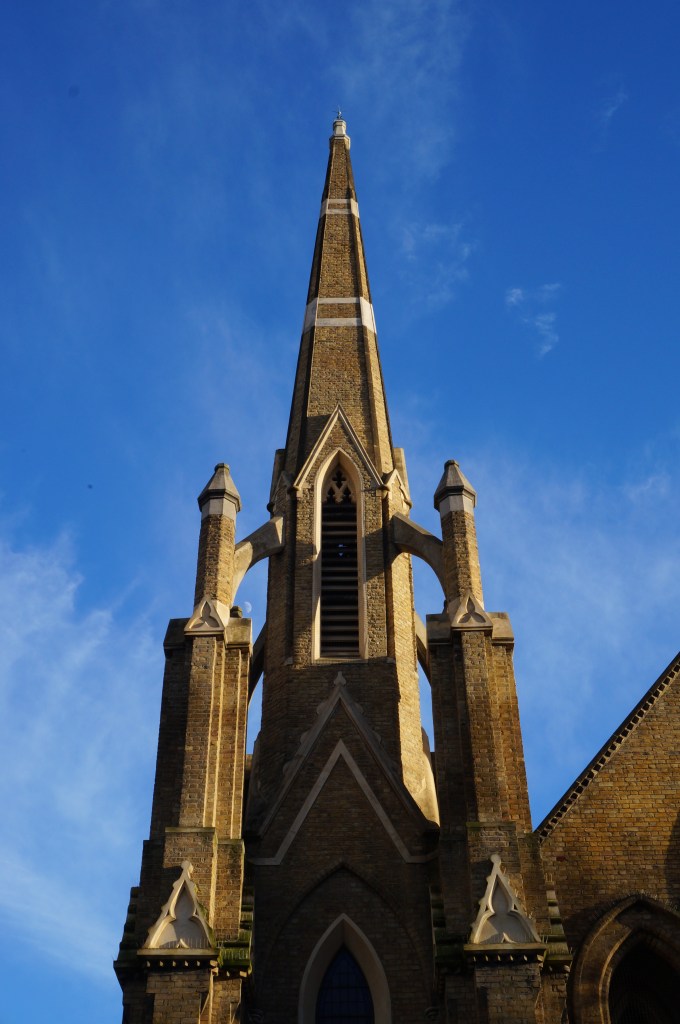
The belfry and spire of the former church of St Peter, Islington

But the partnership did get a chance to demonstrate its flair for neo-Norman design when it was called upon to enlarge the old church of St Pancras in 1847-1848. In the 18th century, this was still a village church in a largely rural setting, but the construction of the New Road (subsequently Euston Road) in the mid-1750s dramatically changed that. Over the following decades, central London expanded outwards through Bloomsbury and spilled across it to the north. New squares and streets were laid out and the existing tiny building quickly became inadequate for the much increased population. In 1819-1822 a lavish, grandly-scaled new parish church was built on Euston Square to a Greek Revival design by William Inwood (c. 1771-1843) and his son, Henry William Inwood (1794-1843). The old church was demoted to the status of a chapel, but the population of the neighbourhood continued to expand and the decision was then taken to increase its capacity. In an article published on 21st October 1848, The Illustrated London News reported that, whereas the old building could seat a maximum of 125, following the completion of the remodelling, that figure had been raised to 750. The choice of Roumieu and Gough for the commission is perhaps explained through their engagement by the parish in c. 1846 to erect new national schools on what is now Tankerton Street, a little to the north of Regent Square. A view in the RIBA collection shows an original and effective piece of neo-Tudor design – a considerable advance on the effort in the same manner from four years previously for a combined Free Church and Schools on Paradise Street (now Wicklow Street) a short distance away. The chimney stacks are handled very emphatically, especially the pair that rises from the junction of the main block and the cross wing. The school was short-lived, being demolished in the early 1890s for the construction of a residential complex by the East End Dwellings Company.

The rebuilt old church of St Pancras, as pictured by The Illustrated London News shortly after the completion of work in 1848

The medieval church of St Pancras was a simple, two-cell structure with a stout west tower. This was demolished and the nave extended out over its footprint, the addition clearly distinguished by being narrower than the original nave, while a new tower, which housed a baptistry in its base, was raised on the south side. The work was carried out by W.S. Dove. Some of the detailing, such as the west portal, was surprisingly grand for a such a diminutive building, but this was tempered by the self-consciously picturesque effect of the irregular massing, with the tower set well back and another volume housing the gallery stairs projecting from the south side in front of it. The building was fitted with stained glass by Gibbs & Co. and there was a reredos of blind arcading containing Decalogue Boards against the east wall. Otherwise, the interior did not make quite as proud a show, the result of stringencies imposed by the limited budget (the existing roof structure had to be largely reused, albeit with decorative texts from Scripture applied to the beams) and the nave was dominated by the galleries necessary to provide the extra seating. Roumieu and Gough’s conception is difficult to appreciate today as the church subsequently underwent several major alterations. In 1888 it was refurnished and in 1925 what remained of the galleries was removed, the gallery stairs were partly dismantled and the spire and belfry stage of the tower were replaced by the present half-timbered confection. The east window was partly blocked and all the stained glass by Gibbs has been removed.

The interior of the old church of St Pancras, as rebuilt by Roumieu and Gough, pictured in 1854 (London Metropolitan Archive)

Like many architects of the time, Roumieu and Gough were involved in surveying. This could be a lucrative line of business, thanks not only to the rapid development of London and other major cities, but also to the expansion of the railway network. As an engineer, Gough made surveys in 1845, partly on his own account and partly in conjunction with Roumieu, for the Exeter, Dorchester, and Weymouth Junction Coast Railway; for the Direct West-End and Croydon Railway; and for the Dover, Deal, Sandwich, and Ramsgate Direct Coast Railway. Roumieu held a number of surveyorships in his own right, including to the Gas, Light and Coke Company’s Estate at Beckton, where what became one of the biggest gasworks in the world commenced production in 1870. More research is needed to ascertain what these posts entailed, but an insight into this aspect of the partnership’s practice is given by the furnace chimney 140ft (42.7m) high that they designed for Messrs Johnson’s ironworks at Cubitt Town in Millwall, which specialized in converting scrap from naval dockyards into rods and bars.

Roumieu goes solo

The conservatory at Whitbourne Hall, Worcestershire: slotted into one side of the U-shaped service courtyard at the rear of the house, the conservatory dominates and closes off one end of the south west-facing elevation overlooking the grassed terrace and pleasure grounds.

The remodelling of Old St Pancras may well have been the last commission to have been executed jointly by the two architects, since the partnership was dissolved in 1848. Gough went on to become a prolific designer of churches, many of them in the suburbs of north London, including St Mark’s in Tollington Park, only a short distance from Nos. 96-108.  He also restored a number of ancient ones. Roumieu seems to have cast his net somewhat wider and though ecclesiastical commissions figure in his output, they were clearly not the mainstay of his practice. He remained involved in domestic design but seems to have shifted his focus from residential development to large suburban residences and also took on a limited amount of country house work.

The interior of the conservatory at Whitbourne Hall: the roof trusses and glazing were removed in the mid-20th century, reputedly after becoming unsafe, but the shell of the structure remains intact.

In c. 1865 he added a conservatory to Whitbourne Hall in Worcestershire, the residence of Edward Bickerton Evans (1819-1893). Evans was a proprietor of one of the largest vinegar breweries in the country, located in the centre of Worcester, but he was also an amateur archaeologist who had led an exhibition to Palmyra. It was perhaps this circumstance that dictated the choice of Greek Revival – by that point distinctly outmoded for country houses – when Whitbourne Hall was built in 1860-1862 to the design of local architect Edmund Wallace Elmslie (1818-1889). Why Evans decided to dispense with Elmslie’s services is currently unknown, but Roumieu supplied a design for the conservatory largely sympathetic in character to the existing fabric. He acquitted himself with aplomb in the difficult task of reconciling the massive, trabeated forms of ancient Greek architecture with the skeletal structure required to support the glazing and admit the maximum amount of light. Again, the stripped classical language of the Islington Institute is brought into play, although here the vertical members are whittled away almost to nothing, producing columns that are enormously tall in relation to their slender proportions.

Presentation drawing showing a design for a staircase at ‘a house in Streatham’: the house in question may well have been Manor Park, but the exact circumstances of this commission await discovery. The stripped classical architectural language is not only reminiscent of the conservatory at Whitbourne Hall, but also strikingly prefigures 20th century innovations. (RIBA Collections)

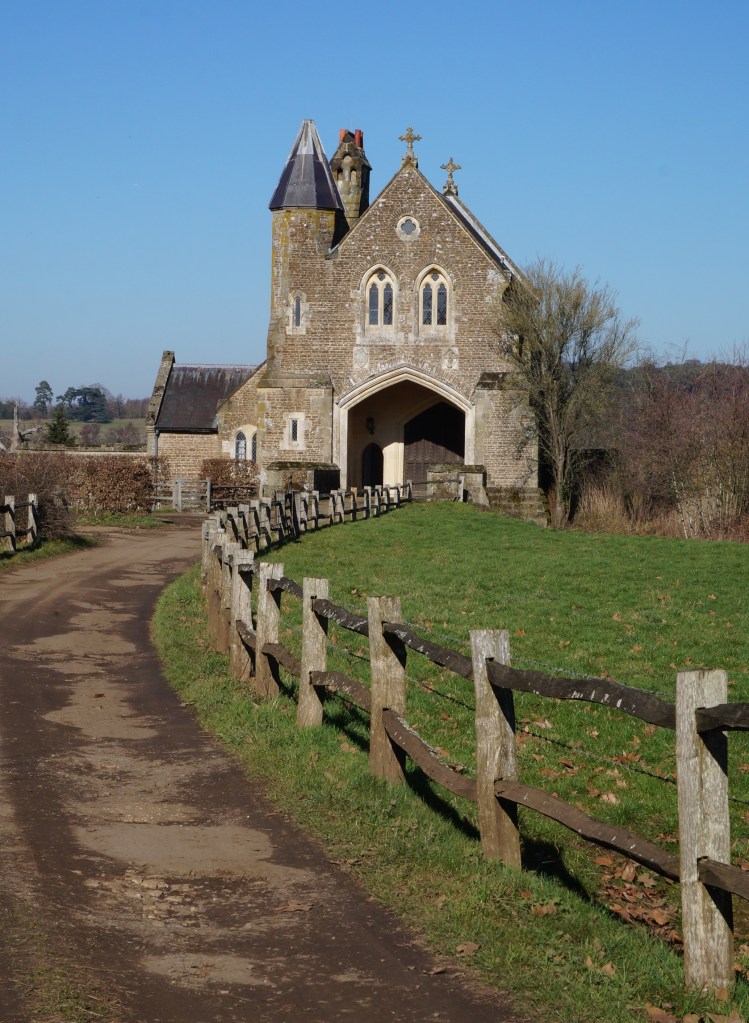
The circumstances of the Whitbourne Hall commission need to be stressed, because as far as it currently known, it represents a stylistic outlier in Roumieu’s work following the dissolution of the partnership with Gough. By the time he set up in practice on his own, he seems to have abandoned Greek Revival architecture and instead was concentrating on cultivating a very personal interpretation of the Italianate style popular at that period. This is evident in one of his first independent works, the lodge to Manor Park in Streatham, completed in 1849. New housing was beginning to encroach on the fringes of this estate occupying the angle formed by the junction of Mitcham Lane and Streatham High Road, and the main house would eventually be demolished for redevelopment in the 1880s. But at this date, the tide of suburbia was not yet in full flood and enough of the parkland was still extant for it to be turned into a public amenity, hence the need for a lodge to house an attendant. It was a substantial dwelling with four bedrooms and two sitting rooms, and it boasted a tower, 70ft (21.3m) in height with a viewing platform at the top, from which, The Builder reported (issue of 7th April 1849), ‘on a clear day Epsom, Harrow-on-the-Hill and Highgate can be seen without the aid of a glass’. Picturesquely composed Italianate villas were common enough in the 1840s and 1850s; what sets this one aside is the almost grotesque attenuation of the tower and peculiar overscaled chimneys, not to mention also the exaggerated blocking to the voussoirs of the arch of the elongated Serliana of the tiny gatehouse in the centre of the roadway. The lodge was located where the main drive leading into the park diverged from Mitcham Lane. It was demolished around 1925 for the construction of the Manor Arms pub, which now occupies the site.
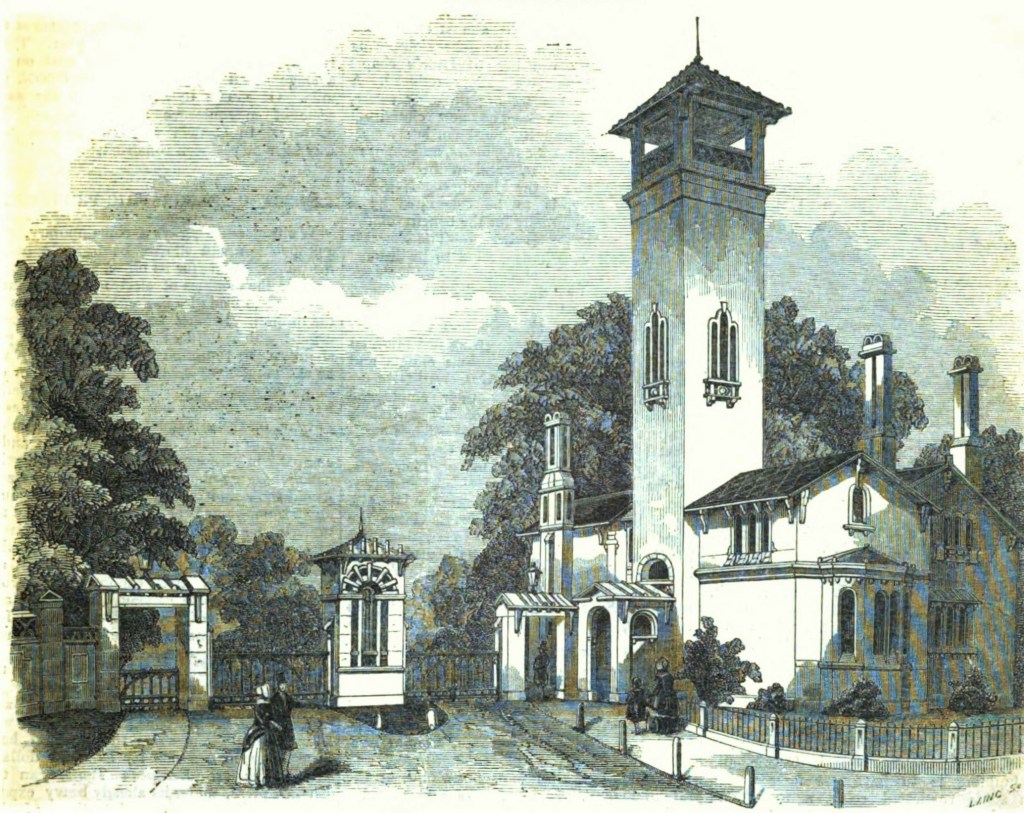
The entrance lodge to Manor Park in Streatham, as pictured in The Builder of 7th April 1849
Undated perspective view in pencil (incomplete presentation drawing?) for a lodge with curving screen walls in an Italianate style – the circumstances of the commission and whether it was executed are not currently known. (RIBA Collections)

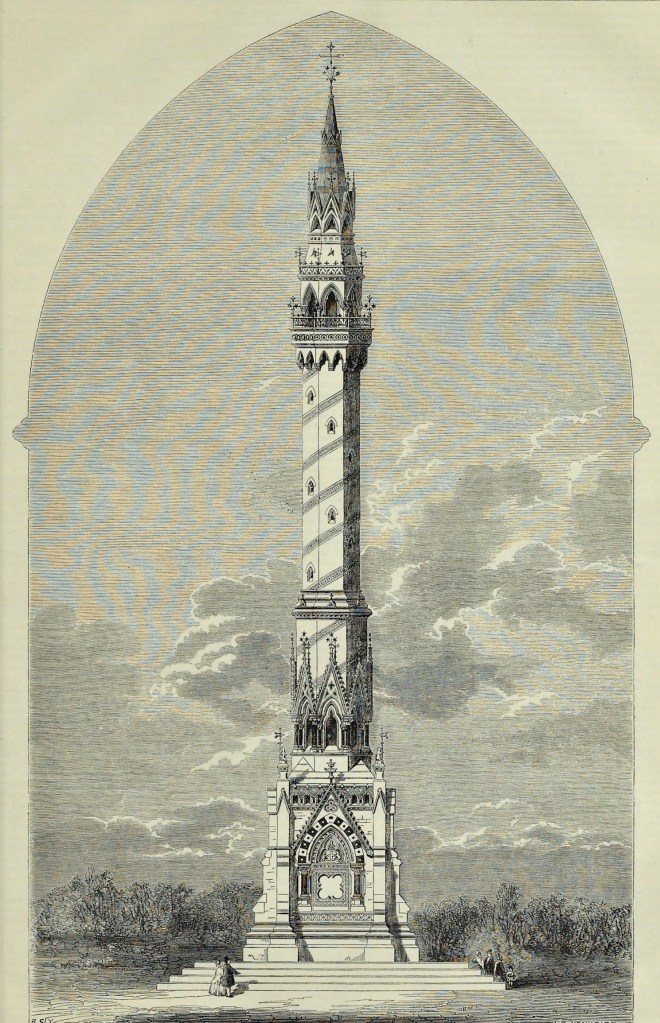
Similar exaggerations and distortions of the language of Victorian Italianate are in evidence in an unexecuted scheme for a bell tower for the church of All Saints, Ennismore Gardens in Knightsbridge (now the Russian Orthodox Cathedral of the Dormition). This church was built in 1848-1849 to a design in an early Christian manner by Lewis Vulliamy (1791-1871). A sketch in the RIBA collection shows that Vulliamy proposed a tall campanile based closely on Italian models, but funds were in short supply and it fell victim to economies. Roumieu’s flamboyant scheme (undated, though one suspects no later than the 1850s) with its strange, gangly proportions took far greater liberties with historical precedents. The designer mixed in classical detailing, such as the rustication of the lowest storey with its over-pronounced batter, with archaeologically correct but rather exaggerated Romanesque detailing, such as the deep corbel table running below the cornice. The arch piercing the lowermost storey has the strange blocking already encountered at Streatham and seems to be carried on clustered pilaster strips. How the brightly patterned surface of the pyramidal spire was intended to be achieved – glazed tiles or some kind of painted metal surface? – is a mystery. The bell tower was finally constructed in 1891-1892 to a design by Charles Harrison Townsend.

Unexecuted and currently undated scheme by Roumieu for the bell tower of All Saints, Ennismore Gardens in Knightsbridge (RIBA Collections)
Alternative scheme by Roumieu for the bell tower of All Saints, Ennismore Gardens in Knightsbridge (RIBA Collections)

An equally capricious interpretation of mid-Victorian Italianate is in evidence in two perspectives held in the RIBA collection depicting designs for what appear to be large suburban villas. Both are asymmetrical and picturesquely composed with low towers, and both stand on peculiar flared and rusticated plinths reminiscent of the Ennismore Gardens campanile. In this one, the tower turns octagonal at first-floor level and the transformation is echoed by the chamfered corner of the adjacent return, from which a chimney breast emerges. In another, which boats a handsome conservatory, the attic spaces are lit by bizarre tiny windows which pierce the cornice between the brackets supporting the eaves. Nothing is currently known of either scheme and it is possible that neither was executed. But the wilful interpretation of the style is consistent with ‘The Limes’, a mansion built in 1851 on a site just off Wood Lane on the east side of Stanmore in Middlesex. The garden front is relatively conventional, but the entrance front is nothing if not original, with its off-centre porch, the adjacent bizarrely shaped chimney breast, eccentrically disposed fenestration (note the long row of small arched windows at ground-floor level) and strange forms breaking through the wall surface.
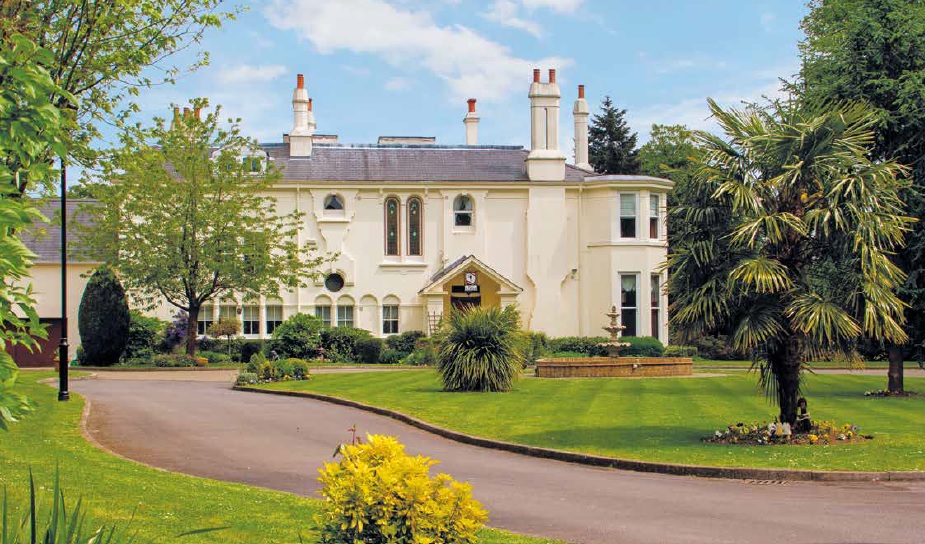
The entrance front of The Limes in Stanmore
Elevations of proposed stables for a Mr Macmurray of Esher in Surrey (RIBA Collections)

A design of 1853 for the shop of Breidenbach, a firm of perfumers and toilet soap makers based at 157B New Bond Street, shows how Roumieu’s Italianate style could lend itself effectively to interior design. No. 147 Hornsey Road, a substantial house of 1860, is tentatively attributed to Roumieu (erroneously stated as still being in partnership with Gough) in the list description, but is relatively sedate compared to works such as The Limes, with a symmetrical entrance front. Latterly used as the vicarage of Emmanuel Church, built over part of the grounds in 1884, on the 1870-1871 1:1,056 Ordnance Survey it is called ‘Tyrolese Cottage’.
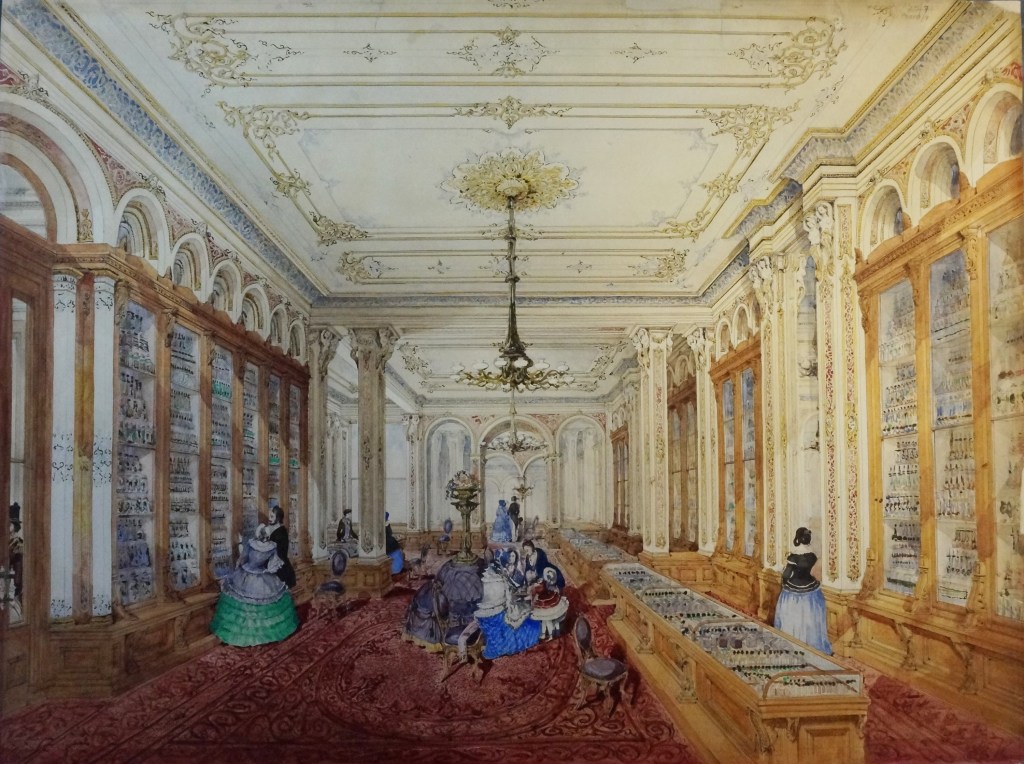
Design for the interior of Briedenbach’s shop on New Bond Street (RIBA Collections)

Roumieu the Rogue Goth

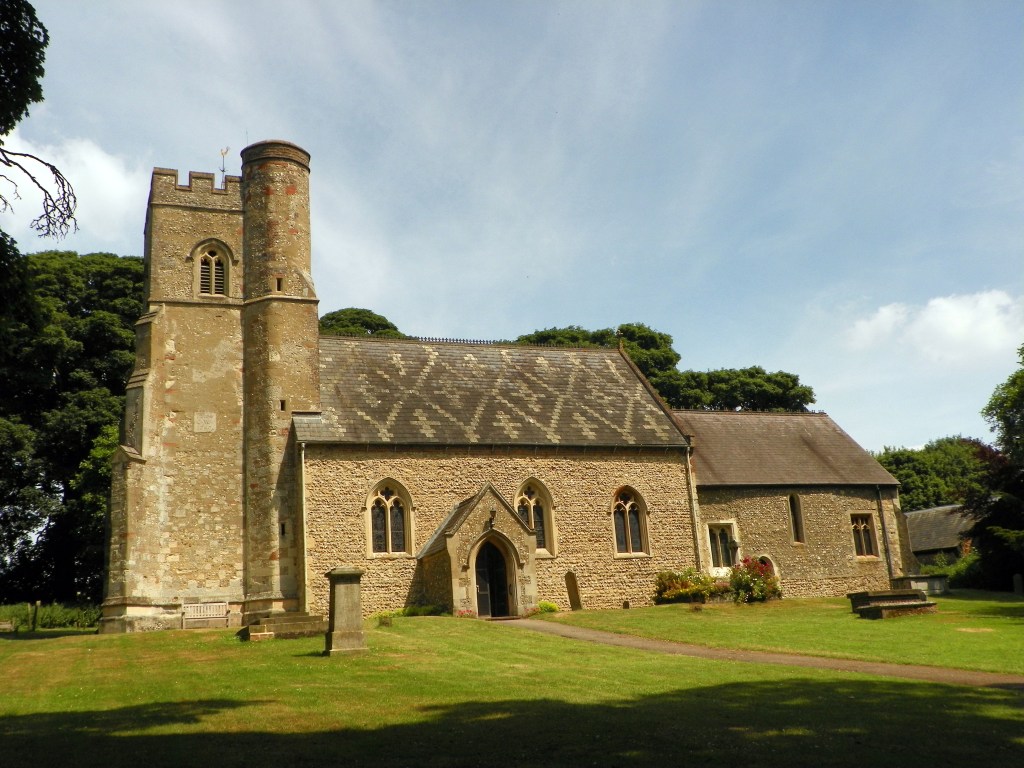
General view from south of St Mary’s, Kensworth in Bedfordshire: this is one of Roumieu’s few works to retain the patterned slate covering to the roof, a favourite device of his. (Peter O’Connor)

In 1856, Roumieu restored the church of St Mary in Kensworth (formerly Hertfordshire, transferred to Bedfordshire in 1897), a largely Norman two-cell building with a later medieval west tower. Little is known of the scheme, which does not seem to be documented, but it evidently involved reroofing the nave, signalled by the patterns worked into the slate covering externally and the unusual roof structure internally, with diagonal braces running from the purlins to the arched braces and wall plates. All that is stridently High Victorian, but the stables that he added to Franks Hall in Horton Kirby near Swanley in Kent as part of his remodelling in 1860-1861 are relatively tame neo-Tudor. The additions to the late Elizabethan main house, such as the new staircase, are stylistically deferential to the older fabric. It seems that Roumieu did not adopt Gothic in earnest until well into the decade and the change in direction would seem to be marked by St Michael’s, Bingfield Street in Barnsbury, located a little to the north of King’s Cross station, established as a daughter church of St Andrew’s, Thornhill Square. Built in 1863-1864, it was a typical High Victorian town church, built of brick and incorporating vividly striped constructional polychromy in the window heads and arches of the nave arcades. There were lean-to aisles and a tower was evidently intended at the west end of that on the south side. The church does not survive, having been demolished in the early 1980s following redundancy in 1973.
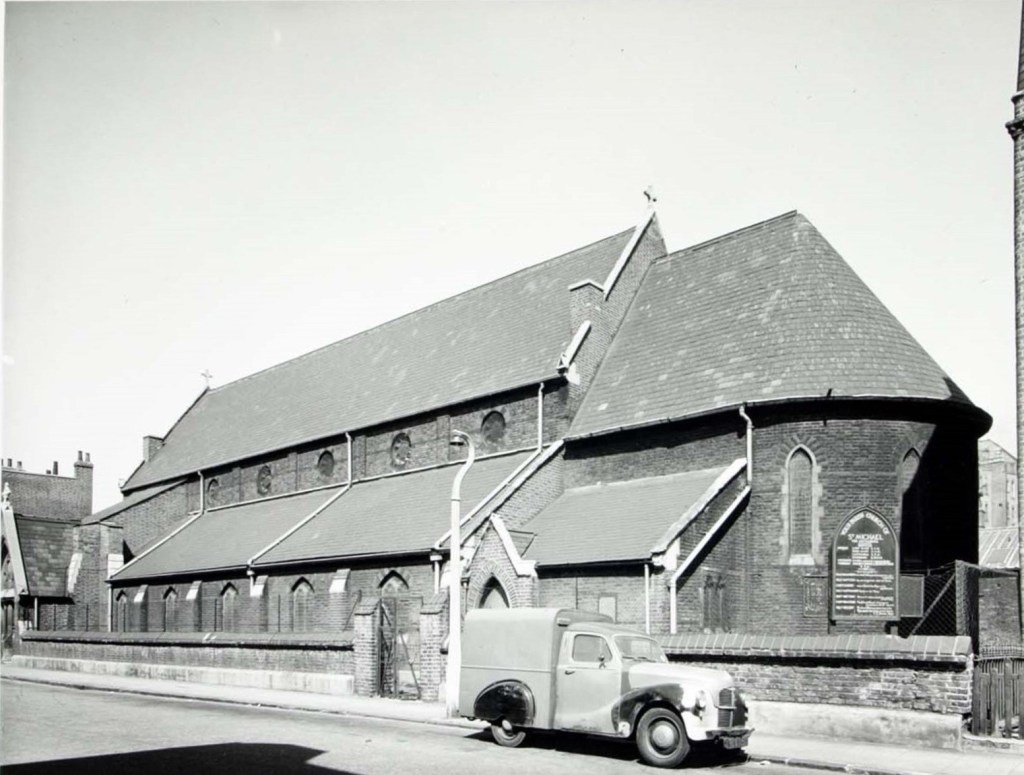
The exterior of St Michael’s, Bingfield Street (Historic England)
The interior of St Michael’s, Bingfield Street looking east (Historic England)

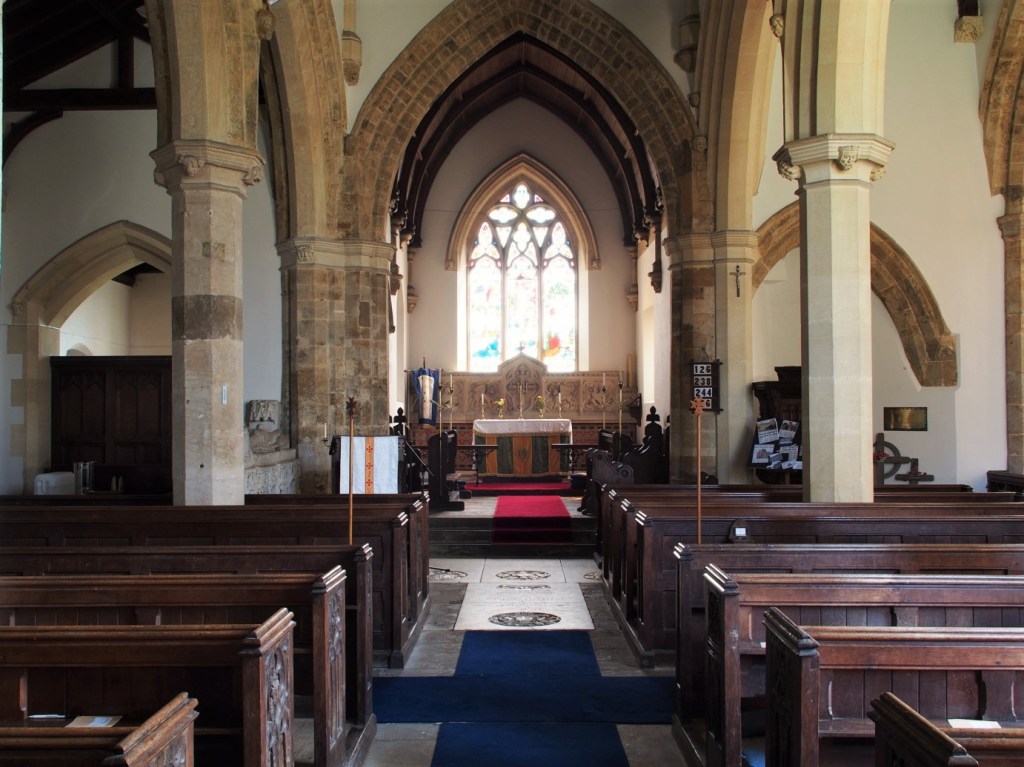
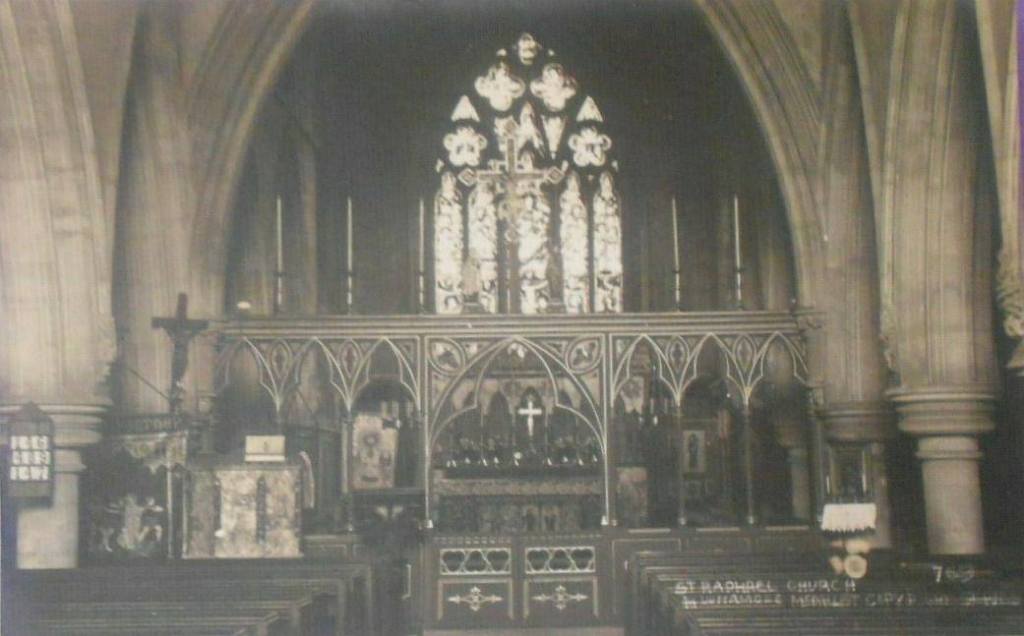
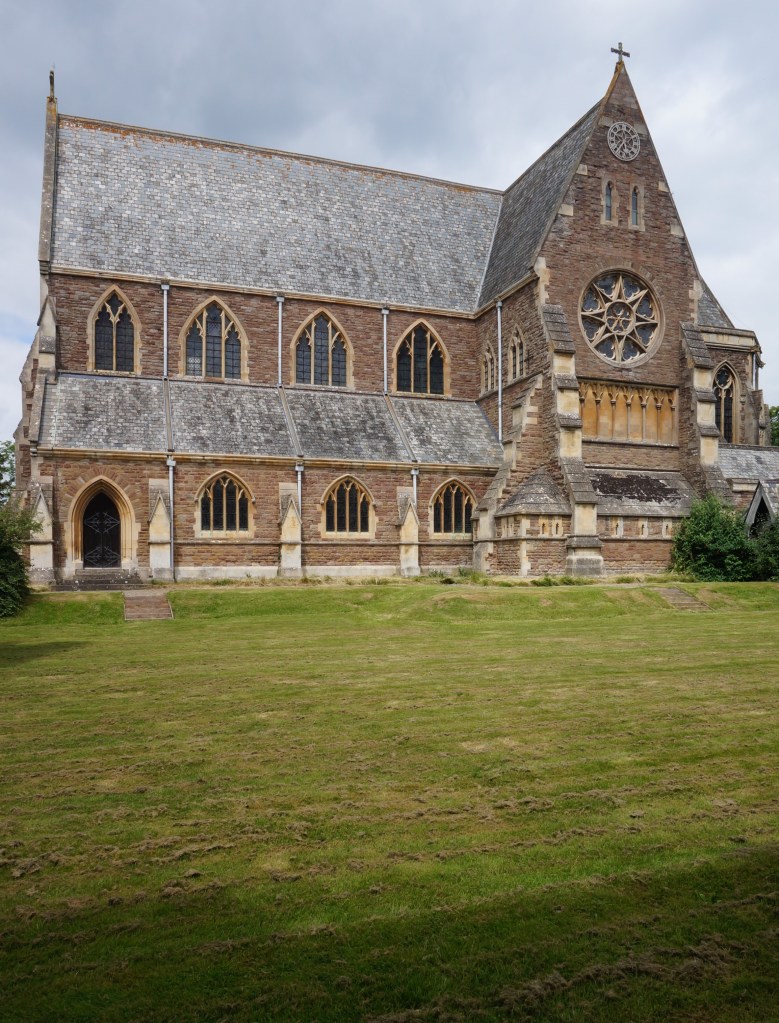
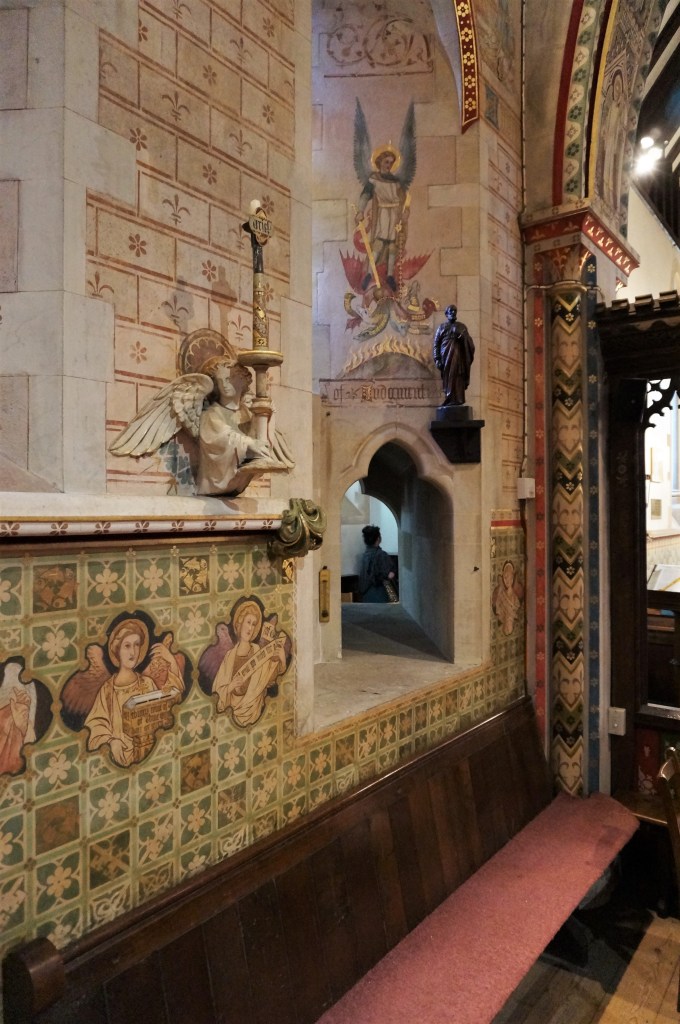
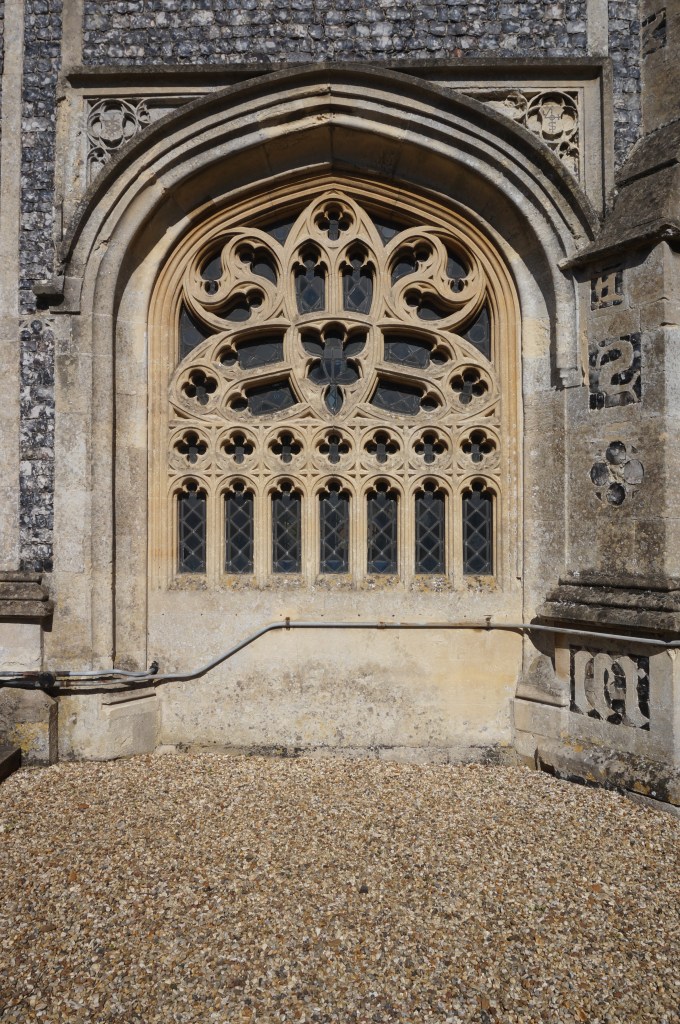
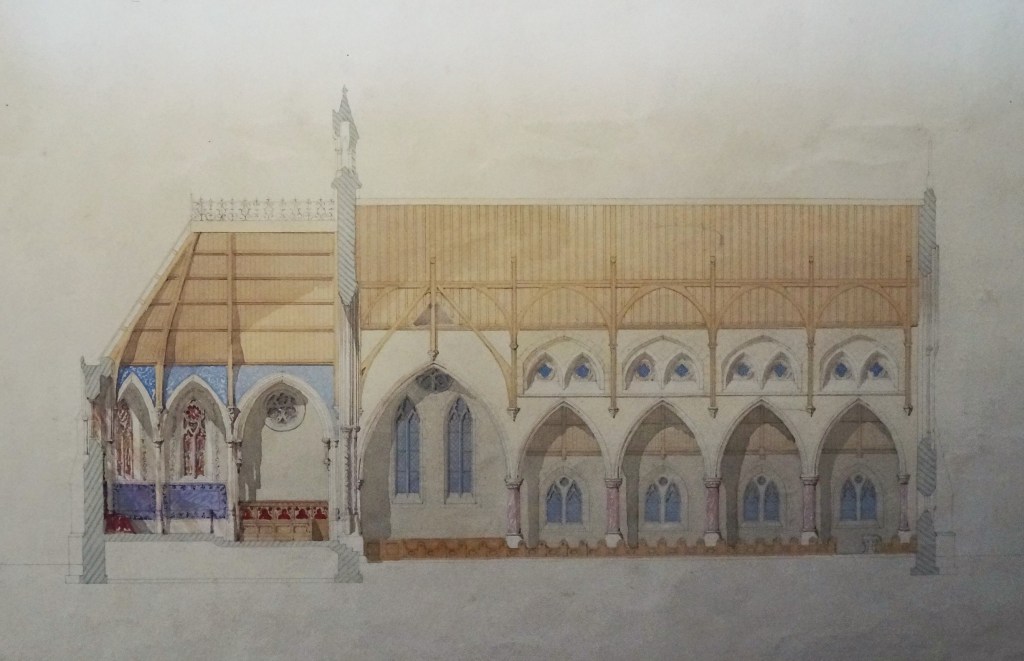
Many of the devices used at St Michael’s were stock-in-trade of any architect of the time and, apart from some wilful touches in the detailing, the design was not especially memorable. But it set the scene for a series of more powerful statements, the first of which was St Mark’s, Broadwater Down, a suburb on the southern edge of Tunbridge Wells, built in 1864-1866 at the expense of the Earl of Abergavenny. In some respects it is a typical High Victorian Middle-Pointed church for an affluent suburb, but the exterior is full of idiosyncratic touches and this reaches its apogee in the extraordinary steeple. The middle stages of the tower are lit by sinister-looking pointed slits and sound is emitted from the belfry through rows of circular, oval and triangular holes. As much as possible of the wall surface between the corner buttresses is broken up into a restless array of steeply pitched set-offs and advancing and receding planes. Starting from the peak of the gable over the main entrance, a strange, mullion-like form runs the height of and bisects the elevation, going through all manner of geometrical transformations and turning half-way up into an attached shaft that itself is broken by a clock face carried on an angel corbel. It emerges at the top through the surface of the base of the spire as a peculiar, lucarne-like form. The grand interior is full of over-ripe foliate carving but, despite some inventive detailing, is not as strongly personal as the tower. Roumieu designed a substantial vicarage located on St Mark’s Road to the south of church. Whether the stable block was executed in accordance with the design held by the RIBA is unclear; at any rate, it seems to have been much altered in the 20th century.
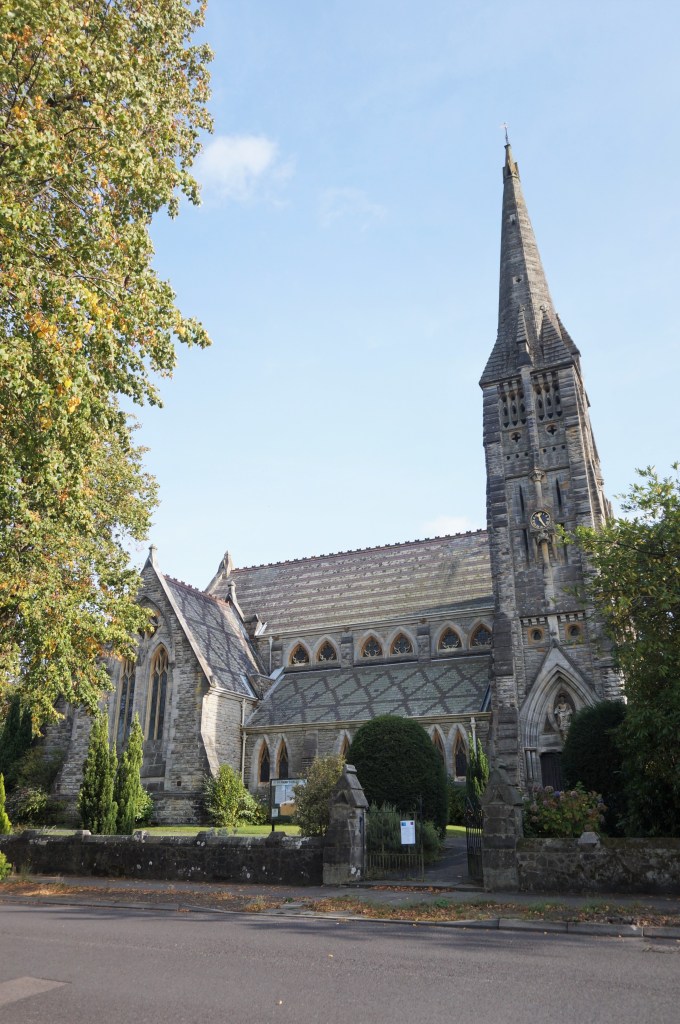
General view from south of St Mark’s, Broadwater Down in Tunbridge Wells: note the patterned slate covering to the roof.
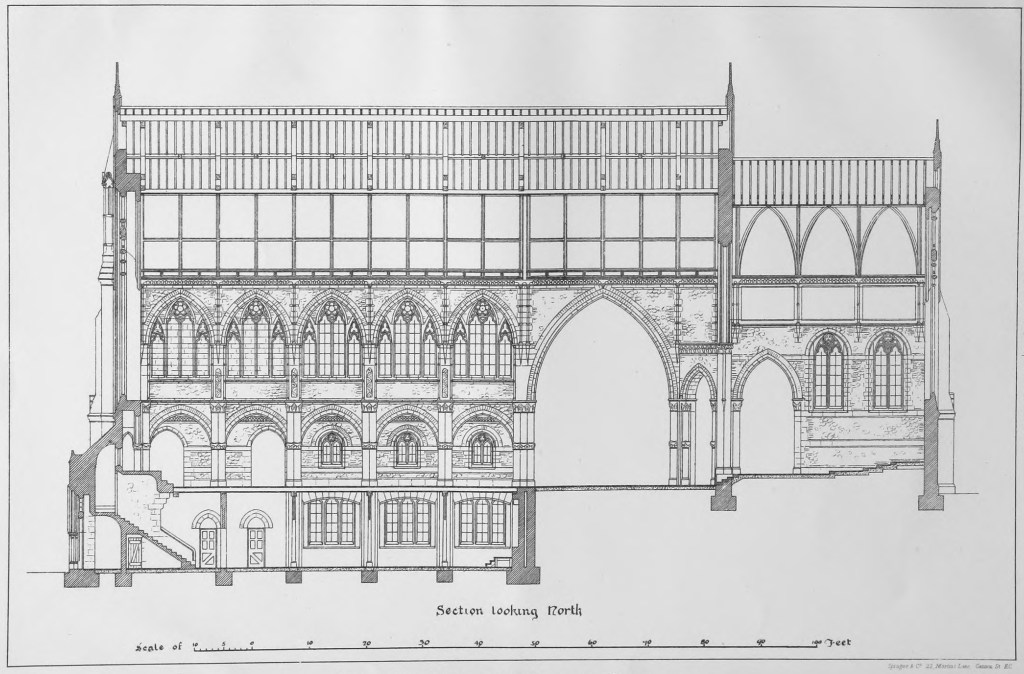
Long section looking south of St Mark’s, Broadwater Down – presentation drawing from Roumieu’s office (RIBA Collections)

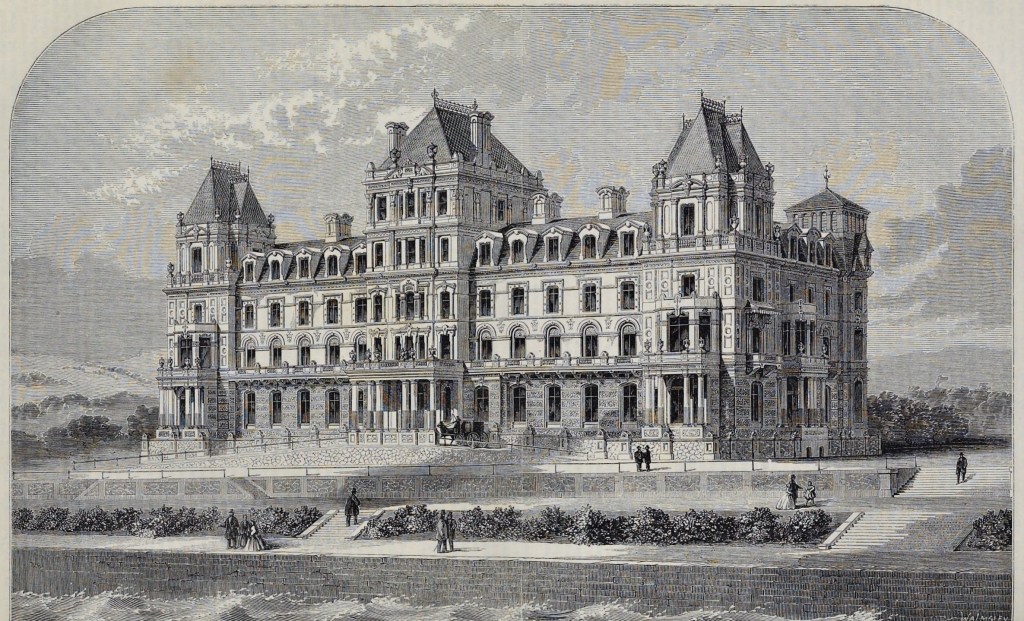
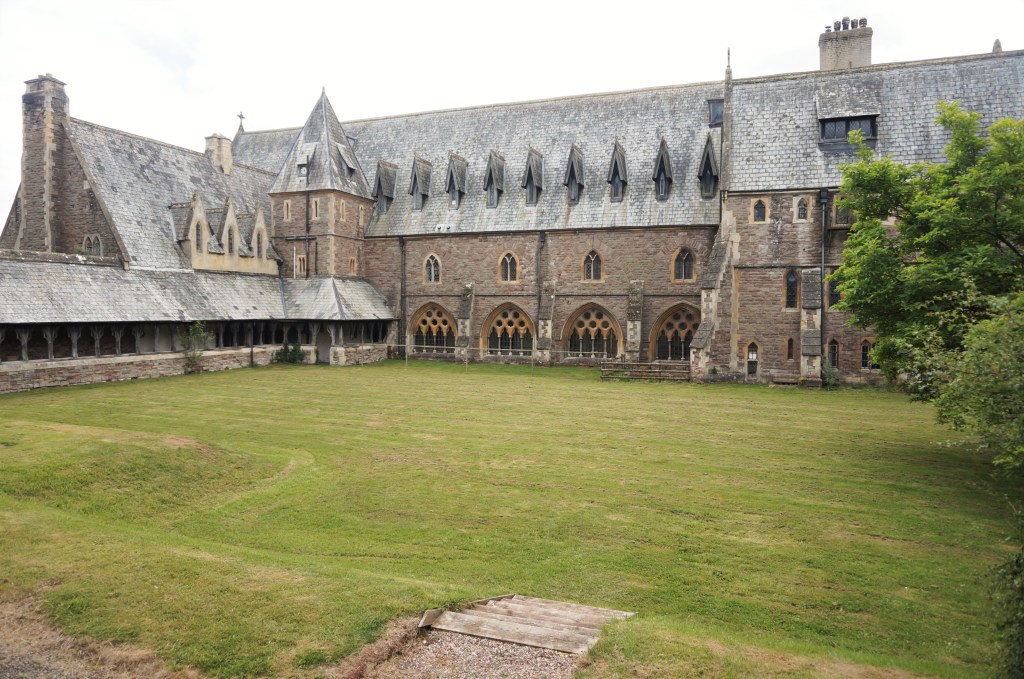
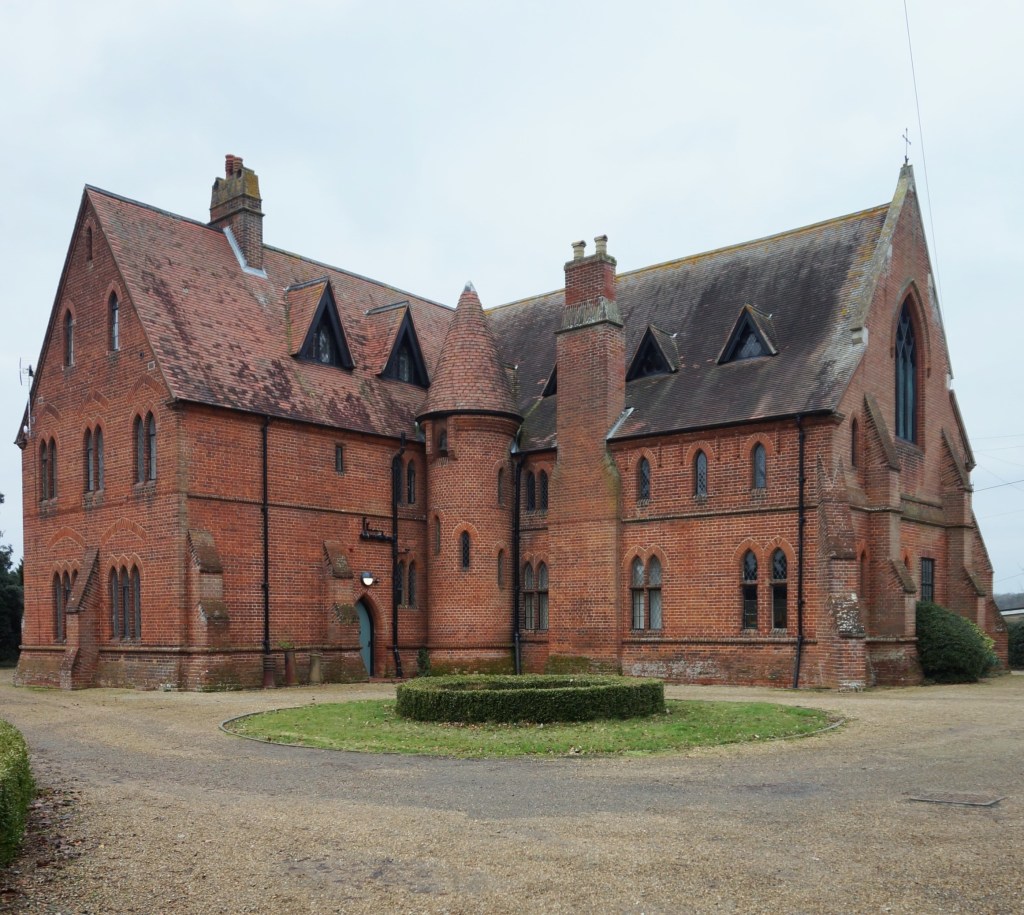
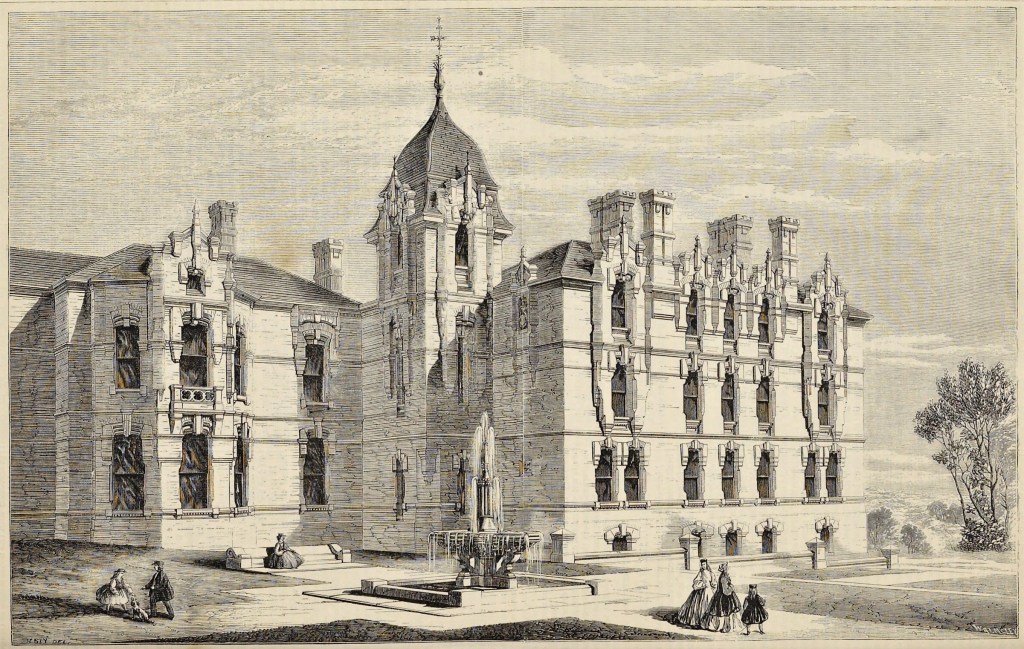
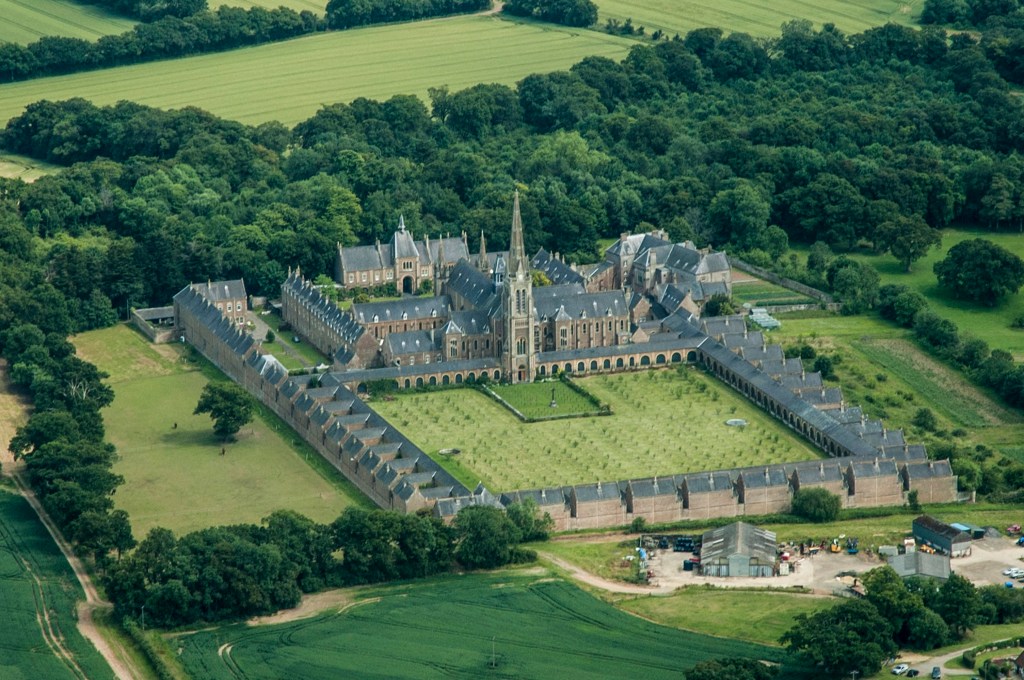
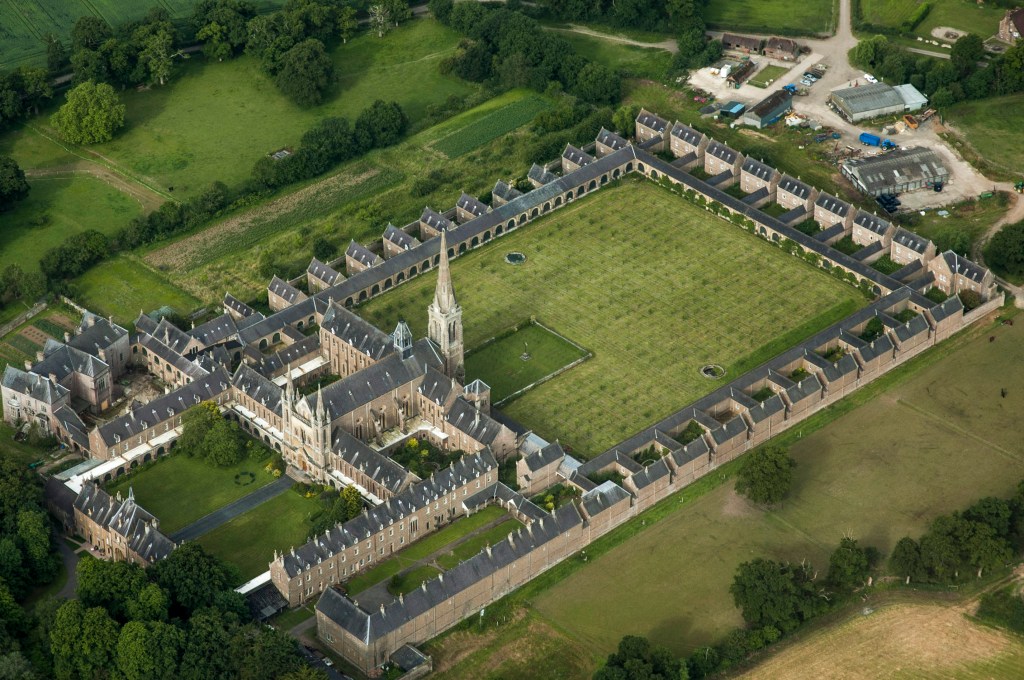
St Mark’s was followed by the French Hospital on Victoria Park Road in south Hackney, built in 1864-1865. The name is slightly misleading – it was a hospital not in the modern but in the medieval sense. It owed its inception to a Huguenot by the name of Gastigny, who on his death in 1708 bequeathed £1,000 towards the foundation of an institution to care for elderly, sick and impoverished French Protestants who had settled in London following the revocation of the Edict of Nantes. This eventually opened in 1718 at a site on what became Bath Street on the northern edge of the City, then in open country, and it was known by London Huguenots as La Providence. As the community got itself on a surer footing, the number of patients and inmates dwindled, but the situation changed after Waterloo, when a wave of cheap imports threatened the silk-weaving industry in which many Huguenots were engaged. The directors of the French Hospital (Roumieu himself was among them, also holding the post of surveyor to its estate) decided to capitalise on the commercial value of the Bath Street site, which was now in a heavily built-up area, and used the income from the leases on it to purchase 3¼ acres near Victoria Park in what were then semi-rural surroundings. The site had originally formed part of the grounds of a large house, and the new premises of the French Hospital bore more than a passing resemblance to a stately home, being set back from the road in spacious grounds with a lodge house at the main entrance.

General view of the main front to Victoria Park Road of the French Hospital, as illustrated in The Builder of 2nd June 1866
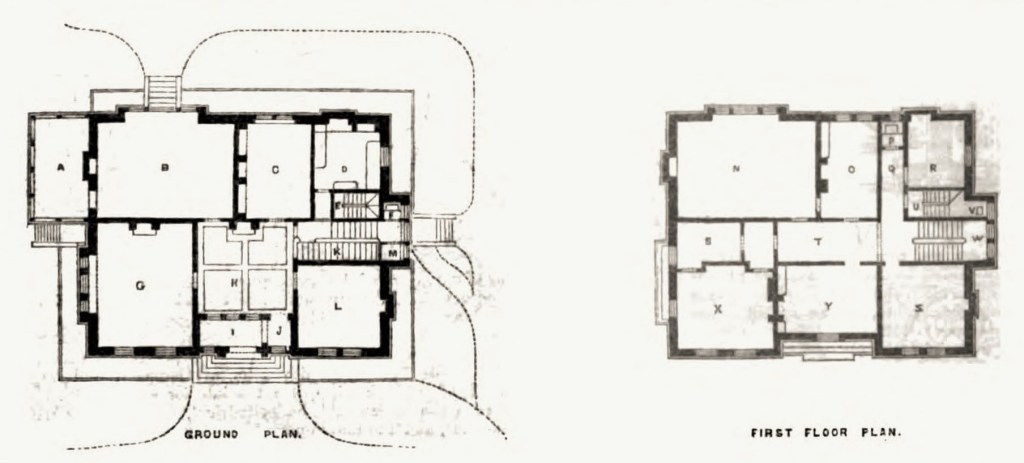
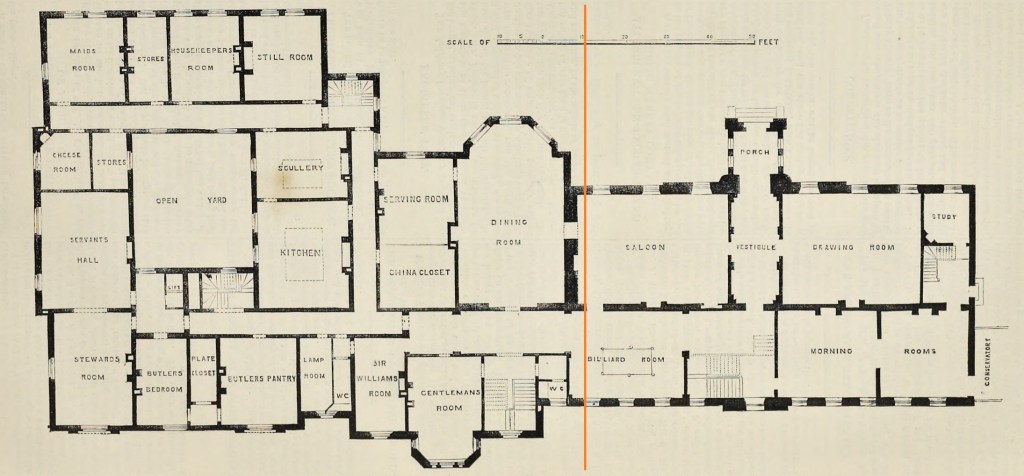
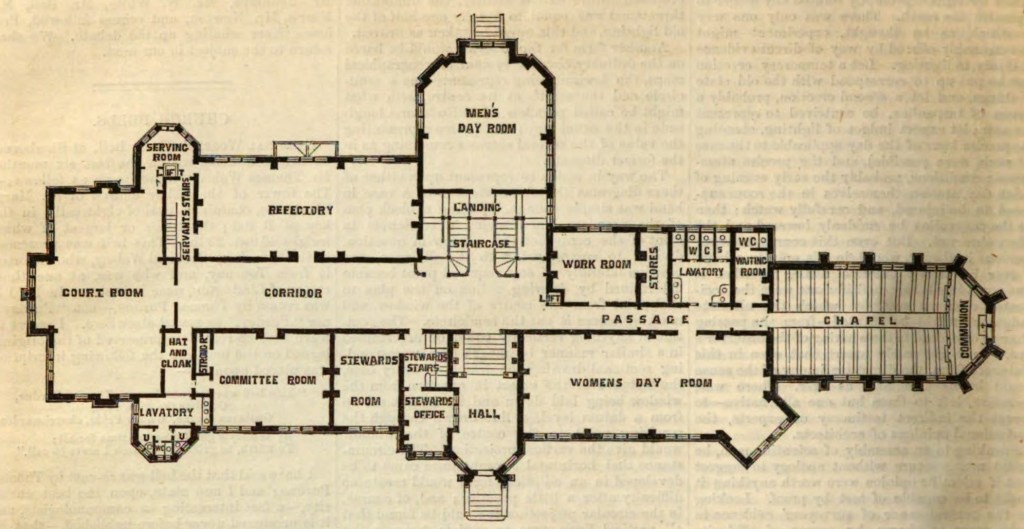
Ground plan of the French Hospital, as illustrated in The Builder of 2nd June 1866
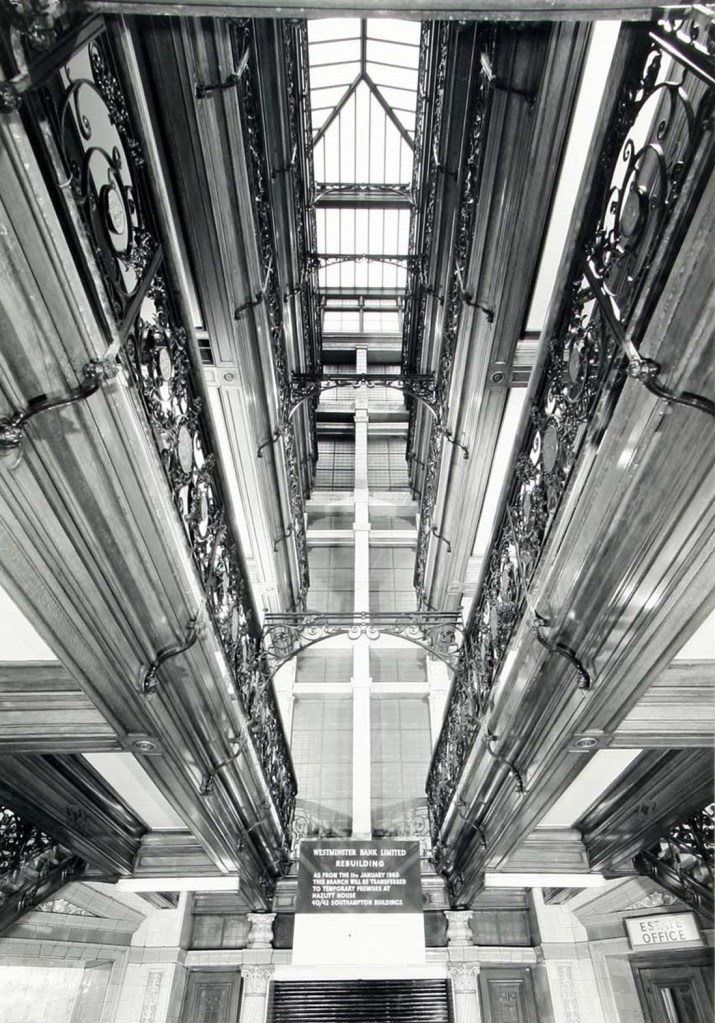
The main corridor of the French Hospital at ground-floor level, looking towards the doorway of the board-room (Historic England)

The plan was roughly cruciform, with a long spine corridor running east-west, which rose the full height of the building, had galleries at first-floor level and was top-lit. On the ground floor it ran from a board-room at the west end to a chapel at the east end. In the centre, an entrance hall on the south side and a staircase on the north side communicated with it. The basement was occupied by service accommodation, while the day rooms, library, dining hall and other function rooms were located on the ground floor. Most of the first floor consisted of four-bed dormitories, with more extensive quarters for the steward occupying the prominent polygonal tower which rose above the main entrance.

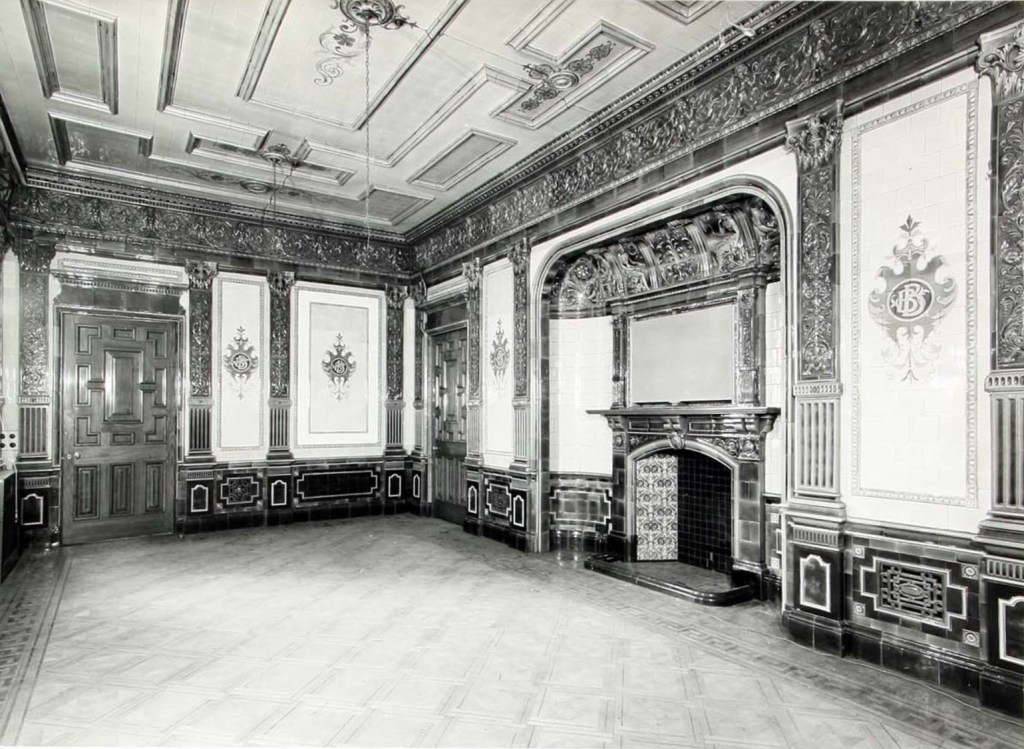
The board room at the French Hospital (Historic England)
The lodge by the main entrance from Victoria Park Road at the French Hospital, pictured prior to the remodelling of 1934 (Historic England)

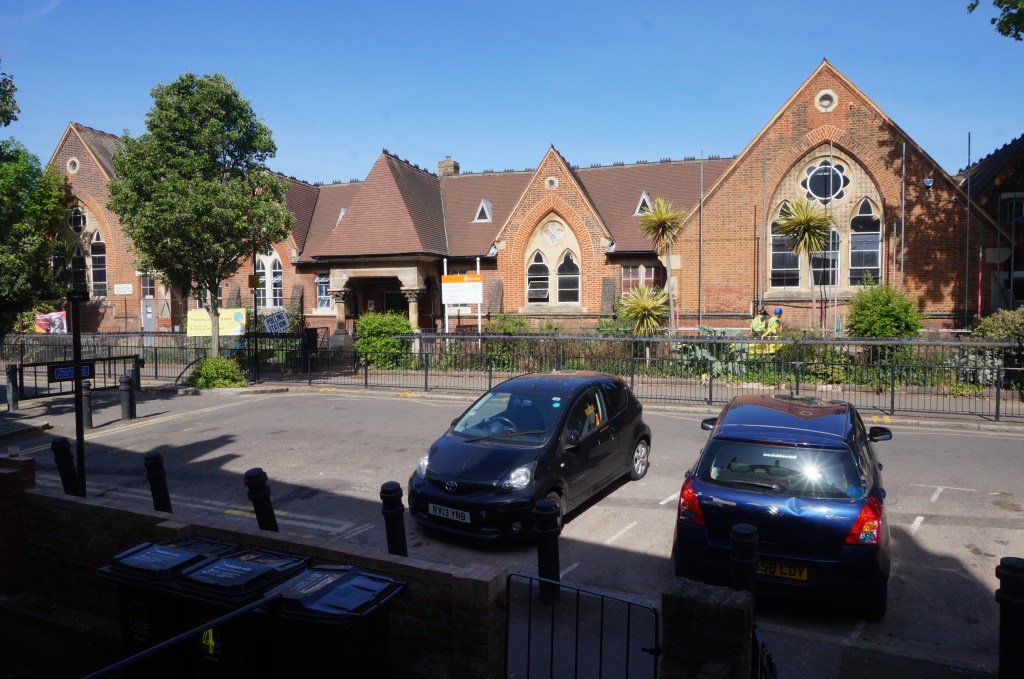
Stylistically, the design mixed a number of influences. In the vertical emphasis, asymmetry, angular modelling of the forms and busy skyline, it was essentially High Victorian Gothic in spirit; explicitly so in the case of the chapel and certain aspects of detailing elsewhere, such as the portal of the main entrance, the roof dormers, the flèche rising from the ridge of the roof of the main tower, the cast-iron cresting and finials. But the diapering of the brickwork and mullion and transom windows owed more to the neo-Tudor of designs such as the St Pancras School. Some commentators, such as the author of the report on the new building that appeared in The Builder of 2nd June 1866 and the author of the list description, have wanted to see French influence in the design; certainly features such as the first-floor windows of the main front with their transverse gables or the acutely steeply pitched roofs have been borrowed from late French Gothic of the early 16th century, when it was already passing into Renaissance. The French Hospital sold the site in the late 1940s when it moved out to Rochester and it was acquired by a Roman Catholic order of nuns, who turned the building into a girls’ convent school. It later became a Roman Catholic secondary school and then eventually the Mossbourne Academy in 2014. The building survives relatively well inside and out, though the patterned slate covering of the roofs has long gone, the chimneys have been truncated, much of the decorative ironwork lost and the lodge building was reconstructed in simplified form in 1934, when part of the site was acquired for residential development by London County Council.

The main staircase at the French Hospital: note the separate flights for men and women, provided in accordance with the principle of segregation of the sexes on which the institution functioned. (Historic England)
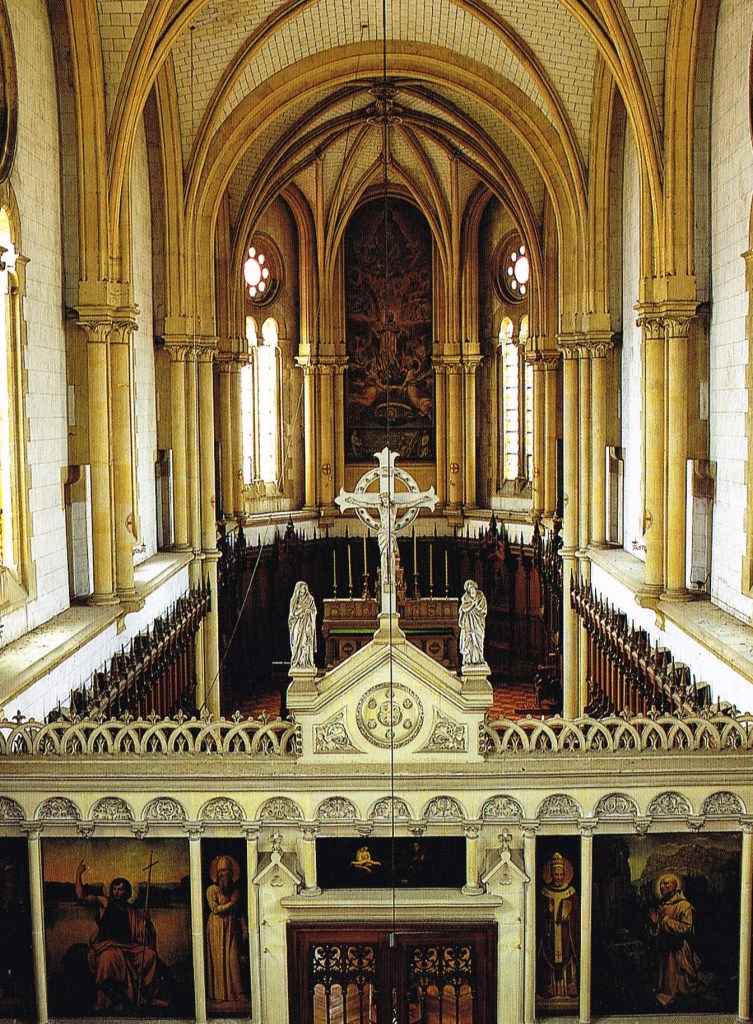
The interior of the chapel at the French Hospital (Historic England)

Yet despite the purported French influence, a number of devices in evidence at the French Hospital, such as the swept eaves, seem to have been more general Roumieu trademarks and they crop up elsewhere, such as in this design in the RIBA collection for a house in Bushey, to the southeast of Watford. Indeed, he seems to have used his High Victorian manner extensively for large suburban villas, such as ‘The Priory’ on Glencairn Road, just off The Ridgway in Wimbledon, built in 1866. It was well suited to irregular, rambling compositions and picturesque detailing, such as deep eaves and bargeboards. In these designs there are reminiscences of domestic architecture in the neo-Tudor and cottage orné styles that had been current several decades earlier. But for what – as far as is currently known – was his most important private house, Hillside on Brookshill in Harrow Weald, Roumieu adopted a distinctly strident and uncompromising manner. It was commissioned by Thomas Francis Blackwell (1838-1907), a director in the Crosse and Blackwell firm producing preserved foods and table sauces, and it was built for his daughter-in-law and her family.

The Priory, Wimbledon (listed as No. 70 Ridgway)
The Cedars in Harrow Weald (undated)
The tombs of Edmund Crosse (left) and the Blackwell family (right) in the churchyard of All Saints, Harrow Weald

The Blackwell connection was an important one for Roumieu: his obituary in The Builder records that he died at The Cedars in Harrow Weald, ‘the residence of his brother-in-law’. This was probably the elder Thomas Blackwell (1804-1880), who with Edmund Crosse (1804-1862) had in 1830 purchased the company originally known as West and Wyatt, where they had both been apprentices, and renamed it after themselves. In 1834, Blackwell married Ann Bernasconi of the Clock House, located just to the south of the Uxbridge Road between Harrow Weald and Hatch End, where he took up residence. He subsequently renamed the property and engaged Roumieu to remodel and enlarge it. The commission is recorded in Roumieu’s obituary in The Builder, although exactly what he did and when is currently unclear, and the building does not survive – it was demolished in the late 1950s after the estate was bought by London County Council for a development of council housing. Given the connection, it would not be surprising to find that Roumieu designed the monument to Edmund Crosse and his wife and the Blackwell family tomb in the churchyard of All Saints, Harrow Weald. Certainly it is plausible on stylistic grounds, although it wants documentary proof.

The garden front of Hillside, Harrow Weald, pictured in 1969 (London Metropolitan Archive)
The main entrance of Hillside, Harrow Weald, pictured in 1969 (London Metropolitan Archive)

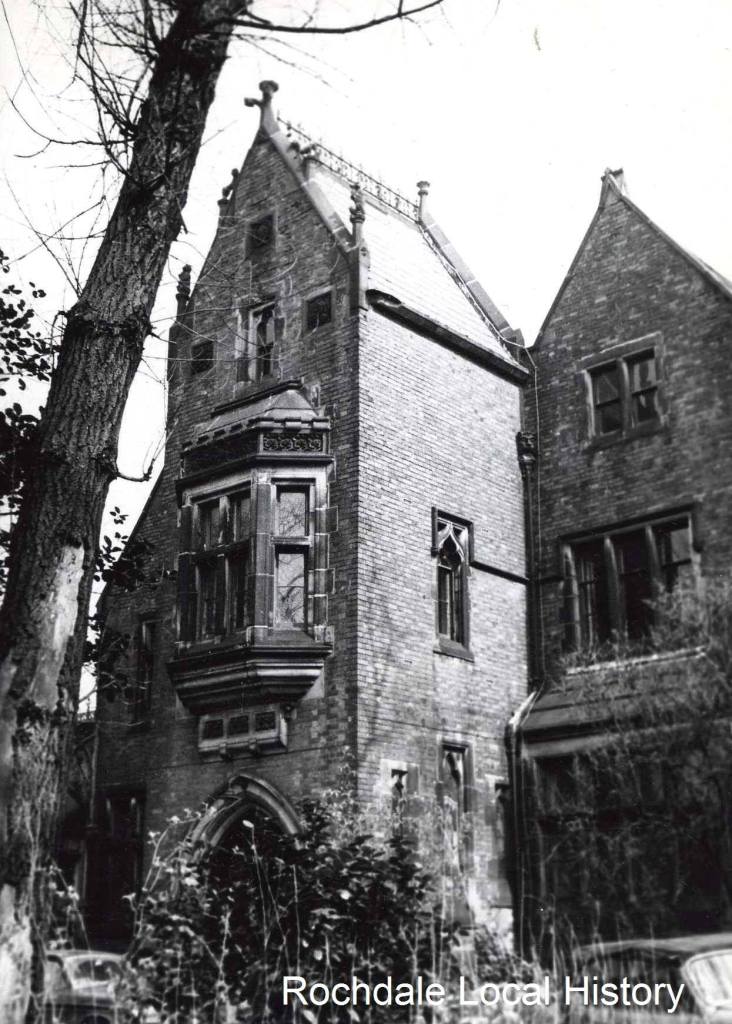
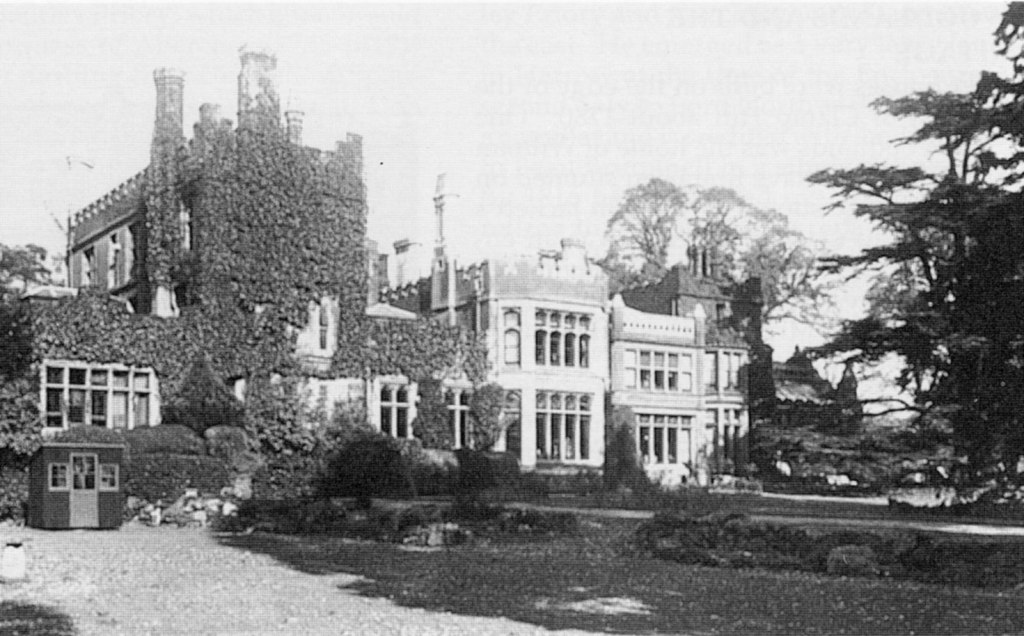
Hillside, located about half a mile away to the northeast of The Cedars, fared little better, also being disposed of by the Blackwells in the late 1950s. It was badly damaged by fire at some point between then and 1969, when it was recorded in a series of melancholy photographs in the collection of the London Metropolitan Archive. The house was a curious blend of neo-Jacobean motifs – such as the numerous Dutch gables and symmetrical composition of three of the bays of the garden front – with thoroughly High Victorian motifs in a muscular Rogue Gothic manner. The brickwork was banded, diapered and notched throughout. The entrance porch was set at an angle in the return of one of the rear wings, with a tiny quarter-turn oriel projecting above and a larger circular tower with a candle-snuffer roof to one side emerging from the end wall of the main garden front range. Some of the windows consisted of plate tracery, while the garden front was fenestrated with extraordinary two-storey bay windows, the upper storeys of which were jettied outwards like oriel windows. The ruins became progressively more dilapidated and overgrown until the site was redeveloped in the 2010s, with the by then scant remains of the old house being incorporated into a new block of flats. The stable block and coach house survives intact, however, and is listed at Grade II.
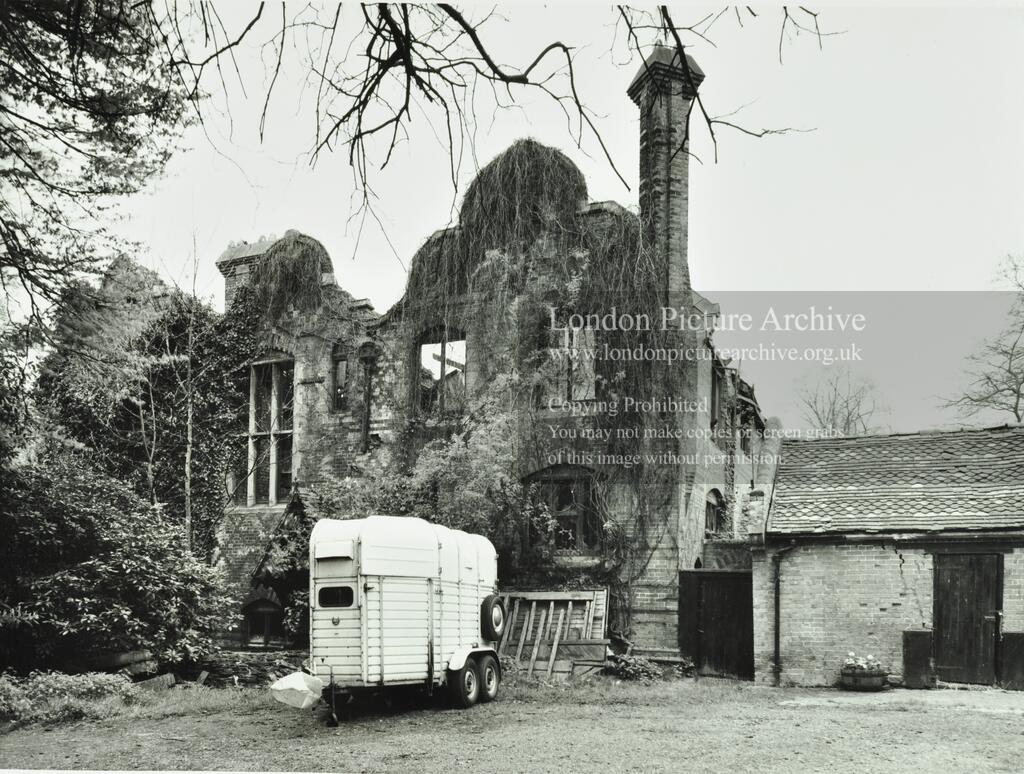
The rear front and (?)service wing of Hillside, Harrow Weald, pictured in 1974
The surviving stable block and coach house at Hillside, Harrow Weald, pictured in 1974 (London Metropolitan Archive)

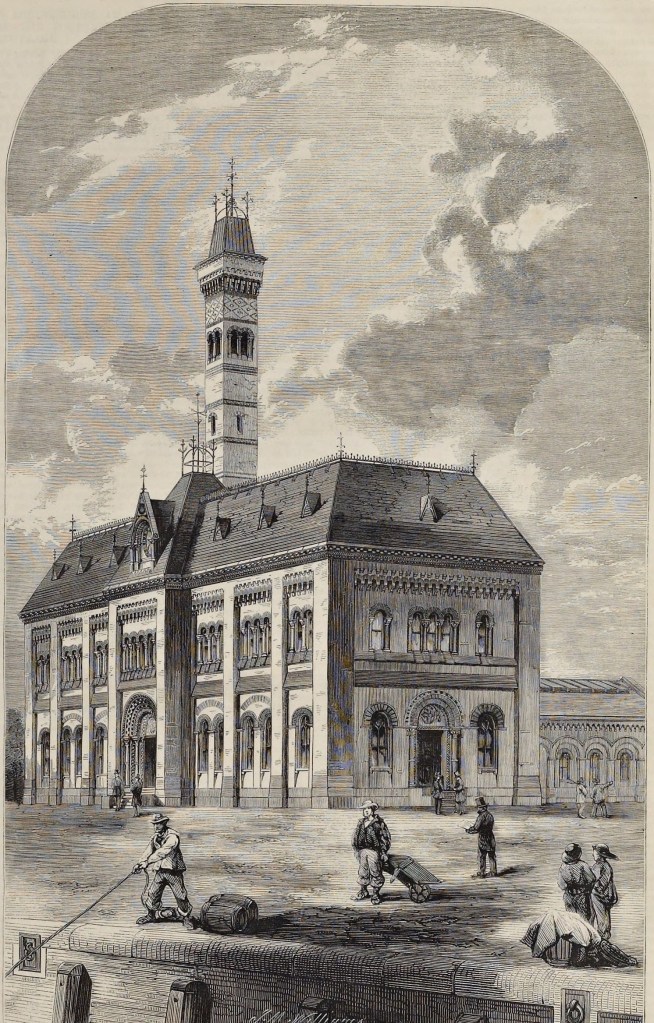
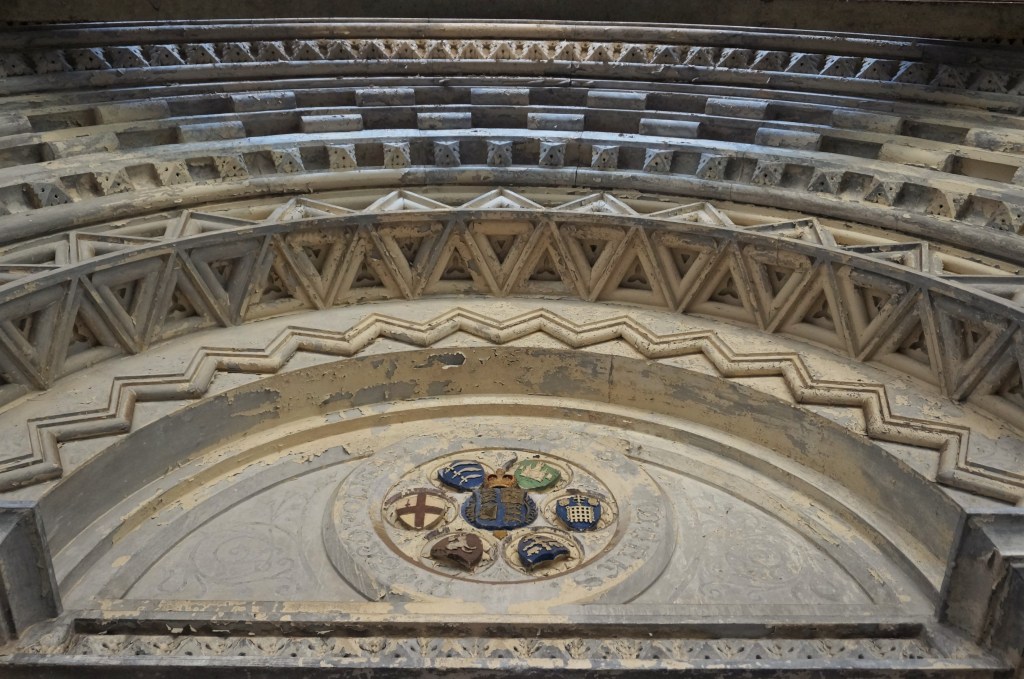
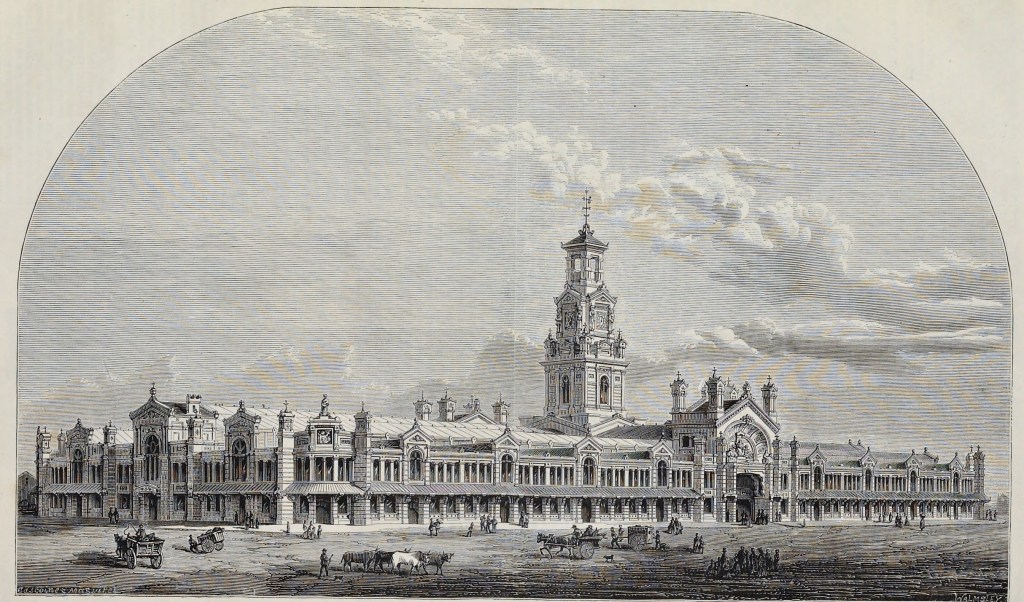
Hillside is the only building in Roumieu’s career that quite stands comparison with his most celebrated work, Nos. 33-35 Eastcheap. That was commissioned by Hill, Evans & Co – the vinegar-brewing concern in Worcester of which Edward Bickerton Evans of Whitbourne Hall was one of the proprietors – to replace their old London premises on Martin Lane, which had had to be demolished for the construction of the District Line. Given the demand for vinegar in the production of its numerous lines of pickles, it seems likely that Crosse and Blackwell had a close commercial relationship with Hill, Evans & Co, and one infers that the commission came about as a result of Roumieu’s marriage into the family. As explained in a lengthy preamble to the report on the new building in The Builder of 10th October 1868, the site was reputed to be that once occupied by Mistress Quickly’s Boar’s Head Tavern, which features prominently in Shakespeare’s Henry IV, Part 1. This was commemorated by a carved roundel of a boar’s head on the tympanum of the central window of the second floor. The building had to provide not only offices for the company, but also storage space, which The Builder explained was accommodated in two tiers of cellars below street level. How the remainder was arranged internally is not quite clear. The classic arrangement during the period for commercial buildings such as this was for the main street entrance to be located in the centre with the stairwell rising out of it, but here the corresponding position is occupied by what appears to be a vehicle entrance, filled with elaborate wrought iron gates. The illustration accompanying The Builder’s article shows doorways at street level reached by small flights of steps in both halves of the building, an arrangement altered in later years when the ground-floor accommodation was converted to shops.

Detail of the street front of Nos. 33-35 Eastcheap: note the roundel commemorating the Boar’s Head Inn which formerly occupied the site.

The report noted that ‘As the rooms were intended for offices in a narrow street in a city having a dull atmosphere, large openings for light become a necessity, and have been provided’. It stated that moulded ‘specials’ had been used for the brick arches (presumably those at third-floor and attic level) and that Tisbury stone had been used for the dressings. The carving was executed by sculptors Frampton and Williamson ‘from drawings by the architect, and is executed cleverly. Messrs Simpson did the external and internal tilework, and Messrs Peard and Jackson most of the ornamental ironwork, the whole of which was designed by the architect for this building’. The value of the contract, which had been awarded to Brown and Robinson, was given as £8,170. But despite the prolixity of the report, which expounded at some length on the output of the contemporary vinegar industry, The Builder was terse about the stylistic treatment of the building, describing it as ‘the Gothic of the south of France, with a little Venetian impress; and the design, if a little overdone, may be considered picturesque and original’.
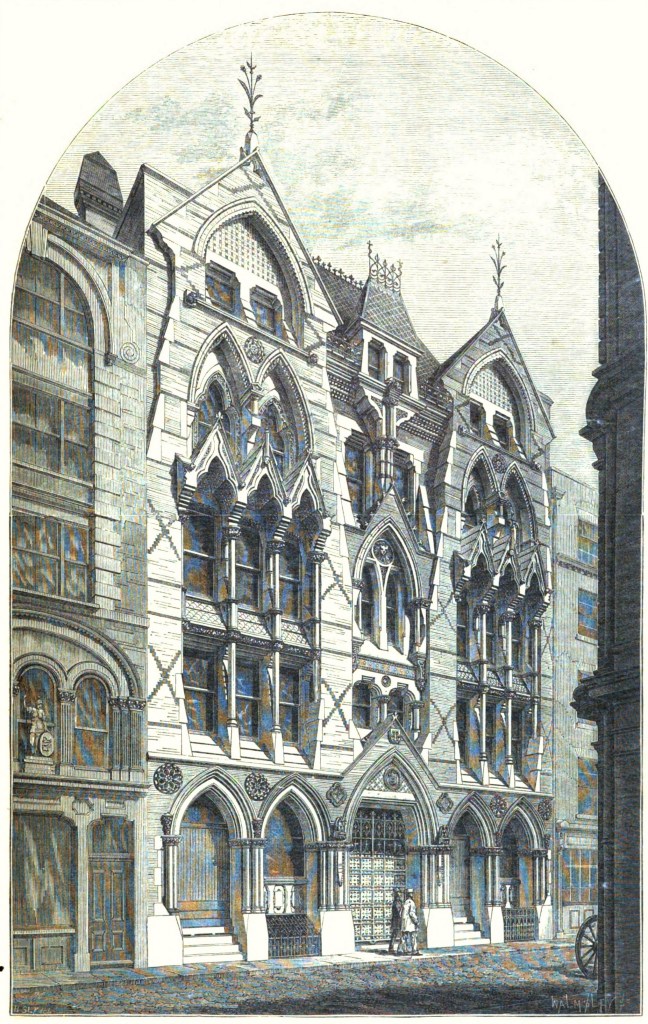
Nos. 33-35 Eastcheap, as pictured in The Builder of 10th October 1868

The design of Nos. 33-35 Eastcheap embodies several enduring preoccupations in Roumieu’s work, such as the love of attenuated forms and narrow subdivisions of the wall surface. A heightened interest in texture is also thrown into the mix, with cogged brickwork used for the tympana of the windows at attic level and cornice running below. The surfaces of the set-offs forming the sills of the windows at second-floor level have a ‘negative fish-scale’ pattern, executed in shallow relief. Even the intrados of each trefoil-headed opening of the canopies in front of them are adorned with diaper-work, while the lintel behind has a strip of foliate ornament. Not for the first time in a High Victorian building, the profusion and exuberance of the ornament give the architecture a temperamental kinship with the High Baroque.
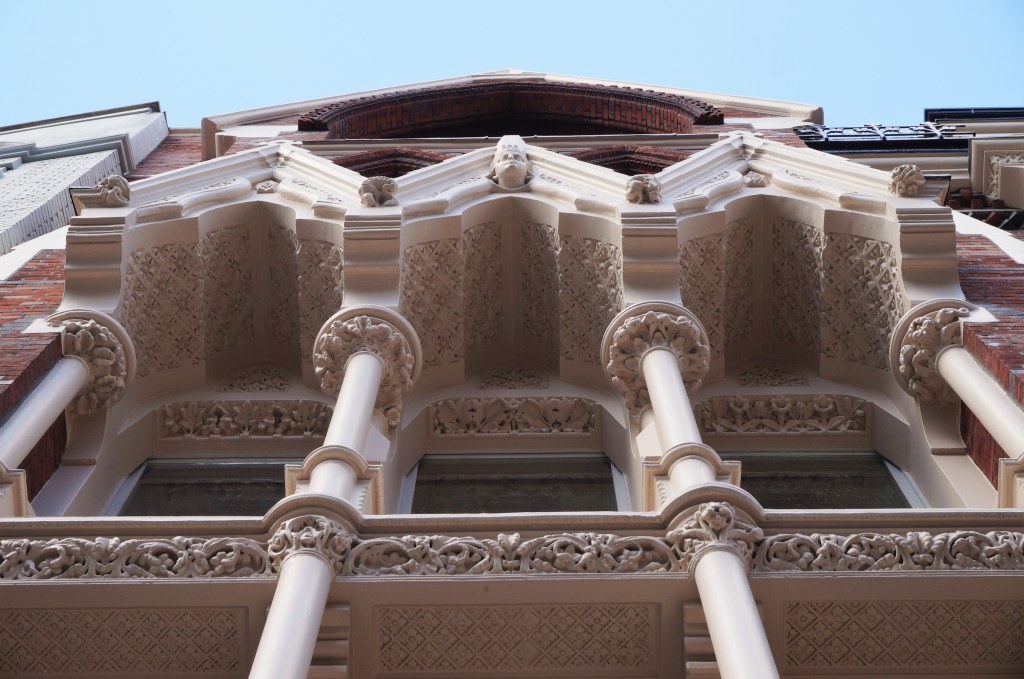
Nos. 33-35 Eastcheap, detail of the facade at second-floor level

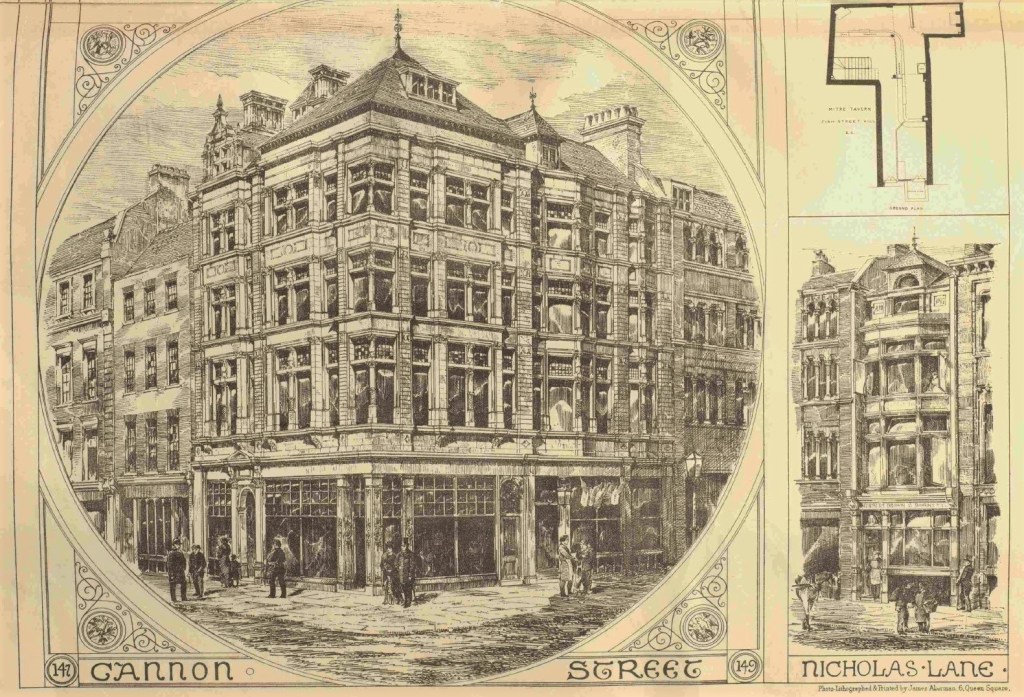
With Nos. 33-35 Eastcheap, Roumieu pushed his interpretation of High Victorian Gothic to an extreme. The danger with this line of development is that it potentially leads up a blind alley. Once replicated, such an aesthetic compromises its own individuality, and shock tactics can only be deployed to full effect once. But something of it re-emerged at least once, this time on a slightly smaller scale, with another commission for commercial properties in the City of London at Nos. 48-49 Cheapside, located on the south side of the street and a little to the west of the church of St Mary-le-Bow. Here, Roumieu was engaged to design new premises at addresses which had previously been occupied by two houses thrown up in haste following the Great Fire of 1666, as explained in The Builder of 26th September 1874. As with the report of six years earlier on Nos. 33-35 Eastcheap, the report holds forth at great length on the history of the site and its environs at the expense of its ostensible subject. It does, however, disclose that initially Roumieu ‘prepared designs of a Medieval character for both of the houses, varying, however, in design, but still in unison so as to form one composition. That prepared for No. 48 has been carried out with very little variation, but Messrs. Lake & Turner preferring the Renaissance style, Mr Roumieu, in conformity with their wishes, prepared a second design for No. 49’.

Nos. 48-49 Cheapside, City of London, as illustrated in The Builder of 26th September 1874

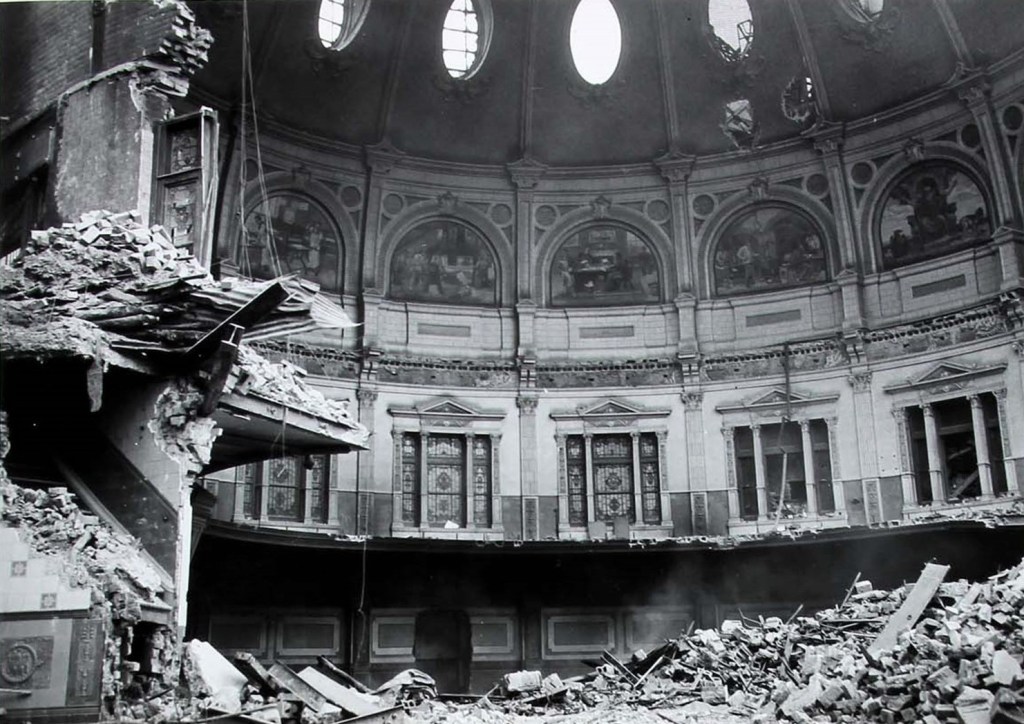
Many of the devices incorporated in the street façade of No. 48, such as the liberal use of patterned and textured surfaces, were familiar from Nos. 33-35 Eastcheap, although the three-centred arches with ogee curves above rising to decorative finials introduced a late Gothic flavour. The fourth floor and attic under a steeply pitched roof, its elevation centred on an oriel aligned with the apex of the arch beneath, almost formed a self-contained composition. At No. 49, the division of the elevation into narrow vertical units, with a profusion of advanced and receding planes and chamfered and faceted surfaces, was effectively translated into Italianate, for which Roumieu had prepared the ground with his idiosyncratic essays in the style of the late 1840s and early 1850s. At No. 48, the carving was once again the work of Mr Frampton, apart from the large figure of King David holding a harp at third-floor level, which was executed by a Mr Wyon – probably Edward William Wyon (1811-1885), who came from a well-established family firm of sculptors, engravers and medallists. The same Wyon executed the figure of Plenty sitting on the extrados of the segmental arch above the shopfront of No. 49 and some of the roundels, again after ‘small sketches by the architect’. The remainder of the carved detail adorning the façade of No. 49 was by a Mr Kelsey, perhaps Charles J. Samuel Kelsey, an architectural sculptor who also came from a London-based family firm. At some point no later than 1931, No. 48 was rather brutally de-Victorianised with the complete loss of the detail enclosed by the Gothic arch, including the figure of King David. Both buildings were gutted during the Blitz, when the neighbourhood was very badly damaged, and the ruins cleared away soon afterwards.
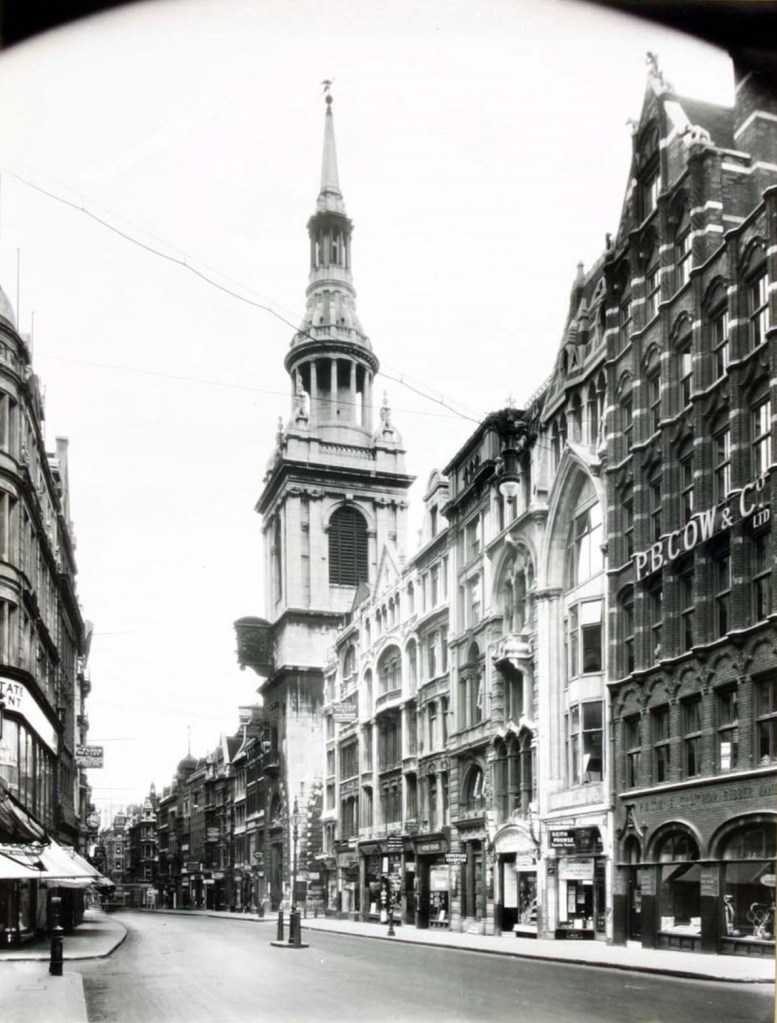
Nos. 48-49 Cheapside, perhaps in the late 1920s, showing No. 48 after its partial ‘de-Victorianisation’: the premises of P.B. Cow & Co. Ltd, visible on the far right of the picture, were a work of 1881 by Ernest George and Peto. (Historic England)

Roumieu designed a number of other commercial buildings in the City of London and its environs, most of which – assuming they have not all disappeared unrecorded – await discovery and study. So far, the only one in the City proper to have come to light is Victoria Wharf on Upper Thames Street, noted in The Builder’s obituary, which stood immediately to the east of Blackfriars railway bridge adjacent to Puddle Dock. Pre-war aerial photographs show a typical Thameside warehouse, five storeys in height and three bays wide, with some sort of ornamental trimmings to the upper part of the river front. Not much more can be deduced and, after sustaining bomb damage, it was demolished for redevelopment during the late 1940s or 1950s. Right at the end of his life, Roumieu designed a couple of commercial premises for Crosse and Blackwell, both of them located on Crown Street in Soho, which subsequently became the northern half of Charing Cross Road between Cambridge Circus and New Oxford Street. At No. 111, what was in effect a depot for delivery vehicles went up in 1875-1876 on a site on the western side formerly occupied by the Plough Inn. As The Builder noted in its issue of 15th April 1876, the rising cost of land meant that ‘London stables are following the example set by London houses of shooting up vertically, instead of spreading horizontally’. The ground floor was mostly given over to bays for the delivery vans, of which there were 18, with storage for fodder, a tack room, a dung yard and so on. The stables proper were on the first floor, 13ft (4m) above ground level, and access was provided by two ramps. Here, there were stalls for 35 horses, a loose box for a sick horse and ancillary facilities. The second floor of the range along the street front was occupied by living quarters for the stablemen, arranged ‘with windows looking into the open space above the stable, so that a view can be taken at any moment of the whole of the stables on the upper floor’. There was a tank for feeding the water troughs, hosing down the stalls and supplying the fire hydrants. Though the ground-floor storage bays and first-floor stalls were arranged around a central atrium, this was not open to the sky, being spanned by king post and queen post trusses resting on intermediate cast-iron columns and incorporating a monitor roof to provide top-lighting.

Street front, section and ground-floor plan of Crosse and Blackwell’s stables on Crown Street (later Charing Cross Road), as illustrated in The Builder of 15th April 1876

The street front was treated in a thick-set neo-Romanesque style, quite unlike anything else in Roumieu’s output, with the fenestration deliberately small to emphasise the massiveness of the wall surface. This was constructed of red brick, incorporating – perhaps for the broad decorative band at first-floor level – Pether’s ornamental bricks. The dressings were of stone and the carving was again the work of Frampton. In the 1920s, Crosse and Blackwell wound up all its operations on the Charing Cross Road and the stables were demolished for redevelopment. Roumieu also designed a warehouse for the company at Nos. 151-155 on the western side just short of the junction with New Oxford Street. It was a substantial structure which eventually rose to a height of 76ft (23m), but construction, which began in 1877, had to be suspended after threats of legal action from the owners of surrounding properties over the loss of light and air. It did not recommence until 1885 when Crown Street was widened to the east as part of the construction of Charing Cross Road and the problem had solved itself. After changing hands, the building was altered beyond all recognition externally in 1925-1926, then the site was cleared in 2009-2010 for the construction of Crossrail.

Succession and conclusion
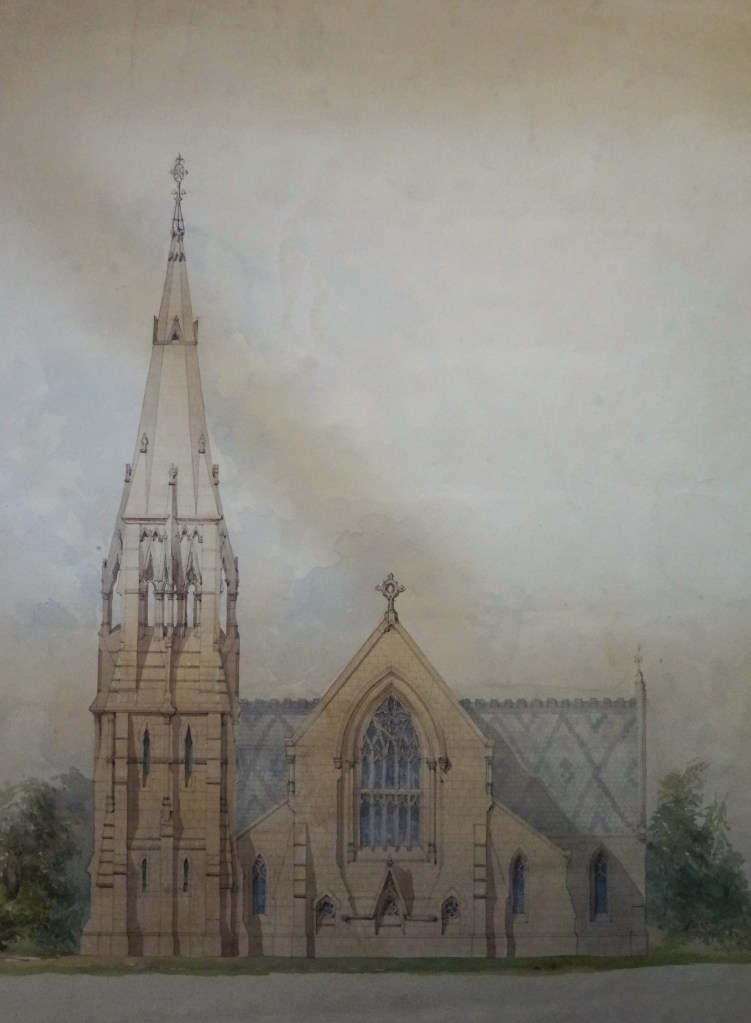
Presentation drawing for the west elevation of St Mark’s, Broadwater Down in Tunbridge Wells, showing the church as built, although with even more dramatically sculptural treatment of the upper stages of the tower. (RIBA Collections)

On Roumieu’s death in 1877, his practice was taken over by his son, Reginald St Aubyn Roumieu (1854-1921). He had trained for six years with his father, but, evidently still green, decided to go into partnership with the older Thomas Kesteven Hill. This arrangement lasted for only two years before being curtailed by Hill’s death. In c. 1880, he went into partnership with Alfred Aitchinson (d. 1914), with whom he oversaw the completion of Nos. 151-155 Charing Cross Road. Gough’s practice, it might be noted briefly, was also continued after his death by his son, Hugh Roumieu Gough (1843-1904) evidently named in honour of his erstwhile business partner. The younger Gough was one of the numerous collaborators of J.P. Seddon, working with him on the design for St Paul’s Hammersmith, rebuilt on a grand scale in 1882-1891. He was also sole designer of the church of St Cuthbert, Philbeach Gardens, providing the grand shell built in 1884-1887 that was later much embellished internally by Ernest Geldart and William Bainbridge Reynolds.

The main front to Victoria Park Road of the former French Hospital (now Mossbourne Victoria Park Academy) in south Hackney

Roumieu’s work has been seen as epitomising High Victorianism, yet it also poses searching questions about its provenance and nature. Firstly, it begs the question of where exactly Victorian architecture begins. His earliest known work with Gough was erected around the time that Victoria acceded to the throne. Yet this cut-off point is largely arbitrary where architectural history is concerned – fashions do not, after all, always proceed in lockstep with politics. Both architects had been schooled in the traditions of the long 18th century, and inhabited a milieu from which many of the influences which would shape High Victorianism were absent. Roumieu involved himself little in ecclesiastical architecture and seems not to have participated in competitions for major public buildings, two areas where debate over architectural theory and aesthetic propriety raged most fiercely. The sort of licence in the use of historical motifs exemplified by the steeple of St Peter’s in Islington is hardly unusual for the first half of the 19th century. It was a hangover from Georgian Gothick, which was gradually purged from architecture by the growing concern with archaeological precedent and the high-minded censure of Pugin, Ruskin and The Ecclesiologist. Yet when one compares the unexecuted design for the Milner Square church with St Mark’s, North Audley Street, a marked difference in feeling between late Georgian and early Victorian architecture becomes apparent, which is more difficult to explain away. What are we to make of this?

Design for commercial premises in a Second Empire style: it is tempting to posit a link with the scheme for the interior of Breidenbach’s on New Bond Street reproduced above, but nothing is currently known of the circumstances of this commission. (RIBA Collections)

Conceivably, this in fact has nothing to do with the Zeitgeist and everything to do with personal character – the prevalence of nature over nurture, in other words. Licence and the impulse to distort, to exaggerate, to carry everything to extremes informed all of Roumieu’s design. Virtually every stylistic influence brought to bear on him by changing fashions – Greek Revival, Italianate, neo-Norman – is refracted through a distorting lens. When one leaves aside 20th century constructs and imposed associations, one sees that Nos 33-35 Eastcheap embodies a common thread in his Roumieu’s aesthetic that runs all the way back to the Islington Literary and Scientific Institute – the preoccupation with subdividing the elevation into tall, narrow units, with endlessly varying the modelling of the wall to eliminate any expanse of flat surface and the fascination with layered planes. The nervous, restless character of his work is a constant.
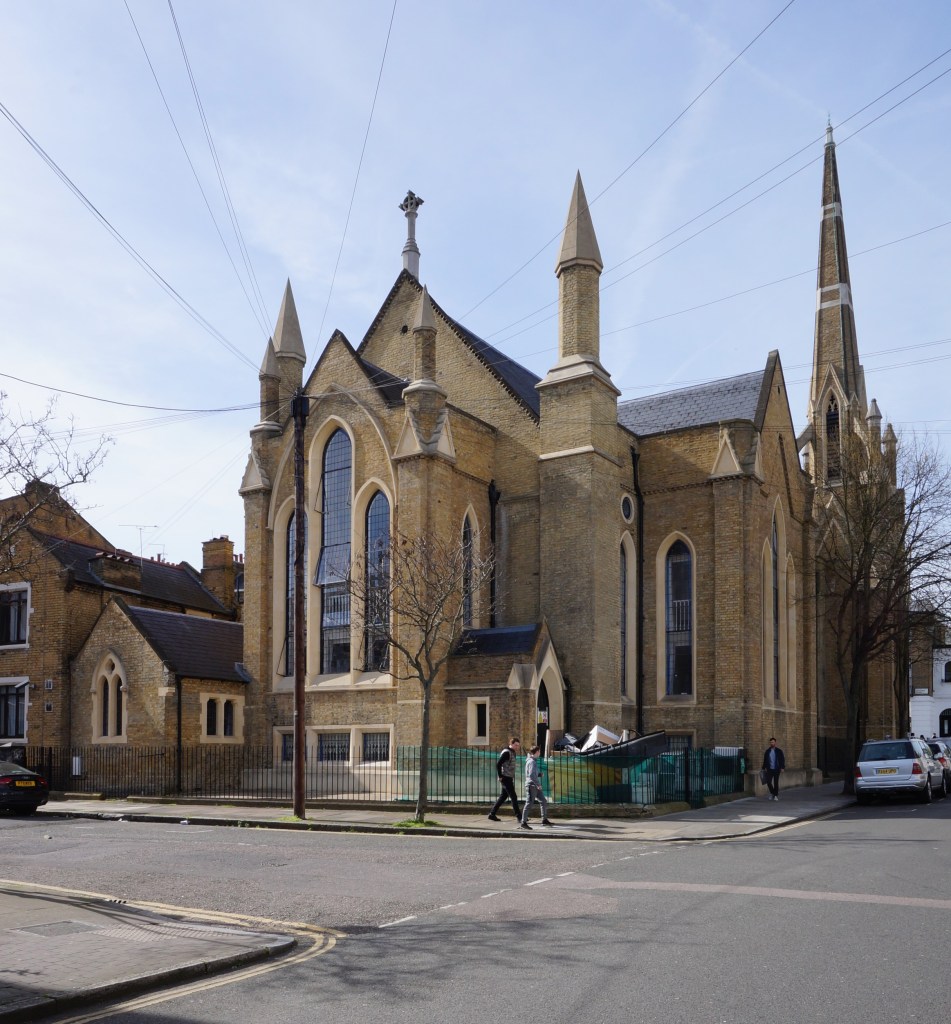
The former church of St Peter, Islington, seen from the junction of Grantbridge Street and St Peter’s Street, showing the chancel and transepts added by Roumieu and Gough.

Goodhart-Rendel was perhaps misguided in grouping in Roumieu with the Young Turks of the 1860s, such as E. Bassett Keeling and Joseph Peacock, not least because Nos. 33-35 Eastcheap comes from the final decade of its architect’s career. The Rogue Gothic buildings are not wholly representative of Roumieu’s output as a whole, and indeed to some extent a swansong. Yet Goodhart-Rendel was right in according to him the status of rogue architect in a more general sense. The epithet has been so frequently applied to the practitioners of the more eccentric brands of High Victorianism of the 1860s that it tends to be forgotten that the chronological scope of the RIBA lecture of 1949 for which he coined the term embraced a period running all the way from the 1840s to the 1890s. The common factor, which for him distinguished every figure featured in it, was a tendency to stay apart from the herd, powerful individualism manifesting itself in highly personal design that was neither emulated by contemporaries nor inspired a school among architects of a younger generation. In the case of some of the rogues, such as Alexander Thomson, the latter was inevitable: they persisted with an idiom that was out of fashion by the end of their career, and thus represent an isolated line of development which was fated to be curtailed by their death. Others, such as Bassett Keeling and Peacock, toned down their style in later life, ceding originality to respectability and conventionality. But in the case of Roumieu, the matter is nothing like as straightforward. Though he reinvented himself more than once, his personality remained inimitable from first to last. Though he had a partner and a pupil, neither went on to produce anything that stands comparison with his work. There is, perhaps, no greater accolade for a rogue.

Design for the painted decoration of the timber roof of a church – the High Victorian character of this design suggests a date towards the end of Roumieu’s career in the 1860s-1870s, but the circumstances of this commission have yet to be established. (RIBA Collections)

Introducing C.H. Driver (1832-1900), Architect to the Steam Age

It is a measure of the prominence which civil engineering assumed in the 19th century that members of the profession achieved the status of household names. Indeed, they not merely achieved, but also retained it – witness, for instance, Isambard Kingdom Brunel polling second place in the 100 Greatest Britons television series of 2002, nearly 150 years after his death. Chief engineer of London’s Metropolitan Board of Works, Sir Joseph Bazalgette (1819-1891), has also enjoyed popular advocacy in the age of mass media thanks to his television mogul great-great-grandson. Bazalgette’s achievement is easily surmised – he was the man who planned and oversaw the construction of London’s sewer system, conceived with such foresight and built to such a high standard that it remains vital to the capital even today. But his fame has eclipsed an important collaborator, and one whose work still forms no less important a part of London’s infrastructure.

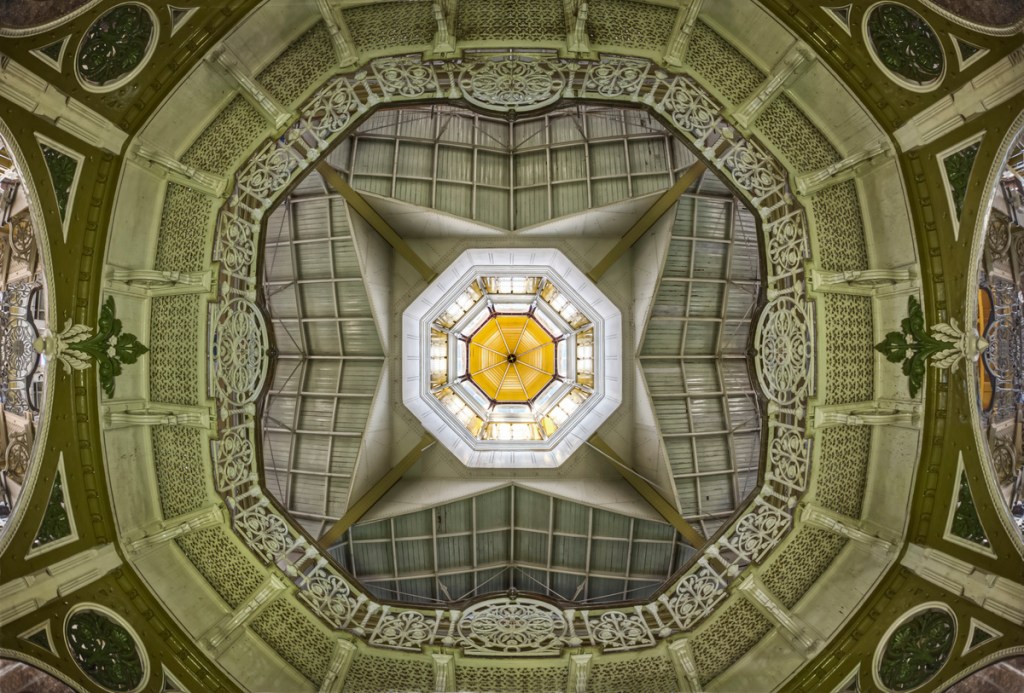
The central octagon and lantern in the engine house at Abbey Mills (Dan Raven)

Bazalgette’s great scheme formed an integral part of a wider programme of urban improvements, principally the creation of the Victoria Embankment along the north side of the Thames from Westminster Bridge to Blackfriars Bridge. But the sewage system itself had little architectural expression. It was hidden away below the pavement, and the benefits to Londoners were not what it brought into their lives, but what it took away from them – the overwhelming, nauseating stench of a dangerously polluted river and the risk of serious disease caused by the lack of proper sanitation. But although effluent was now spirited away from central London by two enormous outfall sewers, something still had to be done with it eventually, and Bazalgette’s solution was to release it into the Thames Estuary at high tide from where it would disperse into the open sea. This involved lifting it into holding tanks, necessitating the construction of large pumping stations. The design of these was entrusted to Charles Henry Driver, an architect whose career is intertwined with those of the great engineers of the age. What he provided did far more than simply shelter the machinery from the elements – these were imposing, magnificent buildings, which exuded self-confidence and expressed faith in technology, reason and progress.

Detail of the former external door on the river side of the engine house at Crossness

That the architectural treatment would have made these pumping stations an ornament to a far more visible location is all the more remarkable when one considers that they went up on the lonely flatlands of the Thames Estuary, and were seen regularly only by the staff who operated and maintained them. But, as a result, they did little to further the reputation of their designer outside professional circles. In some ways, it was Driver’s fate to be overshadowed by the engineers with whom he collaborated. They were engaged in the undertakings that epitomised the heroic age of engineering – improving the sanitation of a metropolis, building transport routes that would move goods and people across the country faster than had ever been possible before, opening up far-flung parts of the globe. Whatever the merits of the architectural treatment of these works might be, it paled in significance compared to the revolutionary economic and social effects of such progress. But as architect, Driver’s task was to do far more than to design packaging for machinery or to add decorative effects to functional structures. It involved nothing less than grappling with a problem that arose from the technological innovations of the day and has remained relevant ever since – the application of art to industry. The aim of this blog post is to demonstrate something of how he achieved that.

The central octagon in the engine house at Crossness, viewed from one of the staircases to the beam floor, with Prince Consort visible in the background.

Driver the railway architect

The town-side buildings with the former stationmaster’s house at Wellingborough Station (Wikipedia Commons)

Born in Westminster to a clerk in an insurance office, Driver began his career as a draughtsman in the office of Frank Foster, engineer to the Commissioners of Sewers. Beyond this, nothing is currently known of his training, although he seems to have had a natural artistic flair, since his obituary in The Builder (10th November 1900, pp. 423-424) notes that ‘at an early age [he] was an exhibitor at the Royal Academy’. Foster may have proved an auspicious connection in view of Driver’s later career, yet the architect first emerged as a specialist not in drainage but in railway stations. The Midland Railway was formed in 1844 through the merger of three pre-existing companies, which, starting in the latter half of the 1830s, had created a network of lines that converged at Derby. This was already extensive, but the directors had greater ambitions, and for future growth it was essential to obtain a connection to the capital. In the first stage of the journey south in 1852-1857, the company put out a branch that diverged from its existing Leicester to Rugby route to run through Market Harborough, Kettering and Wellingborough to Bedford. In time, this would be extended further south to the new terminus of St Pancras, but for the moment the connection to London was to be achieved by striking out across country in a south-easterly direction to meet the East Coast main line, operated by the rival Great Northern Railway, at Hitchin.

Driver’s canopy on platform 1 at Wellingborough Station seen from the island platform, remodelled in 1882 when the line was quadrupled. (John Law)

Driver was engaged by the engineering firm of Liddell and Gordon to design the stations and bridges for the Leicester-Hitchin line. Bedford station was demolished in the early 1980s as part of an upgrade for the electrification of suburban services and the route to Hitchin, having been downgraded from trunk to branch-line status once the new London connection opened in 1868, eventually closed to traffic in 1964. But the stations at Wellingborough and Kettering survive, have remained in use and are well preserved. Stylistically, the town-side buildings at Wellingborough are an amalgam of several different influences. There are the pointed segmental arches with much chamfering to door and window jambs so typical of High Victorian Gothic, and there are round-headed openings with constructional polychromy that show the influence of Ruskin’s promotion of Venetian Romanesque. Yet the prominent bargeboards of the stationmaster’s house and the decorative glazing bars are in the older tradition of the cottage orné. All of these are common enough devices for the period; what sets Driver’s work apart is the virtuoso use of cast iron for the platform canopies. These are based on the ridge and furrow principle established by Joseph Paxton, with transverse gables forming a sawtooth profile in elevation. In section, each truss appears symmetrical, with a central column from which two large brackets project laterally in order to support what is effectively a wall plate and two smaller, subsidiary brackets extend longitudinally to brace what is effectively a principal rafter.

The main entrance front of Portsmouth and Southsea Station

If the design of the platform buildings suggests that Driver had absorbed something of Ruskin, the design of the canopy represents a direct challenge to an article of faith. In The Seven Lamps of Architecture (1849), Ruskin had inveighed against the use of cast iron, directing his vituperation against ornament made of the material, which he regarded as more active a cause than any other ‘in the degradation of our national feeling of beauty’, ‘incapable of a fine line or shadow’ and ‘vulgar and cheap substitutes for real decoration’. Only wrought iron ornament, each work of which was unique and could display the skill and labour invested in it by an executant artist-craftsman, was acceptable. But such an elegantly pared-down construction as the frame of the canopies at Wellingborough (and indeed Kettering, where the same castings were used) could hardly have been achieved in wrought iron, which would lack the necessary compressive strength. An earlier generation of Gothic Revivalists had often used iron for columns since moulded details could be cast far more economically than they could be carved in stone. Only a sharp rap with the knuckles will reveal the sham (such columns are usually hollow internally), but here the design of the ornament is intrinsic to the material. The elegant arabesques filling the spandrels of the brackets are not applied to render a bare construction visually more palatable, but are an integral part of it. The slender proportions of the supporting columns make it immediately obvious that they could not possibly be built of stone.

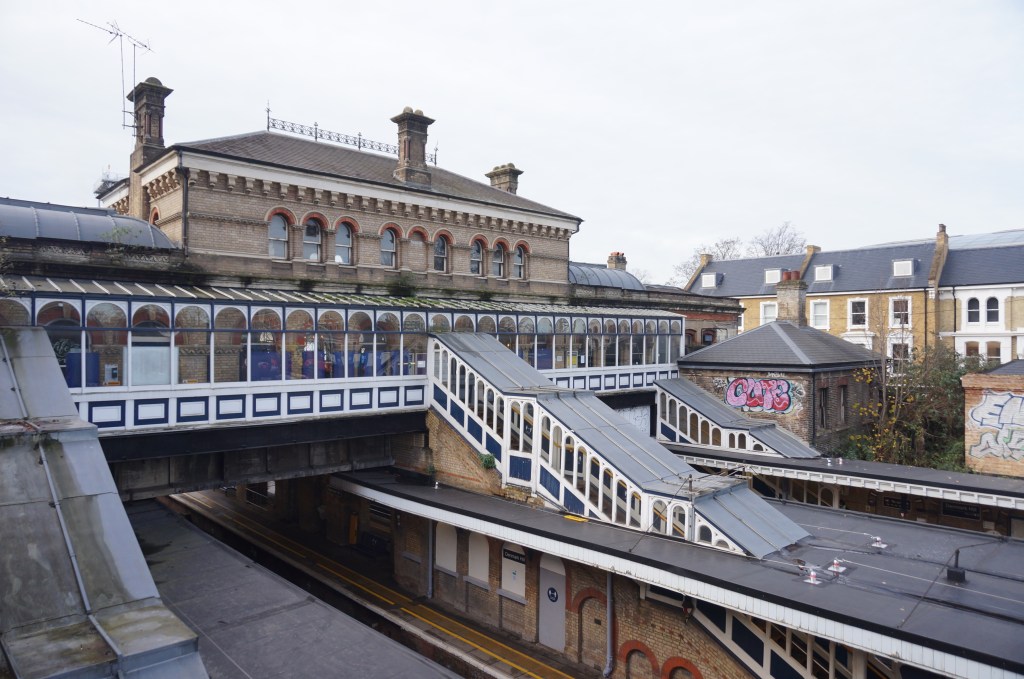
The former ticket office (converted to a pub when reconstructed after a fire in 1980) and the pedestrian overbridge at Denmark Hill station
Capital and cast iron downpipe recessed into the exterior wall of the former booking office at Denmark Hill station

In 1858, Driver joined the office of Robert Jacomb-Hood (1822-1900), resident engineer of the London, Brighton and South Coast Railway (LBSCR). It proved to be a fruitful partnership and Driver was kept busy designing new stations for a company that was rapidly expanding its network throughout the 1860s. He designed the screen wall to the trainshed over the terminus platforms that formed the company’s half of London Bridge station and the main entrance and ticket office to Portsmouth and Southsea station (a mixture of terminus and through platforms, with the former belonging to the LBSCR, just like London Bridge). He designed the stations on the inner-suburban south London loop line running through Peckham Rye and Denmark Hill. In Surrey, he designed the stations on the extension from Leatherhead to Dorking and in Sussex and Kent the stations on the extension of the Three Bridges to East Grinstead line through Groombridge to Tunbridge Wells.

The main entrance on the west side of Leatherhead Station (Sebastian Kasten)
Boxhill and Westhumble station

Stylistically, these stations represent a shift in Driver’s manner when compared to his work for the Leicester-Hitchin line. Ornamental devices drawn from cottage orné designs have vanished and he has clearly absorbed a great deal of the muscular High Victorian idiom. Capitals and friezes have the vigorous, overscaled foliate carving that constitutes one of its trademarks and the constructional polychromy becomes more strident, with bold stripes and banding, sometimes even chevrons. Notched and chamfered detailing abounds. In urban settings, the style tends more to the Italianate: its underlying classical principles could usefully brought into play in settings where a grand, symmetrical street frontage was required, such as at Portsmouth and Southsea (c. 1866), Peckham Rye and Denmark Hill (both 1864-1866). Large central blocks could accommodate spacious waiting rooms or ticket offices and mansard or barrel roofs could be used to give the principal elements in the composition greater visual emphasis. Elsewhere, especially at country stations, Driver tended more to the Gothic. Compositions were asymmetrical with more self-consciously picturesque massing and offset towers with hipped or pyramidal roofs to provide visual interest, as at Tunbridge Wells West (c. 1866), Boxhill and Westhumble and Leatherhead (both completed 1867).

The former waiting room at Peckham Rye Station: after being taken out of service, it was used as a billiard hall and latterly stripped of much of its original decor before restoration commenced in the 2000s. (Quintin Lake)
Detail of the cast iron balustrade of the staircase to the former waiting room at Peckham Rye Station (Quintin Lake)

There is, however, a constant in the masterful use of cast iron structural elements and ornament. The ridge and furrow platform canopies of the Midland Railway stations with their glazed roofs disappear, but the ironwork makes a far greater show in the masonry-built portions of the stations in the form of railings, finials, brackets, roof crests and other ornamental devices. At Leatherhead, vertiginously proportioned columns support a canopy above the main entrance. As Paul Dobraszczyk has shown in Iron, Ornament and Architecture in Victorian Britain, Driver’s skill in the medium is the result of a symbiotic working relationship with founders such as Walter Macfarlane (1817-1885), proprietor of the Saracen Works in Glasgow. During the architect’s lifetime, the firm rose from humble beginnings to become one of Britain’s largest producers of architectural ironwork, much of it designed by Driver, manufacturing prefabricated components and even entire buildings for export all over the globe. In an address to the RIBA given in 1875, Driver explained his working practise, which involved providing full-size drawings to guide the production of the pattern and then a mould. He emphasised that he regarded it as vital for architects to be active collaborators with founders on their own terms, and to understand for themselves the casting process and properties of the material. As Dobraszczyk comments, the architect was instrumental in developing a house style not only for Macfarlane, but also for the LBSCR.

Tunbridge Wells West Station: the line from here to Eridge remains in situ and operational as the Spa Valley Railway, but now terminates short of Driver’s building following the redevelopment of the former carriage yards as a supermarket and conversion of the station to a restaurant, when the platform canopy was partly enclosed.
Tunbridge Wells West in c. 1980, not long before the cessation of train services (Martin Cottam)

Driver continued to be active as a designer of railway stations throughout his career and throughout the country, being involved in projects as widely scattered as the West Lancashire Railway from Preston to Southport (closed in 1964) and the Tottenham and Forest Gate Railway (still in operation as part of Transport for London’s Gospel Oak to Barking route). He also supplied designs for railways in South America, such as the Buenos Aires and Ensenada Port Railway in Argentina (1868-1870) and the São Paulo Railway Company in Brazil. He was architect of the latter’s Estação da Luz in São Paulo, built in 1895-1901, for which Macfarlane’s company provided prefabricated iron components. Involvement with British commercial ventures in South America also brought him a commission to supply designs for the Central Market in Santiago, Chile, built in 1869-1872. The elaborate, top-lit structure of the main market hall with its filigree cast-iron panels bears all his hallmarks.

The interior of the booking hall at Tunbridge Wells West in c. 1980 (Martin Cottam)
Interior of the Central Market in Santiago, Chile (Wikipedia Commons)

Driver the Goth

Driver and Webber’s winning design for the Ellesmere Memorial, as illustrated in The Builder of 6th November 1858

In 1858, Driver briefly went into partnership with an obscure architect by the name of Josiah Webber. The two of them won a competition held that same year to find a design for a monument to commemorate Francis Egerton, 1st Earl of Ellesmere (1800-1857), politician, writer, art patron and owner of the Bridgewater Estates. Erected in 1858-1860 on a site outside Worsley (then in Lancashire, now in Greater Manchester), it rose to a height of 130ft (39.6m), dominating the surrounding countryside. It still exists, although in much truncated form since the central octagonal section had to be removed in 1939 after becoming unsafe. A slightly gauche piece of design, it represented an attempt to paraphrase in High Victorian Gothic the form of a classical columnar monument.

General view looking east of the interior of St Mary’s in Warkworth (Chris Stafford)

The partnership with Webber was dissolved the following year, but Driver’s interest in Gothic survived it and in 1863 he took part in the competition for St Fin Barre’s Cathedral in Cork. He was unsuccessful (no details have yet emerged of his entry), but the restoration carried out in 1868-1869 of the principally 14th century church of St Mary in Warkworth on the southwestern border of Northamptonshire shows that his command of gothic was certainly fluent. He added a belfry stage to the tower, which seems to have been left incomplete at the end of the Middle Ages, and a south arcade within the existing envelope, carefully reproducing the genuine medieval north arcade. He also rebuilt the chancel, which boasts a splendid reredos and fine tilework to the floor and dado in the sanctuary. This is Driver’s only known executed ecclesiastical commission and it would seem that his activity in other spheres kept him sufficiently busy for there to be no need to involve himself in the fraught, specialised and frequently poorly remunerative world of church work.

General view of the frontage to Oxford Road of the Horton Infirmary, as illustrated in The Builder of 10th August 1872

Driver’s obituary in The Builder states that he designed the memorial outside Sledmere in East Yorkshire built in 1865 to commemorate Sir Tatton Sykes, 4th baronet (1772-1863), but this is not borne out by the list description or The Buildings of England, which give John Gibbs of Oxford as the architect, and the reason for the claim is unknown. We are on much firmer ground with the Horton Infirmary in Banbury, completed in 1872, a confident essay in muscular, vividly polychromatic Gothic. A report in The Builder (10th August 1872) explained that it was named after a Miss Horton of Middleton Cheney who, together with her great-nephew, had gifted £10,000 towards the acquisition of a site, construction costs and an endowment for a hospital ‘intended for the use of the poor of Banbury and those residing within a radius of ten miles’. Although the off-centre placing of the tower with its tall hipped roof (presumably a water tower) disrupted the symmetry, it was essentially a classical design. The central block and wings extending out from it housed the consulting rooms, operating theatre, waiting rooms and so on, with accommodation for staff on the first floor. The end pavilions housed the men’s and women’s wards, with a kitchen placed under the latter, taking advantage of the fall of ground across the site. The hospital survives, is listed at Grade II and remains in use, now as part of a much bigger complex, but some of the original detailing has been lost.

Ground floor plan of the Horton Infirmary, as illustrated in The Builder of 10th August 1872

Driver at Crossness

Looking down into the central octagon from the beam floor of the engine house at Crossness: the spiral staircase provides access to the sewage pumps, the condensers and other numerous pieces of equipment below floor level.

The basis of Bazalgette’s grand scheme was two enormous outfall sewers serving London north and south of the Thames. The Southern Outfall Sewer began in Deptford, where three interceptor sewers that ran across suburbs to the west converged at a pumping station, which lifted the effluent so that it could then flow onwards by gravity. The buildings of the pumping station (although not the steam pumps that formerly occupied them) survive and are listed at Grade II. The southern outfall sewer travelled across Greenwich, Woolwich, Plumstead and then out onto Erith marshes, at that date still open country well outside the city limits and partly used as a testing ground for munitions by Woolwich Arsenal. Here, the effluent had to be raised again, this time to flow into a large covered reservoir from which it was released into the Thames at high tide to be dispersed into the open sea on the ebb – initially untreated, although by the end of the 19th century sedimentation tanks had been added to separate out the solids and an electrolytic purification plant had been brought into operation. The work was done by four 125-horse-power rotative beam engines supplied by James Watt and Co of Birmingham, named Victoria, Prince Consort, Albert Edward and Alexandra. The Crossness pumping station, which was completed and brought into operation in 1865, was a substantial complex. Not merely was it a key component of the infrastructure, in view of its remote location it also had to be effectively self-contained. There was a wharf where coal for the boilers was delivered by barge, a fitting shop for carrying out repairs to the machinery, housing for the employees, a school for their children and a gas plant to provide lighting.

The river frontage of the engine house at Crossness, as illustrated in The Builder of 19th August 1865
The exterior of the engine house at Crossness as it appears today from the landward side: the large single-storey wing with the triple gables in the middle of the frame is the former boiler house.

The engine house was the centrepiece of the complex. Driver’s approach to the architectural treatment of the exterior is familiar from his railway stations – a kind of free Italianate able to absorb both Classical and Gothic influences as necessary. The principal aspect was the north elevation that looked out to the river, at that date the only location from which it was likely to be seen by the wider public. This was a grand, spreading, symmetrical façade of seven unequal bays, the central one of which broke forward. In its composition it owed something to the Renaissance palazzo model popular at the time for large public buildings, but the detailing was Romanesque, incorporating structural polychromy in red brick and highly sculptural treatment of the wall surfaces. Pilaster strips divided the bays, with numerous receding and advancing surfaces articulated through the use of set-offs and a vigorously modelled corbel table within the bays. The monumentally scaled central doorway was outright neo-Norman, more in the manner of the 1840s when that style enjoyed a vogue, and aligned with it at roof level was a dormer housing a clock. This emerged from the steep slope of a tall mansard roof with cast-iron cresting and finials. A large single-storey boiler house with three transverse gables projected from the landward side. The flues from the 12 Cornish boilers exhausted into a tall chimney, 208 feet (63.4m) in height and modelled on a Venetian campanile, with much horizontal banding and constructional polychromy. None of this can easily be appreciated now. An extension was added to the north elevation in 1898 to house additional pumping equipment, which, though sympathetic in style, obscured much of the principal aspect. The mansard roof was removed in 1928 and a flat, concrete-built replacement substituted. Once the last of the steam pumps had been decommissioned in the mid-1950s, the chimney was taken down.

Detail of the former main entrance on the river side of the engine house at Crossness, visible in the illustration above and now enclosed within the former Triple Expansion Engine House of 1898.

The interior of the engine house was treated even more splendidly than the exterior. It was planned symmetrically and axially, with one engine to each of the quadrants into which it was divided. The entire inner structure was built of cast iron. The building was divided horizontally to create an upper floor providing access for repair and maintenance to the beams of the engines. Arcades ran laterally across the entire width of each half of the building. The columns and arches were so heavily constructed that they looked as though they might have been built of stone rather than iron. They had to be, since they supported not only the floor members but also the pivoting beams of the pumping engines. At the centre was an octagonal space rising the full height of the building that evidently was aligned with the pavilion roof visible on old illustrations of the engine house, which perhaps provided some form of top-lighting. Again, there is a slight sense of a masonry design translated into cast iron and the potential of that material is most effectively exploited for the screens filling the angle bays, the arabesques in the spandrels of the arches, the panels above them and the railings at beam-floor level. Together with the openwork castings of the flooring, this creates an unusual degree of transparency, no doubt the product of practical as well as aesthetic considerations – for all the splendour, it was a dangerous working environment and for safety’s sake light needed to be distributed evenly through the building. But the most striking feature of the interior is the vivid paint scheme, reinstated from the 1980s onwards when work began to restore the engine house, which is now open to the public. The beam engines remain intact, saved by a quirk of fate – the scrap value would have been less than the cost of removing them when they were finally decommissioned and so they were simply left to rust. Prince Consort, the last of them to be used in 1953, has been returned to working order (it can be seen in operation in a short video here) and Victoria is now in the process of restoration.

General view of the interior of the engine house with Prince Consort to the right (shown in operation on a steaming day) and Victoria to the left, under restoration when this photograph was taken in 2017.

Driver at Abbey Mills

The system described above was mirrored north of the Thames. Here, five interceptor sewers (one of them incorporated in Bazalgette’s Thames Embankment) ran west to east and converged at Abbey Mills on the River Lea just south of Stratford. Here a pumping station lifted the effluent into the Northern Outfall Sewer, along which it travelled by gravity to a reservoir at Beckton, to be released into the Thames at high tide. Abbey Mills was therefore the northern equivalent of the Deptford pumping station, but whereas that was fairly restrained in its architectural treatment, Abbey Mills was more than a match in its splendour for Crossness, which it slightly postdates, having been built in 1865-1868. This may have been prompted by the greater simplicity of the Beckton facility relative to Crossness – The Builder reported in its coverage of the opening of the Southern Outfall Sewer (19th August 1865) that the former consisted simply of a penstock house and residence without any pumping machinery, treated with ‘much less elaboration of detail’.

The exterior of the engine house at Abbey Mills (Scott Mundy)

As at Crossness, the engine house forms the centrepiece of an extensive complex of ancillary buildings, all treated in a similar manner to ensure visual unity. Whereas the engine house at Crossness is rectangular in plan, at Abbey Mills it is a Greek cross. There were eight rather than four beam engines, supplied by Rothwell and Co of Bolton, two to each arm of the cross. These were removed in the 1930s when the pumps were converted to electric operation, but, apart from the loss of the chimney (dismantled in 1941 over fears that a bomb blast might cause it to collapse onto the station), the building is better preserved than its counterpart at Crossness. It is also a good deal more sumptuous. Stone dressings are used much more liberally and the elaborate corbel table incorporates majolica inserts. The windows are arranged in longer stretches of wall arcading and the constructional polychromy is more strident. Cast-iron downpipes in the form of barley-sugar twists have been incorporated as nook shafts. The tall mansard roof with its dormers survives and over the crossing – again, aligned with a central full-height octagonal space below – is a highly ornamental lantern, carried on iron girders and slate-clad externally with a good deal of decorative cast iron crests, finials and so on. It is complemented by four stone-built turrets in the angles of the returns.

The interior of the engine house at Abbey Mills at the level of the former beam floor (Dan Raven)

Although the adoption of a plan-form derived from ecclesiastical prototypes seems to have prompted Driver to tend more to his Gothic than his Italianate manner, the effect is anything but medievalising, as described in appreciative terms in Nairn’s London: ‘[The station] pumps sewage and… It pumps vitality too, and the conviction you look for in Victorian churches and rarely find. If the Russian shape of the main dome and the vaguely Moorish corner towers had not existed, the nineteenth-century engineers would have invented something like them. They were pumping sewage from a great city – not an operation to be disguised with terms such as ‘rodent operative’, but a noble function. The fifteenth century might have called it God’s bowels. The nineteenth kept enough sense of occasion to make the inside… into a kind of cathedral’.

Driver and the street light

Driver’s skill in designing architectural ironwork was put to good use by Bazalgette in another important element of his grand scheme of urban improvements. Streetlights had begun to proliferate in British towns and cities during the first half of the nineteenth century, thanks in part to the growing supply network for town gas, but, although cast-iron offered the possibility of mass-producing items to meet the increasing demand, they had generally been viewed as utilitarian objects, not worthy of any special artistic treatment. With the greatly increased scale and scope of urban improvements being carried out by the Metropolitan Board of Works, that attitude changed. Street furniture had to be worthy of an ambitious venture such as the construction of the Thames Embankment. It was no longer a functional object, but part of an improved urban environment, aimed at fostering a better quality of life, which deserved to be advertised to those who benefited from it. If a sewage disposal plant on remote marshland was now a worthy subject for the architect, then why not a street light?

One of the combined street lights and ventilating shafts on Southwark Street, as illustrated in The Builder of 14th January 1865: Paul Dobraszczyk identifies the bearded figure as Walter Macfarlane, the man on horseback as Charles Driver and the moustached gentleman with the top hat and cane in the middle ground as Joseph Bazalgette.

Southwark Street was the first new street to be created by the Metropolitan Board of Works. It was a major project, authorised by an Act of Parliament passed in 1857, but not completed until 1864, and it had to be cut through a densely built-up neighbourhood. It was aimed at improving transport links between an area that was increasingly busy (thanks in part to London Bridge Station) and Westminster and the West End, by allowing travellers to bypass London Bridge itself and the City of London. The building plots created along it provided opportunities for new commercial development and the finished product must have contrasted greatly with the existing narrow, traffic-clogged, irregularly planned streets in the area. Southwark Street was broad and curved gently, and a subway ran underneath the centre of the carriageway, with parallel runs for gas pipes, a water main, a sewer and telegraph wires, thus providing access for maintenance without any need to excavate and disrupt traffic. The lamps went up at the west end, where it joined Blackfriars Bridge Road, and the east end, where it diverged from Borough High Street. They thus provided lighting for busy junctions, combining the function with that of ventilation shaft for the service tunnel below. As reported in The Builder of 14th January 1865, they were cast by Macfarlane’s Saracen Foundry and set up on red sandstone bases, standing 27ft (8.2m) high. Though the base, the clustered shaft and foliate capital owed a clear debt to the Gothic of the Middle Ages, the lamp brackets, corona and shaft were thoroughly baroque in their complexity and richness. The design exploited to the maximum the potential of cast iron for achieving intricate yet also durable detail.

The street light at the junction of Gray’s Inn Road and Holborn, as illustrated in in The Builder of 16th August 1868: Paul Dobraszczyk identifies the figure on the left accompanied by a lady as Charles Driver and the figure on the right in a broad-brimmed hat as Joseph Bazalgette.

Three years later, Driver provided a design for a streetlight on Holborn. This too was part of a scheme of urban improvements by the Metropolitan Board of Works, directed in this instance at removing a block of houses called Middle Row, which stood on an island site at the junction with Gray’s Inn Road and had long been regarded as an obstruction. Another Macfarlane product, the Holborn lamp was also conceived on an imposing scale, standing 24ft (7.3m) high and being positioned on a traffic island with guard posts and granite kerbs standing on part of the site formerly occupied by Middle Row. The illustration accompanying the report on it in The Builder of 16th August 1868 was calculated to show the contrast that it must have made with a surrounding streetscape, which at that date still consisted largely of timber-framed buildings. The design of the Holborn street light was different to that of its counterparts on Southwark Street, but, being made of cast iron, both could theoretically be reproduced ad infinitum, and indeed the latter subsequently became a standard Macfarlane product. As Dobraszczyk discusses, this circumstance prompted wildly differing responses and a good deal of anxiety. Some commentators, perhaps conditioned by Ruskin’s view of cast iron goods as a second-rate substitute for hand-crafted items, felt that street lights ought to be made to one-off designs specific to their location: even the most artistically distinguished pattern risked wearying the public and devaluing the original contribution of its designer if reproduced endlessly. Others took the opposite line, that mass production allowed the positive influence of good design to permeate widely in a manner that had never been possible before, and would thereby democratise art. Driver, unsurprisingly, sided with the latter group.

Driver at the seaside

Pavilion and railings on the south side of Llandudno Pier: the former a later addition, the latter – as discussed below – a casting produced to a design by Driver.

As a specialist in cast iron, Driver was a natural choice for additions to the Crystal Palace on its new hilltop site in Sydenham, where it had been re-erected in altered form in 1852-1854. In 1869-1873, the complex was expanded with the addition of an orangery and aquarium built to his designs. A report in the Building News of 14th April 1871 (p. 278) described the latter, hailing it as the first satisfactory public aquarium in the British Isles. It was exceptional for being a collection of marine rather than freshwater fauna, and it was briefly the largest of its type anywhere in the world. It was a long, narrow structure occupying a site which had been left vacant after the destruction by fire of the northern arm of the Palace in 1866. Most of the tanks were arranged in a row against a blind rear wall and The Building News reported that they varied in depth from 6 inches to 6ft (15cm to 1.8m) and in volume from 75 to 4,000 gallons (341 to 18,184 litres). Sea water, delivered by rail from Brighton, was supplied from a 130,000-gallon (590,991-litre) tank located beneath the main gallery and circulated constantly by steam pumps to ensure that it remained aerated. The aquarium functioned only until the 1890s, when the accommodation was taken over by the zoo on the site. It survived the fire of 1936 which destroyed the main building, but was badly damaged when the adjacent north tower was dynamited in 1941 and now only scant ruins survive.  

Aerial view of the Crystal Palace at Sydenham from the east in c. 1935 – Driver’s aquarium is circled in red (Walter Mittelholzer)

The success of the aquarium landed Driver a commission from the Council of the Vienna Exhibition in 1872 to design one for that city. The same year, Driver became a Fellow of the RIBA, of which he had been an Associate since 1867. Five years later, Driver – who was now working in partnership with Charles Henry Rew (1842-1912) – attempted a third aquarium, intended for a site on the eastern side of the resort of Llandudno on the North Wales coast. The design was published in The Building News of 16th March 1877, which stated in its report that it was to be ‘constructed generally on the principle of the one at Crystal Palace, but with all the latest improvements and will have about 2,500 superficial feet [232.3 square metres] of plate-glass in the show and table tanks’, which were to be constructed of slate obtained from the nearby quarries. The aquarium was to be housed in the brick-built podium of a substantial iron-and-glass winter garden standing above. This was to be 170ft x 110ft (51.8m x 33.5m) in overall length and width and arranged on a quasi-ecclesiastical cruciform plan with a central crossing, where there was to be a performance space and associated facilities for bands, supporting a dome 42ft (12.8m) in diameter and rising to 60ft (18.3m) in height. There were reminiscences of Gothic in the ornamental glazing bars of the tympana filling the ends of the barrel roofs, but also decidedly orientalising touches in the treatment of the dome and minaret-like chimney, in keeping with the exotic flavour accorded to so much seaside architecture. Driver and Rew’s design was rejected and the project eventually executed on a different site in the form of the Pier Pavilion Theatre.

Artist’s impression of Driver and Rew’s proposed aquarium at Llandudno, as published in The Building News of 16th March 1877 – the inset plan shows the layout of the aquarium in the podium.

Driver’s expertise in cast-iron construction and ornament made him a natural choice for work on designing the piers for coastal resorts. His introduction to this line of work seems to have been the product of a working relationship established four years previously with the engineers Sir James Brunlees (1816-1892), and Alexander McKerrow (1837-1920). A native of Kelso in Roxburghshire, Brunlees was a civil engineer who had cut his teeth on the Bolton and Preston Railway, sanctioned in 1837 and opened in stages between 1841 and 1843. He went on to be involved in numerous projects under way at the time as the railway network underwent rapid expansion, and distinguished himself by constructing routes across difficult terrain. This included the Londonderry and Coleraine Railway in Northern Ireland, which required the formation of an embankment across Rosse’s Bay in the River Foyle, with its deep water and shifting sands. It was his success in such ventures that seems to have won him an appointment in 1856 to oversee the planning and construction of the São Paulo Railway, which necessitated overcoming the considerable obstacle presented by the Serra do Mar mountain range to reach its destination on the coast. This evidently brought about Driver’s commission to design the Estação da Luz terminus and the two worked together on other projects, such as the West Lancashire Railway. Brunlees had an equally illustrious record as a specialist in docks and harbours, and it is perhaps this circumstance that led in due course to his involvement in the construction of piers, including the first iron pier in the country at Southport in Merseyside, built in 1859-1860.

Llandudno Pier as photographed by Francis Bedford soon after completion, showing its appearance prior to the construction of the new landing stage in 1891.

Driver’s first known commission involving a pier was at Llandudno in North Wales, where the need had arisen to replace a wooden structure originally erected in 1858. As Dobraszczyk has shown, Brunlees and McKerrow’s first design, approved for construction in 1876, was plain with fairly perfunctory ornament. It was only in 1877, the same year as the abortive winter gardens project was put forward, that Driver and Rew were engaged to produce a more refined and comprehensive scheme. The reason is unclear, but the Mostyn Estate, the principal landowner in the town, was keen to promote Llandudno as an exclusive resort a cut above those further east along the coast, which catered to workers from the north-western industrial towns, and was thus decidedly image-conscious. While the original pier had been conceived as part of an abortive project to develop Llandudno Bay as a major port, its replacement was very clearly intended primarily for leisure. Driver designed 10 shelters with ornamental roof brackets arranged in pairs at regular intervals along the pier and railings for the main deck based, as Dobraszczyk explains, on a Moorish pattern from Owen Jones’s textbook The Grammar of Ornament, which its author recommended as particularly suitable for cast-iron ornament. All this was manufactured at the Elmbank Foundry in Glasgow of James Allan Senior & Sons.

Plate 43, entitled ‘Moresque No. 5’ from Owen Jones’s The Grammar of Ornament of 1856 – the source of the pattern used by Driver for the design of the railings of the main deck of Llandudno Pier.

The success of the Llandudno project led to other commissions for piers. According to his obituary in The Builder, it was Driver who was engaged to design a pier for the Mediterranean report of Nice, located on the promenade des Anglais. Built in 1880-1883, it proved to be very short-lived – it burned down three days after its official opening, and reconstruction did not commence until 1889. The obituary in The Builder also gives Driver as the architect of ‘the extension and pavilion to the Southend Pier’, another Brunlees project, completed in 1889. The extension was added in 1897 to allow more steamships to moor at the pier, which was lengthened again in the late 1920s to take it to its present length of over a mile. The pavilion was destroyed by fire in 1959. Driver’s obituary in the 1901 proceedings of the Institution of Civil Engineers, of which the architect was made an associate in the year of his death, also attributes to him the design of the pavilion added to Brighton’s West Pier when it was extended in 1893. In most sources the designer is given as Robert William Peregrine Birch (1845-1896), nephew of Eugenius (1818-1884), who had designed the original structure. Possibly Driver’s contribution was limited to the extensive ornamental trimmings, but this wants confirmation. Following collapses in 2002 and fires in 2003, only the iron skeleton of the pavilion now survives, marooned out at sea.

Southend Pier, probably in the early 1900s, showing Driver’s Pavilion at the seaward end

Final years and conclusion

Tympanum with incised ornament to the doorway in one of the end walls of the engine house at Crossness

According to his obituary in The Times, at some point during the final years of his life, Driver entered into a partnership with one Stanley Barratt. The practice was renamed Barratt and Driver and, after the architect’s death in 1900, continued in business at an address in Maida Vale, having latterly been based on Victoria Street in Westminster. The obituary in The Builder noted that Driver ‘was an active and energetic Freemason, and designed and carried out the Mark Mason’s Hall in Great Queen-street’ (evidently this did not survive the rebuilding of the site in 1927-1932) and that ‘He was likewise an active Volunteer, being Captain in his corps’. It mentions that among his executed designs were ‘many private residences’ but gives no further details and this aspect of his work awaits discovery. Driver was buried at West Norwood Cemetery, one of the Magnificent Seven. 

Detail of the street front to the road overbridge of the former booking office at Denmark Hill station

The achievements of Victorian civil engineers in creating infrastructure that continues to give good service well into the second century of its existence means that they have always stood in high regard. They have also been held in high esteem by architectural historians, who praised their exploration of daring new construction techniques for opening the door to the innovations of the 20th century. By contrast, the historicising garb in which so many of these projects were clothed has frequently been perceived as problematic, even as detracting from their achievement. Why – the thinking went – should advanced technology be made to look like a relic of classical Antiquity or the Middle Ages? Why was there no progressive architectural style to advertise and celebrate its modernity?

Capital of a cast iron pillar supporting one of the platform canopies at Denmark Hill Station – a standard pattern used at numerous other LBSCR stations, including for the canopy over the entrance to Leatherhead Station pictured above.

But this is a false dichotomy. While a purely utilitarian structure far from any town such as a railway viaduct could be treated as good building rather than art-architecture, anything with public significance and presence required more thought. For all its boons, this new technology was unfamiliar, even frightening, and architecture had an important part to play in making it feel less threatening. The task went a long way beyond simply adding on decorative frills or hiding everything behind an external skin – the ornament was an integral part of the design. Inevitably, this involved resorting to models drawn from historical precedents to serve at the very least as a starting point. But the capacity for innovation of an architect such as Driver should not be under-estimated, and this becomes particularly clear when one starts to draw parallels with his counterparts in, say, the ecclesiastical sphere. Here, the baggage of the past weighed heavily on architects’ shoulders and the arbiters of taste and rectitude tightly policed their activity. Even modest innovations, such as Bassett Keeling’s use of cast iron columns that were readily identifiable as such, risked censure. It would take until the middle of the 20th century for the architecture of the Established Church to free itself entirely from historicising allusions. By contrast, no comparable strictures applied where new building types were concerned.

The main street front of the Estação da Luz in São Paulo, photographed in 2005 – the overall roof spanning the platforms behind is just visible to the far left. (Wikipedia Commons)

True, once he had developed his mature style, Driver did not evolve far beyond it, and the Estação da Luz could easily be mistaken for a design of 30 years earlier. It fell to a later generation of architects – say, France’s Hector Guimard, another virtuoso in cast iron – to realise the full potential of the innovations of the 19th century. All the same, Driver achieved a great deal in developing a flexible, accommodating idiom, which was able to absorb influences from a large number of different sources and adapt itself to widely varied situations and functional requirements. His skill as a designer in cast iron was exceptional – he accepted it on its own terms, showing that it was every bit as capable of being a high-art material as the products of pre-industrial crafts. Driver may have achieved renown as a designer of places for entertainment and leisure, but buildings such as Abbey Mills pumping station show that his ability to create visual delight was a constant in his work. The experience of starting or finishing a journey at one of Driver’s railway stations ennobles the passenger and brings pleasure in even the most mundane circumstances. His defence of the mechanical reproduction of ornament made possible by cast iron was that to deny the public its benefits represented selfishness, and it is this generosity of spirit that renders his legacy so valuable today.

Panel of a cast iron screen with the emblem of the Metropolitan Board of Works in the engine house at Crossness

Architect of a lost London: Thomas Edward Knightley (1823-1905)

To a greater or lesser degree, lasting success in any profession comes down to luck and architecture is no exception. Success has to be measured not only in terms of what an architect gets to build in his or her lifetime, but also of the subsequent fate of these achievements. Many posthumous reputations which deserved to stand high have been cast into obscurity by the depredations of war, accident and redevelopment. This post looks at one such instance.

Thomas Edward Knightley was architect of two buildings whose disappearance is frequently counted among the bitterest losses in the 20th century to London’s architectural heritage. The capital’s pre-eminent concert venue until World War II and the birthplace of The Proms, the Queen’s Hall on Langham Place was gutted by incendiary bombs during the Blitz. The damage was irreparable and, after the war, the site was cleared to make way for high-rise slab block. The stock of the Birkbeck Bank on Holborn was rising in the early 1960s as appreciation of Victorian architecture burgeoned thanks to the efforts of campaigners and the enthusiasm of Sir Nikolaus Pevsner, who dubbed it ‘a phantasmagoria in majolica’. But by the time news broke in 1964 that it was to be cleared for redevelopment, its fate was already sealed – revoking planning consent for demolition would have required the local authority to compensate the owner. Though its demise was much mourned, the Victorian Society’s campaign to reprieve the building was doomed to failure from the outset. It was least well recorded prior to demolition, but it adds insult to injury that architecture in which colour played such an important role should now be known to us exclusively through black and white photographs.

The smouldering ruins of the Queen’s Hall on 11th May 1941

Reconciling oneself to these losses would be easier if the remainder of Knightley’s output had survived well. But on that score he has been singularly unlucky. Though he was prolific, the bulk of his commissions came from clients based in the City of London or on its eastern fringes. His executed works were therefore predominantly located in areas which were heavily bombed during World War II and then, because of their commercial value, subject to intense pressure for redevelopment in the post-war years – and this at a time when Victorian architecture was poorly understood and little valued. It has therefore been Knightley’s unhappy fate that the grievousness of the demise of the Queen’s Hall and Birkbeck Bank is remembered far better than the figure who designed them, and neither case seems to have prompted any kind of scholarly evaluation of his architecture. To this day, only five of the surviving buildings on which he worked are covered by statutory protection. Several others, while of listable quality, have been passed over by Designations and one was demolished as recently as 2018.

Demolition of the former Birkbeck Bank in progress in 1965 (Historic England)

This is a first attempt at a systematic survey of Knightley’s life and work, aimed at restoring his two most celebrated buildings to the context of their creator’s output and providing a reference source for an informed assessment of those that survive. It does not pretend to be comprehensive: it is clear that there are many blanks still remaining to fill and lines of inquiry to be pursued, and it is hoped that the format of a blog post will allow new information to be contributed and stimulate further research into this intriguing figure. If ever an architect’s reputation deserved rehabilitation, it was Thomas Edward Knightley’s.

Biographical overview

Knightley originated from the area on the border of Middlesex and Hertfordshire. His father, James Knightley (c. 1773–1851), was a bricklayer who came originally from Standon in the latter county and is indicated in both the 1841 and 1851 censuses as living at Enfield Wash in Middlesex. His wife was called Mary. Born in 1823, Thomas was baptised on 8th August the following year in Cheshunt. Nothing is known about Knightley’s education beyond the fact that he was articled to John Wallen (1785-1865). Based in Spital Square just off Bishopsgate, Wallen ran a practice that specialised in warehouses, of which he built several in the City of London, with occasional excursions into country house work and charitable institutions. In 1818, while still in partnership with George Ferry, he designed Myddelton House in Enfield, in 1826 he rebuilt Walter’s and Porter’s Almshouses in Shoreditch for the Drapers’ Company and in 1852-1854 he built St Mark’s Hospital, City Road.

Design for Model Racing Stables from T.E. Knightley’s Stable Architecture of 1862

Wallen’s own training had been with Daniel Alexander (1768-1846), who specialised in the design of large industrial buildings, warehouses, prisons and dockyards, and held a number of prestigious surveyorships in the City of London. This seems to have shaped Wallen’s own career, since it gave him the experience and skills to meet a growing area of demand driven by Britain’s rapid commercial expansion at the time, and one which frequently yielded major, if not always especially well publicised commissions. The training offered in Wallen’s office seems to have been highly regarded and pupils who went on to enjoy notable careers include Sir Horace Jones (1819-1887), architect and surveyor to the City of London, best remembered for designing Tower Bridge.

The date at which Knightley set up his own practice is currently unknown, but it was probably in the 1840s and he was initially based in an office on Gough Square, just north of Fleet Street. The principal sources for biographical information are Knightley’s obituaries in The Builder (16th September 1905, p. 303) and the RIBA Journal (Vol. 12, p. 106). In the 1851 census, he is recorded as lodging at 4 Goldsmith Street in the parish of St Bride’s, Fleet Street. In 1850, he picked up his first professional appointment as architect to the Edmonton Union Board of Guardians. This was followed by a surveyorship to the Birkbeck Building Society on its establishment, a post that he held until his death. The Building Society was the brainchild of Francis Ravenscroft (1829-1901), and, since his activity had a major bearing on Knightley’s career, a few words need to be said about him.

Entrance gates and lodges from a Design for a Model Kennel in T.E. Knightley’s Stable Architecture of 1862

Ravenscroft had been educated at the London Mechanics’ Institute (LMI), founded in 1823 by George Birkbeck (1776-1841). The London Institute was one of a wave that appeared in the 1820s of these philanthropic establishments, which were intended to provide working men with education in technical subjects and to foster an ethos of self-improvement. When Ravenscroft enrolled as a student of the LMI in 1848, its finances were ailing, but through his efforts he was able to revive its fortunes and, only a year later, he was elected to its Committee of Management. In 1851, he founded the Birkbeck Freehold Land Society and Birkbeck Building Society, which were aimed at helping working men to acquire land, thereby also the vote, and to accumulate the means to build their own house on it. The proceeds from both ventures also helped to fund the LMI. Knightley, who was master of the architectural and mechanical drawing classes at the Institute, was a logical choice to oversee residential development on the Society’s estates in the outer suburbs of London.

On 6th August 1852 Knightley married Ann Crober, the daughter of a licensed victualler, at St John’s Church, Paddington. It is likely that in the year of his marriage he also produced his first independent work, the Shoreditch New Almshouses on Brunswick Street. The following year, Knightley moved his office to Cannon Street. He was based initially at No. 25, moving at some point between 1864 and 1868 to No. 106, where remained until his death. In 1856, he became an Associate of the Royal Institute of British Architects, later progressing to the status of Fellow in 1860. Also in 1856, he was appointed District Surveyor to Hammersmith, holding the post until his resignation in 1904. In 1862, Knightley published Stable Architecture, his only known printed work, a folio volume handsomely illustrated with his own plans, elevations and perspective views of designs for model stables for coach horses, racing horses and kennels. It was advertised for sale in newspapers of the time and perhaps was intended as a bid for this particular market, but, if so, does not seem to have been successful in that regard. Initially, Knightley’s practice seems to have been fairly omnivorous, handling commissions for places of worship (primarily non-conformist – only two Anglican commissions are known, both of them alterations to existing buildings), almshouses, schools, warehouses and large private houses.

Design for a Model Stable, Coach Houses and Offices from T.E. Knightley’s Stable Architecture of 1862

He took part in the at least two of the competitions that played an important role at the time in promoting architectural careers – for Smithfield Market in 1864 and the City of London Schools in 1879. Though the practice was evidently busy, there is a substantial gap from c. 1868 to c. 1879 when – at any rate, on the basis of currently available evidence – its architectural output seems to have dropped off completely. It subsequently revived, but from that point onwards seems to have been concerned mainly with office buildings and other commercial premises. In 1901, Knightley took into partnership his former pupil, Thomas Battersbury (d. 1922), who was district surveyor for Plumstead and Eltham. But the joint practice was short-lived – Knightley died, according to the probate record, on 4th September 1905 at the Cavendish Hotel in Eastbourne, one of his own works. According to burial records, he resided at the time in Clive House on Trinity Road in Tulse Hill and was buried in Norwood Cemetery on 11th September. He died a wealthy man, leaving behind an estate valued at £35,256 5s 11d.

Dated works

1852: Shoreditch New Almshouses

The main front of the almshouses, engraving from a drawing by F. Nicholls of c. 1852 (Hackney Archives)

Knightley’s earliest dated commission was erected as new premises for the last of the almshouses founded by the parish of Shoreditch, originally established in 1836 on a site on Kent Street in Haggerston. The new site was located on Brunswick Street (now Thurtle Road) directly opposite John Nash’s church of St Mary’s, Haggerston, with the almhouses positioned on the same axis and set back from the road behind a small garden. They provided accommodation for 20 residents, taking the form of two terraces of five cottages arraged either side of a central portion breaking forward, whose function is currently unknown. The illustration reproduced above suggests that they were treated in a rather flamboyant brand of neo-Jacobean, but this might well have been based on a presentation drawing from Knightley’s office and other archive views suggest the design may have been simplified in execution. The almshouses were damaged by bombing in World War II and the whole area subsequently cleared for redevelopment.

1855: United Methodist Free Church, Poplar

The street front of the unexecuted first design of 1854 as reconstructed by The Survey of London

This commission arose from a split in the congregation of a nearby Methodist chapel on the corner of East India Dock Road and Bath Street. A site was acquired in 1852 and the initial design was submitted to the District Surveyor of the Metropolitan Building Office in July 1854. It consisted of an aisled schoolroom on the ground floor and a galleried worship space above and was intended to be built of brick with Bath stone dressings. On the entrance front, which was to face Bath Street, two flights of external stairs rose laterally to a tripartite, round-headed arcade screening the entrance. The side elevations had straightheaded windows at first-floor and round-headed windows at gallery level. A flat ceiling concealed a queenpost roof. Three months later, this scheme was abandoned (presumably for reasons of cost) and replaced by another in which the worship space was shorter and the school separately accommodated at the west end. Not much can be deduced about the treatment of the exterior of the second version, which is what was eventually constructed in 1855. The congregation outgrew the building so quickly that by 1868 a new, larger chapel had had to be built and its predecessor was then demolished.

Sections and detail of the second design of 1855 (LMA, MBO 34, case 2170, f. 101)

1857: West Ham Cemetery

The Nonconformist (left) and Anglican (right) burial chapels and entrance lodge (above) at West Ham Cemetery, as illustrated in the Civil Engineer and Architect’s Journal of March 1858

The churchyard of All Saints in West Ham was closed for interments on the orders of the Secretary of State and a 12-acre site to the north of Forest Lane in Stratford was purchased as a new burial ground. Knightley was commissioned to design a lodge building at the Cemetery Road entrance and nonconformist and Anglican burial chapels, which were described and illustrated in the March 1858 issue of the Civil Engineer and Architect’s Journal. The lodge was brick-built, faced in red brick on the ground floor and with dummy timber-framing on the first floor. The two chapels were set well back from the road and not quite aligned with each other. They were handled in a typically High Victorian gothic manner, with steeply pointed roofs and Geometrical Gothic tracery, faced in Kentish ragstone with Ancaster stone dressings. They were both cruciform, the Anglican chapel having polygonal apses to the transepts, and both had lean-to volumes flanking the entrance front housing a room for the officiating clergyman and a waiting room for mourners. Internally they were vaulted in timber, the ribs being supported on colonettes of lizard serpentine. The Anglican chapel is still extant and, although it has lost its bell turret (assuming it was executed in accordance with the published illustration), is well preserved, but is not listed. The lodge, which seems to have been enlarged in the later 19th century, is extant, but not listed. The nonconformist chapel was demolished in the late 1970s/early 1980s.

Interior of the surviving Anglican burial chapel at West Ham Cemetery

1857: Trinity Presbyterian Church, De Beauvoir Town

View of Trinity Presbyterian Church published in The Builder of 24th January 1857

This church was commissioned by the oldest Presbyterian congregation in London, which had originally been established at Founders’ Hall in the City of London before 1665, moving in 1764 to premises on London Wall. In 1843 the congregation became part of the newly established Presbyterian Church and moved out of the Old Square Mile. Knightley’s design, featured and illustrated in The Builder of 24th January 1857 (pp. 50-51), which reported that it was already under construction, went up on a site at the corner of Northchurch Road and Southgate Road. It was a substantial building in a wilful interpretation of Decorated Gothic similar in manner to the West Ham Cemetery Chapels. The plan was unusual: it was a very broad parallelogram with capacity for 600 worshippers seated in a single immense block of pews, and circulation was provided by narrow lean-to passage aisles. There were no galleries. It seems that there were no internal supports, but what sort of roof structure was employed is unknown, since no images of the interior have yet come to light. There was a lateral gable with a rose window on one side, partly hidden in the illustration by the bell tower with its tall spire. How this related to the internal configuration is again unclear. In 1935 the congregation merged with Highbury Presbyterian Church, Knightley’s building was abandoned and the site was sold for redevelopment. It is now occupied by de Beauvoir Court, a four-storey block of flats.

The former manse of Trinity Presbyterian Church at No. 60 Northchurch Road (Billy Hurley Reading)

However, what appears on the basis of map evidence to be the former manse survives intact at No. 60 Northchurch Road. It is a fairly typical mid-Victorian detached villa, slightly vamped up with details such as decorative glazing bars to the sash windows that form trefoils, elaborate kneelers to the main gable and deep eaves supported on curved brackets. This must have helped to give it visual unity with the Church in a neighbourhood otherwise consisting of houses with stucco classical and Italianate detailing. A report on an architectural exhibition in The Builder of 2nd April 1859 (pp. 229-230) mentions several views by Knightley, praised for being ‘cleverly sketched’, which are grouped under ‘works of actual execution’ and include ‘a parsonage, De Beauvoir Town’. On balance of probabilities and given that it cannot refer to the vicarage of the church of St Mary in the neighbourhood, this seems likely to constitute proof of his authorship.

1857: Master Bakers’ Benevolent Institution, Leyton

The Master Bakers’ Benevolent Institution from southeast (satellite view from Google Earth)

This complex of almshouses on Lea Bridge Road was begun in 1857, although not completed until 1866. It is conceived on an ambitious scale, consisting of blocks of two-storey dwellings arranged around three sides of a quadrangle, planned axially and symmetrically to create a grand, spreading composition. The manner is a sort of Italianate astylar classicism, executed in stock brick with sparingly used dressings of Bath stone, but the belvedere towers in the re-entrant angles look more Greek Revival than anything else, while the self-consciously picturesque details, such as the chalet gables and oriels with little gables of their own, are slightly at odds with the whole conception. The central block of the longitudinal wing, which incorporates a clock, is emphasised, and seems to accommodate a board room. Did it also originally incorporate accommodation for a superintendent? There is a tablet with a putto harvesting and reliefs depicting ploughing and breadmaking. The comeples is well preserved and listed at Grade II. There is no public access, but the London Metropolitan Archive holds images in its on-line picture library that can be viewed here.

The Master Bakers’ Benevolent Institution from northwest (satellite view from Google Earth)

1857: All Saints’ National and Sunday Schools, Haggerston

Signed contract drawing of the entrance from to Livermere Road (LMA, Y/SP/091/01/A-D)

This was the parish school attached to the church of All Saints, Haggerston. The contract drawings, which are held in the London Metropolitan Archive, are dated 15th July 1857. The building occupied a triangular site at the junction of Livermere Road, standing directly opposite the church and vicarage, and Haggerston Road. It was a single-storey building on a ‘T’-plan, the two main blocks accommodating a boys’ and a girls’ schoolroom and smaller classrooms in the angle of the two. The main entrance was to Livermere Road. The drawings suggest that it was constructed of stock brick with stone dressings. It was handled in a simple Gothic manner with one or two minor wilful touches, such as the hipped ‘peak’ projecting from the porch. It was probably damaged by bombing and seems to have been demolished during the post-war clearance and redevelopment of the neighbourhood. The site is now occupied by the church hall.

Signed contract drawing of the site plan – Livermere Road is to the bottom as normal orientation has been inverted (LMA, Y/SP/091/01/A-D)

1858: Presbyterian Church, Bristol

In its April 1858 issue (Vol. 1, p. 136), the Civil Engineer and Architect’s Journal briefly reported on a competition that had been held for the design of a Presbyterian church in Bristol, in which Knightley had taken second place. It noted that ‘The committee informed the author of the second design that as to artistic merit it stood first, although it did not meet all their requirements so fully as the first design’. This was the St James’s Parade Church, which was eventually executed to a design by Bristol architect Joseph Neale.

1859: St Paul’s Presbyterian Church, Westferry Road, Millwall

General view of the former Presbyterian Church of St Paul, photographed in 2009

Built in 1859 for the London Presbytery of the Presbyterian Church in England for a mission aimed chiefly at Scottish shipyard workers who had been drawn to the Isle of Dogs by major project such as Brunel’s Great Eastern. John Scott Russell, the Scottish builder of the Great Eastern (himself the son of a Presbyterian minister), laid the foundation stone. The design was intended to be able to be extended and it was envisaged that it would eventually be able to seat 520, but the congregation never grew to the size that was expected. When extra capacity was required in 1867, a gallery was added. An extension at the far end was built on in 1906 (not to Knightley’s design) to provide a classroom, vestry and kitchen. The church closed for worship in 1972 after being superseded by a new building and was used as premises for light industry for a period until it was taken over by a community arts trust, which in 1993 began work on converting it to The Space, a venue for performing arts.

Cross section of St Paul’s Presbyterian Church from The Survey of London, showing the arrangement of the laminated semicircular trusses and monitor roof: the arched recess for the sanctuary visible here was a later addition of 1906.

Knightley employed a style based on Tuscan Romanesque with vivid constructional polychromy. The front, with its tiers of arcading, is based on churches such as Pisa Cathedral and San Michele in Foro, Lucca. The side windows have cast iron ‘Lombardic’ tracery with separately cast colonettes on the outside. Externally, the configuration suggests a basilican plan; in fact, Knightley achieved a space unencumbered by internal supports (c.f. Trinity Presbyterian Church) by spanning the space with three lateral semi-circular timber arches made up of 11 laminations, each one formed of two lap-jointed pitchpine planks, and screwed rather than glued together. A monitor roof with a clerestory is carried on the purlins and is slate-hung to lessen the weight on the structure. The wrought iron tie rods are a later addition – the building suffered from structural movement because of the unstable subsoils. Originally invented in the 16th century, laminated timber construction was revived and underwent development from the late 18th century because of its suitability for use in structures where a large unbroken span was required. But although the technology found wide application in civil engineering and industrial architecture, its application to a religious building is unusual. Writing in the mid-1960s, Ian Nairn called St Paul’s ‘an improbably fierce survival’ and ‘a very lovable firework [which] needs to be much better known’ (Nairn’s London). Listed at Grade II in 1973.

1859: Chapel and schools, Croydon

According to a brief report on p. 552 of The Builder of 20th August 1859, Knightley had won a competition to design a (presumably nonconformist) chapel and schools, but the exact location and denomination are not stated and it is unknown whether the design was executed.

1860: Norton Folgate almshouses, Puma Court

General view of the frontage to Puma Court

Built to replace almshouses originally erected in 1728 on Commercial Street for inhabitants of the Liberty of Norton Folgate, which were demolished for road widening necessitated by increased volumes of traffic heading to and from London Docks. A site on Red Lion Court (as Puma Court was then called) was purchased in 1851, but construction did not start until 1860. The complex consists of plain, stock brick structures with simple detailing accommodating 16 rooms on two floors in two separate blocks, set back slightly behind cast-iron railings. These were subsequently combined into eight one-bedroom flats and in 2011 the former washhouses to the rear were replaced with extensions by Manalo & White to turn them into four two-bedroom flats. Well preserved, but not listed

1860: St Matthew, Bethnal Green

The exterior of St Matthew’s, Bethnal Green as remodelled by Knightley: note in particular the cupola and decorative leading of the windows.

This church was originally built in 1743-1746 to the designs of George Dance the Elder (c.1694-1768) and was a fairly typical product of its time – a stock brick galleried preaching box with a western tower and sparing classical detailing. In December 1859, it was badly damaged by fire. Work on a reconstruction to Knightley’s design began the following April and the finished scheme was described at some length in The Builder of 4th January 1862 (p. 14). The scheme was based on imposing a free round-arched style on Dance’s fabric, a common treatment for the restoration of Georgian churches. The low-pitched, temple-form roof of the original was replaced with a new structure that extended higher, with more steeply pitched sides and a central flat. A square cupola with consoles at the angles and a tall dome was added to Dance’s tower. New glazing was fitted, with ornamental glazing bars, ‘relieved with gold and glazed with green muslin glass’. The addition of an eastern apse was proposed, but abandoned for lack of funds. Nevertheless, the east wall of the church was substantially remodelled, as shown by a comparison with Dance’s drawings in the Soane Museum: the serliana was replaced with a single, much larger arched opening fitted with stained glass by Charles Clutterbuck of Stratford (1806-1861). The chancel arch was raised and new arches made either side of it and in the lateral walls of the chancel to open up the stairwells of the gallery stairs into the interior of the building. The galleries on Tuscan columns seem to have been retained from Dance’s original structure.

The interior of St Matthew’s, Bethnal Green as remodelled by Knightley looking east – date unknown but probably early 20th century.

The church was refurnished (at least in part, though the nave benches look as though they may be cut down box pews) and Knightley provided a stone font, pulpit and reredos, as well as flooring of encaustic tiles. The brass gas standards and gasoliers were bespoke and made to the architect’s designs. According to The Builder, ‘The walls and ceilings are relieved with mural decorations, in geometrical patterns, in gold and colour, with margins of polished scagliola, the upper portions inclining to red, the lower being blue and gold’. The commission did not proceed happily: progress was delayed by a strike and the building committee insisted on several changes to the interior layout, such as siting the pulpit in the middle of the south side of the nave and retaining various features that had survived the fire, as a result of which Knightley subsequently partly disowned the scheme. Conceivably, this was the reason why he latterly avoided ecclesiastical work. It seems that the interior was subsequently altered and in the only photograph of it to have come to light, the painted scheme appears to have been covered over with whitewash and the reredos is hidden behind a curtain. The church was badly damaged again in 1940, this time by bombing, and all of Knightley’s additions were removed in the post-war reconstruction, which aimed to return the exterior of the building to Dance’s original intentions.

1862: Colvestone Primary School, Dalston Kingsland

Originally built to provide accommodation for the sixth of the Birkbeck Schools, which had been founded in 1852. An initiative of the educational reformer William Ellis (1800-1881), the first Birkbeck school was established in Southampton Buildings on Chancery Lane in 1848, where the LMI was also based, and named in honour of that establishment’s founder. Ellis was actively involved with the LMI and espoused the ethos of self-improvement aimed at achieving self-sufficiency that it promoted. His educational philosophy, which notably for the time was secular, sought to inculcate useful knowledge through investigation and well-directed research rather than learning by rote. A successful businessman who was chief underwriter of the Indemnity Mutual Marine Assurance Company, Ellis partly funded the schools out of his own salary and bonuses.

Main front to Colvestone Crescent of the former Dalston Birkbeck School

The school is handled in robust High Victorian Gothic, built of brick with stone dressings and overscaled windows with plate tracery characteristic of the manner. The broad street front is symmetrical about a prominent central porch with a hipped roof, trabeated and supported on stout columns with large foliate capitals, again typical of the manner. The cross-wing to the left was the girls’ schoolroom and that to the right, which extends further back into the site, was the boys’ schoolroom. The functions originally allocated to the remainder of the accommodation are not currently known. The Elementary Education Act of 1870 and establishment of the London Board of Schools spelt the end for the Birkbeck Schools. It seems that the Dalston School was absorbed by the Board and in the 1880s/1890s was extended to the rear in a manner typical of its in-house design. Map evidence shows that there was a Literary and Scientific Institute, evidently a local branch of the Birkbeck Literary and Scientific Institute (as Ravenscroft rebranded the LMI in 1866), at the south end of the site on the triangular plot at the junction of Colvestone Crescent and Birkbeck Road. This had been demolished by the time of the first post-war Ordnance Survey and nothing is currently known of its appearance. The remainder of the complex is extant, a functioning primary school and listed at Grade II.

1862: All Saints’ Church, Haggerston

General view of interior of All Saints, Haggerston looking east (John Salmon)

Presumably on the strength of his design for the school, the parish of All Saints, Haggerston commissioned Knightley to enlarge the capacity of their church building. This predated the school only by a couple of years, having been constructed in 1855-1856 to the designs of Philip Hardwick (1792-1870), who provided an essay in robust High Victorian gothic, stylistically quite forward-looking for the date. Why Hardwick was not used again and how Knightley came to be appointed is currently unknown. In the original design, the aisles extended for only two bays of the nave, the remainder of which was aisleless. Knightley’s brief was to extend them to run the full length of the nave and to raise them by a storey to allow galleries to be introduced. These represented a very retrogressive feature for the date and the result was effectively a High Victorian preaching box, with the typical Georgian configuration of two tiers of windows in the flank walls. Curiously, access to the galleries was arranged by open external staircases. Extant, a functioning Anglican place of worship and listed at Grade II.

1864: No. 27 Martin Lane, City of London

General view of No. 28 looking south down Martin Lane – the former churchyard of St Martin Orgar is behind the railings to the left.

This five-storey commercial property occupies a narrow site bordering to the south the former churchyard of St Martin Orgar, a medieval church abandoned for Anglican worship after the Great Fire and used subsequently by French Protestants until it was demolished in the 1820s. It incorporates a passageway leading through to No. 28 to the rear. It is built of white brick with ashlar dressings, but also incorporates structural metalwork. This is visible in the cast iron central column of the ground-floor shopfront to Martin Lane and also in the pillars supporting the outer edge of the stack of four oriels above the passageway on the corner. The proportion of window to wall of the Martin Lane elevation suggest the incorporation of at structural metalwork here as well. Stylistically, it is a rather eclectic kind of classicism, correct Tuscan at ground floor level, but with High Victorian paraphrases further up, including foliate capitals at second- and third-floor levels. There is a heavy cornice marking off the attic storey. The flank wall overlooking the churchyard is modelled and detailed with an unusual degree of elaboration. Not listed.

1864: City Meat and Poultry Markets, Smithfield

An open-air meat market had been held at Smithfield since at least the 10th century, but by the first half of the 19th it had come to be regarded as a nuisance and a major threat to public health because of the highly insanitary conditions. An Act of Parliament was passed in 1852 authorising the establishment of what eventually opened in 1855 on Copenhagen Fields, not far from Kings Cross Station, as the Metropolitan Cattle Market. However, Smithfield was not abandoned and in 1860 the Metropolitan Meat and Poultry Market Act was passed, authorising a new establishment on the site. This was to be a covered market, systematically organised and drawing on all the technological advances of the time. The Metropolitan Railway and the London, Chatham and Dover Railway’s connection to it from Holborn Viaduct were to run under the site, obviating the need for livestock to be delivered on the hoof.

General view of Knightley and Mew’s entry as published in The Builder of 10th March 1866: although the omission of any surrounding buildings is artistic licence, this is how the executed design might conceivably have appeared viewed from the region of Charterhouse Square.

In 1864, a competition was held to find a design, which was won by Knightley and Mew. The second architect may have been Frederick Mew (1832-1898), but this wants confirmation. It is the only joint design by the two men so far discovered and it is currently unknown how this collaboration came about. The design was thoroughly classical in conception, axially planned with symmetrical elevations and much ornamental detail. Of all Knightley’s preceding works so far identified, the Master Bakers’ Benevolent Institution and No. 27 Martin Lane come closest to it stylistically. The brief was a difficult one, as The Builder explained (10th March 1866, pp. 174-175). Lifts had to be provided to allow livestock and meat to be raised up from the subterranean railway sidings to the trading floor, which interfered with the imposition of a regular plan form. Moreover, ‘Difficulties also arose in consequence of the wishes of the trade, some desiring long shops, others corner shops; a close market was the wish of many, and an open market the desire of the public. To meet these irreconcilable views, Messrs. Knightley & Mew prepared two designs; one having the shops arranged in groups of four around the outlines of the site, with spaces between, each group thus forming corner shops; and the other having the shops arranged in long lines; thus deep shops were obtained’. It appears that the second design was the one depicted in the artist’s impression accompanying the article.

‘The site is 640 ft. long by 240 ft. broad [195m x 73.2m], and upon it 200 shops of various sizes were required. Each shop has on the ground-floor a small office, and a staircase leading to an upper office, with lavatory &c. This upper compartment takes up one-half of the area, consequently one-half of each shop has a height of 28 ft [8.5m]. The roofs are either flat or simple V roofs; the avenues between the shops have iron roofs covered with slates, glass louvres to the sides, and spring-blinds to run horizontally to keep out the heat. The outer walls, it was proposed, should be built of Portland stone, the penthouse roofs [i.e. the canopies running above the shopfronts] to be covered with lead and supported on iron brackets, the timber arranged in deeply moulded panels. Penthouse roofs were suggested in preference to a colonnade, which would obstruct the public way. The large archway shown in the long side of the design, relieved with sculpture, spans the public roadway that crosses the market site. The central tower, in its lower stages, contains a refreshment-room; above, a clock; and again, above that, a bell. The architects guaranteed the carrying out of their design for £100,000’.

The Corporation of London dithered over the future of the site, apparently still unsure even after the competition as to whether a market should remain there at all. It had invited participation on the understanding that it would reserve the right to award the commission to its own architect if it thought fit. Why Knightley and Mew’s entry was eventually deemed unsuitable is unknown, but the Corporation of London exercised this right that The Builder had condemned as ‘neither fair nor wise’ and a design was eventually executed by Sir Horace Jones (q.v.), who had been elected architect and surveyor to the City of London in February 1864.

1866: Cavendish Hotel, Eastbourne, East Sussex

Artist’s impression of the seafront of the Cavendish Hotel published in The Builder of 11th August 1866: it was never completed in accordance with this design.

In its issue of 11th August 1866, The Builder published details of a hotel under construction on the Grand Parade in Eastbourne, which was reported to be about two thirds complete. It was conceived on an ambitious scale, with a frontage 230ft [70.1m] in length and rising to five storeys, which overlooked the promenade and seafront. A ground floor plan was published, showing that the principal public space was a grandly proportioned coffee room, 74ft long and 42ft broad [22.6m x 12.8m] at its widest point. The adjacent bedrooms and sitting rooms were intended for the use of invalids. ‘On the first-floor a corridor extends centrally from end to end of the building, with sitting and bed rooms opening from it, the angle being taken up by a ladies’ coffee-room, with windows commanding Pevensey Bay and St. Leonard’s [i.e. looking northeast]. With this one exception, the same arrangement is repeated on each floor’. The artist’s impression accompanying the report depicts a grand building in a French Mannerist and early Baroque manner, its composition somewhat resembling a compressed version of Louis Le Vau’s original front to the River Seine of the Louvre, built in 1660-1663. The history of the project seems to have been somewhat troubled, since at some point around the time that the report appeared in The Builder, Knightley’s scheme was abandoned and the western half of the hotel was completed to another, somewhat cruder design, which added on an extra floor, upstaging the central section of the frontage, and incorporated repeated polygonal bow windows. Photographs from the late 19th century convey the strange, lopsided effect that it produced. The eastern wing was subsequently remodelled to bring it up to the same height as the western side, but then a large part of it was destroyed by a German bomb in May 1942, leaving only three bays intact. It was reinstated in an elegant but uncompromisingly modernist form by Fitzroy Robinson & Partners, completed c. 1960. Not listed.

Ground-floor plan of the Cavendish Hotel published in The Builder of 11th August 1866: the darker shading represents what had been executed by this date.

c. 1867: Warehouses at 1, 3, 5, 7 Leonard Street, Finsbury

This may have been a speculative venture by Knightley himself, since the lease of 1867 (in the form of a copy dated 1881) in the London Metropolitan Archive is made out in his name. The plan accompanying the lease shows an oblong structure of six bays with two rows of intermediate, presumably cast-iron columns to support the floor beams, located in the middle of a city block. It had extensions projecting from two sides, one of which gave access to Leonard Street (originally Tabernacle Row). No information has been located to give a more complete picture of the building. It is indicated as having been damaged beyond repair on the London County Council bomb damage map and the last remains were evidently lost as part of the post-war clearance and redevelopment of the area.

1867: The Quarry, Sevenoaks, Kent

View of ‘The Quarry’ from Kippington Road published in The Builder of 28th August 1868

The circumstances which brought about this, one of only two known large houses by Knightley, are currently a mystery. The design was published in The Builder of 28th August 1868, which reported that it had been commissioned by Andrew Swanzy (1817-1870) and that building works had commenced in the autumn of the previous year. Swanzy was descended from a family that originated from County Monaghan in Ireland and had gone into West African trade, growing wealthy on palm oil, gold concessions and general trading. The company he founded, F. & A. Swanzy, became part of Unilever in 1929. Swanzy took up residence at The Quarry – which went up on a site at the Kippington Estate, only a short distance to the west from Sevenoaks railway station – following his departure from the Gold Coast in the 1850s.

Ground and first-floor plans of ‘The Quarry’ published in The Builder of 28th August 1868 – A: Conservatory; B: Drawing room; C: Library; D: Butler’s pantry; E: Servants’ staircase; F: WC; G: Dining room; H: Hall; I. Entrance lobby; K: Staircase; L: Morning room; M: Lavatory; N: Bedroom; O: Dressing room; P: WC; Q: Lobby; R: Bathroom; S: Dressing room; T: Corridor; U: Servants’ staircase; W: Staircase; X: Bedroom; Y: Bedroom; Z: Bedroom

The design was classical in spirit, but slightly gauche in its treatment in that the receding central section was far narrower than the advancing wings to either side, which were not quite symmetrical in their fenestration. The house was constructed of red bricks with Ancaster stone dressings and The Builder reported that it incorporated sculpture ‘executed from the architect’s drawings, by Mr G. Seal of Walworth’, possibly a misnomer for John Wesley Seale (c. 1826-1885). Although map evidence shows that it stood in open country when first built, The Quarry was compactly modelled in the manner of a suburban mansion. Also in accordance with such models, the service wing (servants’ hall, kitchen, scullery, dairy, store rooms, etc) were located in the basement, taking advantage of the fall in land across the site to admit natural light. The Builder somewhat implausibly claimed that the decision had been made because of the absence of trees to screen a service wing. ‘To prevent the smell of cooking and heat from the kitchen proving annoying, the dining room being over the kitchen, a match-boarded false ceiling has been constructed, 10 in. below the ordinary one of plaster, and, by means of air-bricks in the external and cross walls, a current of air is maintained’. The Builder reported that The Quarry had cost £10,000. There was an entrance lodge a short distance away, overshadowed slightly comically by the main house. The Quarry was demolished for redevelopment at a date prior to 1930 when the Kippington Estate became an exclusive private housing estate.

1878: Royal Commercial Travellers’ Schools, Hatch End, Middlesex

This institution was founded by John Robert Cuffley, himself a commercial traveller, to house and educate the children of those in his profession who had died or become unable to support their family. Following a fundraising campaign, the charity was formally instituted in 1846 and the Schools opened the following year, initially occupying premises in Wanstead, Essex. They quickly outgrew them and plans were put in hand for a larger, purpose-built complex. Land was purchased on the Uxbridge Road at Hatch End, northeast of Pinner in then-rural Middlesex, and the foundation stone of the new building was laid by Prince Albert on 20th July 1853. This was a large, High Victorian Gothic building designed by Lane and Ardish, essentially a classical design in fancy dress. It was opened on 27th October 1855 and the construction cost £20,000.

The infimary, laundry and swimming pool (left to right) at the Commercial Travellers’ Schools as pictured in The Graphic of 24th August 1878 – the view looks south, with Uxbridge Road in the foreground and the main building of 1853-1855 to the right in the background. The inset depicts the lost majolica bust of George Moore.

George Moore (1806-1876) was a lace merchant and former commercial traveller who had been involved in setting up the charity, was its treasurer and subsequently much engaged in philanthropic ventures. Following his death, a complex of new buildings was added to the school in his memory, which Knightley was engaged to design. As reported in The Graphic (Vol. XVIII, No 456, 24th August 1878, p. 188) these comprised a two-storey infirmary, a laundry and a covered swimming pool, which went up on a new site just to the east of the existing complex. New dormitories were also added to the main building. The main front of the infirmary, which looks onto Uxbridge Road, was 11 bays long with two-storey bay windows at each end. Constructed of red brick with stone dressings, it was handled in a free Tudor manner with mullioned windows and tall chimneys, owing something to Norman Shaw’s ‘Olde English’ style. The central bay broke forward slightly and the central pediment enclosed what The Graphic reported to be ‘a bust of the late Mr. Moore, surrounded with a floral border, beneath which is a panel and a bas relief depicting Mr. Moore distributing prizes to the children, the whole executed in Della Robbia ware and set in a black marble moulded frame, with panels right and left containing the arms of Mr. Moore, and of the institution, and flora and fauna of the neighbourhood’. The bust and flanking panels were removed at a later date and the recess turned into a window. The complex of single-storey former laundry buildings, located immediately to the rear, is stylistically all of a piece with the infirmary.

The former infirmary and laundry buildings today (satellite view from Google Earth)

The swimming pool stood a short distance away to the west and appears from the illustration in The Graphic to have been a hall-like structure with a monitor roof to top-light it. Four dormers break through the lateral roof slopes and a large mullioned window breaks upward through the hipped section of the roof to the front. It was later demolished and replaced by a new building on a different site. The school closed in 1967 and the main building had been demolished by the mid-1970s, but the remainder of the complex survives, now in a variety of community uses. Neither the former infirmary nor the former laundry is listed.

1879: City of London School

The City of London School owes its origins to a bequest made in 1442 by town clerk, John Carpenter the Younger, which came to be administered by the Corporation of London. It was used to support the education of boys from poor families, but over the centuries the income became progressively less sufficient for the purpose. In the 1820s, discussions began about how it might be put to better use and the eventual result was an Act of Parliament in 1834, which authorised the establishment of a boys’ school at a site on Honey Lane Market. A Georgian Gothick building was erected to a design by J.B. Bunning (1802-1863), who subsequently was appointed architect to the City of London. The school outgrew its premises and, in 1879, the City of London School Act was passed to allow it to move to a new site on the Victoria Embankment, just to the west of Blackfriars Bridge – an unusual move at a time when many such institutions were seeking to move out of central London. A competition was held to find a new design and Knightley’s contribution, entered under the motto ‘Playgrounds’, took second prize, for which he was awarded £200. A photo-lithographed artist’s impression of his design, prepared by William Penstone after the perspective view submitted for the competition and accompanied by floor plans, was published in The Building News of 2nd January 1880.

Knightley’s entry for the City of London School competition as published in The Building News of 2nd January 1880: it shows the main front to Victoria Embankment with inset plans of the ground floor (top left) and first floor (top right).

Although the site offered the opportunity for a grand frontage overlooking the Thames, it was restricted, being bounded by roadways on all side, and the space had to be used as efficiently as possible. There was an extensive basement, which housed the lavatories and covered playgrounds. The front half of the complex consisted of ranges grouped around a large entrance hall, through which was to rise an imperial staircase. A lecture theatre, chemistry laboratory with attached classrooms and dining hall were located on the first floor. The kitchen was directly above the dining hall on the second floor in the roofspace, perhaps indicated by the clerestory projecting from the roof slope of the return to John Carpenter Street. The rear portion of the site was occupied by a large hall rising through two storeys, enclosed by blocks housing two floors of classrooms on either side. The style was French Renaissance, cribbed from buildings of the time of François Ier and Henri II, such as the châteaux of Fontainebleau, Blois and Chenonceau. It was Knightley’s first, most archaeologically correct and grandest essay in the manner.

1882: Chase Farm Hospital, Enfield

Chase Farm Hospital from the south (satellite view from Google Earth)

Enfield Workhouse was originally built in 1827 on a site at Chase Side, north of the town centre. In 1836, control passed to the Edmonton Union Board of Guardians and it became a school for orphans. It was enlarged in 1839 and an infirmary was added in 1844, but the number of children continued to grow. In 1881, it was decided to move it to new, more spacious accommodation, which was to be built on a site then in open country at Chase Farm, a short distance away to the west. As architect to the Edmonton Union Board of Guardians, Knightley was commissioned to design the complex, which was intended to accommodate 500 children and opened in 1886. Set in spacious grounds, it was conceived on a grand scale. There was a large entrance block, three storeys high with a façade symmetrical about a central clocktower overlooking the forecourt with its two lodge buildings. Behind this was another large block consisting of a row of top-lit spaces with monitor roofs arranged transversely, one of them much larger than the others. To either side of this and behind it were outlying wings, connected by narrow link buildings. The complex was constructed of stock brick with slate roofs and sparing stone dressings incorporating detail in a simplified version of Knightley’s French Renaissance manner. By 1938, the school had become an old people’s home, then during World War II it was turned into an emergency hospital, retaining this function in peacetime and being absorbed into the NHS on its creation in 1948. During the course of the following decades, the complex was much expanded. Although they had been subjected to numerous alterations, Knightley’s original buildings survived largely intact until 2018, when all but part of the Clock Tower wing were demolished for the redevelopment of the site. None was listed. Annotated photographs of the original hospital buildings taken in 2008 are available here.

1883: Nos. 30-32 Fleet Street, City of London

Street front of Nos. 30-32 Fleet Street

In its issue of 27th October 1883, The Builder reported that construction work was now under way at this site belonging to the Cordwainers’ Company located almost exactly between the Temple Church and St Dunstan-in-the-West. The project was initiated by ‘Messrs. Philip, the large map and chart printers and stationers of Liverpool, who have had for many years a branch establishment on this spot’. The firm was to occupy part of the basement and ground floor, while the remainder was to be rented out. The report states that this portion of the accommodation was ‘arranged in pairs’ and the accompanying illustration shows that the one-third/two-thirds division visible today was part of the original conception, suggesting that the premises occupied by Messrs. Philip may have been at No. 32. A wing at the rear of No. 32 extended to the back of the site, but the space behind Nos. 30 and 31 was left intact as Falcon Court. According to The Builder, the fourth floor was intended as draughtsmen’s offices, taking advantage of its position facing north. The lower portions of the roof between the large dormers are glazed (something not immediately appreciable from street level) to provide extra light. The space in the attic was occupied by the housekeeper’s rooms.

Street front of Nos. 30-32 Fleet Street

The front was clad in brown Portland stone, but the proportion of window to solid walls suggests that the underlying structure may have incorporated steel framing. Stylistically, it was an essay in Knightley’s early French Renaissance manner, incorporating much intricate and pretty detailing – note especially the reliefs adorning the wall and coving at fourth-floor level. The brackets supporting the projecting roofs of the fourth-floor dormers and the pediments of the dormers lighting the attic space incorporate the goats’ heads depicted on the coat of arms of the Cordwainers’ Company. Other motifs apparently related to the firm of Messrs. Philip. The rear elevations are far plainer and built of stock brick. The building is extant, externally very well preserved – even the shopfronts seem to have survived intact – and listed at Grade II.

c.1884: six buildings in the City of London

The sole source for the next six buildings is a feature that appeared in The Building News of 19th September 1884 entitled ‘Street Architecture in the City’. It consisted of a double-page spread of lithographed illustrations depicting commercial premises – generally office buildings with shops on the ground floor – all of them located in the City of London near Knightley’s offices on Cannon Street. Frustratingly, the commentary that accompanies the feature, which gives the impression almost of being an advertisement for Knightley’s practice, is extremely brief and provides no background information about the circumstances of any of the commissions. All the buildings pictured in it have been lost and seem to have left only scant traces in the archives.

(Left to right) No. 2 Pancras Lane, the Billiard Room at the Gresham Club, Brown, Janson & Co’s Bank on Abchurch Lane and The Mitre Tavern on Fish Street Hill, as illustrated in The Building News of 19th September 1884 .

No. 2 Pancras Lane

This was one of several variations on the theme set by Nos. 30-32 Fleet Street. The treatment of the fenestration, which strongly suggests the presence of structural metalwork, and the deep coving beneath the cornice have particular affinities with that building. The canting forward of the central lights to create a prow-like projection must have been done primarily to increase the area of glazing and admit extra light, but was effectively exploited and combined with a steeply pitched roof to turn the building into a discrete, strongly modelled form, giving it extra presence in the cityscape.

Gresham Club, No. 1 King William Street

This institution was founded in 1843 as a dining club for professionals in the City of London and named after Thomas Gresham (c. 1519-1579), the Elizabethan merchant who established the Royal Exchange and posthumously founded the college that bears his name. The following year, construction began of purpose-built accommodation on a site at the junction of St Swithin’s Lane with King William Street. This was a three-storey building of the Italian Renaissance palazzo type popular at that date for club houses, designed by the obscure architect Henry Flower. It is not clear how Knightley’s billiard room related to the original building. It was a top-lit structure with transverse arches supporting a monitor roof, which implies a location enclosed on all sides, yet the club occupied what was almost an island site, abutting neighbouring buildings only at one end. In 1915, the club moved to new accommodation at Nos. 15-17 Abchurch Lane and the original club house was subsequently demolished for redevelopment.

No. 25 Abchurch Lane

The relative proportion of glazing to solid wall of the street front of this building strongly suggests the presence of load-bearing metalwork. However, the width of the plot allowed for generous proportions in relation to its four-storey height, meaning that the trabeated structure could be articulated in more classical terms, marking a return to Knightley’s earlier manner. The rusticated central bay presumably indicates the location of the stairwell. According to Knightley’s obituary in The Builder, this building was the premises of Brown, Janson and Co’s bank.

The Mitre Tavern, 38 Fish Street Hill

This was another variation on the theme set by Nos. 30-32 Fleet Street. As at No. 2 Pancras Lane, a bay window ran the full height of the building above the ground floor, receding slightly into the mass of the building. This was presumably done to increase the amount of light entering a narrow site that extended deep into the plot behind. As at No. 2 Pancras Lane, this left the party walls projecting forward and here they were emphasised through the use of rustication and pilasters. The bar extended to the rear of the building, where the plot widened to become roughly ‘T’-shaped. This may have been the last of the buildings depicted in this feature to be lost, being demolished in c. 1985.

Nos. 147-149 and the unidentified property on Nicholas Lane, as illustrated in The Building News of 19th September 1884; the ground plan of The Mitre is depicted in the top right-hand corner.

147-149 Cannon Street

This was the largest of the properties depicted in the article and it occupied a site at the corner of Cannon Street and the southern end of Nicholas Lane. The impression given by the illustration is deceptive – the latter thoroughfare is narrow, meaning the two elevations would have been difficult to view simultaneously in their entirety, and this may account for the use of the bay windows to admit extra light. The detailing is again in Knightley’s François Ier manner, but the nature of the site provided the opportunity for much more sculptural modelling of the volume. A pyramidal roof allowed part of the building to read as a tower-like form, emphasising the junction of the two streets in the cityscape. Together with the dormers of varying form, the tall chimneys and the elaborate ironwork finials, this made for a vivid skyline. The modelling of the elevations is frantically busy with constantly advancing and receding planes. Structural metalwork must have allowed the junction of the two elevations to be non-load-bearing, emphasising the elegant forms of the stylised Corinthian columns and balusters forming the corner mullions.

Property on Nicholas Lane

This was another building occupying a narrow plot enclosed on either side by party walls and was treated very much like No. 2 Pancras Lane and the Mitre Tavern, interest and prominence being given by the hipped dormer to the third floor. It is not presently clear where this building stood. According to Knightley’s obituary, he designed offices for the East Indian Railway Company on Nicholas Lane, but the address is given in contemporary newspapers as Nos. 26-30, which suggests a much larger building than that shown here. A figure 14 can be made out above the entrance doorway (if accurate, this would place the building at the southern end of Nicholas Lane near the junction with Cannon Street) and the date 1877 appears to be shown on one of the panels at third-floor level. The name ‘Herbert, Brown and Burnett’ is indicated on the fascia board, but no information about this company has yet been traced.

1885: No. 321 Strand

This building was described at length in a report in The Builder of 7th February 1885, which stated that a tender from a contractor for £3,250 had been accepted and that construction was in hand. The property was the premises of ‘an old-established business of confectioner’ and the view accompanying the report showed that it stood directly opposite the church of St Mary-le-Strand. ‘The basement contains bakeries with three ovens, bread-lift, flour and other stores, ice-well, coal-cellars &c. […] On the ground-floor will be the shop, luncheon-room, kitchen, and offices, and barrow-shed, and water-closet &c., for the men in the rear. There is to be a refreshment-room on the first floor, with water-closet, lavatory, and lift. The upper part of the house will be occupied privately by the proprietress [one Mrs S.S. Torrie, according to an inscription on the accompanying illustration], and contains dining and drawing rooms, seven bedrooms, bathroom, lavatory, and water-closet. There will be a dinner-lift from the second floor to the fifth floor, on which is the private kitchen, ventilated and lighted by a large skylight, with scullery, larder, coals, &c. The back part of the building will be roofed in by a fireproof flat covered with asphalte, enclosed by iron railings for convenience of shaking mats, &c., and to serve as a fire-escape. The front will be built of concrete moulded blocks, coloured red by the incorporation of pounded red bricks, the ornaments being cast with the blocks’.

The Torrie bakery on the north side of The Strand at No. 321, as illustrated in The Builder of 7th February 1885.

The tall, narrow street front was another essay in Knightley’s neo-Renaissance manner, although tending more to the Baroque in some of the detailing, such as the swags and drops adorning the friezes, the consoles flanking the attic window and so on. It was clearly steel-framed and the large sash windows to each floor had fixed overlights with elaborate decorative leading, a feature also present at Nos. 147-149 Cannon Street. The tall, narrow gable gave the building something of the air of a Flemish merchant’s house. No. 321 was short-lived, being demolished in the early 1900s for the construction of Aldwych and Kingsway.

c. 1890: Nos. 93-94 Chancery Lane

The street front of Nos. 93-94 Chancery Lane

This commercial property occupying a long, narrow plot on the west side of Chancery Lane marks a departure from Knightley’s favoured French Renaissance manner. The fenestration is handled in bands of relatively small windows – trabeated with stone lintels at first-floor level, segmental-headed on the second floor and arched on the third floor. These all have stone transoms with casement lights below and decorative glazing bars in the overlights to the first and second floors. The street front is faced in high quality pink brick, with rubbers used for the window heads of the upper two storeys, and incorporates decorative bands of cut brick and bricks laid in patterns. The slate roof is hipped and the front slope incorporates a dormer built of ashlar masonry with a mullioned window. The street front is well preserved, with apparently little erosion of the original detailing, but the building is not listed.

The Great Hall of St James’s Hall, as pictured in The Builder of 4th October 1856, where it accompanied an article stating that construction work by the company recently formed to build it was about to commence.

1891: Queen’s Hall, Langham Place

The origins of this commission lie in Knightley’s link to Ravenscroft, who in 1885-1886 had purchased the leases on a group of properties on the east side of Langham Place by its junction with Riding House Street. In 1887, he surrendered most of the to the Commissioners of Crown Lands and entered into an agreement with them for the construction of a concert hall with the grant of a lease on its completion. Ravenscroft himself seems to have had no particular interest in music, but his lawyer, J.S. Rubinstein, apparently did and evidently persuaded his client that it was a lucrative proposition. At that time, the pre-eminent venue for concerts of orchestral music in central London was St James’s Hall, which occupied a site between the Quadrant of Regent Street and Piccadilly. It had been built in 1856-1858 to the designs of Owen Jones (1809-1874), but, though renowned for its acoustics, had major shortcomings. Its capacity was limited, the space on stage for performers was very restricted and cooking smells from the restaurant below permeated the auditorium, as did noise from performances taking place in other parts of the venue.

The front to Langham Place of the Queen’s Hall – part of the portico of All Souls’ Church is just visible at the far left, while Riding House Street extends into the distance behind the lamp post. The attic above the right three bays must have corresponded to the top-floor Chamber Hall. (Historic England)

Initially, two promoters were involved in the project, each employing its own architect, and Knightley worked jointly with theatre architect Charles John Phipps (1835-1897), who among other things had remodelled Bassett Keeling’s Strand Music Hall as the Gaiety Theatre. Phipps devised the ground plan and Knightley was to handle the elevations. The second promoter later dropped out of the project, forcing the withdrawal of Phipps, who then accused Knightley of having appropriated his contribution. The matter was referred for adjudication to John Macvicar Anderson (1835-1915), then-President of the RIBA, who ruled that Phipps was indeed responsible for the plan, and for this reason the design is sometimes credited jointly to the two architects. The scheme was published in The Builder of 14th February 1891 (pp. 128-129), with a detailed commentary written by Knightley himself.

‘For many years Langham Place has been disfigured by ugly and dilapidated buildings extending from St George’s Hall to Riding House Street. These are now in course of demolition and in their place will rise… a large concert hall designed to accommodate three thousand persons [by comparison, St James’s Hall seated only 2,000]. Questions of light and air obstructed progress, and necessitated placing the area and platform below the level of the street, but the facts that the site is a fine bed of gravel, and the sewer very deep, are favourable points in reference to this arrangement. The first balcony (of which there are two) is on the street level; the entrance, therefore, will be central vertically to the façade. At the level of each floor, on flank and front, in addition to the surrounding corridor, there will be loggie with doors opening on to them and several staircases, so that in the event of fire or panic, escape may be easy and immediate. The loggie will serve also for lounge and promenade. On the lowest floor will be ornamental vestibule, saloon, grill-room, &c.; at the street level, offices and two vestibules; on the first-floor, foyer and saloon, and on each floor rooms for ladies and gentlemen; and above these a small concert-room’. The last of these was the chamber hall, located on the top level of the building.

Ground-floor plan of the Queen’s Hall, as illustrated in The Builder of 14th February 1891

The main auditorium of the Queen’s Hall, which was 125ft long and 87ft wide [38.1m x 26.5m], was renowned for its superlative acoustics – clear, with limited reverberance, and so flattering to orchestral sound. These were the result of Knightley’s (and perhaps also Phipps’s) careful planning. The stage was framed by wings arranged as convex splays, the junction of the wall and ceiling took the form of deep convex coving and the opposite end of the hall was curved, all of it serving to focus and reflect sound from the performers into the centre of the space. The acoustics were further enhanced by the internal finish, as explained by Knightley himself. ‘The walls of the auditorium will be lined with wood, fixed clear of the walls on thick battens; coarse canvas will be strained over the wooden lining, on which will be spread a film of composition, and on this will be raised ornament. The canvas is to check the vibration of the woody fibres; and as vertical forms of support internally have been dispensed with, that the sound waves may not be broken, the hollow lining, it is calculated, may be as the body of the violin – resonant’. The stalls provided seating for 1,264 people and the floor structure was capable of being dismantled to reveal a dance floor beneath, apparently in defiance of the wishes of Ravenscroft, who had wanted raked seating there. The principal balcony sat 580 and the second balcony 610. Above the stage was a William Hill organ in a case designed by the architect. Knightley sought to improve not only acoustics but also visibility by eliminating any internal supports. This was achieved through the use of a structural steel framework designed by engineering contractors Richard Moreland & Sons, which allowed the principal and second balconies to be cantilevered out from the wall, entirely independent of each other. The roof was also steel framed. The massing had to be stepped back on the side facing Riding House Street so as not to overshadow All Souls’ Church and schools on the opposite side, and here the principals emerged into the open air, ‘appearing as flying buttresses’ in Knightley’s words.

The exterior of the Queen’s Hall was faced in Portland stone. For the stylistic treatment of the building, Knightley drew once again on French sources. The main front to Langham Place with its paired Corinthian giant order and central pediment owed a clear debt to Claude Perrault’s east façade of the Louvre of 1667-1670. Much of the detailing, however, owed more to the Mannerism of architects of the preceding generation, such as the caryatids adorning the architraves and mullions of the first-floor windows. Unlike its prototype, the façade was bowed: Knightley noted in his commentary in The Builder that the opportunity had been taken to round off the sharp angle formed by the junction of Langham Place and Riding House Street, the surplus ground being thrown into the roadway. He added also that he had originally intended the front to be ‘of more imposing height, and above each pair of columns groups of figures were intended’, but this had had to be abandoned after encountering opposition from All Souls’ Church and school, which were concerned about being overshadowed. As it was, the main front was copiously adorned with statuary, with busts of Brahms, Gluck, Handel, Mendelssohn, Wagner and Weber depicted in high relief at ground-floor level and busts of Bach, Beethoven, Haydn, Mozart, Purcell and Tchaikovsky depicted in the round in niches placed between the pairs of columns above.

General view of the interior of the main auditorium of the Queen’s Hall looking towards the stage, as it appeared prior to the alterations of 1919 and 1937. (Historic England)

Other than a tier of Corinthian pilasters at high level, Knightley made little attempt to articulate the elevations of the box-like space of the auditorium in classical terms, treating the wall surfaces as tiers of panels of varying size, for which Mannerist and Baroque relief ornament – swags, drops and so on – came into its own. The convex coving was pierced by oeils de boeuf flanked by full-height figures, those over the stage being dummies, while the convex wings were adorned with busts of famous composers. The colour scheme was based on tones of terracotta and grey – the latter reputedly specified by the architect as the shade of the belly of a London mouse – with Venetian red used for the upholstery, carpets and lampshades. The central part of the ceiling was adorned with a painted composition by an obscure French artist by the name of Carpegat, who was reputed to be associated with the Opéra Garnier in Paris – perhaps a marketing ploy. The ceiling features in the famous description of Beethoven’s Fifth Symphony in E.M. Forster’s Howards End, when Helen’s attention wanders during the slow movement and her gaze settles on the painted Cupids.

Construction work began in 1891 and the inaugural concert was given on 25th November 1893. As a commercial venture, the Queen’s Hall was a success, achieving the aim of usurping St James’s Hall, which closed in 1905, as central London’s preeminent venue for large orchestral concerts. In August 1895, impresario Robert Newman (1858-1926), whom Ravenscroft had appointed as first manager, held the first in a series of informal, cheaply priced concerts that in time evolved to what continues to this day as The Proms. In 1919, alterations were carried out to improve seating and backstage arrangements, as a result of which the capacity of the hall was reduced to 2,400. The auditorium was redecorated in a new colour scheme based on a bluish-green tone and Knightley’s decorative scheme was greatly simplified, the tiers of panelling either side of the stage being stripped off and replaced with a giant order of Corinthian pilasters. In 1937 an extensive renovation was carried out by architect Joseph Emberton (1889-1956), a notable early proponent of the International Style. In the process, the seating was replaced and much of the ornament removed from the balcony fronts and the upper part of the walls. The auditorium was redecorated in a new colour scheme based on a putty colour and what remained of the ceiling painting was covered over.

General view of the interior of the main auditorium of the Queen’s Hall looking towards the main entrance on Langham Place as it appeared prior to the alterations of 1919 and 1937. (Historic England)

The hall suffered blast damage on two occasions during World War II, then, during one of the most destructive raids of the Blitz, was completely gutted by incendiary bombs on the night of 10th-11th May 1941. After the war, there was considerable public pressure for the hall to be rebuilt, but in 1946 the Commissioners of Crown Lands increased the ground rent almost ten-fold and efforts were redirected towards the construction of the Royal Festival Hall. In 1954 the government set up a committee to examine the practicability of reconstruction, which concluded that, despite public support for the initiative, a rebuilt Queen’s Hall would be unable to hold its own commercially and so the proposal was finally abandoned. The ruined shell was cleared and the site is now occupied by the St George’s Hotel.

1896: Birkbeck Bank, Holborn

Plan and exterior from southwest of the Birkbeck Bank, as illustrated in The Building News of 4th July 1902: such a view of the building, with the two elevations to Southampton Buildings visible simultaneously, would have been impossible to obtain in real life.

Ravenscroft’s building society proved to be a successful, highly lucrative venture, which grew rapidly. The same was not true of the Birkbeck Institute, however, and following a financial crisis in 1877, Ravenscroft arranged for the building society, now trading as the Birkbeck Bank, to purchase the Institute’s premises on High Holborn. He launched an appeal for funds to construct new premises for it, which raised nearly £4,000; Ravenscroft personally guaranteed the balance of the total cost. Work began on the new building in 1883 and the Institute took up residence there in 1885. Ravenscroft then looked to redevelop the Institute’s former home at Southampton Buildings to provide new accommodation for the bank which suitably reflected its ambition, ethos and prosperity, and also to add to his investment portfolio. The location alone, outside the boundary of the Old Square Mile and so well away from old-established banking houses, was a strong statement of its democratic aims. Knightley was engaged and his perspective of the design attracted favourable comment when it was exhibited at the Paris Salon in 1889.

Detail of the lower section of the facade showing the portrait busts – those of Stephenson (right) and Charles Lamb (centre) can be identified, but the subject of the third is currently a mystery. (Historic England)
The elevation to Staple’s Inn – this part of the building was originally occupied by the Birkbeck Bank’s own offices. (Historic England)

The project was split into two phases. The first phase, begun in 1896, consisted of a vast new building occupying the southern half of the irregularly shaped block bounded by High Holborn, Southampton Buildings and Staple Inn. At its centre was a huge domed circular banking hall, 72ft [22m] in diameter and rising to a height of 80ft [24.4m] in the middle. The eastern half of this portion was occupied by the Birkbeck Bank’s own premises, the western by office accommodation that was to be offered for rental. Throughout, the building was of steel-framed, fireproof construction, the girders being embedded in concrete, and it was extremely solidly built, the structure being taken down far below the surface of the ground so that it could rest on the bed of London clay, as recounted by Knightley in his own description of the building in The Building News of 4th July 1902.

The bottom landing of the main staircase in the entrance hall (Historic England)

Though the exterior of the bank looked out onto narrow thoroughfares, it was treated with splendour meriting a far more prominent location. Stylistically, it was a sort of free, lushly ornamented Mannerism, the basic idea of the elevations being a two-storey plinth supporting a coupled giant order embracing the upper two storeys. At the southwestern corner was a tall entrance tower set at 45 degrees to the main axes, which rose to a pyramidal spire. This had a practical as well as decorative function, since the topmost stage housed a tank fed by water from the Bank’s own artesian well sunk below the site. The outstanding feature of the exterior was the cladding of matt-glazed stoneware, an innovation of Doulton’s of Lambeth dating from 1888, which was marketed under the name Carrara ware. From a practical point of view, its principal appeal was its resistance to atmospheric pollution, an important consideration at the time.

The central well of the main stairs looking upward and towards the rear side of the wall of the central banking hall: the window at first-floor level was glazed to transmit borrowed light to the banking hall, but the other three above were dummies. Note the steel stanchion in the centre, part of the structure supporting the dome. (Historic England)

However, it also provided the opportunity for vivid polychromy, handsomely exploited by Knightley, who was advised on the choice of colours by the painter Sir William Richmond (1842-1921). This is now appreciable only from written accounts, such as that by Nicholas Taylor, who described the building at length in ‘Ceramic Extravagance’, a valedictory article that appeared in the Architectural Review in 1965. Writing of the exsterior, he recalled, ‘The columns were of a gorgeous peacock green, hung with biscuit-coloured shaft rings and swags. The plinth was ginger-brown in its lower stage, a little pinker in its upper, with framed panels and paterae inset with peacock green. Besides tablets with ‘B’ (for Birkbeck) and winged cherubs’ heads, there was a series of large portrait busts in oval medallions. From south-east to north-west these were: Bessemer, Pugin, Edison, Flaxman, Brunel, Sir William Richmond, Tennyson, Dr. Birkbeck, Stephenson, Villiers, Lamb, James Watt, ‘Venetian banker’, Raphael, Hazlitt (he and Lamb once lived on the site), Michelangelo, Leonardo da Vinci, della Robbia’. These were the work of John Broad, a sculptor and medallist employed by the Royal Doulton Company and were 4ft high and 2ft in width. ‘The topmost parts of the building were finished in white glazed brick with pinkish brown dressings’.

The banking hall, as as illustrated in The Building News of 4th July 1902
The dome of the banking hall (Historic England)

The treatment of the exterior did not exploit the opportunities for non-load-bearing construction in the same way as Knightley’s smaller commercial properties in the City of London. But the interior was another matter. The main entrance led into a top-lit stairwell with twin staircases on either side of a central atrium running the full height of the building, which seems to have been based on a skeleton construction (i.e. a structure based on a load-bearing steel framework as opposed to using steel just for horizontal spans between masonry-built walls). The staircases were richly ornamented, with carved oak newels and rails, and cast-iron balustrades. At the opposite end to the entrance, the steel structure of the central banking hall was exposed to view. As explained in Jonathan Clarke’s Early Structural Steel in London Buildings, the dome was framed with 16 mild-steel ribs. ‘Each rib was seated on a cast-iron stanchion embedded in the thick brick wall forming a 30ft-high [9.1m-high] drum, the outward thrust contained by a steel ring connecting the tops of the stanchions. The upper ends of the ribs were bolted to a steel compression ring, 15ft [4.6m] in diameter, which formed the base of a circular iron and glass lantern. Lightweight hollow ceramic blocks and timber rafters, covered with boarding, felt and lead, spanned between each rib, forming the dome’s 16 panels, each of which was pierced by an oval window’. The steel construction allowed for the incorporation of a 10ft/3m-wide gallery which, cantilevered out from the stanchions, extended for the whole of its perimeter at first-floor level.

Tile paintings depicting scenes of commerce and industry in the lunettes of the banking hall – that in the centre is the throned god Apollo supposedly modelled on Francis Ravenscroft. (Historic England)
Detail of the banking hall at ground level: note the counter to the far right and the faience corbel supporting the gallery above. (Historic England)

The interior of the banking hall was finished in coloured Carrara ware. While the incorporation of a circular, top-lit banking hall might have invited comparisons with Soane’s Bank of England, the iconography of the scenes painted on tile in the lunettes of each bay conveyed something very different to traditional images of established wealth. As Taylor explains, ‘Some were unexceptional genre scenes: Merchant or Shipowner, Minting, Nasmyth’s Steam Hammer, Copperplate Printing, Agriculture, Shipping, The Miser, Printing, Coining. The other seven were truly remarkable: a winged cherub representing the recent marvel of electricity; two scenes from the seventeenth canto of Dante’s Inferno representing Fraud and Usurers; a graphic portrayal of the Run on the [Birkbeck] Bank, September, 1892; a scene of Gothic suburbia representing The Building Society; a Gothic model village representing The Land Society; and finally, last but not least, the majestic figure of the god Apollo, which, according to The Times, was recognisable as ‘the figure of the lamented manager, Mr. Ravenscroft, with a dog, representing fidelity, and an eagle, representing foresight, at his feet’. The ribs of the dome were clad with specially designed blocks that gripped the flanges of the I-beams, yet with clearances to allow for thermal expansion and contraction of the metal. The spaces between were finished with embossed tiles made by Boote and Co. and gold mosaic. The gallery appeared to rest on white faience corbels (which must have been purely decorative) depicting boys riding gryphons. The floor was laid to patterned black and white tiles of India rubber, intended to reduce noise. Carrara ware was used extensively in the rest of the building, the waiting room and manager’s office being especially notable for the rich ornament and vivid colours. The floors of the entrance hall and corridors were laid to a specially designed marble mosaic.

The ground-floor board room (Historic England)

The building made extensive use of recent technological advances in its services, such as water-tube boilers to provide steam for the radiators, which warmed filtered air circulated by electric fans, a hydraulic lift to the strong rooms beneath the banking hall, on-site electricity generation to power the lighting and passenger lifts and so on. In a second phase of the development, completed in 1902, part of the northern half of the island site, which fronted Holborn, was demolished to make way for Birkbeck Chambers. A seven-storey block incorporated six shop units on the ground floor, arranged either side of an archway giving access to the public thoroughfare that ran through the complex, threading behind one side of the banking hall and emerging into the entrance hall at the southwestern corner. There was also a large, hall-like space on the ground floor intended to be used as a warehouse or restaurant. Stylistically, the façade was a kind of free Mannerism, with a clear debt to North German and Flemish prototypes not evidenced by the earlier phase. Despite its prominent location, the colour scheme was relatively restrained, polished Norwegian granite cladding being used for the ground floor and ivory white Carrara ware for the remainder.

The Holborn elevation of Birkbeck Chambers, as illustrated in The Building News of 4th July 1902

But for all the confidence exuded by its new premises, the Birkbeck Bank had not much longer left to exist. With so much of its equity tied up in small deposit accounts, it needed a large amount of ready money to function, which left it vulnerable to runs. Rumours of malpractice led to a run on the bank in November 1910, and although it was saved from collapse by a bail-out from the Bank of England, a second crisis in June 1911 led to its complete failure. Its assets were taken over by what became the National Westminster Bank, which in 1965 demolished the entire complex for redevelopment. ‘This is the kind of thing that makes me not too proud of being British’, wrote Ian Nairn, who bitterly rued its loss.

Currently undated and untraced works

  • Schools in Enfield, Middlesex
  • Schools in Greenwich
  • Parsonage, De Beauvoir Town, London
  • Villa in Caterham, Surrey
  • Chapel in Islington, London
  • Warehouses on Milton Street and City Avenue, City of London
  • Shops and warehouses on corner of Aldersgate Street and Jewin Street, City of London
  • No. 79 City Road, Moorgate, London
  • St Leonard’s National Schools, Shoreditch
  • East Indian Railway Co’s offices, Nos. 28-30 Nicholas Lane, City of London
  • City Soap Works, Moorfields, London
  • Model dwellings, Finsbury, London
  • Additions to Upper Edmonton, Chase Side and Enfield workhouses, Middlesex
  • Shops and offices on Aldersgate, City of London
  • Offices of the public health department at the Guildhall, City of London

Conclusion

Knightley was a talented and versatile architect who deserves to be remembered for far more than the Queen’s Hall and Birkbeck Bank, outstanding though those two achievements were. He is all the more interesting for standing outside the main lines of development in Victorian architecture represented by most of the figures featured on this blog so far. Though competent, imaginative and fluent in his handling of the style, with solid command of the High Victorian idiom, he seems not to have been an enthusiastic Goth. Indeed, he abandoned the style at the height of its popularity, long before developments such as the rise of the Queen Anne Movement had begun to challenge its dominance. He employed it only for commissions where Gothic was an established idiom by the 1850s, such as chapels and schools, eschewing it for public and commercial buildings. Moreover, he clearly had little interest in ecclesiastical work, meaning that he was detached from the dogma and polemic that flowed out of that sector into wider architectural currents. The designs for the Poplar and Millwall chapels serve as an important reminder of the greater freedom and scope for innovation offered by nonconformist denominations when compared to the Church of England.

There seems little doubt that Knightley was essentially a classicist, albeit one who assumed different guises during the course of his career. In many ways, it was a natural corollary of his line of work, since the classical principles of planning and composition provided the most satisfactory ways of organising large institutional and functional complexes, such as the Bakers’ Benevolent Institution or Smithfield Market. Even the Gothic designs in Stable Architecture are essentially classicism in fancy dress. But whereas Victorian architects generally used the Italianate manner as an outlet for classical impulses, Knightley took a very different, far more individual approach. His classicism was by turns severely astylar and floridly ornamental. There is a slight French flavour to the design for Smithfield Market and it would be interesting to know more about the influences that might have been at work on him at the time, assuming evidence survives that would allow them to be traced. But for all that, the works of the 1850s-1860s also give the impression of an architect struggling to find his bearings and not, as yet, always able to give his architecture a strongly personal stamp.

Whether Knightley really did step back from architectural practice in the 1870s is a hypothesis that still needs to be tested. Assuming it to be true, there is a sense when one looks at the competition entry for the City of London School that he has emerged from the hiatus having reinvented himself. French architecture of the 17th century had suggested the forms adopted for the design of the Cavendish Hotel; he now turned for his inspiration to sources from the same country, but the preceding century. Perhaps the troubled building history of the Hotel had reminded him of the Achilles heel of classical design – that monumental compositions in urban settings need plenty of space to be truly successful and, unlike Gothic, do not take kindly to interruptions in construction, accretive development and changes in stylistic direction. Knightley’s French Renaissance manner neatly solved several of these problems through its flexibility. It was far more accommodating of disruptions to symmetrical planning forced on architects by constricted sites, such as was the case with the City of London School. It also allowed for thrilling skylines of tall roofs, dormers, turrets, spires and tall chimneys to give buildings extra presence in the cityscape. It combined the best features of Gothic and Classical without any need to resort to eclecticism.

The flexibility of the style made it particularly suitable for the commercial buildings on burgage plots that seem to have been Knightley’s bread and butter by the 1880s. For a classicist, such a site with its narrow street frontage poses a difficult aesthetic problem. Firstly, if it is bounded by the party walls of neighbouring properties, there is no question of modelling a building in the round. Secondly, while satisfactory proportions might be obtainable in an area of low-rise construction, if scarcity of land and high property prices are forcing developers to build up, a frontage that is very tall in relation to its width becomes inevitable, No. 321 Strand being an extreme instance. This makes it difficult to articulate a façade successfully using, say, the basement-plus-piano nobile-plus-attic scheme of the Palladian canon. But the French Renaissance manner allowed the architect to side-step these problems. Though pilasters could still be used to mark off storeys, it provided Knightley with a broad repertoire of forms which could be applied as sparingly or as liberally as he wished with great freedom, almost like a repeating pattern. It could also be combined with thoroughly unclassical features, such as the large, polygonal bay windows made possible by innovations in construction technology and necessary by deep, dark city centre streets. There were certain similarities to what Richard Norman Shaw had pioneered with innovative buildings such as New Zealand Chambers on Leadenhall Street in the City of London, but embodied in stylistically very different terms.

Knightley seems to have had little truck with archaeological correctness and from an early stage was creative in his planning. Achieving large spaces unencumbered by any intermediate supports seems to have been a lasting preoccupation. He embraced new developments in structural engineering and construction technology, showing how these could be combined with historicising stylistic languages. But once he had arrived at this personal style, he developed no further. Though there are hints of Edwardian Classicism in the façade of the Queen’s Hall, the Birkbeck Bank, for all its exuberance, appears retrogressive when judged against the rediscovery of Baroque by a younger generation of architects such as John Belcher. But there is no reason why these works should be judged solely against the yardstick of emerging new trends, of course. Knightley was in his late 60s when his two greatest building were designed and they are better understood by looking backwards than forwards. They are the culminating achievement of a long and fruitful career which bequeathed to London a rich legacy of colourful, entertaining and original buildings that represented a highly distinctive contribution to public and commercial architecture of the latter half of the 19th century. That so much has gone is our loss every bit as much, posthumously, as Knightley’s.

Bibliography

Ancestry.com

Brodie, Antonia, Franklin, Jonathan, The Directory of British Architects, 1834-1914, Vols. 1 & 2 (London: RIBA, 2001)

Cherry, Bridget and Pevsner, Nikolaus, The Buildings of England, London 4: North, (New Haven and London: Yale University Press, 2002)

Cherry, Bridget, Pevsner, Nikolaus, The Buildings of England, London 2: South (Harmondsworth: Penguin, 1999)

Clarke, Jonathan, Early Structural Steel in London Buildings (London: English Heritage, 2014)

Clarke, Richard, Birkbeck Places – Landscapes of Learning? Paper delivered to ‘Putting Education in its Place’: Space, place and materialities in the history of education. History of Education Society annual conference, 4-6 December 2009, Halifax Conference Centre, University of Sheffield

Clarke, Richard, ‘Self-help, saving and suburbanization: the Birkbeck Freehold Land and Building Societies, their bank, and the London Mechanics’ Institute 1851-1911’, London Journal, Vol, 40, no. 2, July 2015, 123-146

Colvin, Howard, A Biographical Dictionary of British Architects 1600-1840, 4th edn (New Haven and London: Yale University Press, 2008)

Elkin, Robert, Queen’s Hall 1893-1941 (London: Rider & Co, 1944)

Hitchcock, Henry-Russell, Early Victorian Architecture in Britain (New Haven: Yale University Press, 1954)

Knightley, Thomas Edward, Stable Architecture (London: Baily Brothers, 1862)

Nairn, Ian, Nairn’s London (Harmondsworth: Penguin Books, 1966)

O’Brien, Charles, Cherry, Bridget, Pevsner, Nikolaus, The Buildings of England, London 5: East, (New Haven and London: Yale University Press, 2005)

RIBA Journal

Stamp, Gavin, Lost Victorian Britain (London: Aurum Press Ltd, 2013)

Taylor, Nicholas, ‘Ceramic Extravagance’, Architectural Review, November 1965, 338-341

The Builder

The Building News

The National Heritage List for England

Webster, C. (2010). ‘An alternative to Ecclesiology: William Wallen (1807–53)’, in Brandwood, G. (ed.). Seven Church Architects 1830-1930 – Ecclesiology Today, Issue 42, June 2010, 9-28

Acknowledgements

Edmund Bird, Robert Carr, Jonathan Clarke, Professor Geoffrey Chew, Daniel Hayton, Peter Higginbotham, Malcolm Tucker

Joseph Clarke (1819/20-1888): an unexpectedly deft safe pair of hands

Today’s post forms something of a pendant to the preceding post on Henry Woodyer, not least because it takes in the remarkable church of SS Peter and Paul in Foxearth, Essex. It deals with an architect who, like Woodyer, was active chiefly in the Home Counties. Again like Woodyer, he specialised in ecclesiastical work – new churches, restorations of ancient churches, church schools and charitable institutions. There, however, the similarity ends. Woodyer may have kept out of the limelight, but worked with an eye to posterity, preferring to take on commissions that allowed him to show his mettle and always guarding his aesthetic integrity, even in preference to retaining ancient fabric. The result was a highly distinctive body of work imprinted with a readily identifiable architectural personality. But the subject of today’s post is more elusive.

Holy Trinity, Sittingbourne, Kent: the tower and eastern arm added by Clarke in 1873-1874 to an incomplete building of c. 1867 commenced to a design by R.C. Hussey (1802-1887)

Joseph Clarke is someone who initially gives the impression of being one of Victorian architecture’s also-rans. His name crops up most frequently as a prolific restorer of medieval rural churches across a wide swathe of southeast England. He was surveyor to the Dioceses of Canterbury, Rochester and St Albans, meaning that his domain effectively consisted of the whole of Kent, Essex and Hertfordshire. He seems to have been the default choice in the numerous instances where there was no rich, well-connected patron able to bear the cost of more than a basic overhaul of the fabric or in a position to dictate his own aesthetic preferences. Men like Clarke undoubtedly saved the numerous ancient churches that were approaching the point of no return by the time they stepped in, but often at the expense of character, patina and atmosphere. Dressings were renewed in Bath stone, walling in knapped flint was relaid to achieve a uniform surface, roofs were replaced in their entirety, Stuart and Georgian fittings were discarded and replaced by pitch-pine substitutes with generic, unsophisticated detailing, bright interiors were made gloomy through the introduction of stained glass. In short, it is everything conveyed by a favourite term of 20th century architectural and topographical writers – ‘Victorianised’.

SS Peter and Paul, Foxearth, Essex: parclose screen and wall painting of the Company of Saints on the north side of the chancel

The implications of the term for readers schooled in that coded shorthand are always clear: ‘There is nothing here for the connoisseur, go elsewhere’. The inference in the case of an architect who specialised in such work is that he was an uninspired plodder, and certainly a passing acquaintance with Clarke is unlikely to produce any desire to explore further. Nor is it easy to do so, in any case. To the best of my current knowledge, there is no monograph on him and, surprisingly, he does not warrant a single entry even in The Faber Guide to Victorian Churches. My own acquaintance with his work has proceeded slowly and haphazardly. But a picture has gradually emerged of an architect who is far more interesting than usually imagined. Although it is far from complete, it deserves to be presented here.

The pulpit and tiled flooring introduced by Clarke at St Clement’s Church in Sandwich, Kent during his restoration of this 12th-15th century church in 1865-1870

Training and early years

Clarke’s early biography still awaits study, but it is known that he trained with John Griffith of Finsbury (1796-1888). For the moment, Griffith’s biography is also obscure and his reputation rests on a single, although most remarkable venture. In the early 19th century, London’s dead were still interred in burial grounds attached to parish churches and nonconformist chapels. These were fast running out of space, and it was also becoming evident that decaying corpses were polluting the water supply and spreading disease. The situation was clearly untenable and this stimulated interest in establishing a suburban, garden-style cemetery on the model of Paris’s Père Lachaise. A committee was set up, which purchased a site for the purpose bounded by the Harrow Road and Grand Union Canal in then-rural Middlesex, and in late 1831 it held an architectural competition to find a design. This was won by a Gothic entry contributed by Henry Edward Kendall (1776-1875) and in July the following year an Act of Parliament was passed to authorise a ‘General Cemetery Company for the interment of the Dead in the Neighbourhood of the Metropolis’. This led to the foundation of the General Cemetery of All Souls, Kensal Green, which became the first in a first wave of grand metropolitan cemeteries established during the course of the following 10 years known as ‘The Magnificent Seven’.

The Anglican Chapel at Kensal Green Cemetery (John Griffith, 1835-1836)

Despite the outcome of the competition, company chairman, banker Sir John Dean Paul (1775-1852), hankered after a Grecian design and Kendall’s scheme was eventually abandoned. Griffith, who had been one of the judges of the competition and was a shareholder in the company, was approached instead. Kendall’s picturesque landscaping was discarded in favour of an axial layout with a central avenue leading up to a grandly scaled Anglican chapel, taking the form of a Greek Doric temple with flanking colonnades and pavilions. The Dissenters’ Chapel at the opposite end of the site – the first purpose-built Nonconformist funerary chapel in a public cemetery – took the form of an Ionic temple, albeit more modestly scaled. The entrance gateway mixed Greek and Roman motifs, being treated as a triumphal arch but with attached Greek Doric giant orders.

The Dissenters’ Chapel at Kensal Green Cemetery (John Griffith, 1831-1834) (Martin Brewster)

It is difficult to know what conclusions to draw from all this about Griffith’s influence on his pupil. Architects active during that period tended not to be stylistically dogmatic – the victory of Gothic in the ‘Battle of the Styles’ was a good 25 years in the future – and, as with Thomas Leverton Donaldson and J.P. Seddon, the training was probably most useful for a practical grounding in the field and the opportunities for networking which it brought the younger man. At any rate, Clarke seems to have wasted little time in embedding himself in the architectural establishment and cultivating professional contacts. He became an Associate of the Royal Institute of British Architects in 1841, progressing to Fellow in 1853 and eventually serving as its Vice-President. The three posts of Diocesan Surveyor have been mentioned above; by 1852, he was also in the employ of the Diocesan Boards of Education of Oxford, Rochester and Canterbury. Drawing on his experience, that year he published Schools and School Houses: a series of views, plans, and details, for rural parishes, a book of designs to suit all situations and budgets.

School and college buildings

The book was reviewed in the Civil Engineer & Architect’s Journal in June that year, which welcomed the initiative, calling schoolhouses ‘a very satisfactory test of architectural capacity, because… the end has been that schools have been artistically and economically built, such as will serve of permanent utility, and in many cases of ornament to the localities in which they have been erected. The inference to be fairly drawn by the public from this experience is, that if an architect can be usefully employed on a small schoolroom costing only £120, he can be usefully employed on a small cottage of like outlay’. The reviewer added that hitherto reputable architects had tended to view taking on such commissions as beneath their dignity and that in the few instances where they had involved themselves by producing standard designs, this had done little to improve matters since an executive architect was still required to oversee the siting and construction. Clarke was quoted at length in the review, setting out the factors that needed to be taken into consideration in designing school buildings, such as providing a north light for the desks in the school room and positioning the main rooms of the schoolmaster’s residence so that they faced south. He mentions that in many cases gifts of land as a site for a school, though well intentioned, had done more harm than good, so ill-suited had they proved to be for the function.

The former Church of England school in Foxearth, Essex (Joseph Clarke, 1847)

The review was illustrated with a set of plans, elevations and sections, running to two full-page plates, of Clarke’s school at Foxearth in Essex, built in 1847. It should be noted briefly that the previous year there had been a major reorganisation of Anglican dioceses in the southeast of England, and Essex, which had previously fallen within the Diocese of London, was annexed to the Diocese of Rochester, along with all of Hertfordshire. In the previous post on Woodyer, I described how, following his appointment as rector of Foxearth in 1845, the Rev’d John Foster quickly set about restoring his church. Although this ultimately occupied him for several decades, the first phase of work seems to have been completed fairly quickly and Foster then turned his attention to the school. For the site, he purchased the village ale house, located on the main street only a stone’s throw from the church, ‘with the double object of appropriating it to the beneficial purposes of education, as well as removing the source of idleness and intemperance’, states Clarke in the commentary on the design quoted in the review. He notes that Foster paid entirely out of his own pocket not only for the site, but also for the cost of construction, which amounted to £900, hence ‘The detail is richer, and the whole building partakes more of medieval character and composition than can usually be adopted. The roof over the school is taken from one of the few good examples of domestic buildings which we have remaining of the fifteenth century’. As can be seen from the sections reproduced here, it was of crown-post construction, typical of the later Middle Ages.

Artist’s impression and plan of the Church of England school in Foxearth, Essex as illustrated in Joseph Clarke’s Schools and School Houses: a series of views, plans, and details, for rural parishes, published in 1852

Clarke’s antiquarian interests were evidently firmly established by this date and would remain with him for the rest of his life. He was a fellow of the Society of Antiquaries and it was noted in his obituary in The Builder that ‘He was the author of many architectural and archaeological papers’. But he had clearly also imbued much from Pugin, as shown by the clear articulation of the component volumes of the building and the choice of early Decorated Gothic for the detailing and fenestration. The configuration of a large, chapel-like schoolroom with a more compactly massed dwelling for the schoolmaster attached to one end was widely used by Clarke’s contemporaries. It is not clear whether the discrepancies between the published design and the building as now extant, such as the absence of the corridor linking the schoolroom and dwelling house, is due to later alterations. The building is no longer used for its original function and is now a residential conversion.

Sections and elevations of the Church of England school in Foxearth, Essex as illustrated in Joseph Clarke’s Schools and School Houses: a series of views, plans, and details, for rural parishes, published in 1852

Schools require teachers and Clarke’s position as architect to the Diocesan Boards of Education of Rochester and Oxford led to his being commissioned to design two teacher training colleges. By drawing a deliberately unfavourable comparison in Contrasts between the Perpendicular Gothic gatehouse of Christ Church in Oxford and Sir Robert Smirke’s Strand entrance to King’s College London, Pugin had enjoined architects to take medieval collegiate architecture as their model when designing new educational buildings. Clarke took this up enthusiastically for the Diocese of Rochester’s college at Hockerill on the eastern side of Bishop’s Stortford in Hertfordshire. The style he chose was Tudor Gothic – already a little old-fashioned for the date of 1852, though with an excellent historical pedigree for the building type, as exemplified by Queens’, St John’s and Magdalen Colleges in Cambridge. Features such as the crenellated oriel corbelled out over the arch leading into the main quadrangle, the diapered patterning of the wall surfaces, the gabled dormers and the splendid paired octagonal chimneys of moulded brick show that he must have studied the prototypes carefully. During the 20th century the fenestration was altered and the wooden bell turret above the gateway has been lost, but the original appearance is well recorded in this photograph of 1922. The complex was subsequently enlarged in several phases. In 1858, Clarke added a second practising school, apparently still neo-Tudor, then in 1878 a chapel – of brick, but in a plain lancet style. The complex is still used for educational purposes, but is now home to the Hockerill Anglo-European College.

Former Church of England school on The Moor in Hawkhurst, Kent (Joseph Clarke, 1863)

Around the same time, Clarke designed a training college at Culham for the Diocese of Oxford, founded at the initiative of Bishop Samuel Wilberforce (1805-1873). As at Hockerill, the building took the form of a ‘U’-shaped block enclosing a central quadrangle, but here Clarke returned to the manner of the school at Foxearth, employing the Middle-Pointed Gothic promoted during that period by the Ecclesiological Society. Devices such as wilfully asymmetrical elevations and emphatically positioned chimney breasts, together with a varied roofline of tall chimney stacks, dormers and turrets gave visual interest to the long two-storey ranges. Again, subsequent alterations have removed some of the detailing, and Clarke’s intentions are best conveyed by this photograph of the main front range from c. 1900. A chapel was incorporated from the outset, sited a short distance away from the main block and connected to it by a cloister arm. A single-cell, towerless structure, it was furnished internally in the collegiate manner with rows of pews facing each other and the walls were vividly patterned, as shown in this archive image. Whether this was part of Clarke’s original design is unclear, and in any case the chapel was heavily modified in c. 1960. As at Hockerill, the complex has remained in educational use, but is now an international school.

Middle-Pointed for the moneyed

St Mary the Virgin, Farnham, Essex (Joseph Clarke, 1858-1859): exterior from northeast
St Mary the Virgin, Farnham, Essex (Joseph Clarke, 1858-1859): the sanctuary – the opus sectile figures on a mosaic ground infilling the blind arcading of the reredos were added in 1890 by James Powell & Son (Malcolm Woods)

Clarke’s professional commitments could not have allowed him to move exclusively in the circles of wealthy patrons of the ideals of the Ecclesiological Society in the same way as Woodyer did. But from time to time, the opportunity arose to give more sumptuous treatment to a commission which did not obviously warrant it. In the case of the rebuilding in 1858-1859 of St Mary the Virgin, Farnham, a village just north of Bishop’s Stortford on the Essex side of the county border, this came about thanks to the generosity of Robert Gosling, owner of the Hassobury Estate. He contributed £4,000 of a total cost that eventually ran to £5,000, the remainder being gifted by the then-rector. For a church serving a tiny, sparsely populated rural parish, it is unexpectedly sumptuous. The exterior is faced with rubble coursing of flints and pebbles in the manner of medieval churches in the area, but otherwise this is a sustained and forceful essay in a florid brand of Geometrical Decorated Gothic. The expense lavished on the building shows itself even more clearly within, especially in the wealth of carved detail executed by William Farmer (1825-1879). Around 10 years after executing the work at Farnham, he would go into partnership with his employee William Brindley (1832-1919), forming one of the most celebrated firms of architectural sculptors in Victorian England. Ancaster stone was used for the dressings, with serpentine and various other kinds of coloured marble for the shafts of the reredos, the chancel arch, the lectern and so on. The stained glass in the east window was supplied by Hardman and Co at the time of construction, the remainder followed later.

St Mary the Virgin, Farnham, Essex (Joseph Clarke, 1858-1859): interior looking east (Malcolm Woods)
St Mary the Virgin, Farnham, Essex (Joseph Clarke, 1858-1859): label stop in a spandrel of the south nave arcade (Malcolm Woods)

The following year, an even more exciting opportunity in this vein presented itself, this time in the mill town of Heywood (originally in Lancashire, now Greater Manchester), where Clarke was commissioned to design a new parish church of St Luke to replace a humble 17th century chapel-of-ease. The circumstances of the commission are far from clear (a total of eight commissions in Lancashire, together with a thin scattering of others in Cheshire, Cumbria and West Yorkshire represent a geographical anomaly in Clarke’s output), but one surmises that it was intended as a statement of the self-assuredness brought by the burgeoning cotton industry, which in a few decades had transformed a moorland hamlet into a populous and flourishing town. The wealth generated by the Industrial Revolution in the northwest offered exciting opportunities to architects and Clarke seems to have been swift to exploit them. He evidently already had some standing in east Lancashire, where he had been busy since 1847. That year, he produced a cruciform neo-Norman design for St Michael’s Church in Lumb, Rossendale and a surprisingly sophisticated piece of revived Perpendicular, given its date, for St Bartholomew’s in Whitworth. Both are still extant, although the former is a residential conversion and the latter was much altered when it was rebuilt in 1988 after a serious fire.

St Luke’s Church, Heywood, Greater Manchester (Joseph Clarke, 1860-1862): view from west (© Dave Kelly and licensed for reuse under a Creative Commons Licence.)
St Luke’s Church, Heywood, Greater Manchester (Joseph Clarke, 1860-1862): ground plan in Clarke’s hand from Incorporated Church Building Society file No 5416 – east is to the left and the Fenton Chapel extending out from the chancel can be clearly seen.

In 1854, Clarke built Dunster House in Rochdale, a Gothic suburban mansion for the wealthy stockbroker Jonathan Neild, who was a managing partner in the bank of J. & J. Fenton and Sons. It was opulently finished internally, with an elaborate decorative scheme, much stained glass and a cantilevered stone staircase, and it was hung with the owner’s extensive collection of paintings. It was the only house in Lancashire to be included in the gazetteer of Charles Eastlake’s A History of the Gothic Revival of 1872. Clarke was brought back to extend the house in 1862, but Neild was ruined by the failure of the bank in 1878 and sold the property, which was subsequently divided into flats and then demolished in 1968 following the discovery of an outbreak of dry rot. A tiny fragment salvaged at the time of demolition, which was put up for sale at auction five years ago, hints at the richness of the lost interiors.

Artist’s impression of the interior of St Luke’s in Heywood as illustrated in the Building News of 10th May 1861
Dunster House, Rochdale, Greater Manchester (Joseph Clarke, 1854): entrance front

At Heywood the budget was generous, and circumstantial evidence suggests that this was due to the munificence of the Fentons, for whom Clarke incorporated a private chapel extending out from the north side of the chancel. Clarke produced a thoroughly Puginian essay in best Middle Pointed on a grand scale, with a lofty interior (unusually, the chancel is clerestoried and almost the same height as the nave) and soaring tower and spire rising to 189 feet (57.6m). It was completed in 1862, although works to embellish the interior continued for long afterwards. Some of these, such as the reredos, pulpit and font, introduced in the 1880s, were executed under Clarke’s supervision. Others were not, such as the windows by Belgian stained glass artist Jean-Baptiste Capronnier in the Fenton chapel.

St Alban’s, Rochdale, Greater Manchester (Joseph Clarke, 1855-1856): exterior from southeast photographed around the time the church was made redundant in 1971 (Historic England)
Artist’s impression of the chancel of St Alban’s in Rochdale depicting the intended decorative scheme, as illustrated in The Builder of 29th August 1863

Thanks to another generous local benefactor, shortly after St Luke’s was completed, Clarke was given full rein to execute a substantial decorative scheme at the church of St Alban in Rochdale (originally Lancashire, now Greater Manchester). Originally built to his designs in 1855-1856, this was another Puginian essay in Middle-Pointed. On 28th August 1863, The Builder reported that ‘It is proposed, for the reredos, to paint a triptych, after the manner of the early Florentine painters, the subjects to be ‘The Lord’s Supper’ with others supplementary. The east wall, above the string-course, will be painted in fresco, adopting the new water-glass process [i.e. treating the painted surface with potassium silicate or sodium silicate to create a protective film, thought at the time to be capable of guarding against the effects of atmospheric pollution], with subjects from the Incarnation of Our Lord; whilst the lower part, in a line with the reredos, is proposed to be enriched with Algerian onyx marbles, and ceramic work. A series painted similarly in fresco, the subjects taken from the miracles or parables of Christ, or from the lives of the saints, will occupy the upper part of the north and south walls. The lower part of these walls will be coloured, in diaper or otherwise. The roof [will be] painted with a representation of a choir of Angels. The stonework of the arches, &c, will be slightly enriched with colour. At the sides of the chancel-arch, the Commandments will be written; and above, will be the seven Acts of Mercy, or other subjects. The present tiles will be removed and a more appropriate floor relaid’.

High Victorianism for the capital

Proposed quadrangle with chapel, refectory and dormitories at the House of St Barnabas on Greek Street in Soho, London, as originally conceived by Clarke and as illustrated in The Builder of 7th June 1862

Impressive and competent though all these designs are, they do not evidence a particularly strong artistic personality. There is little unequivocally identifiable as the work of Clarke and no one else. But shortly afterwards, his architecture took a different turn. Unless further scholarship provides grounds for a revision of this assessment, it seems to have happened in 1862, when he was commissioned to design a chapel for the House of Charity (later known as the House of St Barnabas) in London’s Soho. Founded in 1846 to provide relief for the destitute and homeless, this institution initially occupied premises on Manette Street. In 1862, it moved a short distance to No. 1 Greek Street, a splendid mansion originally built c. 1746 as a speculative venture. In 1754, the lease on the property was sold to Richard Beckford (1712-1756), brother of MP and twice-Lord Mayor of London, William Beckford (bap. 1709, d. 1770), who lived nearby at No. 22 Soho Square. Both Beckfords were extremely wealthy men, who owned their fortunes to the extensive plantations that their family owned in Jamaica, where Richard had resided until taking up residence at No. 1 Greek Street. In the event, he occupied the property for only around 12 months, but during that time (the evidence is not absolutely conclusive) he had what may have an empty shell at the time of acquisition opulently fitted out in a Rococo manner. In 1811, the property was taken over as office accommodation by the Westminster Commissioners of Sewers, passing in due course to the Metropolitan Board of Works.

Chapel of the House of St Barnabas in Soho, London (Joseph Clarke, 1862-1863): apse and sanctuary (John Salmon)

The House of Charity’s first list of associated members included several august figures, among them William Gladstone. Conceivably, Clarke’s engagement came about as a result of the position he held, recorded in his obituary in The Builder, as consulting architect to the Charity Commissioners, although it is not currently known when he took this up. ‘It is a fine house; and in all the alterations made by the charity, at an expense of nearly £2,000, all its decorative features have been preserved’, proudly reported The Builder in its issue of 7th June 1862. ‘The elaborate plaster ceilings, with the carved chimneypieces and wainscot panelling, have come out quite fresh again. Considerable alterations have been made; and the old members of the Board would now hardly find their way about’. But if the work carried out on the Georgian property respected its character, the next phase would be profoundly at odds with it.

Chapel of the House of St Barnabas in Soho, London (Joseph Clarke, 1862-1863): interior looking northwest – the object suspended from the ceiling is an artwork. (John Salmon)

Clarke’s brief was to build over a vacant site to the rear of the property with a complex of new buildings. The site fronted Manette Street at its southern end, and here he proposed to erect a large chapel to enclose the space, which would be turned into a quadrangle. Dormitories would extend out from a refectory on the northern side and all the parts of the complex would be interconnected by a cloister walk at ground-floor level. ‘The walls of the chapel are fast rising’ reported The Builder, but when the shell was completed the following year, it emerged that there was a considerable shortfall in the funding and the remaining elements of the scheme were abandoned. The Sainte-Chapelle in Paris was a popular model for institutional places of worship at the time and something of that building comes across in the tall, narrow proportions of the main volume with its apsidal east end and the flèche perched on the roof ridge. But the style that Clarke chose was not the Rayonnant Gothic of the original, but a muscular Gothic based on earlier French models, which has a close kindship with the work of William Burges. The planning was also unexpected: essentially, it was to be seated internally like a college chapel, with staff, council members and the choir facing each other in the nave, but behind these banks of pews there extended out pairs of lateral apses on either side, where the inmates of the House were to sit. Funds sufficed for an opulent interior incorporating shafts of serpentine and green Irish and Devon marbles, mosaics, much foliate carving, marble revetments and stained glass (all destroyed during World War II). But the flèche, intended to have been executed by Skidmore of Coventry, seems to have been much simplified in execution and later disappeared entirely.

Street front of the Royal Architectural Museum on Tufton Street in Westminster by Joseph Clarke and Ewan Christian, as illustrated in The Builder of 24th July 1869 around the time of its completion

Much of Clarke’s vigorous High Victorian manner also comes across in the splendidly chunky village school of 1863 in the village of Hawkhurst on the western edge of Kent that he designed in his capacity as architect to the Canterbury Diocesan Board of Education. It also comes across in what little is recorded of the appearance of the long lost Royal Architectural Museum. Pugin had enjoined students of Gothic to treat England’s medieval heritage as a school, and to study buildings on the ground to understand the true principles of the style. But at a time when the railway network was still limited in its extent, this was easier said than done. Printed illustrations alone could not suffice, and it was believed necessary to establish a publicly accessible collection of examples of Gothic detailing and ornament to uphold good standards. In 1851, George Gilbert Scott wrote to The Builder setting out a plan for a Government-funded ‘Public Museum of Mediaeval Art’ and the initiative was enthusiastically supported by Clarke, who in due course became vice-president. The museum was in operation by the following year and a collection of plaster casts was soon complemented by original examples of decorative ironwork, tiles, woodcarving, sculptural stonework, stained glass, architectural models and drawings. The Museum also incorporated a school for art-workmen. But its early history was precarious, threatened by poor quality accommodation and a lack of funding. Despite the patronage of Prince Albert and the support of John Ruskin, an attempt to relocate it to the South Kensington Museum proved unsuccessful and it became clear that it needed its own premises.

Plaster casts displayed in the Royal Architectural Museum (Cornell University Library @ Flickr Commons)

A lease was taken out on a site at Nos 18-20 Tufton Street in Westminster and a new building erected, which opened in 1869. It was a joint effort by Clarke and Ewan Christian (1814-1895), but the exact nature of their collaboration is unknown and the design lacks features which could be confidently and unequivocally attributed to either man – Christian was every bit as proficient as Clarke in the High Victorian manner. The site, in the centre of a city block bounded by thoroughfares on all four sides, was constricted and allowed for only a relatively narrow street frontage. The slightly top-heavy composition of the elevation, with blind arches encompassing the upper two storeys and a tall parapet to hide the roof, was in the Ruskinian line. The media and subject matter of the prominent frieze and reliefs are unknown, although one suspects majolica or terracotta. The internal layout is a mystery: all that can be deduced from surviving illustrations, in which the structure of the building is all but obscured by the displayed plaster casts, is that there was a top-lit, atrium-like space rising the height of the building with galleries running round it at first- and second-floor levels. On Scott’s death in 1878, J.P. Seddon became President and in 1884 he published a guide illustrated by T. Raffles Davison to a collection that now numbered over 6,000 items. In 1904 the Museum was subsumed by the Architectural Association, whose school occupied part of the premises until 1915, when it was decided that conditions were too cramped. The collections were dispersed, primarily to the Victoria and Albert Museum, and the building was sold the following year, serving as the National Library for the Blind until it was demolished in 1935.

Church restorations and not only

The medieval church of St Margaret’s in Hucking, Kent, restored by Clarke in 1867-1868: exterior from southwest
The medieval church of St Margaret’s in Hucking, Kent, restored by Clarke in 1867-1868: sanctuary and reredos

It would be disingenuous to pretend that all the numerous restorations that Clarke carried out on medieval churches reward close study. But at his best, he was capable of adding a great deal of interest and character, and this is well illustrated by St Margaret’s Church in Hucking, a tiny village on the Kent Downs between Maidstone and Sittingbourne. Resemblance to the medieval church, recorded in Petrie’s watercolour of 1807, is largely coincidental. Clarke’s restoration of 1867-1868 was very extensive and none of the original fabric seems to have survived untouched: the walls were refaced, all the dressings were renewed, the roof and bell turret were replaced in their entirety and the building was refurnished. The work bears an unmistakably High Victorian stamp and the east window, replacing a three-light, Perpendicular predecessor, is entirely Clarke’s invention. The interior is dimly lit and rustic, with simple, robust furnishings, but as one progresses to the chancel, where two-light windows dispel some of the gloom, a dazzling display of tiles comes into view. The floor of the sanctuary is laid to an extensive variety of patterned encaustic tiles, used also for the reredos, where the palette is expanded and chevron banding and borders with stylised plant motifs are brought into play. Above is a window of stained glass by Clayton and Bell, installed at the time of the restoration, depicting events from the Life of Christ. Encountering such richness and colour as the unexpected culmination of a plain, rustic interior achieves a memorable coup de théâtre and embodies a precept of the Ecclesiological Society applied with similar skill in the designs of rural churches by R.J. Withers. The immense font of alabaster and Devon marble at the opposite end of the building forms an effective counterpoint.

The medieval church of St Margaret’s in Hucking, Kent, restored by Clarke in 1867-1868: interior looking east
The medieval church of St Margaret’s in Hucking, Kent, restored by Clarke in 1867-1868: the font

If decorative effects had to be deployed tactfully in a simple rural church, no such strictures applied at St Mary’s in Beddington, one of Clarke’s most notable ecclesiastical commissions. By the end of the 19th century, the Surrey village that this large medieval parish church served would effectively have been subsumed into the outer suburbs of the capital (it is now part of the London Borough of Sutton), but at this date it was still positively bucolic relative to the over-populated, heavily polluted centre of the metropolis. This circumstance may have brought about Clarke’s introduction to the place. During the course of the 19th and early 20th centuries, the capital’s public schools and charitable institutions began to move out of central London to more salubrious suburban and rural locations. One such was the Lambeth Female Orphan Asylum, which had originally been established in 1758 in premises on the South Bank to house orphan girls whose parents’ abode could not be established, meaning that there was no parish to which their upkeep could be assigned. This would have left them destitute and at risk of being drawn into prostitution. Girls were admitted between the ages of nine and twelve, housed and educated, and then apprenticed as a domestic servant or into a trade from the age of about fifteen.

The medieval church of St Margaret’s in Hucking, Kent, restored by Clarke in 1867-1868: stained glass in the east window by Clayton and Bell
Beddington Place as remodelled by Joseph Clarke in 1865-1866, view of the entrance front from west (© Peter Trimming and licensed for reuse under a Creative Commons Licence)

In 1866, the Asylum moved to Beddington Place, the former home of the Carew family. In origin this was a Tudor mansion, but only the great hall had survived a major remodelling carried out in 1702-1714, which incorporated it into the central wing of a half-H-plan house. As shown by the illustration of the main front in Vitruvius Britannicus, its Perpendicular Gothic forms were disguised externally by an English Baroque recasing with a central entrance and giant order Corinthian pilasters. Clarke was commissioned to undertake a second remodelling carried out in 1865-1866 to adapt the building to its new function and, although the hypothesis has yet to be corroborated, it seems likely that this came about thanks to his position as consulting architect to the Charity Commissioners. He demolished the end wings, substituting replacements which extended outwards to form a courtyard, which he enclosed on the fourth side with a single-storey walkway and entrance pavilion. The clocktower over the main entrance to the great hall was remodelled and heightened. All the English Baroque detail was planed off the great hall, which was refaced in brick with Perpendicular Gothic fenestration, the remainder of the complex being treated in a loose neo-Tudor manner to harmonise with it. It was an unhappy compromise and the retention of the symmetrical layout initiated by the English Baroque remodelling, combined with the weakness of the detailing that lacks the conviction of Hockerill College, would reinforce many prejudices about Victorian institutional buildings. The Asylum later moved again, this time to High Wycombe, and its former premises are now occupied by the Carew Academy.

St Mary’s, Beddington, Surrey (medieval, restored by Joseph Clarke, 1867-1869): general view of the interior looking east (Andrew Wood)
St Mary’s, Beddington, Surrey: the organ case on the north side of the chancel of 1869 with decorations by Morris & Co (Andrew Wood)

It is hardly surprising in the circumstances that the year after the Asylum took up residence at Beddington Place, Clarke was commissioned to undertake a restoration of neighbouring St Mary’s Church by the Rev’d A.H. Bridges, who had been appointed rector in 1864. To an extent, the one commission grew naturally out of the other – the Asylum’s original premises had incorporated a chapel, and Clarke’s brief included the addition of a new outer north aisle to provide accommodation for the inmates. But the wealthy Bridges had ambitious plans for the building and the scheme, carried out in 1867-1869, went a long way beyond the provision of extra seating. Much of the chiefly 14th century fabric of the building was renewed – the walls were refaced, dressings recut, a chancel arch constructed and the roofs rebuilt. A two-storey vestry was added in the angle of the new outer north aisle and the north side of the tower. It is strikingly modelled, with double gables, a prominent chimney and fenestration that is more obviously High Victorian than the Decorated Gothic with reticulated tracery that Clarke used for the adjacent elevation of the aisle. Internally, the church was refurnished and acquired a spectacular scheme of painted decoration applied to the walls and roof structure. The quality is considerable and one would like to know more, but research is needed to establish who devised the iconography, who was responsible for the design and who executed it. The pièce de résistance is the organ, a personal gift of Bridges, housed in a case with exuberant painted decoration by Morris & Co. It is in many ways a typical product of the firm, but, as with the wall paintings, whether Clarke was involved in the design and, if so, what the nature of his involvement was, remains to be elucidated.

St Mary’s, Beddington, Surrey (medieval, restored by Joseph Clarke, 1867-1869): the chancel roof (Andrew Wood)
St Mary’s, Beddington, Surrey: Joseph Clarke’s gatehouse to the new burial ground of c.1868 (Angela Parker Photography)

At some point no later than when the restoration was carried out, the churchyard was extended with the addition of a new detached burial ground on the opposite side of Church Road. For this, Clarke provided a charming gatehouse with separate hipped roofs over the pedestrian and vehicle entrances, with what looks like it may be a sexton’s hut under a lean-to roof. Bridges had acquired much of the former parkland of Beddington Place, which he had enclosed and where he carried out all sorts of improvements. This included the provision of a lodge at the entrance to the park and for the design he turned once again to Clarke. This went up in 1878, and the time lag between this and the work carried out on the church is immediately evident, for stylistically it is worlds apart from any other building by the architect discussed here. Though the genealogy is that of the cottage orné, as shown by features such as the imitation half-timbering and overscaled bargeboards, the influence of the Queen Anne style is unmistakable, and indeed carried almost to the point of parody. The prominent spreading roof with its tall central chimney owes more than a little to W.E. Nesfield’s Avenue Lodge of 1866 at Kew Gardens, a locus classicus for the early development of the style. The deep coving running beneath the eaves is another device to be found there which was much taken up by practitioners of the style, as was the elaborate pargeted decoration applied both to that and to the panels in the timbering. The planning is ingenious, the main volume taking the form of a slightly elongated octagon to allow the building to address both of the arms of Church Road, which forks in front of it. The hipped dormer above the porch is crowned by a wrought iron finial in the shape of a sunflower, the badge of the Aesthetic Movement which was inextricably linked with the Queen Anne style. It is a sustained performance carried off with huge flair, and it would be interesting to know whether it has any counterparts or remained unique in Clarke’s output.

East Lodge, Beddington Park, Surrey (Joseph Clarke, 1878), view from south showing main entrance (Wikipedia Commons)
East Lodge, Beddington Park as illustrated in The Building News of 4th October 1878

Clarke returned to Foxearth late in his career, carrying out a third phase in Foster’s remodelling of the church of SS Peter and Paul in c. 1884. Frustratingly, the nature of his involvement remains unclear and, unless research can throw more light on the matter, has to be deduced through process of elimination. In the early years of his incumbency, Foster added the south porch and reputedly refurnished the building. The steeple, added in 1862, was the work of Henry Woodyer, but there is currently no reason to think that he did any more than that and nothing else in the building that bears obvious hallmarks of his style. Clarke’s contribution, most probably, was the wall paintings in the chancel. It would fit with his interest in painted decorative schemes and the drawing of the figures and composition (with a frieze-like band of full-height figures occupying the upper half of the wall) gives them a slight affinity with those at Beddington. The tympanum filling the roof truss at the junction of nave and chancel, decorated with a composition depicting Christ in Glory surrounded by the symbols of the Evangelists, appears to be part of the same scheme, as do the polychrome decoration of the roof structure and the figures of angels mounted on brackets extending out from the wall plate in the chancel. Conceivably at least some of the chancel fittings are also Clarke’s work. The upper part of the rood screen (though much restored, the dado with its figures of saints is early 16th century) is plausibly of this date – it would represent exceptionally sophisticated treatment of Perpendicular Gothic for the 1840s, to say nothing of still being liturgically contentious at that time. Perhaps the elaborate tiled pavement in the sanctuary is also Clarke’s work, but this, like all the other attributions, must remain a tentative conjecture.

SS Peter and Paul, Foxearth, Essex: the tympanum above the rood screen
SS Peter and Paul, Foxearth, Essex: interior looking west from the chancel

Conclusion

St Mary’s, Beddington, Surrey (medieval, restored by Joseph Clarke, 1867-1869): the sedilia and piscina on the south side of the sanctuary (Andrew Wood)

Clarke is representative of a particular group of Victorian architects, to whom one might add names such as Ewan Christian or A.W. Blomfield, often dismissed with the epithet ‘a safe pair of hands’. They were consummate professionals, well regarded by their peers and by the Establishment, who had an inordinate capacity for work and who could be depended upon to deliver proficient and durable results on time and on budget. They were the foot soldiers of the Gothic Revival – as the influence of the Ecclesiological Society spread to even the furthest flung corners of the British Isles and as the Established Church strove to keep pace with rapid urban expansion, so they were always on hand to design premises to further its mission through the cure of souls, education and relief of poverty. Figures such as Pugin and Ruskin had preached the Word, disciples such as Clarke would now go and teach the nations. At the same time, they were temperamentally the very inverse of art-architects such as Henry Woodyer. Stylistically, they were seldom in the vanguard. They founded no movements, nor did they cultivate individuality. They were good committee men, who would rather content themselves with a salaried post and dependable stream of commissions from a well-established employer than seeking out opportunities for self-expression and prestige. In short, they were worthy, but dull.

St Mary the Virgin, Farnham, Essex (Joseph Clarke, 1858-1859): exterior from west

Or so, at any rate, received opinion goes. But critical assessment in all branches of art history often falls back on generalisations, and never more so than when dealing with the legacy of prolific figures such as Clarke. Forming an objective view is impossible because of the dearth of scholarly literature. These are not figures through the study of whom academic reputations are made, and the sheer size of the subject in comparison to the rewards to be gained tends to act as a deterrent to would-be students of them. A brief survey such as this post cannot fill that gap, but it can at least whet the appetite of anyone curious about Clarke’s work and thereby help to make the case for devoting time and effort to a proper study of him and his collaborators. Fluency in his command of Gothic was matched by fluency in his command of the architectural language of his contemporaries: the chapel of St Barnabas is no mere pale imitation of William Burges, the lodge at Beddington Park much more than just derivative of W.E. Nesfield. But this is about far more than filling a lacuna in literature on the Victorian period. Ultimately, the strongest motivation for studying any architecture is its ability to bring pleasure and delight, and that is what I hope the reader has been above to derive from the examples of Clarke’s work selected for this post.

SS Peter and Paul, Foxearth, Essex: general view of the chancel – the stained glass in the east window is by Charles Clutterbuck the Elder (1806-1861) and dates from the mid-1850s.

Dandified Gothic: the architecture of Henry Woodyer (1816-1896)

This blog does not deal primarily with lost heritage, but recently a long-vanished building was brought to my attention which is simply too good not to feature here. The most grievous losses suffered by 19th and early 20th century architectural heritage as a result of accident, war damage, changes of fashion and redevelopment are well known, and Gavin Stamp’s Lost Victorian Britain provides a good, if depressing national overview. But they were so extensive that only the most voluminous of publications could ever provide an exhaustive catalogue. That this loss should not be better known is surprising because it was inflicted on a major city and on the legacy of someone whose output otherwise survives well. But it forms a useful hook on which to hang an introduction to a wonderful architect whose colourful and entertaining work gives endless pleasure and delight. About him in due course, but first, the sad story of the building featured in the picture below.
St Raphael’s Church and Almshouses, Cumberland Road, Bristol (Henry Woodyer, 1858-1859, demolished): view from southwest. The taller building with the prominent chimneys in the background is St Raphael’s House of Charity.

St Raphael’s Church and almshouses, Bristol

Although the whole ensemble has a clearly ecclesiastical character, this was more than just a place of worship. This establishment was founded as a mission to active seamen and almshouses for retired sailors and the widows of those who had been lost at sea. It was the initiative of Canon R.H.W. Miles, who paid the entire cost of construction out of his own pocket. This was carried out in 1858-1859 and ran to some £10,000. Miles chose for it a site on Cumberland Road in the harbour area on Spike Island. To the south, the complex fronted the embankment of the River Avon, while to the rear was an extensive network of railway lines serving the docks. It was dominated by the chapel, a substantial affair 100ft (30.5m) long and 51ft (15.5m) wide, capable of seating up to 350 worshippers. This was a single volume and externally the division between nave and chancel was marked only by a wooden bellcote of quite fantastical form. Internally, the label stops of the arcades were decorated by carvings of anchors, nets, seaweed and other items with nautical associations. The east window was filled with stained glass by Hardman and the reredos was constructed of variously coloured types of marble.  

St Raphael’s Church, Cumberland Road, Bristol (Henry Woodyer, 1858-1859, demolished): the interior looking east

The church was adjoined to the west by an elongated range, 160ft (48.8m) in length, consisting of a terrace of six almshouses terminating at the opposite end in a residence for the chaplain. This was effectively a single-storey construction, although as the prominent dormers make clear, there was accommodation in the roof space. A cloister walk ran the entire length, providing covered access between all the parts of the complex. There were small walled gardens to the rear, a larger walled garden at the west end of the site for the chaplain, and a grassed communal area that was larger still to the Cumberland Road side. Twenty years after the almhouses went up, another charitable institution appeared on the neighbouring site to the east. Opened in 1880, St Raphael’s House of Charity – it is not currently clear exactly to whom it ministered – was a substantial affair, four storeys in height on a raised basement with a chapel of its own, designed by local architect Edward Henry Edwards. Like St Raphael’s, it was Gothic and the two must have made a most imposing ensemble. But for all of Miles’s good intentions, his venture proved to be ill-starred. The chaplain made St Raphael’s a centre for Anglo-Catholic ritualism and overstepped the bounds of liturgical and theological propriety to such a degree that in 1878 his licence was revoked by the Bishop. The chapel closed and did not reopen until 1893, now as a parish church.

St Raphael’s House of Charity, Cumberland Road, Bristol (E.H. Edward, demolished): view from north west, artist’s impression published in The Building News of 10 January 1879

The complex was damaged by bombing during World War II. The effects do not seem to have been serious, but, as happened in so many cases, this provided a convenient excuse to offload a building which was by now a liability. One conjectures that the dock area was becoming depopulated and the church was far too big viably to resume its role as an institutional chapel. St Raphael’s was made redundant in 1946 and used for a short time as a warehouse (a vehicle entrance was opened in the east wall) before being demolished in 1953. The almshouses survived a little longer, but seem to have been disused and dilapidated by the time they were demolished in 1970. St Raphael’s House of Charity has also disappeared without a trace. All that survives today is the lower part of the west wall of the church with a pent roof between two buttresses (not statutorily listed) spanning what appears to be a public right of way that runs between two modern blocks of flats. It was a sad loss by any standards and particularly so in the context both of Bristol’s architectural heritage and the output of its architect. As is noted in Andor Gomme, Michael Jenner and Bryan Little’s Bristol, an Architectural History, it was ‘one of the best works of the underrated Henry Woodyer, and the church the only one in Victorian Bristol to be anywhere near the class of [G.E.] Street’s great buildings of the 1860s’. The last comment alludes to Street’s church of All Saints in Clifton (designed 1863, finished c. 1881, demolished in 1964 after being gutted in World War II) and the nave and west towers that he added to the cathedral (designed 1867, completed in 1888).

The triple chancel arch at St Mary’s, Westwell in Kent, thought by John Newman in The Buildings of England to be an insertion into older fabric dating from no earlier than c. 1250. This is the possible inspiration for a distinctive device used by Woodyer at Twinstead and elsewhere.

Background and training

Since Bristol, an Architectural History was published in 1979, Woodyer might deserve at the very least to be recategorized as ‘poorly known’, as he has been the subject of a monograph that includes a comprehensive catalogue of his works: John Elliott and John Pritchard (eds.), Henry Woodyer, Gentleman Architect (Reading: Department of Continuing Education, The University of Reading, 2002). I am indebted to that source for much of the information presented here, especially the extensive biographical details. A perusal of that book will quickly demonstrate why Woodyer merited serious scholarly attention and that his stock deserves to be high. But it has one major failing, which is the small number of colour plates and the poor quality of the reproductions. Presumably this was the result of a need to keep costs down (ultimately to no avail, as the book is expensive to acquire, although that is due more to the limited number of copies in circulation), but it sells badly short an architect in whose work material, colour, pattern and texture all play a very important role. That is something that I would like to rectify here.

‘Contrasted Residences for the Poor’ from A.W.N. Pugin’s Contrasts

Woodyer’s upbringing and professional formation are important, as they throw light on why he built as he did, where he did and for whom he did. He was born in Guildford to a father who had a successful and lucrative practice as a surgeon and accoucheur. Brought up in comfortable circumstances, he was sent to Eton and then was a student at Merton College, Oxford between 1835 and 1838. This was not a typical background for an architect at the time (it was a line of work viewed more as a trade to be acquired through apprenticeship than a learned profession) and there was little in his educational career that suggested a predisposition to the vocation that he eventually chose. He is supposedly the first Old Etonian to have become a professional architect. Thomas Gambier Parry (1816-1888), the artist, art historian and art collector, claimed that, contemplating his future on graduation, Woodyer at first vacillated between law and Holy Orders. But Woodyer’s university education did have one very important bearing on his career in that it placed him right at the centre of considerable theological ferment from which High Anglicanism eventually emerged. John Keble had delivered his Assize Sermon ‘National Apostasy’ two years before Woodyer went up to Oxford, and the publication of Tracts for the Times was in full flood throughout his undergraduate career. Many of Woodyer’s contemporaries from both school and university, including Parry, fell under the influence of the so-called Oxford Movement, subsequently referred to more generally as the High Church. Though initially theological and liturgical, it soon became a vitally important driving force in the rediscovery of Gothic architecture, promoting the style not merely as a fashion, but as symbolic of a revived Anglican faith that had rediscovered its place as part of the One Catholic and Apostolic Church.

A.W.N. Pugin’s gatehouse at Oxenford in Peter Harow, Surrey of c. 1843

By January 1842, Woodyer was back in his home town designing fittings for one of its churches and came into contact with the Rev’d John Mason Neale (1818-1866), who three years earlier as an undergraduate at Cambridge had founded the Cambridge Camden (later Ecclesiological) Society with Edward Boyce and Benjamin Webb to define correct principles of church architecture and decoration, ritual and music. Woodyer was approvingly recorded in Neale’s diary as ‘a man of some architectural taste’, but at that date he still lacked any professional training. This may have come three years later when he seems to have come into contact with A.W.N. Pugin (1812-1852), who was busy at Peper Harow, a few miles to the southwest of Guildford. In 1843, Pugin designed a barn and fortified gatehouse at Oxenford on the Peper Harow estate, and the following year he extensively remodelled the parish church of St Nicholas, of which Woodyer’s uncle by marriage was rector. In an entry for 1845, Pugin records Woodyer’s name and address in his diary, but whether this led to any prolonged contact between the two men is unknown. However, the course was now set. That same year, Woodyer set up an office in Guildford and quickly received a commission for a new church in the hamlet of Wyke near Ash in Surrey. Then in 1846 he entered the office of William Butterfield (1814-1900) as one of only two pupils that he is known ever to have taken. The two worked together on the restoration of the medieval collegiate church at Ottery St Mary in Devon and evidence from London Post Office Directories suggests that Woodyer maintained some kind of presence in Butterfield’s office until as late as 1857. At any rate, the two remained in contact and from time to time Woodyer approached his former mentor for professional advice.

Career and style

St Martha-on-the-Hill, Chilworth, Surrey: Woodyer’s reconstruction carried out in 1848-1850 of a medieval church which had fallen into serious disrepair. The roof of the chancel and transepts had fallen in two years before he began work and the nave had long been a ruin, but he allowed himself considerable licence – the central tower is entirely his invention (Michael Coppins, Wikipedia Commons).

In the previous post on J.P. Seddon, I looked at an architect who advanced his career by cultivating contacts in professional organisations, participating in architectural competitions, lecturing and writing. In many ways, Woodyer is the exact inverse of that. He was not clubbable, nor a believer in architecture as a profession. He never joined the RIBA, the Royal Academy or even – surprisingly – the Ecclesiological Society. He shunned architectural competitions. Once he had wound up whatever presence he had had at Butterfield’s office, he worked solely out of the estate at Grafham in the Surrey Hills. He purchased this in 1854, rebuilding on a grander scale the farmhouse that formerly occupied it to include office accommodation for his practice and laying out a formal garden. He never occupied any post as diocesan architect and held no surveyorships. He did not actively seek commissions and did not advertise his services, preferring instead to take advantage of personal connections made at school and university. Though he apparently later rued the fact that no opportunity had ever arisen to build something in Oxford, there seem otherwise to have been no regrets and one surmises that he was selective about the jobs that he took on. In part, this was because the practice was never big, but in any case he could afford to be discerning: on his father’s death in 1849, he inherited several properties and a private asylum, making him independently wealthy. Though his marriage was tragically short-lived (Frances died 10 months after their wedding, not long after giving birth to their only daughter), his wife had also been brought up in comfortable circumstances and he benefited from the money that had been left in trust to her by her mother. He dressed rakishly and owned a yacht called The Queen Mab, a substantial craft with six berths that required a crew of three.

St Mary’s Church, Stratford St Mary, Suffolk – the upper stages of the tower, completely rebuilt to Woodyer’s design when he remodelled this large Stour Valley wool church for the Rev’d Henry Golding in 1876-1879.

Though he dealt with a small amount of country house work, Woodyer was primarily an ecclesiastical architect. Churches (both new buildings and restorations of existing ones) account for 60 percent of his output. If one widens the definition to include any work for a client in ecclesiastical circles, such as parsonages, church schools, religious houses and charitable institutions, that figure rises to 90 percent. It needs to be stressed at this point that the activity of the High Church embraced not just liturgical and aesthetic but also social reform. In Contrasts (published 1836, revised 1841), Pugin advanced the notion that a decline in architectural standards with the abandonment of Gothic in the 16th century had led to moral degradation, poignantly demonstrated by the paired illustrations of ‘Contrasted Residences for the Poor’. High Church clergy – and J.M. Neale is an important case in point – were actively engaged in establishing missions to the fast-growing major industrial and commercial centres and organising relief for the dire poverty caused by overcrowding and exploitative working conditions.

Lithographed bird’s eye view of the House of Mercy at Clewer, outside Windsor in Berkshire, a penitentiary for fallen women living as a religious community, which in time became the kernel of a substantial complex of schools and charitable institutions, all designed by Woodyer. This shows the original complex erected in 1854-1858. The chapel, visible to the left of centre, was superseded by a much larger building, put up in 1878-1881. (© British Museum)

For that reason, St Raphael’s represents the quintessence of Woodyer’s milieu. But in all other respects, it is a most unusual building for him, since he worked primarily in rural areas and his few urban churches are almost exclusively in country towns. He designed only one in the capital, St Augustine’s in Haggerston, east London (1865-1870). Even that qualification might be narrowed still further, since Woodyer was active primarily in the Home Counties and then mostly to the southwest of London. Where there are geographical outliers, it seems generally that a ‘bridgehead’ would lead to a scattering of more commissions in the locality. Thus it was, for example, that the new church that he designed at Parry’s estate of Highnam Court and the restoration of the existing church and new school at Upton St Leonards, jobs both won in 1849 and both in the vicinity of Gloucester, led to a crop of buildings in that county. St Raphael’s is again unusual for remaining his only job in Bristol. Woodyer’s output begins to fall off in the 1870s and largely ceased after his daughter Hester married in 1891. One of his last jobs was to remodel a half-timbered farmhouse outside Padworth in west Berkshire, which he had purchased in 1893 (it survives, and surprisingly is not covered by any statutory designation). He look up residence there in 1895, but was in poor health and died the following year.

St Andrew’s Church, Clewer, Berkshire: the combined sexton’s lodge and lychgate added by Woodyer in 1866 when the churchyard was extended. (© Jaggery and licensed for reuse under a Creative Commons Licence)

Though the question of Pugin’s direct influence on him will probably remain forever open, Woodyer was very much an architect in the Puginian mould. His sources were essentially English Gothic of the late 13th and early 14th centuries. He showed no interest in the early French Gothic with its ‘vigour’ and ‘go’ that had such an influence on his contemporaries, and he resisted the influence of the Ruskinian aesthetic derived from Italian sources. Indeed, his style changed little throughout the course of his career. But whereas Pugin’s architecture aims to conjure up a vision of the Middle Ages – albeit one conceived by a medieval architect of exceptional skill and individuality – Woodyer always achieves an effect readily identifiable as a product of the 19th century. In some ways, it is Gothic in a hall of mirrors. Proportions are distorted (take, for instance, the arcades at St Raphael’s, with arches that are enormously wide and tall in relation to the diminutive piers on which they rest) and individual features overscaled.

St Michael and All Angels, Tenbury Wells, Worcestershire (designed 1853, built 1854-1856): general view of the interior looking west from the chancel. The first collegiate church to be established in England since the Reformation, it was intended by its founder, clergyman and musician Sir Frederick Gore Ouseley (1825-1889), to train choristers, who provided daily sung worship here, with a view to improving the standards of church music nationally. Ousley bore much of the total cost of £20,000 himself and no expense was spared. Note that even the organ pipes are painted and gilded – individually, rather than according to a unified scheme.

This wilful, sometimes even perverse treatment of historical models places Woodyer in a similar line of development to that demonstrated by Charles Buxton’s buildings on his estate of Foxwarren – a concern with eliciting a primarily emotional response in the viewer that arguably points ultimately towards the work of 20th century Expressionists. By the same token, his architecture encapsulates Romanticism in its purest form and what Ian Nairn said about an early design by Woodyer’s teacher – St Mary Magdalen, West Lavington in West Sussex of 1850 – might well be applied to the work of his pupil: ‘Butterfield’s artistic pattern – like Beethoven, unlike Haydn – was one in which inspiration was everything. Without it, his buildings are worse than dull: with it, they catch alight, ordinary Middle Pointed details smouldering away with an intensity and rigidity which would probably astonish their 13th century creators’. But whereas Butterfield could be aggressively strident, Woodyer tends more to playful and picturesque effects, sometimes verging on the grotesque. The originality is concentrated in the detailing and ornament, much of which is highly capricious. It begs the question of where exactly ‘roguishness’ in Victorian Gothic ends and gives the lie to the notion that archaeological correctness and seriousness of intent were the be-all and end-all for the Ecclesiologists.

St Michael and All Angels, Tenbury Wells, Worcestershire (designed 1853, built 1854-1856): south elevation of the church seen from the quadrangle separating it from the adjacent collegiate buildings.

The architecture is, indeed, sometimes a little too reliant on wilful detailing. Nairn’s criticism of his churches (taken from the entry on St Martin’s in Dorking of 1868-1877 in the ‘Surrey’ volume of The Buildings of England) for having ‘weak overall design and intriguing detail’, which ‘nags and grinds, working out what may well have been a 19th century psychological problem, because a lot of Woodyer’s work is neurotic’, is fair comment. But despite that, Woodyer’s aesthetic was every bit as uncompromising as that of his teacher. As also with Butterfield, it is a total aesthetic, permeating everything down to fine detail, even essentially utilitarian features as apparently insignificant in the overall effect as the candle stands in the nave at St Peter’s in Hascombe. He was lucky to have among his clientele numerous wealthy patrons who had the means to indulge his perfectionism and taste for visual extravagance. Woodyer formed a close working relationship with the stained glass artist John Hardman Powell (1827-1895), which seems to have begun in the mid-1850s, when they worked together on the church and college of St Michael, Tenbury Wells in Worcestershire. Powell was able satisfy Woodyer’s taste for the rich, jewel-like colours that are such an important component of his interiors. Woodyer had little sympathy with the incipient conservation movement and left the strong imprint of his architectural personality on his numerous restorations of medieval churches, having no qualms about replacing or improving on ancient fabric.

St Michael and All Angels, Tenbury Wells: view of the block of collegiate buildings from the quadrangle that separates it from the church, which provided living and teaching accommodation for the boys and warden. The cloister arm to the left with its pentice roof provides direct covered access from the south transept. Note the closely spaced dormer windows with acutely pitched roofs, a favourite Woodyer mannerism. After the college closed in 1985, the building became an international school, but this recently vacated the premises, which at the time of writing (July 2021) are empty and decaying. The featured photograph at the top of the page shows the collegiate buildings from the opposite side, with larger windows marking the location of the library to the right and the dining hall to the left.

St John the Evangelist, Twinstead, Essex

St John the Evangelist, Twinstead, Essex (Henry Woodyer, 1860): view from south east
St John the Evangelist, Twinstead, Essex (Henry Woodyer, 1860): the chancel

Selective Woodyer may have been, but he clearly never wanted for commissions and his output was prolific. I have no intention of attempting to rival the excellent monograph mentioned above and can aim to do no more than give you a flavour of his work in this post. But through the descriptions of four churches – one a restoration, the remainder completely new buildings – that follow, I hope to be able to concretise some of the generalisations made above. The first is St John the Evangelist in Twinstead, just over the border from Sudbury in Essex, a county where Woodyer would subsequently be kept busy for most of the rest of his career. It replaced a predecessor that was ancient in origin but appears from surviving views to have incorporated a substantial amount of Georgian fabric. It had become dilapidated, and the replacement, erected in 1860, was intended to be a confident statement of revivified Christianity.

St John the Evangelist, Twinstead, Essex (Henry Woodyer, 1860): general view of the interior looking west from the chancel
St John the Evangelist, Twinstead, Essex (Henry Woodyer, 1860): the font

Built of brick and with elaborate constructional polychromy outside and within, this church comes closer in style to Butterfield than any other building in Woodyer’s career. But whereas Butterfield could make a virtue out of rustic simplicity, this building is frantically busy. Observe the tall, acutely pointed gable of the bell cote, the top-heavy buttresses with their tall upper offsets and inflated proportions of the windows – four lights to those in the nave, a miniature rose on the south side of the chancel. Yet despite their size, the interior is relatively dimly lit, a consequence of the extensive scheme of Hardman glass, which the scale of the building allows to be viewed at close range. Along with the brick polychromy and encaustic tiles by Minton and Poole, this imparts a dark richness. This building represents the first appearance of a striking device – the triple chancel arch, perhaps cribbed from a 13th century prototype at St Mary’s, Westwell in Kent. Woodyer used it again at St Nicholas, Mid Lavant in West Sussex (a restoration of 1871-1872) and St John the Evangelist, Woodley in Berkshire (a new church of 1871-1873). Note the ironwork filling the upper part of the three arches and also forming the support for the lifting mechanism for the font cover: this was supplied by Filmer and Mason of Guildford, a favoured collaborator.

St John the Evangelist, Twinstead, Essex (Henry Woodyer, 1860): Hardman glass in the window on the south side of the sanctuary

SS Peter & Paul, Foxearth, Essex

SS Peter & Paul, Foxearth, Essex: early 20th century view of the church from the east, showing Woodyer’s now destroyed spire of 1862.

Only a few miles to the north, also just on the south side of the county border with Suffolk, is Foxearth, Woodyer’s second job in Essex. In 1845, John Foster, an enthusiastic ritualist, became rector of the parish and he embarked on a lengthy scheme of refurnishing, remodelling and beautifying the medieval church, which occupied him for several decades. This seems to have begun in 1848 with the reconstruction of the south porch and by 1863 the church had been supplied with a rood screen, pulpit, new altar, lectern and reredos. The authorship of these items is not clear at present and may not have been Woodyer. Certainly, they bear no obvious hallmarks of his style. In 1861, Foster’s wife, Margaret, died and he and his brother paid for the construction the following year of a new west tower and spire to commemorate her, as recorded by an inscription in Gothic lettering running just below the string course dividing the ground floor and ringing chamber.

SS Peter & Paul, Foxearth, Essex: Woodyer’s tower of 1862 from south west
SS Peter & Paul, Foxearth, Essex: the mosaic dado in the base of the west tower

Woodyer handled the elevations of the belfry stage in a most original manner, with five single-light openings to each face, almost equal in width to the sections of solid wall that separate them. There are three bands of what appears to be red sandstone running from side to side, the uppermost incorporating the cusped window heads. The tower was originally crowned by a vertiginous spire rising to 130ft (39.6m), which must have been at least equal to it in height. This could have been a risky ploy, but the imaginative treatment of the belfry openings gave the tower greater visual prominence, preventing it from being overwhelmed and keeping the two sections in balance. Blown down in 1942, the spire was not replaced. The interior of the tower is decorated with mosaics and the west window is filled with glass by Hardman, neither easily visible since the space is now filled by the Father Willis organ, installed in c. 1863 and painted in 1880-1884 with decoration in the style of Fra Angelico by one Henrietta Fricker.

SS Peter & Paul, Foxearth, Essex: detail of the south elevation of the tower, showing the clock face and part of the commemorative inscription.

St Peter’s, Hascombe, Surrey

St Peter’s, Hascombe, Surrey (Henry Woodyer, 1863-1864): general exterior view from south
St Peter’s, Hascombe, Surrey (Henry Woodyer, 1863-1864): the north side of the apsidal sanctuary, showing three of the seven figures of Archangels bearing candlesticks. In the quatrefoils adorning the dado, angels are depicted bearing Old Testament types.

Woodyer executed more commissions in Surrey than in any other county and did some of his best work here. Though it is not his largest church, St Peter’s in Hascombe to the south of Godalming is one of his most celebrated and certainly one of his most sumptuous. Again, it represents the fruit of the long incumbency of an enthusiastic, deep-pocketed incumbent thoroughly imbued with the ideas promulgated by the Oxford Movement. Canon Vernon Musgrave (1831-1906) was born into a wealthy, landowning family and educated at Rugby School and Trinity College, Cambridge. As an undergraduate, he became friendly with William Dawes Freshfield (1831-1903) and Edwin Freshfield (1832-1918), who were prominent members of the Cambridge Camden Society and whose sister, Frances, he went on to marry.

St Peter’s, Hascombe, Surrey (Henry Woodyer, 1863-1864): general view of the interior looking east – note the paired cusped rere-arches supported on slender shafts, which correspond to the twin lancets visible in the exterior shot.
St Peter’s, Hascombe, Surrey (Henry Woodyer, 1863-1864): candle-holder with sconce attached to a splay of the nave windows, with part of the decorative scheme added in the 1880s representing the Miraculous Draught of Fishes below.

In 1862, Musgrave was inducted as rector of Hascombe, taking charge of a building that was in a poor state of repair and lacking in capacity (whether this claim was in fact wishful thinking on his part is a moot point). Despite the considerable archaeological interest of a church that illustrations show to have incorporated Anglo-Saxon fabric, the decision was taken to demolish and rebuild. Work proceeded quickly and the new church was consecrated in 1864 – less than a year after the last service had been held in its predecessor, from which only a 15th century chancel screen was salvaged. Musgrave contributed generously towards the cost of construction and the later embellishment of the building, much of the remainder being borne by local landowners. It was perhaps the same Musgrave who, as part of the committee tasked with looking into the establishment of what became Cranleigh School, also helped Woodyer to secure the commission for that complex, which was under construction at exactly the same time.

St Peter’s, Hascombe, Surrey (Henry Woodyer, 1863-1864): the stone pulpit dates from the time of construction, but was not polychromed until the scheme of decorative works carried out in 1883-1885.
St Peter’s, Hascombe, Surrey (Henry Woodyer, 1863-1864): the reredos was introduced at the time of construction, but the wall surface above was originally decorated with abstract geometrical patterning. The painted and gilt panels representing the Adoration of the Mystic Lamb were added in 1883-1888.

At first sight, the exterior appears restrained. The shingled western bell turret and the rubble coursing of Bargate stone both show deference to medieval traditions in the area and only one traceried window is to be seen. But on closer inspection surprising details emerge. The central lancet of the apse pierces a buttress. What appears to be a continuous drip moulding on the flank wall of a side chapel (originally a separate pew for the Lord of the Manor, now a Lady Chapel) in fact marks a change in the wall plane, and the geometry implies the presence of much larger openings than the four small, trefoil-headed lancets over which it runs. The lancets lighting the nave are abnormally narrow in relation to their height, yet the spacing is not quite right for them to read as pairs (the architectural logic for this curious arrangement become apparent only within). The ridge of the chancel roof terminates in a fiddly gablet over the apse, placed there seemingly without any architectural or constructional logic.

St Peter’s, Hascombe, Surrey (Henry Woodyer, 1863-1864): the south side of the chancel, showing one of the seven figures of Archangels bearing candlesticks. In the quatrefoils adorning the dado on this side, angels are depicted bearing emblems of the New Testament. The squint formerly provided views of the high altar from the Lord of the Manor’s pew.
St Peter’s, Hascombe, Surrey (Henry Woodyer, 1863-1864): the spiral stair giving access to the bell turret in the southwestern corner of the nave. To the right is part of the composition depicting Christ commanding the Apostles to go and teach to all nations, to the left above the main door is a list of former rectors of the parish.

If the exterior tantalises, the interior overwhelms. As completed, it was relatively plain, with the exception of the ingenious reredos. The lower section behind the altar consists of trefoil-headed openings in a slab of alabaster supported on red granite colonettes. But above it ascend tiers of trefoil-headed gilt and painted panels bearing representations of the Apostles and the Heavenly Host, rising up above the wall plate into the roof space and extending into the deep splays of the central window (where they depict the Instruments of the Passion) so that the stained glass window depicting the crucified Christ is made the centrepiece of the whole composition. It has more than a touch of the iconostasis of an Eastern Rite church. The motif of the trefoil is taken up by the braces of the roof trusses and thus extended around the semi-circle of the apse. The organ with its gilt and stencilled pipes appeared in 1869. The wall paintings were executed in stages between 1883 and 1887 by J.A. Pippet of Hardman’s. In the chancel, they extend all over the walls and roof structure. In the nave, they rise only as far as the dado (decorated with a pattern representing the Miraculous Draught of Fishes) with two exceptions: Christ in Glory flanked by the Twelve Apostles over the chancel arch, and Christ commanding the Apostles to go and teach all nations on part of the west wall. In 1898-1899, the same Pippet applied a richly coloured and gilt decorative scheme to the medieval chancel screen. The stained glass, all by Hardman apart from the eastern lancet mentioned above, was installed in increments between 1865 and 1892. A clergy vestry was added in 1873, but a scheme of 1884 by Woodyer to add a two-bay south aisle remained on paper.

St Michael & All Angels, Waterford, Hertfordshire

St Michael and All Angels, Waterford, Hertfordshire (Henry Woodyer, 1871-1872): view from northwest. Note the lean-to vestry visible to the left.
St Michael and All Angels, Waterford, Hertfordshire (Henry Woodyer, 1871-1872): the lychgate

For this small village north of Hertford in the valley of the River Beane, Woodyer produced no less of a jewel box. This church forms part of an ambitious programme of architectural works initiated by Robert Smith, the owner of the Goldings Estate. In 1871 he engaged the remarkable George Devey (1820-1886) to design a replacement for the family’s Georgian seat, which eventually turned out to be the biggest country house that that architect built in his whole career. There was no church in the vicinity, the area falling within the ancient parish of Bengeo, and Smith decided to put up a chapel-of-ease to save local residents the trouble of walking the distance to attend services there (St Michael’s became a parish church in its own right only in 1909). This implies a modest edifice and certainly St Michael’s is modestly scaled, although it is effectively positioned on its site to gain extra presence from the fall of the ground from west to east. It is a two-cell church with a timber bellcote, rising to a small broach spire and clad in shingles, straddling the ridge of the nave roof at its west end – in short, a Victorian evocation of the type of medieval rural church so common in the southeast of England. But, as always with Woodyer, quirky details soon catch the eye: the number of traceried windows, relatively large for a humble building; the dormer breaking through the eaves of the chancel on the south side; the peculiarly emphatic buttresses; the vestry on the opposite side with its grotesquely narrow lancets and tiny dormers. Note also the ingenious lychgate with its hipped roof and Woodyer’s trademark acutely pitched dormers, a tour de force of his skill in packing maximum visual interest into minimum space.

St Michael and All Angels, Waterford, Hertfordshire (Henry Woodyer, 1871-1872): general view looking east
St Michael and All Angels, Waterford, Hertfordshire (Henry Woodyer, 1871-1872): the font cover

The quirkiness continues inside with features such as the extraordinary cusped rere-arches of the nave windows. But the eye is inexorably drawn to the wonderful red, green and gold opus sectile work by Powell and Sons adorning the walls of the chancel. As at Hascombe, the reredos is visually locked into place by making its iconography an integral part of the wider composition: figures of angels, also executed in opus sectile, fill the spaces between its verde antico colonettes with alabaster capitals and bases. All this was part of the original design and executed at the time of construction, but the mosaics filling the upper part of the chancel walls – figures of angels on a dark blue background surrounded by stylised plant motifs – were added in stages between 1901 and 1912, and also executed by Powell and Sons. The sanctuary is paved with dazzlingly patterned tilework by Minton. As if all that were not already enough, the chancel windows and west windows of the nave are filled with superb quality stained glass produced by Morris and Co to the designs of the firm’s leading artists and installed at the time of construction. The scheme was later extended to the south side of the nave; the windows on the north side did not appear until the 20th century and are the work of other hands. Waterford is the only instance of Morris and Co glass being commissioned for a Woodyer church and the choice may well have been that of the client rather than the architect. Amid such colour and splendour, the fittings (in fact all contemporary with the building) rather pale into insignificance, but the fine pyramidal font cover is worth a special look.

St Michael and All Angels, Waterford, Hertfordshire (Henry Woodyer, 1871-1872): the north side of the sanctuary
St Michael and All Angels, Waterford, Hertfordshire (Henry Woodyer, 1871-1872): the east window by Morris & Co installed at the time of construction – the central panel depicting the Nativity was designed by Edward Burne-Jones, the angels by William Morris.

Conclusion

Woodyer is known only to have had four pupils, none of whom achieved particular note. His practice was apparently dissolved on his death (no personal papers and little professional correspondence survives) and, in any case, his idiom looked distinctly old-fashioned by the 1890s. Perhaps it was the most fitting outcome for an architect who walked by himself. A wealthy, privileged man, he had made a career largely out of indulging the pre-occupations of his even more wealthy, privileged peers, providing them with intricate, expensive toys. It was a world that no doubt seemed at the time as though it would last forever, but its days were numbered. After World War I, many of the big landed estates would be sold off and broken up, and the mansions turned over to institutional use. Goldings, for instance, became a Barnado’s Home. As the 20th century wore on, Anglo-Catholic triumphalism faded and the religious houses that Woodyer designed have in two cases been closed and converted to residential accommodation.

St Mary, Stratford St Mary, Suffolk: finial to one of the uprights of the wrought iron railings and gates surrounding the main north porch
St Mary, Stratford St Mary, Suffolk: tracery of Woodyer’s invention in the west elevation of the north porch

In the 21st century, we are no strangers to extreme affluence and conspicuous consumption, but in a largely secular society the notion of a wealthy individual directing means into a display of piety seems very foreign. The tradition is not entirely dead – witness, for example, Craig Hamilton’s splendid neo-classical Roman Catholic chapels at Williamstrip Park in Gloucestershire, Culham in Oxfordshire and at an unnamed site in the north of England, all built during the last decade. But, exquisite though they are, they feel more like a retreat from the modern world than the product of religious fervour convinced that, in town or country, the truths revealed by the beauty of holiness will redeem the body and soul of all who behold them. They exist for initiates, not to proselytise. 

The former Convent of All Hallows in Ditchingham, south Norfolk was first established in 1854 as a penitentiary Anglican convent for fallen women known as the House of Mercy, just like the Convent at Clewer, illustrated above. Soon afterwards it moved to purpose-built accommodation erected to Woodyer’s design shown here, viewed from the southeast. The ground plan is a Latin cross, and the composition and massing are masterfully handled. Though the budget was limited and economies forced Woodyer to simplify his design in execution (construction was a protracted affair, beginning in 1856 and not finishing until 1864), he successfully avoided the dullness and grimness that dog so many Victorian religious houses. The window with reticulated tracery – subdivided by a latticework grid composed of straight rather than ogee lines – marks the location of the first-floor chapel. The community seems to have outgrown this and a larger, free-standing chapel was subsequently erected a short distance away in the grounds.
View from southwest of the former House of Mercy at Ditchingham – note the Woodyer trademark of the rows of acutely pointed dormers. Though not quite as extreme as those at St Michael’s College in Tenbury Wells, they encapsulate his wilfulness, which is carried into perversity with the extraordinary asymmetrical oriel in the angle of the two wings. The nuns left the complex at Ditchingham for new accommodation in 2018 and the future of the complex, none of which is currently statutorily listed, is not altogether clear.

The more beauty there is, the greater the redemptive power. It sounds like a simplistic equation, and it may be unfair to impute such a motive to Woodyer’s clients. All the same, as I pondered in my post on John Middleton’s church in Llangynllo, to do excess well requires a great deal more than a taste for expensive materials and piling on ornament, and what is true of that church is also true of Hascombe or Waterford. Given Woodyer’s own sartorial preferences, the comparison perhaps invites itself too readily, but there is an element of dandification in his treatment of Gothic, which conveys sophistication and luxury every bit as effectively as lavish display. Just as a common garment can be made visually arresting through, say, the use of an unconventional cut, a boldly coloured lining or bright stitching to the buttonholes, so a familiar architectural language is subjected to subtle transformations, underscored with bolder treatment of the detailing, that tease and intrigue. I see no need to draw any further conclusions, beyond pointing out that Woodyer’s work, like that of so many other architects featured in this blog, shows yet again just how dramatically the Victorian age broadened and deepened the range of expression of Gothic.
St Michael and All Angels, Tenbury Wells: stained glass in the west window by Hardman of 1856 depicting the Last Judgment, part of the firm’s superlative scheme of glazing for this building supplied at the time of its construction.

J.P. Seddon at Birchington-on-Sea: from ‘Vigour and Go’ to Sweetness and Light

The subject of this post is a particular favourite of mine. Over the course of his long life, he was hugely industrious, not just in architecture but also in the applied arts – furniture, ceramics, stained glass, wall and ceiling painting, textiles and metalwork. Active as an author, polemicist and lecturer, he wrote almost prolifically as he designed. He was clubbable, a good committee man who served on numerous worthy bodies, and enviably well connected. All this begs the question of whether he really deserves to be classified as ‘less eminent’. But for all that, he is a difficult figure to get to know and a connoisseur’s architect rather than a household name. His two designs for public buildings in London, which would undoubtedly have brought national and, quite probably, international fame, never got off the drawing board. Moreover, scholars have tended to focus on a handful of celebrated buildings and to ignore the rest of his output. Though usually rewarding to investigate, it is unpredictable: no single work quite prepares you for the rest of his oeuvre, and he did not always operate at the same level of inspiration.

John Pollard Seddon, portrait from The Building News of 17th January 1890

Like many grand old men in a particular field, he was respected rather than loved by the end of his life, praise in his obituaries being tempered by the acknowledgement that he had resisted the influence of new tendencies that by then had largely eclipsed the High Victorian manner in which he was formed. As with so many generalisations, that is a truth, but it is not the truth, and I want to show you here a fascinating piece of design which gives the lie to that notion and is by any standard most striking for its date. But I cannot explain why it is unexpected in Seddon’s output without setting it in context, and that requires me first to give you an overview of his life and career. I shall indulge myself by lingering on buildings that are particular favourites and, I think, illustrate the architect’s particular strengths. There are two sources of information about his work on which I have drawn extensively. The first, Michael Darby’s John Pollard Seddon, was published by the Victoria and Albert Museum in 1983 and is an impressively well detailed catalogue of its extensive collection of his architectural drawings, prefaced by a useful biographical sketch. But it has one major defect, which is that only those works for which drawings were deposited in the collection are covered. Then there is ‘‘An architect of many churches’: John Pollard Seddon’, a survey of his ecclesiastical work that appeared back in 2010 in issue 42 of Ecclesiology Today (‘Seven Church Architects 1830-1930’). The author, Tye R. Blackshaw, obtained a PhD in 2001 from the Courtauld Institute on Seddon’s life and work up to 1885 and went on to write the entry on him for the Oxford Dictionary of National Biography.

St Catherine’s, Hoarwithy, Herefordshire: the ambo on the north side of the chancel arch, richly carved and decorated with Cosmati work

Background and training

Seddon was born in London into a family that ran a well-established cabinet-making firm and was sent to study at Bedford Grammar School. But the influence that had the greatest bearing on his future development was not his formal education, but his elder brother, landscape artist Thomas Seddon (1821-1856). Under pressure to enter the family business and looking to acquire the skills needed to set him up as a furniture designer, between 1842 and 1847 the older Seddon had attended the architecture course at University College, London taught by Thomas Leverton Donaldson (1795-1885), the first professor of architecture at that institution. A luminary in Victorian architectural circles who pioneered the academic study of the subject and was a founding member of the RIBA in 1834, Donaldson was awarded the Institute’s royal gold medal in 1851 and served as President in 1863-1864. The older Seddon’s period of study with Donaldson brought about an introduction to him of his younger brother, to whom he offered a pupillage in 1847.

Thomas Seddon, Jerusalem and the Valley of Jehoshaphat from the Hill of Evil Counsel, 1854 (Tate Gallery)

No doubt Donaldson gave Seddon a thorough practical grounding in architecture, but he can have had little lasting influence on his stylistic development. Though able to turn his hand to popular styles of the time – neo-Jacobean for Lambourn Place in Berkshire of 1843, neo-Tudor for University Hall on Gordon Square, London of 1848 – Donaldson was essentially a classicist. Instead, it was the wider artistic and intellectual milieu of the period that shaped the young architect. While training with Donaldson, Seddon had fallen under the spell of Gothic architecture, thanks in part to John Ruskin, whose Seven Lamps of Architecture appeared in 1849. It was not merely an apology for a style, but a manifesto for an entire aesthetic philosophy, which promoted the notion of the creative autonomy of designer and craftsman, and of a building as a collaborative effort involving practitioners of all the arts. Thanks again to his older brother, Seddon had the good fortune to make connections that would allow him in due course to put these ideas into practice. While attending life classes at the studios of portraitist and history painter Charles Lucy (1814-1873), Thomas Seddon had met Ford Madox Brown (1821-1893), who became his artistic mentor and introduced him to Pre-Raphaelite circles. He subsequently set up a drawing school in Camden Town, where his younger brother was in turn able to forge his own connections with the Pre-Raphaelites, among them a lasting friendship with Dante Gabriel Rossetti (1828-1882).

St Oudoceus, Llandogo, Monmouthshire (J.P. Seddon, 1859-1861): writing in The Buildings of Wales, John Newman calls the belfry ‘a sort of pulpit in the sky’, noting also that the twin two-light windows of the west front were copied from clerestory windows in the transepts at nearby Tintern Abbey. The constructional polychromy is achieved by using local Old Red Sandstone and Bath stone. The stubby columns and capitals rising out of the set-offs of the buttresses, apparently entirely capricious at first sight, turn out on closer inspection to be hopper heads.

On completing his articles in 1851, Seddon went on a sketching tour of Europe which seems to have taken in Holland, Belgium, northern France, the Rhineland, Switzerland and northern Italy. On his return, he set up in practice in London and publicly exhibited views made on his travels. This detail of St Sauveur in Caen, Normandy, now held by Tate Britain, exemplifies their superlative quality. But despite his clear enthusiasm for Gothic and Ruskin’s theory, for the moment Seddon lacked the technical skill needed to design proficiently in the style. The opportunity to acquire it came in 1852, when he was appointed architect to the Dunraven Arms Hotel in Southerndown near Bridgend in Glamorganshire, which stood on an estate owned by his uncle. While visiting the site, he came into contact with John Prichard (1817-1886), architect to the Diocese of Llandaff. Prichard at that point was engaged in the lengthy project – begun in 1843, it carried on until 1869 – to restore the partly ruined hulk of Llandaff Cathedral, which had largely collapsed in the 18th century and then been patched up in a classical style by John Wood the Elder (1704-1754). Prichard had acquired a thorough schooling in Gothic thanks to his training with the Scottish-born architect Thomas Larkins Walker (c. 1811-1860). Walker had spent five years studying architectural draughtsmanship in London with Auguste Charles Pugin (1768/9-1832) and in due course became closely associated with his son, A.W.N. Pugin (1812-1852). He completed the elder Pugin’s last book, Examples of Gothic Architecture (published in three volumes in 1836-1838), adding three studies of his own. An unpublished Essay on the study of architecture of 1833 shows the extent to which Walker had fallen under his influence. On his return to London, Seddon discovered that Prichard had offered him a partnership. He accepted it, wound up his affairs in the capital and relocated to Llandaff.

The entrance front of Ettington Park (now a luxury hotel), southwest of Stratford-upon-Avon in Warwickshire: this 17th and 18th century house was completely recased by Prichard and Seddon in their remodelling of 1858-1863 for Evelyn Philip Shirley. Five different varieties and colours of stone were used to achieve the spectacular constructional polychromy. (Aidan McRae Thomson)

The exact nature of the working relationship between the two men is not clear, but, as Michael Darby comments, there is evidence that the dynamic was more that of mentor and pupil than partners working as equals. Prichard’s office handled a large number of commissions for church restorations, new churches, vicarages, schools and so on, and it may be that – at least initially – the less taxing work was delegated to the younger man while he cut his professional teeth. But Seddon quickly matured as an architect, as shown by St Odoceus, Llandogo, just north of Tintern in the Wye Valley, designed in 1859 and completed in 1861. It exemplifies the lush, florid brand of revived Decorated Gothic that Seddon made his trademark and late on in life, in an interview published in 1902, he singled it out as one of his favourite designs. Seddon was actively involved in the latter stages of the restoration of Llandaff Cathedral and must have had much to do with the commission given in 1855 to Dante Gabriel Rossetti for the reredos, not eventually delivered until 1865. In 1858, the Prichard and Seddon partnership opened an office in London, with the younger architect in charge. Four years later, Seddon married and bought a house on Park Street in Mayfair.

Independent practice and maturity

In 1863 the partnership was dissolved, ostensibly because the income was insufficient for two men, but more likely because Seddon was frustrated at having to deal on his own with the final stages of the remodelling of Ettington Park in Warwickshire, begun in 1858. He had been left to his own devices as a result of Prichard’s prolonged absence for a job in Spain, during which time an acrimonious dispute arose between client and contractor. It is a common enough career path for architects who feel they have hit a ceiling in their existing employer’s practice to strike out on their own, and Seddon had been using his time wisely to make a name for himself. He took part in the numerous well publicised architectural competitions for major projects: Whitehall Government Buildings in London (1856), the Crimea Memorial Church in Istanbul (1857), St Finn Barr’s Cathedral in Cork (1862), the Law Courts in London (1867) and Bradford Town Hall (1869). He was a mordant commentator in the architectural press on the work of his peers, pillorying E. Bassett Keeling’s Strand Music Hall (described in this preceding post) in the Building News as the ‘hair-stand-on-end style’. He cultivated contacts with prominent figures among his contemporaries, some of whom subsequently became collaborators. E.W. Godwin (1833-1886) was to be his partner for an entry for the competition held in 1871 for the Royal Holloway Sanatorium in Virginia Water, Surrey. In 1864, he became a Fellow of the RIBA.

Model (no longer extant) of J.P. Seddon’s entry for the competition for the Law Courts in London of 1867

He also cultivated contacts with suppliers of art materials – Hart and Sons for metalwork, Godwin’s of Lugwardine for tiles, Morris, Faulkner and Co for stained glass and his family firm for furniture. Following his return to London, he had renewed his contacts with the Pre-Raphaelites, working with them on King René’s Honeymoon Cabinet, displayed at the Great Exhibition of 1862. Ford Madox Brown suggested the overall theme – scenes from the life of the medieval King René of Anjou, a notable patron of the arts, as imagined in Sir Walter Scott’s novel of 1829, Anne of Geierstein. Brown designed the panel representing Architecture, in which Seddon was depicted as a lobster settling disputes with clients and builders as snakes. ‘Painting’ and ‘Sculpture’ were by Edward Burne-Jones (1833-1898), while Rossetti was responsible for ‘Music’ and ‘Gardening’. William Morris (1834-1896) – depicted in ‘Ironwork’ as a blacksmith – designed the decorative backgrounds.

King René’s Honeymoon Cabinet of 1861 (© Victoria and Albert Museum, London)

Old College, Aberystwyth

Seddon’s entries to the architectural competitions mentioned above were all unsuccessful and the one opportunity to design a major public building came about instead through his Welsh contacts, doing so in the most unexpected circumstances. Thomas Savin (1826-1889) was a railway engineer, entrepreneur and politician, who in 1857 had formed a partnership with David Davies (the same who commissioned Poundley and Walker to design his residence of Broneirion in Llandinam, as described in the post on that practice). They did so initially for the construction of the Vale of Clwyd railway from Rhyl to Denbigh, then went on to be principal contractor for many of the lines in Central Wales that became the Cambrian Railways. But Savin had a number of other business interests, which included the hotel trade – naturally enough, given the demand generated by the growing railway network – and when he initially contacted Seddon in 1864, he did so for advice on the completion of an unfinished hotel at Borth. That same year, he purchased the Georgian Gothick Castle House in Aberystwyth with a view to converting it to a hotel. Occupying a splendid location right on the seafront, it had originally been built in c. 1795 to the designs of John Nash (1752-1835) for Sir Uvedale Price (1747-1829), rural improver and theorist of the picturesque.
Castle Hotel in Aberystwyth in 1865, showing the south wing added by Seddon to Nash’s Castle House: note the timber framing with cement panels to the first floor. (Ceredigion Museum)

It was an exciting commission, but also an onerous one, for Savin was both ambitious and impatient. Initially Seddon was engaged to design a large public restaurant with a flat roof to provide a viewing platform overlooking the sea. Everything had to be done at breakneck speed – Seddon’s sketches made during the day were approved by Savin in the evening so that work could begin on laying the foundations the next morning. The restaurant was extended upwards to provide more bedrooms, then a larger extension to the south with suites of rooms was added, then additions were made to Castle House itself, a ten-storey tower was erected and finally the sea wall was reconstructed to allow for the creation of a promenade, a major piece of civil engineering. There was no time to prepare project documentation – the work was directed using a rough wooden model, with detail drawings being provided as and when required. Five hundred men were employed on site and Seddon was expected to keep them all busy. Inevitably, shortcuts were taken.

The Old College at Aberystwyth as it appears today from the seaward side as a result of J.P. Seddon’s and John Coates Carter’s remodelling of 1886-1887 following the fire of 1885: the taller section in the centre of greyer stone was added by C.A. Ferguson in 1896 when Nash’s Castle House was finally demolished. (Wikipedia Commons)
The Old College at Aberystwyth as it appears today from King Street as a result of J.P. Seddon’s and John Coates Carter’s remodelling of 1886-1887 following the fire of 1885. (Wikipedia Commons)

The hotel opened in June 1865, but Savin, who had spent £80,000 on the project, was now in financial trouble and would be declared bankrupt the following year. The still incomplete property was put up for sale and in 1867 it was sold for £10,000 to the committee for the University of Wales as accommodation for their new establishment. Seddon was engaged to convert the hotel into University College, which opened in 1872. But work proceeded slowly and in July 1885 there was a major setback when a fire broke out in a chemistry laboratory, completely gutting the complex. Abandonment was contemplated and a competition for a new building even held, but Seddon succeeded in winning round the university authorities by showing how the existing building could be salvaged and repaired far more cheaply. The work was carried out in 1886-1887 and Seddon was assisted by John Coates Carter (1859-1927), whom he had taken on as a partner in 1884, the same year that he opened an office in Cardiff. The mosaic of Archimedes adorning the tower at the far end was designed by C.F.A. Voysey (1857-1941), who had been a pupil of Seddon between 1874 and 1879 and would go on to have a major influence on British domestic design of the Arts and Crafts movement. In the fenestration and massing of the staircase tower adjoining the ingenious triangular porch on the landward elevation to King Street, there are echoes of the gargantuan record tower proposed as part of his scheme for the Royal Courts of Justice, evidently too good an idea to be allowed to go to waste.

Old College at Aberystwyth, the mosaic of Archimedes designed by C.F.A. Voysey and executed by Rust & Co: note that the figure to the left is presenting him with a railway locomotive and that to the right with a steamship. (Wikipedia Commons)
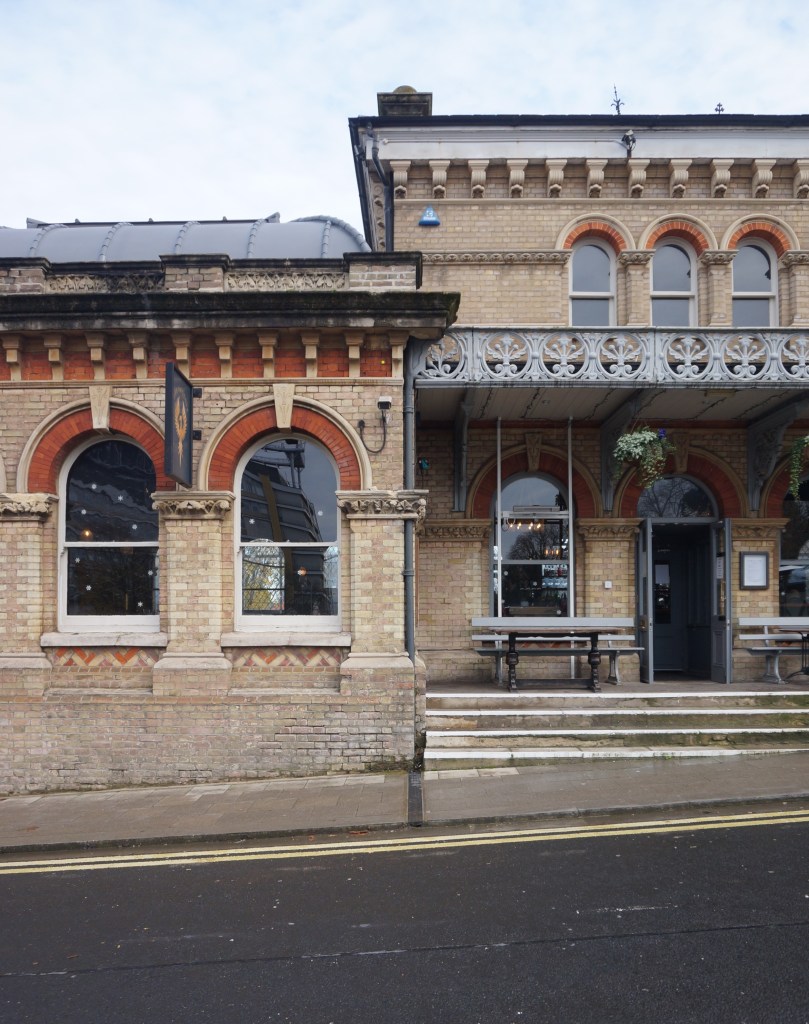
Monumental Halls, London

In composition, the Aberystwyth building, now known as Old College, was somewhat rambling and disjointed, an inevitable consequence of its troubled construction history. This suggested the accretive development to be found in so many medieval buildings, which did not sit badly with the muscular early Gothic style that Seddon employed, full of the ‘vigour’ and ‘go’ beloved of High Victorian architects. But any such picturesque winsomeness was banished from his final design for a public building. By the middle of the 19th century, the amount of monumental masonry in Westminster Abbey had burgeoned, spilling out from the eastern arm of the church into the transepts and nave. The situation was clearly untenable, but despite Sir George Gilbert Scott’s putting forward two schemes for additional accommodation in the form of a cloister, nothing was done until 1890, when a Royal Commission was established to investigate possible solutions. Rather curiously, Seddon’s first drawing is dated two years previously.
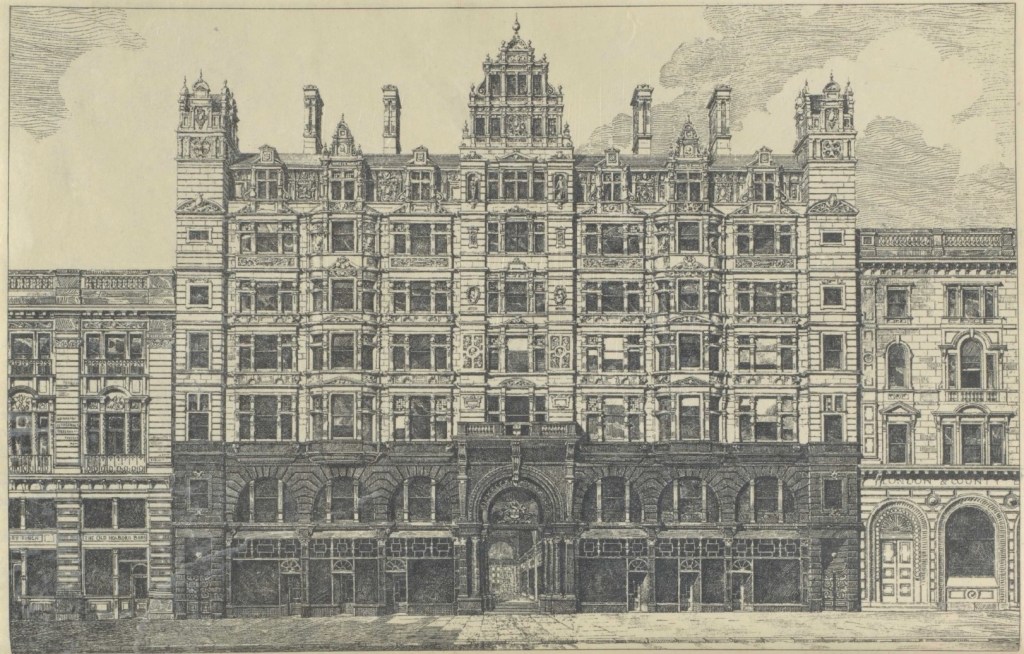
South elevation of J.P. Seddon’s design of 1888 for the mausoleum forming part of the first version of the scheme for the Monumental Halls

Seddon, working in partnership with Laurence Harvey, Instructor of Scientific Masonry at the City and Guilds, was among a group of architects who contributed proposals. They envisaged giving the chapter house a diadem of six chapels, with a new ambulatory around the east end of the building to provide access to them. This would also connect with an immense new mausoleum fronting Abingdon Street, designed in Seddon’s favourite Geometric Decorated Gothic. There were to be emphatic octagonal towers at the corners and along the flank walls, where they broke through tiers of niches holding statues presumably representing the worthies commemorated within. The principal chamber was to be raised up above some sort of undercroft and to have a tierceron vault running for its entire length. Construction of the mausoleum alone would have run to £200,000 out of a total cost for the scheme estimated at £480,000, and buying out the properties occupying the proposed site on Abingdon Street would have inflated it by a further £100,000.

Artist’s impression of the 1904 version, bird’s eye view from south west: the central tower added to Westminister Abbey is not known to have formed part of the scheme and seems to have been pure artistic licence, added simply to counteract the crushing visual effect of the immense campanile. (RIBA Collections)

Nothing came of the project, but in 1901 Edward Beckitt Lamb (1857-1932), son of Edward Buckton Lamb (about whom see this recent post) exhibited a design for a National Monument to British Heroes at the Royal Academy. This seems to have inspired Seddon to approach him with a view to reviving and revising the 1890 scheme, which was eventually published in The Building News in March 1904. This time, everything was concentrated in a single separate mass linked to the Abbey by an arm running off the Great Cloister. This led into a reception hall, 64ft (19.5m) across, to be situated on the ground floor of an immense tower that was to rise to 550ft (168m) in height. Above it, this would accommodate a series of galleries for monuments and space for archives. There would be a walkway around the top of the tower and the lantern of the crown steeple above would house a belfry. Again, there would be an enormous vaulted memorial hall, 192ft (58.5m) in length, which at its southern end, fronting Great College Street, would expand into a huge transepts with polygonal ends, reaching 157ft (48m) in width. A chapel-like space interposed between the hall and the tower and terminating in a polygonal apse balanced the east-facing apse of the double transept to create a grand, spreading, symmetrical elevation. Towers with needle spires were to rise from the re-entrant angles. Stylistically, the project had undergone a metamorphosis, chaste Geometrical Decorated Gothic having given way to an overripe, heavily ornate version of Perpendicular, not entirely unlike that used by Lamb’s father.

Artist’s impression from Parliament Square and plan of the scheme, as published in The Building News of 25th March 1904

Without a doubt, it was hypertrophied Edwardian imperial triumphalism, albeit evocatively portrayed in artist’s impressions that suggested visionary architecture of a kind almost to rival Étienne-Louis Boullée. But it is difficult to believe that it was intended as a serious proposal (in any case, Seddon would retire from professional practice very shortly afterwards) and it does not show at its best an architect who generally performed better on a much smaller scale where his penchant for the applied arts could be properly appreciated. That is something that comes through well in his numerous designs for vicarages, villas and schools and is also in evidence at Sir William Powell’s Almshouses in Fulham, one of Seddon’s finest and most characteristic secular commissions.

Sir William Powell’s Almshouses

Sir William Powell’s almshouses, Fulham, London (J.P. Seddon, 1869-1871): the entrance to the complex from Church Gate and former library and water tower (Mark Berry)

This institution had originally been established in 1680 to provide accommodation for 12 poor women. In 1869 it was re-established on a new site on the northern boundary of the extensive graveyard of All Saints’ Church. In essence, it is an L-shaped terrace of 12 two-storey houses, but treated in a very sumptuous manner: The Building News of 12th May 1871 reported that the Rector and his wife had organised a subscription to supplement funds already raised through the sale of the old building ‘for the special purpose that the work might be made more architectural than would be otherwise justifiable under the circumstances’. The manner is Seddon’s ornate Geometrical Decorated Gothic, cleverly adapted to a domestic setting. He establishes an effective rhythm of repeated forms and alternating solid and void through the use of polygonal bay windows at ground floor level, joined by triple arches to create porch openings. That allows for a continuous pent roof to be sustained, running the whole length of the frontage. Invention in the vertical plane is complemented by the varied roofline – tall chimney stacks and traceried dormers at first floor level, and a tower with a hipped roof at the street entrance to the complex from Church Gate. This originally a housed a small library on the first floor and a water tank in its uppermost stage, where the external niches are filled with figures representing Miriam, Ann, Deborah, Dorcas, Ruth and the Virgin Mary.

Sir William Powell’s almshouses, Fulham, London (J.P. Seddon, 1869-1871): the inner courtyard (Wikipedia Commons)

St Peter’s, Ayot St Peter, St James’s, Great Yarmouth and St Catherine’s, Hoarwithy

This same flair for achieving great richness on a small scale can be even better appreciated at two important ecclesiastical commissions both begun in 1874. Of all Seddon’s churches, St Catherine’s in Hoarwithy, Herefordshire has probably attracted the most attention, not least for its glorious setting in the Wye Valley, from which it rises like a vision of Tuscany. Seddon’s involvement seems to have resulted from a typical case of an enthusiastic Victorian clergyman, finding no other outlet for his energy in a remote rural parish, directing it into a comprehensive remodelling and beautification of his church. When appointed to the living, the Rev’d William Poole found there a plain preaching box of 1843 in a round-arched style. This seems to have prompted him to direct Seddon (from whom in c. 1868 he had already commissioned a combined schoolroom and schoolmaster’s house) to produce a scheme in a Continental Romanesque manner. It is, as far as I am currently aware, Seddon’s only essay in the idiom and it is paradoxical that his best known church should be the least typical of his output.

St Catherine’s Church, Hoarwithy (remodelled by J.P. Seddon, 1874-1903) viewed from the south: note the cloister arm connecting the porch in the base of the tower with the narthex at the west end.
St Catherine’s Church, Hoarwithy (remodelled by J.P. Seddon, 1874-1903): the vault over the chancel supported on columns of Devonshire marble.

The work was carried out at Poole’s own expense, which may explain why it dragged and was completed only around the time of his death in 1903. Seddon recased the nave in the local red sandstone also used for the rest of his additions, refenestrating the older fabric and replacing the roof. He added a triple-apsed chancel adjoined by a tall campanile to the south. This accommodates a porch on the ground floor (it is the east end that faces the road) and leads through to a loggia running the length of the nave, which provides access to the narthex at the opposite end where the church is entered through the west door. The building is meticulously detailed – the capitals of the loggia alone would make it worth a special visit – and Seddon’s study of Romanesque prototypes in the Rhineland and Venice on his travels as a young man seem to have stood him in good stead. There are mosaic floors throughout, the timbers of the roof structure of the nave are adorned with painted decoration by George Edward Fox (1833-1908) and there is a gold mosaic of Christ Pantokrator in the central apse. The choir stalls of 1883, incorporating figures of saints and scriptural subjects, and prayer desk of 1884 were executed by Harry Hems of Exeter (1842-1916) and carved in oak from Poole’s estate. Some of the stained glass was by Hugh Arthur Kennedy (1854-1905), a favourite collaborator, while those windows in the apse that commemorate Poole were made to Seddon’s own designs.  

St Catherine’s Church, Hoarwithy (remodelled by J.P. Seddon, 1874-1903): the loggia running along the south side of the nave looking towards the porch in the base of the tower. A detail of the mosaic pavement is shown in the frontispiece at the top of the page.
St Catherine’s Church, Hoarwithy (remodelled by J.P. Seddon, 1874-1903): one of the windows in the apse depicting Christ and the Evangelists designed by the architect and installed in 1904.

The chancel is a miraculous toy – monumental in conception, yet miniature in execution. It appears to be a scaled-down version of a spatial arrangement first tried in one of Seddon’s most intriguing schemes for an urban church – St James’s in Great Yarmouth. In 1862, Seddon had been approached to carry out a comprehensive restoration of the town’s vast medieval parish church of St Nicholas. It was in a badly dilapidated state and this turned out to be a major project that would occupy him for the best part of 10 years. Great Yarmouth was expanding rapidly at the time and the place of worship serving its new suburb of Camperdown was intended to rival the medieval mother church in magnificence and scale. In c. 1869, Seddon produced a most unusual design based on a cross-in-square plan, a favourite device of Stuart church designers derived ultimately from Dutch models. An evocative artist’s impression of the interior, published in The Architect in 1882, shows a central dome supported on squinch arches, with what infers to be a colourful decorative scheme complementing the vigorous structural polychromy. According to a paper entitled ‘Sundry Working Drawings’, which had been read by Seddon to the Architectural Association on 24th November that same year and was published the following month in two installments by The Architect, accompanied by this and other illustrations of his work, the internal walls were to have been faced in buff-coloured brick diapered in red, while the dome was to have been built of concrete, faced internally by mosaics executed by Rust & Co. Mosaics by the same firm were also to be set into the pulpit, which was to be made of stoneware from Fulham Pottery and to be set upon a base of polished serpentine. The history of the project is somewhat obscure, but it seems that only the central aisle was completed to Seddon’s design and the original scheme was then abandoned. The crossing was dismantled and four-bay arcades substituted for the three immense openings to the central vessel when Bottle and Olley added lean-to aisles in their completion of 1902-1908.

St James’s Church, Great Yarmouth: artist’s impression of the exterior as published in The Building News of 20th December 1872
St James’s Church, Great Yarmouth: view of the interior based on a coloured perspective drawing by Howard Gaye as published in The Architect of 2nd December 1882
St Peter’s Church, Ayot St Peter, Hertfordshire (J.P. Seddon, 1875): view from north west
St Peter’s Church, Ayot St Peter, Hertfordshire (J.P. Seddon, 1875): the chancel ceiling – the wrought iron chancel screen is a later addition of 1908 by an unknown designer

Despite the renown of Hoarwithy, if one were to pick a single building to stand for all of Seddon’s new churches and his aesthetic ideals, St Peter’s at Ayot St Peter in Hertfordshire would be the better choice. The commission came about in unusual circumstances. In 1862, John Loughborough Pearson (1817–1897) had provided a new church for the village to replace a curious octagonal Georgian predecessor of 1750-1751, which itself had superseded a medieval building. But in 1874 it was hit by lightning and badly damaged. The decision was taken to abandon everything other than the chancel, which was retained as a mortuary chapel, and to construct a replacement on a new site located nearer the village centre. A competition was held that same year, from which Seddon emerged victorious, and the new building was completed within the course of 10 months in 1875. In form, it is typical enough for the period – a simple, two-cell building with an apsidal chancel and a small tower and spire adjoining the nave to the south, all handled in a muscular Gothic style with much constructional polychromy. But the geometrical games played in the design of the tower – an octagonal belfry stage with broaches in the angles – and the colourful clock face already hint at a very different temperament to that in evidence at its numerous counterparts from the period.

St Peter’s Church, Ayot St Peter, Hertfordshire (J.P. Seddon, 1875): the floor of the sanctuary, with Godwin tiles set in a mosaic pavement by Rust & Co
St Peter’s Church, Ayot St Peter, Hertfordshire (J.P. Seddon, 1875): the lectern

This is confirmed by the interior, a deliciously pretty confection of bright colours and varied patterns and textures. It is spanned by a wagon roof, a favourite device of Seddon’s. That in the nave is a trefoil in section, that in the chancel is richly painted, with Christ in a mandorla in the centre over the altar and symbols of the Evangelists, the Company of Angels, suns and stars in the other panels. It was the work of a ‘Mr Gage’ (perhaps Howard Gaye) and J.R. Thompson, who executed it partly on canvas and partly directly on the panelling using stencils. The painted scheme was to have been extended to the nave, but fell victim to economies. The encaustic tiles in the chancel were manufactured by Godwin’s of Lugwardine. Such features are noteworthy, but by no means peculiar to Seddon’s churches and other devices, such as the colonettes of polished coloured marble to the pulpit and font, are commonplace in the period. But more unusual media are brought into play, too. The chancel arch is clad in blue-grey glazed stoneware by Walter Frazer Martin of Fulham Pottery, the concern originally established in the 1670s by John Dwight and revived by C.J.C. Bailey, who purchased it in 1864. This is reputedly the firm’s only ecclesiastical commission.

St Peter’s Church, Ayot St Peter, Hertfordshire (J.P. Seddon, 1875): the font, executed by Henry Poole & Sons of London to Seddon’s design with mosaics by Rust & Co
St Peter’s Church, Ayot St Peter, Hertfordshire (J.P. Seddon, 1875): the east face of the belfry with the mosaic clock face by Rust & Co

Mosaics play an especially important role. These were executed by Rust & Co, a firm established in Lambeth in 1856 by Jesse Rust, who around 1864 devised a method of producing coloured and gold- or silver-enamelled vitreous mosaics from recycled glass, intended to be sufficiently durable to be usable for exterior features. It was heavily promoted by Sir Henry Cole (1808–1882), who commissioned floors and mosaic panels from Rust for the first phase of the South Kensington (subsequently Victoria and Albert) Museum. The mosaic dial to the clock has already been mentioned; Rust provided something similar for Seddon’s church of St Mary’s at Ullenhall in Warwickshire of 1875, where design of the tower and spire is a verbatim quotation of that at Ayot St Peter, and also executed the mosaic for the Old College in Aberystwyth mentioned above. Rust was responsible for the mosaic floor in the sanctuary, which forms a sort of matrix for the Godwin tiles, and the delightful frieze depicting fish and lilies that runs around the tub of the font. It was originally intended that slabs of vitreous mosaic by Rust should decorate the walls, and that the door and window dressings should be made of terracotta, but this proposal had to be abandoned on grounds of cost. The church retains its original fittings, all designed by Seddon.

Tower Bungalows, Birchington-on-Sea

Detail of Sea Tower, the tallest of all the eponymous towers of Tower Bungalows: it delivered no less than the name promised – commanding views over the North Sea, which begins quite literally at the bottom of the garden.

St Peter’s has been characterised as proto-Arts and Crafts. That is true of the ethos that informed it, with the building treated not so much as a definitive statement of an architectural concept as a vehicle for contributions by practitioners of the applied arts. But stylistically, for all the individuality of some of the devices employed, it is resolutely Gothic. Moreover, it is the work of an architect who had little truck with the fundamental stylistic shifts that were taking place in Victorian architecture at the time. Around the late 1860s, architects had begun to rediscover the heritage of the early 18th century, embracing a tradition which had been anathema to the followers of Pugin and Ruskin. This took domestic design in a very different direction, as recounted at length by Mark Girouard in Sweetness and Light, his study of the Queen Anne movement. Inveighing against this new trend, Seddon thundered from The Building News (9th July 1872), ‘Of réchauffés, of even Elizabethan architecture, and certainly of the Queen Anne style, lately come into fashion, we had had more than enough… their hybrid jumbles of detail are not sufficiently eclectic in any good sense to deserve imitation at our hands’. And again, three years later (Comments on H.H. Stannus’s paper, ‘The Queen Anne movement and its relationship to Gothic and Classic’, read to the Architectural Association on 17th April 1875 and printed in the Building News shortly afterwards): ‘There was no point of merit of interest in the work of Queen Anne’s time that was original, inherent or due to the style. There was no style whatever about it. The few desirable points which it possessed… [are] wholly independent of the senseless, trashy nature of the details used. Let architects go back… to that whence it derived all that it had of inspiration, and beyond that whence it got all its impurity and absurdity. And whither should we go but to Gothic?’

One of John Taylor’s bungalows at Birchington-on-Sea, as illustrated in The Building News of 15th August 1873. Quoting Sir Erasmus Wilson’s words of approbation, the accompanying article on p. 166 laid great stress on the simplicity and practicality of the construction. The roofs were composed of common rafters rather than full trusses and covered in patent tiles of Taylor’s own invention, which locked into one another and thus were not prone to being dislodged by winter storms or the vortex effect. The gap between the inner and outer skins of the wall was filled with overlapping slates, which protected the building from damp ingress caused by driving rain or sea sprays. It was claimed that this would also insulate the house during winter and prevent solar gain during the summer. Cornices had been omitted internally, ‘as also all other ornaments and decorative features, usual even in speculating builders’ erections, and for which no one but the plasterers are ever one whit the better’.
An as yet-unidentified property (possibly Birce Bungalow), also put up as part of John Taylor’s development at Birchington-on-Sea, pictured around a century after its construction. At the time it was unoccupied and would shortly succumb to redevelopment, along with most of its neighbours.

And yet five years later, Seddon produced a remarkable group of buildings that give every indication of the readiness to abandon Gothic that he so deplored in architects of the younger generation. Something of the context from which they emerged first needs to be sketched in. The growth of resorts along the Kent Coast, particularly on the Isle of Thanet, began early and predated the railway age. It was stimulated in part by the enthusiasm for sea-bathing with its perceived curative properties, in part by pleasure-trippers from London who arrived by paddle steamer. Towns such as Margate and Ramsgate expanded rapidly, and by the mid-19th century, developers were turning their attention to the area to the west, which had yet to be built up, but was now served by a rail connection.

View by Raffles Davison of Station Hotel at Birchington-on-Sea as originally proposed by Seddon, published in British Architect of 12th May 1882
View of the six Tower Bungalows as originally proposed by Seddon from the landward side by Raffles Davison, published in British Architect of 12th May 1882

In the late 1860s, work began on laying out what would become the new resort of Westgate-on-Sea to a scheme devised by architect Charles Nightingale Beazley (1834-1897). The potential for speculative development attracted an architect by the name of John Taylor (1818-1884), who had previously designed a number of stations for the London, Chatham and Dover Railway, the operator of the line running through the settlement. In 1869, he constructed six single-storey villas believed to be the first bungalows in the country. Four of them were bought by the dermatologist and philanthropist Sir Erasmus Wilson (1809-1884) and the venture, which was covered by The Building News, was successful enough for Taylor to look at another development further west in Birchington. There, he put up a number of bungalows on a clifftop site to the northeast of the original village near Coleman’s Stairs, a path leading down to the seashore. ‘Fair Outlook’, built in 1872-1873, survives, albeit hemmed in by much later development, and is listed at Grade II. Two of the others named ‘Haun’ and ‘Thor’, built in 1873 and 1874 respectively, though no longer extant, were covered in some detail by The Building News. As originally built, the bungalows stood in isolation on the cliff top, some distance from the medieval village centre. This was an entirely conscious ploy: Taylor intended his development to appeal to buyers seeking to escape the already overcrowded, overbuilt established resort towns, such as those further east along the Thanet Coast, and to return to a way of life that was simpler and closer to nature, playing on the associations of this novel building type with the Indian hill towns where it had originated. Nothing would hinder communion with nature, enjoyment of marine views and partaking of bracing sea air. By all these tokens, it was also a very exclusive kind of simplicity. All but the affluent upper-middle classes were priced out, while there was little chance of day-trippers and holidaymakers disturbing the occupants’ peace, not least because each of the houses had its own access to the beach via an underground flight of steps.

Satellite view of Tower Bungalows from the north showing (right to left) Sea Tower, Tresco House, Whitecliff and Del Monte (Google Earth)
The entrance to the private road providing access to Tower Bungalows, showing (left to right), Sea Tower, Tresco House, Whitecliff and Poet’s Corner

It seems that for a while Seddon had some kind of professional involvement with Taylor and around this date was engaged to produce a master plan for the development of the area between the railway and the sea front, which was to be called ‘The Cliff Estate’. Streets began to be laid out and Seddon produced an imposing design for a hotel that was to go up on a site immediately to the north of the railway station. Editor of British Architect Raffles Davison (1853-1937) visited in 1882 to report on the project, producing views of some of the buildings. These must have been based on Seddon’s drawings, since he reported that little progress had been made with the scheme. Davison’s view of the hotel shows a sprawling complex in a robust High Victorian manner, leavened by more informal touches in the vein of Norman Shaw’s ‘Olde English’ style, such as the areas of half-timbering. To the right of the octagonal tower directly above the platform shelter is an intriguing building with a semi-circular veranda and suggestions of painted or incised decoration on the plastered areas between the timbering, which looks like it might well have been intended to be purely cosmetic. This may represent the re-emergence of an idea first tried at Aberystwyth, where Seddon substituted timber framing with incised and coloured cement panels for stonework since it could be executed more quickly by Savin’s men. There are medievalising overtones, but very little that is explicitly Gothic. The design did not leave the paper it was drawn on and the hotel that was eventually built on the site (which does not survive) was far more modest in all respects. But it provides some fascinating clues to what was in Seddon’s mind at the time and informed the design of the one part of his scheme to be realised.

Tower Bungalows from north west viewed from Winston Court
The tower of ‘Sea Tower’ from south west: note the recessed panel with the sgraffito figure and, to the right, the stair tower with the monopitch roof. Immediately next to that is a glass lantern which presumably lights the main octagonal circulation space.

Evidently prompted by Taylor’s success, Seddon planned a development of bungalows between ‘Haun’ and ‘Thor’ and Coleman’s Stairs. They were to go up on a row of long, narrow plots running all the way down to the edge of the clifftop, fronting not Spenser Road – the main thoroughfare running east-west across the Cliff Estate – but a small private road looping out from it. The island site between the two was to be occupied by mews buildings. Six bungalows were planned, but only four were actually built – ‘Sea Tower’, ‘Tresco House’, ‘Whitecliff’ and ‘Del Monte’. Seddon seems to have borrowed several features from ‘Fair Outlook’ – the long, narrow massing, the spreading, low-pitched roof and the incorporation of a tower at the seaward end. The tower of the westernmost bungalow, Sea Tower, is one storey higher than those of the others and Davison’s view suggests that it was to be answered by a tower of equal height to the unbuilt easternmost bungalow at the opposite end of the group, giving the ensemble symmetry as a whole.

Floor plan of ‘Sea Tower’ as published in The Building News of 20th October 1905
The passage leading to the main entrance at ‘Whitecliff’

The bungalows vary slightly in size and configuration, but the general plan form was apparently the same. The principal rooms are all concentrated at the north end to take advantage of views over the garden and the open sea beyond. The entrance is surprisingly informal, set well back from the road front and to offset to one side. It leads through to a polygonal lobby and then into an octagonal circulation space, from which a long spine corridor extends back towards the road, terminating (in Sea Tower, at any rate) in a billiard room. In between these two points, rows of what must be bedrooms open off it. Mosaic flooring within was produced by Rust and Co and marble fireplace surrounds survive which supposedly were designed by Seddon.

The Old Coach House and Sunny Lodge (former mews buildings for Tower Bungalows) seen from Spenser Road, showing the sgraffito panels by George Frampton
West elevation of Poet’s Corner (former mews buildings for Tower Bungalows), showing the sgraffito panels by George Frampton

The exteriors of Tower Bungalows are plain whitewashed stucco and decorative touches are used sparingly – brackets for the broad eaves, glazing bars subdividing the upper lights or margins of the windows. The flank walls face narrow passageways, and thus would have hardly benefited from any decorative treatment, while the road fronts were not the main point of access. There is more visual interest in the garden fronts with their clever grouping together of two large bay windows under a single gable and advancing and receding planes, but only that of Sea Tower can really be viewed from the public realm over the garden wall. Architectural effects are concentrated on the upper stages of the towers (which Seddon’s drawings suggest may originally have been finished with dummy timber-framing), the powerful sculptural forms of the chimneys and the roofs, with bands of fishscale tiles and ridge cresting. The real swagger is reserved for the only part of the complex wholly visible from the public realm – the three mews buildings, where the panels between the dummy timbers are adorned with brightly coloured sgraffito panels by George Frampton (1860-1928) depicting putti and stylised plant motifs.

Detail of Frampton’s sgraffito decoration to Tresco Lodge and The Porch, another one of the mews buildings for Tower Bungalows: the difference in colour scheme reflects that fact that what was formerly a single property has been split into two.

Birchington-on-Sea and Dante Gabriel Rossetti

By popular repute, one of these bungalows was the final address of Seddon’s friend Rossetti, who moved to Birchington in February 1882. In fact, he resided not at Tower Bungalows, but at a different property a short distance away to the southwest. This was a most intriguing piece of design, put up in 1877 as part of Taylor’s original development, but built out of prefabricated timber components and with an asphalt roof. Despite the less substantial construction, it was set in spacious grounds and every bit as was well appointed, with six bedrooms, a lounge, library, dining room, a study and service accommodation. Regrettably the house is no longer extant. Sold to Irish millionaire H. Osbome O’Hagan after Rossetti’s death, it was subsequently inherited by his daughter, then, after she died in 1952, was subdivided into three smaller properties before being demolished for redevelopment in 1966.

The Rossetti bungalow on Beach Avenue in c. 1952: the construction techniques had numerous affinities with those employed at the Bungalow Hotel, put up in 1878, which Seddon’s scheme for the Station Hotel pictured above was presumably intended to supersede.
Ground plan of the Rossetti bungalow, as published in The Building News of 1st September 1905
Cross-section of the drawing room of the Rossetti bungalow, as published in The Building News of 1st September 1905: it is clearly identifiable in the photograph above by the prominent clerestory roof. This must be the interior depicted by Davison in the view published in British Architect of 12th May 1882, which suggests that it was furnished with items such as Japanese ceramics that were the badge of allegiance of a follower of the Aesthetic Movement.

Rossetti did not reside in Birchington for long. His health was already failing, the result of a stroke the previous December and many years of substance abuse, and he died on 9th April 1882. He was buried in the churchyard of All Saints’ Church, where his grave is marked by a cross designed by Ford Madox Brown and executed by Jane E. Patterson. Inside the church, he is commemorated by a stained-glass window in the south aisle by Heaton, Butler and Bayne, installed in 1884. But though short, the association seems to have been useful for raising the profile of Tower Bungalows, which later attracted the painters Arthur Gilbert (1819-1895) and Simeon Solomon (1840–1905). In due course, Seddon was approached to design a monument to his friend, which took the form of a drinking fountain in Chelsea Embankment Gardens opposite Rossetti’s house at 16 Cheyne Walk, where he had resided from 1862 until the move to Birchington. Unveiled in 1887, it is a ponderous piece of neo-Romanesque executed in granite, with a bronze portrait bust by Ford Madox Brown. As a brief aside, it might be noted that Seddon’s connection with Thanet did not cease at Rossetti’s death. In 1896-1897, Belham & Co executed to his design at the church of St Peter in Broadstairs an elaborate painted scheme to decorate the boarded chancel ceiling, originally introduced when he replaced the roofs throughout this substantial medieval building in a restoration of 1872.

Window commemorating Dante Gabriel Rossetti in the south aisle of All Saints’ Church. Birchington-on-Sea by Heaton, Butler and Bayne of 1884
The Celtic cross over the grave of Dante Gabriel Rossetti in the churchyard of All Saints in Birchington-on-Sea, designed by Ford Madox Brown and executed by Jane E. Patterson
The Dante Gabriel Rossetti Memorial in Chelsea Embankment Gardens, London (J.P. Seddon with bronze relief by Ford Madox Brown, 1887)

Conclusion

The former vicarage at Kenardington on the edge of Romney Marsh in Kent: J.P. Seddon’s contract drawings for the building, dating from late 1873, are in the RIBA Collection and the design bears several hallmarks of his style, but is not featured in The Buildings of England and is not statutorily listed.

Victorian architecture can throw up some bizarre and perplexing conundrums, few of them more so than Seddon’s Tower Bungalows. While a study of this length cannot do more than give a brief flavour of their architect’s prolific output, one does not need to assemble too many examples of his work to see that they are very uncharacteristic of it. In such situations, positing a division between an architect’s secular and ecclesiastical modes can sometimes elucidate matters. The Victorian age was dogmatic and prescriptive about what was acceptable for a church, whereas domestic commissions often offered much greater scope for innovation. But not here. Even allowing for the substantial differences in the nature of the commission, Seddon’s other notable speculative residential development, Victoria Terrace in Aberystwyth (just like Tower Bungalows, intended to be the first stage in a much larger project that proved abortive), is wholly characteristic of its date from the turn of the 1860s and 1870s. At the moment, forming an objective view is difficult in the absence of a comprehensive survey of Seddon’s life and career that would allow any one of his works to be placed in its proper context, and we must hope that Tye R. Blackshaw gets the chance to write the monograph that is so badly needed. Her published writings on Seddon suggest that she would be eminently capable of doing him justice.

West elevation of the church of St Andrew, Redruth in Cornwall, as published in The Architect of 9th December 1882: work on this essay in Seddon’s favourite Geometrical Decorated Gothic, which was produced jointly with local architect James Hicks (1846-1896), began the following year and construction commenced at the west end, although the planned tower was omitted at the outset. The use of a tall octagonal belfry stage to effect the transition from the tower to the spire was a favourite device, used not only at Ayot St Peter, as pictured above, but also at St Mary’s, Ullenhall in Warwickshire of 1875.
Long section of the church of St Andrew, Redruth in Cornwall, as published in The Architect of 9th December 1882: the design was based on a broad nave with narrow passage aisles and prominent transepts. Note how the nave is canted inwards at the east end where it meets the narrower chancel. The church was not completed until 1937-1938, by which point the original design by Seddon and Hicks had been abandoned in favour of a much simpler scheme by R.F. Wheatly of Truro.

It is a mistake to view any period in art history as a succession of avant-gardes – one will always end up with figures who do not fit into any discernable trend. But there is nevertheless a strong impulse to schematise Victorian architectural history because the field is so vast and so diverse. It is difficult to make sense of a period of huge artistic plurality without at least sometimes reaching for labels, and the polarising effect of the various polemics that raged for much of the 19th century only increases the temptation. The waters have been further muddied by twentieth century historians such as Sir Nikolaus Pevsner, who seized on a select few works to support a teleological view of the emergence of modernism, even when they are not necessarily typical of their creator’s output as a whole or may not have spawned any direct descendants. To take one example, the handful of furniture and graphic designs of Arthur Mackmurdo (1851-1942), which have attracted so much attention for their use of the ‘whiplash’ motif, look less like a precursor of Art Nouveau when viewed in the context of his often gauche and stylistically indeterminate architecture and more like an intriguing flash in the pan.

The font at St Jerome’s in Llangwm Uchaf, Monmouthshire, a medieval church heavily restored in 1863-1869 by Seddon, who largely rebuilt the nave and south porch and refurnished the building. Here is one of the architect’s excursions into complex geometrical form, complemented by capitals depicting local flora.
The Annunciation, as depicted in the east window of St Jerome’s, Llangwm Uchaf: this was designed by Seddon in c. 1877 on the basis of a cartoon by Hugh Arthur Kennedy (1855-1905) and executed by S. Belham & Co using Rust’s ‘antique’ glass. ‘The nervous intensity of the figures, their pre-Raphaelite style and the unusual colouring in turquoise and brown make this an exceptional creation’ (John Newman, The Buildings of Wales).

But then architectural history is full of dead ends and they are problematic only when we insist on trying to make sense of them by demonstrating how they might fit into a wider pattern of development. By that token, we should not speculate about Tower Bungalows and what Seddon might have produced had he had the chance to complete the Cliff Estate and to continue his stylistic explorations. Unless scholarship can demonstrate otherwise, it is possible that the progressive treatment of the architecture was the one-off result of a chance convergence of external influences and circumstances. Perhaps, given the success demonstrated by Taylor’s innovations, there was even an element of opportunism. But I would like to think that it was a considered choice – Seddon was too careful, too thoughtful and indeed too strong-minded an architect to be meretricious. At any rate, we can only lament that the designers of 20th century successors to Tower Bungalows and developers of such large tracts of coastline in the vicinity lacked the ability to equal them in charm and individuality.

High Victorian Gothic unto the last: the School of Science and Art, Stroud, Gloucestershire, designed by J. P. Seddon in collaboration with W. H. C. Fisher and built in 1890-1899.

The Gothic horrors of a Victorian worthy – Charles Buxton and Foxwarren

The roots of the Gothic Revival extend as far into literature as they do into archaeology. The endeavours of one of its key progenitors, Horace Walpole (1717-1797), to recreate the Middle Ages in brick, wood, plaster and stone through his remodelling of Strawberry Hill were inextricably bound up with his evocations of the Middle Ages in writings such as his novel The Castle of Otranto. It was about more than just historicising escapism, and ventured into a fascination with the supernatural. Medieval buildings become the setting for visions and experiences that by turns thrill and horrify, a sort of architectural pathetic fallacy. Thus – to cut a very long story short – we arrive ultimately at Gothic Horror. By the High Victorian period, attitudes had changed dramatically and a high moral purpose, directed at spiritual, aesthetic and social improvement, drove the revival of Gothic architecture. And yet some of the products of that movement are so emotionally and psychologically unsettling that it is hard not to sense in them the spirit of Walpole, even Edgar Allan Poe. Here is one such.

Strawberry Hill – the main staircase, designed by Richard Bentley (1708-1782) in the 1750s.

I was brought up in Surrey and have an ambivalent attitude towards the county. Some of the countryside in the North Downs and Surrey Hills is truly lovely, but the M25 belt and outer fringes of London are all too often echt subtopia, badly lacking in beauty and interest. But for all that, it is a rich hunting ground for Victorian architecture. Foxwarren Park is an estate today located just to the north of junction 10 on the M25 (the interchange with the A3), only a short distance from Painshill Park and Wisley Gardens. But whereas those are both visitor attractions, Foxwarren is overlooked and barely known since it is still a private residence – or perhaps I should say, ‘barely recognised’ rather than ‘barely known’, but let me come to that a little later.

Charles Buxton (1822-1871), albumen carte-de-visite by the London Stereoscopic & Photographic Company, 1860s (National Portrait Gallery)
Charles Buxton’s entry to the competition for the Foreign Office, as reproduced in The Illustrated Times of 27th March 1858, which reported that it had been produced jointly with William Gilbee Habershon (c.1818-1891) and (Matthew) Edward Habershon (1826-1900), with Buxton contributing the elevations.

The history of Foxwarren epitomises Victorian high moral purpose, for this was a seat of a scion of the Buxton family. Sir Thomas Buxton (1786-1845) was the son of an Essex squire who married into the Gurneys, the influential Norfolk Quaker family of bankers and philanthropists. Elizabeth Fry, the prison reformer, was his sister-in-law. In 1808 he joined the brewers Truman, Hanbury, Buxton & Co, where his maternal uncle was a partner. At the general election of 1818, he was elected MP for Weymouth, and subsequently represented the borough until 1837. He was involved in organising famine relief, promoted prison reform and was a founding member of what became the RSPCA. He campaigned vigorously for a number of humanitarian causes, most notably abolition. He was the partner of and successor to William Wilberforce as leader of the anti-slavery group in the House of Commons and, after his political career finished, devoted himself even more wholeheartedly to the cause. He was interested in agricultural improvement and established model farms at Runton and Trimingham near Cromer.

The Buxton memorial fountain, designed by Charles Buxton in collaboration with S.S. Teulon and originally erected on Parliament Square in 1865-1866
The interior of the Buxton Memorial Fountain, pictured also in the photograph at the top of this page.

Buxton had three sons, the youngest of which, Charles Buxton (1822-1871), was the owner of Foxwarren. After studying at Cambridge, he became a partner with Truman, Hanbury, Buxton & Co and in 1848 produced a biography of his father, which was an international bestseller. In many respects, he followed in his father’s footsteps, not least in entering politics (he was elected Liberal MP for Newport in 1857, Maidstone in 1859, and East Surrey in 1865, occupying that seat until his death) and embracing various causes for political, legal and social reform. Also like his father, he was interested in agricultural improvement, putting his ideas into practice on an estate that he purchased in County Kerry, Ireland. But unlike his father, he had a strong interest in architecture – not just visiting historic buildings (although he certainly did that), but actually producing and executing designs.

The north side of Home Farm at Foxwarren
The former Custom House at Ipswich Docks: by John Medland Clark (1813-1849): the design, with which Barnes assisted Clark, was selected in a competition held in 1843 and building work was completed in 1845.

A less ambitious man keen to try his hand at architecture might have started off small with something like a gazebo. But when in 1855 Buxton purchased the land on the edge of Wisley Common that would become the Foxwarren Estate – the name, incidentally, reflects his great passion for fox-hunting – he did so expressly with the intention of designing his own seat. He was not a man to be trifled with. In 1856, he entered the competition for the design of the complex of new government buildings that were eventually executed as what we know today as the Foreign and Commonwealth Office. His Gothic entry – he was a committed and evangelical Goth – came sixth and he was awarded a prize of £100.

The town side of the railway station in Needham Market, Suffolk (Frederick Barnes, completed 1849)
The town side of building of Stowmarket railway station (Frederick Barnes, completed 1849)

Buxton lacked professional training and that achievement owed something to the architect whose help he enlisted in working out the drawings. The identity of that figure is unknown, but fortunately we do know the name of the practitioner that he engaged for assistance with designing the buildings at Foxwarren. Frederick Barnes (1814-1898) was a native of Hackney, who had trained with Sydney Smirke (1798-1877), then worked in London and Liverpool for several years before coming to Ipswich in 1843 to assist his friend John Medland Clark (1813-1849) on the designs for the new Custom House building on the quayside. He settled in the town, setting up a practice of his own in 1850. Predictably for an architect of the period, he handled a substantial number of ecclesiastical commissions, restoring medieval churches and designing a number of non-conformist chapels. He also worked on public buildings, such as a town hall for Needham Market in Suffolk.

The interior of Christ Church United Reformed (originally Congregational) Church on Tacket Street in Ipswich by Frederick Barnes of 1857-1858
The entrance front of Barnes’ Methodist Church on Museum Street in Ipswich of 1860-1861

Probably his most notable works are the stations that he designed for the Ipswich and Bury Railway. The company was formed in 1845 to extend the existing London-Colchester route of the Eastern Counties Railway and Eastern Union Railway through to Stowmarket and Bury St Edmunds. It was subsequently partly incorporated into the main line to Norwich, the remainder becoming a branch line to the titular destination, which in due course was extended through to Ely. The line symbolised the arrival of the steam age in a rural and agricultural area, and Barnes rose to the occasion by providing buildings of some magnificence. Like most architects of the period, he was stylistically no dogmatist, aiming to handle proficiently whatever manner was most appropriate to the circumstances – Gothic, naturally enough, for the churches and chapels, classical at the Custom House, Italianate for the town hall.

Barnes’ former Presbyterian Church on Barrack Corner in Ipswich of 1870-1871
St Lawrence’s Church, Dial Lane, Ipswich, in Suffolk: the upper stages of the tower, sumptuously remodelled by Frederick Barnes in 1882.

For the railway stations, he used a free interpretation of neo-Jacobean, a style that enjoyed great vogue in the 1830s-1850s. Unsurprisingly, it was popular for country houses, but it could come into its own wherever something in the grand manner was required for a public function – schools, lunatic asylums, almshouses and much else. For Needham Market, the first settlement of any size on the route out of Ipswich, Barnes provided a grand symmetrical composition with a central block housing the ticket office bookended by cross wings that presumably originally provided accommodation for station staff (the building has long been out of railway use and now houses other functions). At Stowmarket, the next station down the line and a larger town, he used the same basic composition but expanded it by pulling the cross wings outwards and turning them into end pavilions, set at a slight distance from the central block and linked to it by corridor wings, the whole forming a monumental spreading elevation. For what was originally a terminus at Bury, Barnes provided a grand train shed, with imposing baroque towers rising from the ends of the screen walls, adjoined on the town side by a grand entrance block with a façade of five bays.

The town side of the railway station in Bury St Edmunds, Suffolk, designed by Frederick Barnes in collaboration with Sancton Wood (1815–1886) and built c. 1847: the later removal of the overall roof makes a nonsense of the screen walls and towers, grand though they are.
The former town hall of Needham Market, Suffolk (Frederick Barnes, 1849)

All this makes an interesting digression, but ultimately – other than the East Anglican connection, which presumably was the reason for their acquaintance – is by-the-by where Buxton is concerned, for the buildings at Foxwarren are strongly individual. One surmises that Barnes’s involvement was confined to purely technical matters. If one were to affix a stylistic tag to the main house, ‘neo-Tudor’ would need to suffice – and to be used advisedly. Like neo-Jacobean, the style enjoyed a vogue in the early Victorian period for a wide variety of building types and generally was fairly placid in temperament. But Buxton was aiming at something very different. We know something of what he had in mind thanks to Notes of Thought By the Late Charles Buxton M.P, a collection of his writings on various subjects published posthumously in 1883 and prefaced with a bibliographical sketch by the Rev. J. Llewelyn Davies. This is quoted in addenda of 1970 by Nicholas Taylor to the Surrey volume of The Buildings of England.

The entrance front of Foxwarren Park, Wisley, Surrey (Charles Buxton and Frederick Barnes, c. 1856) as depicted in The Illustrated London News in 1860
Foxwarren Park, Wisley, Surrey (Charles Buxton and Frederick Barnes, c. 1856): the entrance front today

Buxton had in mind the brick early Tudor mansions of his native Norfolk. The crow-stepped gables make the inspiration at once obvious, as does the adapted ‘E’-plan of the entrance front, the diapering of the brickwork, the groups of tall octagonal chimney stacks and so on. Architects of neo-Tudor buildings of the period generally used Bath stone for the tracery, copings, mouldings, arches and other dressings – stone masons were abundant and well versed in architects’ needs. Buxton broke with this by using ‘specials’ for all the detailing. These are custom-moulded bricks and, though commonly used in the 16th century, would have been far more difficult to obtain by this date, and there is a strong suggestion that they had to be made to order. In February 1856 Buxton noted, ‘I wonder whether our house will turn out as beautiful and picturesque as we intend. I think our plan of having brick mullions, mouldings, etc, which sounds common enough, is, in fact, very rare. I have never seen any house done so except the one at Harrow [which one he meant is not known]; the effect is surprisingly good, especially in sunshine, which gives it a rich warm effect, pleasant to the eye in our climate’. In April that same year he wrote, ‘I find we are striking out a new line, and that the world does not even know what one means by moulded brick. I hope we shall stimulate that style of building, and also set an example of the use of the pointed arch in house-building; I think our house will be singularly pretty and original’. But The Builder was unsympathetic: commenting on a view of the house displayed at an exhibition that year, an anonymous reviewer, writing in the issue of 19th March 1859, remarked sniffily that it ‘in our mind helps to show – what every one should be aware of but what we have had to point out – that good architecture of the day requires presence of more than elements such as mere Gothic old work and red colour’.

Foxwarren Park, Wisley, Surrey (Charles Buxton and Frederick Barnes, c. 1856) – the garden front
Foxwarren Park, Wisley, Surrey (Charles Buxton and Frederick Barnes, c. 1856) – the clock tower

Other buildings on the estate, such as the Byfleet Road and Redhill Road lodges, are recognisably cut from the same cloth. But Home Farm, located some way to the north of the main house, is another matter. Built in c. 1856, it is a substantial complex consisting of a quadrangle of single-storey farm buildings with a two-storey house for the supervisor at one corner and a detached octagonal dairy. It was intended as a model farm and the efforts directed at agricultural improvement through logical, rational planning invite comparisons with Home Farm at Leighton Hall (and of course numerous other such model farms nationwide). But whereas the treatment of that complex is, for the most part, in what the 20th century called the functional tradition, at Home Farm Buxton almost caricatured his own style. Though some of the design features must have been arrived at through purely practical considerations (the sinister-looking slit windows were presumably intended to provide constant ventilation to the barns without admitting intruders), the emotional effect of the distortion and scaling-up of the Gothic and Tudor forms is decidedly unsettling. It is not difficult to see why Ian Nairn, who had a good eye for Victorian architectural eccentricity, described it in The Buildings of England as a ‘nightmare… possibly the [most] extreme example in the country [of a Victorian model farm], and… certainly worth seeing. The sinister and neurotic atmosphere comes off all too successfully – usually these Victorian excesses are just a joke – and rivals Soane at his most eerie’.

Foxwarren Cottage, the former lodge to the southern entrance to the estate from Redhill Road (Charles Buxton and Frederick Barnes, c. 1860)
Foxwarren Cottage from the garden side

But imputing aesthetic motives post factum is a risky business. We may never know what Buxton had in mind when he designed Home Farm: it may have been nothing more than to produce something as ‘beautiful and picturesque’, ‘singularly pretty and original’ as the main house. Despite the reassessment of it that began in the 1960s, our view of Victorian buildings is still to an extent coloured by the attitudes of mid-20th century generations that viewed it with revulsion and distaste (Laver’s Law of Fashion coming into play again). It has become obscured by associations that are now not easy to dispel – Gothic in the wider sense of the word, which is why I began this post with a brief discourse on Walpole. Foxwarren Park has been used – albeit never starring as itself – as a location for numerous TV programmes and films, which have consciously exploited the sinister undertones of the architecture: The Comeback, a slasher film of 1978, and ‘A Tale of Two Hamlets’ in The Midsomer Murders to name but two. Yet for illustrator E.H. Shepard a couple of generations earlier, it evidently brought to mind not horror, but associations with the Victorian nouveaux riches, the sort of people whose architectural taste appealed to a parvenu like Mr Toad. He loosely based his illustration of Toad Hall early in Chapter 2 of The Wind in the Willows on Foxwarren Park, and the gate of one of the former lodges is literally reproduced for the third illustration of Chapter 11.

The north side of Home Farm, Foxwarren
The south side of the main quadrangle of Home Farm, Foxwarren, near Wisley in Surrey showing the vehicle entrance and adjacent supervisor’s house (Charles Buxton and Frederick Barnes, c. 1856)

Then again, we have on record that there were Victorian buildings regarded as beyond the pale by contemporaries, such as the Strand Music Hall discussed in the post on Bassett Keeling. There were notions of aesthetic propriety, of styles that were deemed especially suitable for particular building types, and situations when extravagance was and was not permissible. To embellish agricultural buildings in this manner is a conscious choice, and to subject the forms of medieval architecture to the transformations necessary to achieve such striking effects – Expressionism avant la lettre – is a conscious choice as well. Victorian Gothic is neo-Gothic, a reinterpretation – architecture such as Buxton’s will never be mistaken for anything produced by the Middle Ages. Nor, apparently, did he design like that here because he had no other mode or as a result of a lack of skill. Contrast the baleful, unsettling aesthetic of Foxwarren with the colourful, joyful fountain that he designed in collaboration with Samuel Sanders Teulon (1812-1873) to mark the achievement of his father and his associates in bringing about the Slavery Abolition Act of 1833. Originally erected on Parliament Square in 1865-1866, it was dismantled in 1949 and not re-erected until 1957, this time in Victoria Square Gardens.

The south side of Home Farm, Foxwarren, as photographed by Ian Nairn in the early 1960s when it was still a working farmyard and illustrated in the Surrey volume of The Buildings of England. Compare this with the contemporary view from approximately the same angle reproduced above.
The former dairy at Home Farm with the main quadrangle in the distance

But alas, it is now the black and white photograph of the farm taken by Nairn himself and reproduced in the old Surrey volume of The Buildings of England that most vividly conveys the impression made by the architecture. The elevation with the main cart entrance, illustrated here, does not disappoint the expectations raised by it, but unfortunately the rest of the complex most certainly does. At some point in, I would guess, the 1980s it fell victim to an insensitive residential conversion. Not a bad thing in itself – it gave redundant buildings a sustainable future – but the infilling of the open sheds facing into the central quadrangle needed to be handled far more sensitively. Was it simply hamfistedness? Or was the prospect of living in a Victorian gothic nightmare simply too much for denizens of the leafy Surrey stockbroker belt?

The Buxton Memorial Fountain: detail of the enamelled roof, which was made by Francis Skidmore of Coventry. Note also the mosaic inserts to the niches.

A house and a manifesto: E.B. Lamb’s Fawkham Manor

Word reached me at the end of last month of an exciting new addition to the National Heritage List, Historic England’s register of all the listed sites nationwide. On 26th November 2020, Fawkham Manor of 1866-1867 near Brands Hatch in northwest Kent became a Grade II-listed building. Far more than the date makes it of interest to this blog: Fawkham Manor is an important work by a singular architect who produced some wildly original buildings, the inimitable Edward Buckton Lamb (1805-1869).

Fawkham Manor: view from northwest
Fawkham Manor: the northeast-facing garden front

We have already encountered the term ‘rogue architect’ here in my previous posts on John Croft and on E. Bassett Keeling. In those I said a few words about why it can sometimes be rather problematic, the reason essentially being that subsequent commentators have interpreted it in a manner arguably not intended by its progenitor, H.S. Goodhart-Rendel, and applied it to figures not mentioned in his lecture of 1949, ‘Rogue Architects of the Victorian Era’, for which it was first coined. But in the case of E.B. Lamb, no such reservations need arise. He was the first architect to be covered that evening and Goodhart-Rendel discusses his output at length, rhapsodising about its innovative and eccentric nature, and emphasising that it was regarded as beyond the pale even by some of Lamb’s contemporaries.

Fawkham Manor: angled oriel at the junction of one of the elevations overlooking the garden and the service front
Stained glass in what is now the vestry of St Margaret’s in Leiston, Suffolk: 1854, the date on the scroll intertwined with the dividers, is when Lamb’s rebuilding of this church was completed. In the lobe of the quatrefoil to the left is his coat of arms, while that to the right contains a monogram formed of his three initials.

Fawkham Manor is especially interesting because it was intended to be Lamb’s own house – intended to be, but never inhabited as such, since the expense of the project bankrupted its creator and it was put up for sale before, in all likelihood, the interior had been completed. The background to and subsequent fate of the house are very well recounted in the excellent list description (the entry for a building on the National Heritage List, which sets out its history, describes its form, function and style, and explains why it was granted statutory protection) and I refer to that anyone interested in learning more.

Fawkham Manor: the rear entrance on the service side of the building – the large dormer with the striped, tile-hung cheek is a later addition.
Fawkham Manor: the former service range – the lantern may originally have provided ventilation for the kitchen.

Unless it is destroyed or altered beyond recognition, it is rare for a building to be completely ‘lost’ and Fawkham Manor had, so to speak, been hiding in plain sight, since it is mentioned with a date and attribution – albeit briefly – by John Newman in the ‘Kent: West and the Weald’ volume of The Buildings of England. But Victorian architecture is all too often passed over in a county better known for its medieval heritage, and there was a clear antiquarian bias on the part of the inspectors who compiled the first list for Kent in the 1950s-1960s and then revised and expanded it in the 1980s. Nineteenth or 20th century buildings that were too visible or too celebrated to ignore got their due, but a great deal was omitted. Besides, Fawkham Manor, being tucked away in a remote, wooded setting on the side of a valley and latterly in institutional use, was all too easy to overlook.

Before E.B. Lamb was E.B. Lamb, I: west elevation of the church of St Philip’s, Granville Square in Clerkenwell, the architect’s earliest church, designed in 1829, when he was aged just 24, built in 1831-1832 and demolished in 1938 after developing structural problems. A typical late Georgian Gothick preaching box, it prompted Goodhart-Rendel to remark, ‘Considering what they were to produce afterwards, Lamb’s powers as an architect developed late’.

Fortunately, given the possibilities offered by the internet to carry out exploration and research without leaving home, such risks these days are greatly reduced. A Google image search returned some tantalising photos which left me in no doubt that an expedition to see Fawkham Manor for myself was in order, and I visited with my camera last Saturday afternoon. The overcast, drizzly weather may not have showed off the building to best effect, but the architecture delighted and intrigued me. I hope what you see in my pictures here will delight and intrigue you as well. Seeing inside was not possible, since the private hospital that latterly occupied the house closed in 2019 and the site is currently being looked after by a security firm pending a decision on its future.

St Stephen’s, Aldwark, North Yorkshire: built in 1851-1853 and the church where Lamb’s trademark centralised design combining both cross-in-square and cruciform plans – repeated on a much larger scale at St Martin’s, Gospel Oak and St Mary Magdalene, Addiscombe near Croydon (1868-1869) – was first tried out. Lamb specialist Edward Kaufman described this building in The Faber Guide to Victorian Churches as one of the architect’s most important works, praising ‘the mysterious quality of this small but intricate space, part axial and part centralised, humble and low-roofed, yet full of flickering light and Gothic wonder’. (Chris Stafford)
General view and plan of St Martin’s, Gospel Oak, London as published in The Builder of 20th October 1866, around the time the church was completed: ‘a completely original, and, I think, almost perfect solution of what a large auditorium for Protestant services should be’, H.S. Goodhart Rendel, ‘Rogue Architects of the Victorian Era’.

Pity the architect designing a house for himself. On the one hand, it is a private residence, where he is free to do as he pleases. On the other, by that same token, he may feel under pressure to make it the purest example of his work, since he is under no obligation to make compromises to suit the wishes of a client and can use it to advertise his aesthetic credo. That is a responsibility that can weigh heavily on his shoulders and I have much sympathy with an architect of my acquaintance who protested that ‘My house is not my manifesto’. But that was not the case with Lamb. While his reputation for bold invention has tended to be most closely associated with his ecclesiastical output – Goodhart-Rendel describes enthusiastically his ingenious solutions for reconciling a medievalising language of form with the requirement in a modern Protestant church to seat as many worshippers as possible within sight and earshot of the preacher – domestic work seems to have brought out an even more wilful streak in him. As Goodhart-Rendel puts it, ‘In his churches he had reason to innovate: he wished to evolve an unprecedented type of plan which the customary proportions of Gothic would not fit. In his secular buildings he innovated without necessity just because he liked doing it’.

The east-facing elevation to Broad Street of the town hall of Eye in Suffolk, built in 1857 – like Fawkham Manor, an extravaganza of flint and patterned brickwork distantly inspired by local vernacular traditions. The base of the tower shelters the porch and there was formerly a lock-up on one of its upper storeys, while the ground floor of the adjoining wing originally housed a library.
The west-facing elevation to Cross Street of Eye town hall showing the principal volume, which originally housed the corn hall.

But evaluating this part of Lamb’s output is far harder. His public buildings, such as the town halls at Eye in Suffolk (1857) and Berkhamsted in Hertfordshire (1859) are well known. That they are strongly individual is not in doubt, but this is because they have survived well and can easily be assessed against counterparts of the same period. With domestic buildings, however, one is on much shakier ground. That it was important in Lamb’s output is clear enough. Early on in his career, he provided numerous designs for the Encyclopaedia of Cottage, Farm and Villa Architecture (first published 1833, expanded and revised second edition 1842) by landscape-gardener John Claudius Loudon (1783-1843), Loudon himself lacking an architectural training. Subsequently, he built up an extensive network of connections with landed aristocrats, but although that produced commissions for domestic work, for the most part it has attracted far less interest from architectural historians than his churches. The sole exception is Hughenden Manor outside High Wycombe in Buckinghamshire, which he remodelled in 1862-1863. Though characteristic and distinctive, its form still betrays its Georgian origins, and it is probably fair to say that the house owes the attention that it has attracted principally to the fame of the client, one Benjamin Disraeli. As Mark Girouard remarks in his biographical note on Lamb in The Victorian Country House, which includes a useful chronological list of works, ‘The large country house practice of this individual and independent architect remains unexplored’.

Before E.B. Lamb was E.B. Lamb, II: Hrádek u Nechanic, Hradec Králové Region, Czech Republic: designed 1839, executed 1839-1857 by Karl Fischer. In the context of the houses discussed here, it is interesting primarily as an indication of the kind of architectural milieu from which Lamb emerged. Like S.S. Teulon, he was schooled in the traditions of the late Georgian Gothic Revivalists and his idiosyncratic brand of High Victorianism took time to develop. (Wikipedia Commons)
Hughenden Manor, Buckinghamshire (originally Georgian, remodelled by E.B. Lamb in 1862-1863): the garden front (Hans A. Rosbach, Wikipedia Commons)

That was written in the 1970s and, as far as I am aware, the only person since then to have picked up the gauntlet was Edward Kaufman in his essay of 1988, ‘E.B. Lamb: A Case Study in Victorian Architectural Patronage’ (published in The Art Bulletin, Vol. 70, No 2). As Kaufman shows, for the most part Lamb’s country house work consisted of remodelling and enlarging existing, often relatively modest properties, his clients’ means seldom running to anything more ambitious. According to Kaufman, during the course of his career Lamb designed only three completely new country houses. That total, it should be noted, excludes Hrádek u Nechanic of 1839-1857 in the Hradec Králové region of the Czech Republic: though the design was indeed originally the work of Lamb, it may well owe more to the executive architect, one Karl Fischer, and in any case the relatively tame neo-Tudor manner is fairly generic for its date.

Aldwark Manor, North Yorkshire (1862-1864): the entrance front around the time of the completion of building work (Historic England)
Aldwark Manor: the entrance front today (© Copyright Paul P. Buckingham and licensed for reuse under a Creative Commons Licence)

Not only did Lamb rarely get a chance to show his mettle in country house design, his major commissions, unlike his ecclesiastical work, proved to be sadly ill-fated. All architecture is vulnerable during the perilous period, well explained by Laver’s Law of Fashion, when it has gone out of vogue and has yet to be reassessed and accorded a place in the canon. This was especially the case with Victorian country houses. Those whose architecture required a strong stomach were found positively indigestible by the inter-war years and many were ‘de-Victorianised’ – that is to say, toned down through the removal or simplification of ornament and detail. Others, having become too big to be manageable, were cut down in size, and the situation was exacerbated by the pressures on landed estates from death duties, falls in rents from tenant farmers, and the damage done by military use during World War II. Aldwark Manor in North Yorkshire of 1862-1864, an exuberant essay in muscular Gothic to rival the most outlandish of Lamb’s churches, was altered almost out of recognition in a late and rather weak Arts and Crafts-style remodelling carried out, I would guess, in the 1920s (other buildings by Lamb on the estate seem to have fared better). The enormous wing with its restless, vividly modelled wall surfaces that Lamb added in c. 1864 to Nun Appleton Hall in the same county was demolished in c. 1946 when that house was returned to its original proportions.

Aldwark Manor, North Yorkshire (1862-1864): the garden front around the time of the completion of building work (Historic England)
Nun Appleton Hall, North Yorkshire: the north-facing entrance front, showing E.B. Lamb’s now demolished wing of c. 1863 to the right. The porch to the main entrance – which was relocated from the south side to this side during the remodelling in order to allow the pleasure grounds to be kept entirely secluded – was also his work. (Historic England)

All this makes Fawkham Manor an even more precious survival. Its architecture points to so many interesting potential lines of development that one can only regret that Lamb did not live longer and design more houses. But we can at least be grateful that even if he had to risk everything to bring it into being – was it stress of being bankrupted by the construction costs that resulted in his premature death? – Lamb was able to produce for himself a pure statement of his unique, compelling architectural vision.

The wing added by Lamb to Nun Appleton, as illustrated in The Builder of 12th March 1864: the woodcut conveys well the extraordinary sculptural modelling of the wall surfaces. Yet despite the outlandish nature of the forms, the lengthy report on the house which it accompanies – probably written by Lamb himself – stresses that much thought had been given to the visual relation of the new wing to the existing fabric and that, since Gothic had been explicitly rejected, ‘it was therefore determined that with the splendid bricks made on the estate – square, and moulded in various forms – an attempt should be made to apply these materials in such a manner as would be consistent with their nature and convenience of construction, and such pictorial effects as with mere outline and light and shade could be produced. Gothic character – or rather the picturesque effect of the harmonious arrangement of numerous parts both in form and material – with also the harmony of construction, would in some degree produce that charm which renders Gothic architecture so generally popular’.
Plan of Nun Appleton, as reproduced in The Builder of 12th March 1864: it is shown upside down in relation to the view of the entrance front above – that is to say that the older portion of the house is to the right, rather than the left. The junction between the two phases is indicated by the red line. The plan reveals that Lamb’s addition housed a new dining room, staircase, gentleman’s room and room for Sir William [Milner], but otherwise was principally a service wing. The report states that the previous service wing was the result of a long series of piecemeal alterations, which had resulted in a very inconvenient layout, to say nothing of its poor condition, so ‘that nothing short of rebuilding and remodelling could effect a cure of the several evils’.

Contrary to popular misconception, listed status provides few guarantees where the upkeep of a building is concerned: that remains the responsibility of the owner and the mechanisms in law for taking action against negligent owners are now rarely exercised. Residential conversion has been mooted for Fawkham Manor. Given that the interior is of relatively limited interest, this has the potential to be a good solution although much depends on the sensitivity of the developer and architect, and it is an open question whether the venture will be viable in an uncertain economic climate. Still, whatever the future of the site, a major victory has been won by securing statutory protection for the house and ensuring that any decision on its future must take its historical and architectural significance into account. So thank you, Historic England, but your job is not yet done. Please now go back and assess the residential property hiding behind a hedge just across the road that looks from map evidence and a photo of c. 1960 like it may be the manor’s former service block!

St Stephen’s, Aldwark, North Yorkshire (1851-1853): ‘one of the most striking examples of mid-Victorian constructional polychromy, a technique initiated by William Butterfield [at All Saints, Margaret Street] in 1849. At Aldwark, Lamb radically reinterprets Butterfield’s innovation, replacing his smooth, hard materials with handmade bricks and rounded cobbles straight from the river bed’, Edward Kaufman, The Faber Guide to Victorian Churches. A similar technique and love of differing textures and natural colours is in evidence at Fawkham Manor. (Roy Macintyre)

An obscure figure finally gets his due

I am delighted to announce that I am the winner of this year’s annual Stephen Croad Essay Prize of the Ancient Monuments Society. My entry, ‘From Georgian antiquarian to Victorian rogue’, was an account of the life and work of the architect Edward Lushington Blackburne (1803-1888). It is, to the best of my knowledge, the only study of this figure. The news was embargoed when it was first communicated to me about two months ago, but since it was announced to the Society’s members at this afternoon’s AGM, I trust I can broadcast it from here without fear of breaking any confidences.

SS Peter and Paul, Ospringe, Kent (medieval, remodelled by E.L. Blackburne, 1856-1866): view from south west

The essay will be published next year in the Society’s annual Transactions, so I shall limit myself here just to a few works about how the project came into being. I first came across Blackburne many years ago as the designer of the upper stages of the tower added in 1877-1880 to St Mark’s Church in Dalston, east London. Now that building is one of the most spectacular extravaganzas of rogue Gothic anywhere in the country, full of notched and stripy brickwork, vertiginously slender cast iron columns and with stained glass panels in the roof to boot. It was built in 1864-1866 to the designs of Chester Cheston Junior, surveyor to the Tyssen-Amhurst Estate, where it stands. Cheston seems to have been out of his depth where technical matters of construction were concerned (reputedly, he provided no drains for the building) and was dismissed for incompetence before the tower and spire could be completed to his design.

SS Peter and Paul, Ospringe, Kent (medieval, remodelled by E.L. Blackburne, 1856-1866): the tiled dado of the chancel

That leaves Blackburne as little more than a minor footnote, one might imagine. But some years later I discovered that he had remodelled the church of SS Peter and Paul in Ospringe, just south of Faversham in Kent. It was difficult to know just what he had done, but it was clear from photographs that the imposing saddleback tower was his work. This, by contrast, was something to conjure with and it stuck in the memory. Four years ago, by chance I came across an illustrated description of the Smithfield Martyrs’ (Memorial) Church, built to his designs in 1869-1871 on a site on St John Street in Clerkenwell (alas, it no longer exists, having been demolished in 1955-1956, partly as a result of sustaining bomb damage). This was even better – a rogue Gothic extravaganza to rival St Mark’s – and immediately left me wondering what other forgotten masterpieces by him there might be out there, waiting to be discovered.

St Peter’s (Smithfield Martyrs’ Memorial) Church, Clerkenwell (1869-1871): artist’s impression from the Building News of 16 July 1869

A little over two years ago, my job provided an opportunity to see inside Ospringe church. The tower did not disappoint, but the interior was an even greater delight – a riot of brightly patterned tilework, entertaining grotesques and intricately detailed joinery, with even the doors to the nave pews sporting decorative hinges. Until the 1950s, all this was complemented by a richly patterned scheme of wall paintings. Now there was no doubt about it, Blackburne was someone who deserved proper investigation. As it happened, the parish was contemplating a reordering project and it seemed like an opportune moment to offer help with writing a Statement of Significance on the building. I knew from my own research that there was no authoritative account of Blackburne’s life and work and feared that otherwise they might struggle.

SS Peter and Paul, Wangford, Suffolk (medieval, remodelled by Blackburne in 1864-1870 and 1875): the lectern of 1883, made to Blackburne’s design by Richardson, Ellison & Co

Initially I planned to write no more than a couple of pages. But the project drew me in far further than I had expected. After some desktop research at home, I headed to the Library of the Royal Institute of British Architects (RIBA) to see what was in the biographical file there and what I could glean from Victorian architectural periodicals. Quickly, numerous leads opened up. Though a search of the National Heritage List for England had revealed only a tiny handful of buildings where Blackburne had been involved – not of them listed solely on the merit of his contribution – it quickly emerged that his catalogue was much more substantial than I had anticipated. Between Christmas and New Year 2018 I started writing up my findings, and in the process quickly discovered more leads to investigate. These led to sessions in a number of different archives, where I had the opportunity to examine surviving contract drawings from Blackburne’s office, and field trips to examine surviving works.

The title page of Blackburne’s Sketches Graphic and Descriptive for a History of the Decorative Painting Applied to English Architecture during the Middle Ages, published in 1847

I won’t repeat here what will be published in due course in the Transactions. Suffice it to say that Blackburne turned out to be an intriguingly multi-faceted architect. Although he trained with John Henry Taylor (c. 1792-1867), a founder member of the RIBA, he initially was more antiquarian than architect, thanks probably to a generous inheritance from his father (a wealthy inhabitant of the Caribbean island of St Vincent, raising the spectre of contested heritage). The voluminous Blackburne files in the Norfolk Record Office testify to his lifelong interest in medieval architecture, as does his second book, published in 1847, Sketches Graphic and Descriptive for a History of the Decorative Painting Applied to English Architecture during the Middle Ages. It is gorgeously illustrated and I can thoroughly recommend perusing the digitalised version available here.

The ceiling of the chancel of St Mary’s Church, Huntingfield, Suffolk, painted by Mildred Holland between September 1859 and April 1860

As one might expect for someone of this bent, he worked on the restoration of medieval churches, mostly in the capacity of surveyor to the Diocese of Norwich and mostly in Suffolk, which it then covered. He advised Mildred Holland when she embarked on her wonderful painted scheme for the roof of St Mary’s in Huntingfield, carried out between 1859 and 1866, thanks to which he appears in a supporting role in Pamela Holmes’s novel of 2016, The Huntingfield Paintress. Like many ecclesiastical architects, he was also kept busy designing schools and vicarages, one of the latter going up in the parish of Westwell outside Ashford in Kent, of which his brother-in-law was rector. This survives, apparently unstudied and certainly unlisted – identifying it and establishing the attribution was one of my biggest discoveries.

The Old Vicarage in Westwell, Kent (probably before 1868)

Evidently not someone to let good designs go to waste, he published the design for the Westwell vicarage – albeit considerably reworked – in a pattern book that came out in 1869 entitled Suburban & rural architecture: English & foreign, of which he was the editor and to which he contributed ten of a total of 44 entries. Just like Sketches Graphic and Descriptive, it is a handsomely illustrated volume and a pleasure to peruse, an opportunity available to everyone, since it has also been digitalised and is available here. If your pockets are deep enough, copies sometimes turn up on the antiquarian books market. Whether this promoted his practice as a domestic architect is unclear, but certainly his line in villas and lodges seems to have been more successful than his sole venture into country houses, the ill-fated Pantglas Hall in Carmarthenshire, with which he began his architectural career.

East Lodge at Henham Hall in Suffolk (1864)

There are some Victorian architects whose neglect is genuinely inexplicable and it usually comes down to sheer bad luck – the destruction of major works, the absence of a scholar prepared to take on the task of providing an authoritative account of a life’s work. Do I think that Blackburne is a neglected genius? No – it would be silly to make that sort of claim for him. I doubt bringing him to light will fundamentally change our understanding of Victorian architecture. But he deserved to be written up and I am very glad that, thanks to the Ancient Monuments Society, anyone whose curiosity is pricked in the same way that mine was all those years ago will be able to find something in print to satisfy it. That matters a great deal more than prizes, welcome though they are.

Label stop on the west side of the tower at SS Peter and Paul, Ospringe, Kent (c. 1866)

French Architecture for Armchair Travellers – the éolienne Bollée and Clovis Normand

Tracing and unravelling all the routes by which France exerted an influence on Victorian architecture is such an enormous task that it would more than suffice to keep an architectural historian busy for the whole of an academic career. Some of the influence is very obvious, such as the enormous interest excited by the restoration of the Sainte-Chapelle in Paris and the imitations that it produced (notably G.G. Scott’s Exeter College Chapel in Oxford of 1856-1859, although there are numerous other variations on the theme). Some of it is less so, although in its way even more pervasive, such as the theoretical writings of Eugène Viollet-le-Duc (1814-1879). I can already foresee these claims sparking all sorts of lively argument and counter-argument from people well-versed in these matters. Instead, therefore, I would like to look at a fascinating site where French influence is incontrovertible because, though barely 50 miles from central London, this is in fact effectively a bit of France on English soil.

The éolienne Bollée at the château de Breuil in Chédigny (Indre et Loire), France (Wikipedia Commons)

The splendid contraption pictured above rusting away in a Corot-esque glade, which looks at first sight like a World War II searchlight as it might have been conceived by Rowland Emett, is in fact a wind pump. In essence, it is the same thing that you might have seen twirling away in the background in films set in the Australian Outback or the Mid-West. But it has been completely rethought and (to reach for an obvious cliché) a fair bit of Gallic refinement and sophistication has been applied – Gallic, because this is what is known as an éolienne Bollée, named after its designer, the French engineer and inventor Ernest-Sylvain Bollée (1814-1891).

St Hugh’s Charterhouse at Parkminster in West Sussex, aerial view from east: the éolienne which survived until 2003 stood at Mockford Farm, just out of range of this shot, a little way beyond the bottom edge of the photograph. (A. Jeremy Shapiro)

He was born into a family of bell founders, which produced a number of gifted inventors, and in 1842 set up a foundry not far from Le Mans. His design for a wind pump was first patented in 1868, although the prototype probably only saw the light of day as a model and seems to have undergone a fair amount of research and development before it eventually went into production. What makes it unique? Firstly, instead of a latticework tower, the wind turbine is supported on a tall, cast iron column. This is hollow in the middle to take the drive shaft and incorporates a spiral staircase to provide access to a platform at the top for maintenance. The column is made up of modular components so could be constructed to any required height and is guyed to ensure stability. The turbine itself is enclosed in a casing which pivots on the axis of the column. It follows the configuration of a water turbine in being composed of a rotor (i.e. the fan-like wheel that is actually driven by the wind) enclosed by a stator (i.e. a ring of fixed blades directing the currents of air towards it, which thereby increases efficiency), a unique arrangement not employed for any other form of wind engine.

The éolienne Bollée at Le Clône in Pons, Charente-Maritime, France

A diminutively scaled fantail turns the whole assembly back into the wind when that changes direction. Cardinal points are fixed to the supports for the handrail running around the platform at the top for the wind vane crowning the turbine assembly. The output shaft of the rotor is linked to a governor and, if the speed at which it revolved goes above a certain limit, the fantail will turn the whole turbine assembly through 90 degrees out of the direction of the wind to stop it from running away. At the bottom, the shaft is connected to a reciprocating pump, often housed in a small brick structure, as seen here. Four firms manufactured the éolienne Bollée in a range of models with the rotors varying in size from 2.5 to 7 meters (approx. 8ft to approx. 23ft) and production seems to have carried on until the early 1930s.

Notre-Dame-des-Ardents in Arras, France by Clovis Normand, 1869-1876
Notre-Dame-des-Ardents in Arras: general view of interior

Although the original intention seems to have been that they would be used for irrigation or public water supplies in rural areas, most of them in fact were purchased by aristocratic landowners, such as the two examples pictured here. The elegant design of the éolienne Bollée in several cases inspired equally gracious treatment of the pumphouse and the one at Le Clône in Pons, Charente-Maritime was mounted on a castellated stone tower, which accommodated a water tank. Two éoliennes Bollée were erected in England and it can hardly be a coincidence that they both served a building by a French architect – St Hugh’s Carthusian Monastery at Parkminster south of Horsham, which was designed by Clovis Normand (1830-1909) and built in 1877-1883. One was a machine of the No. 1 type, with 2.5m-diameter rotor, while the other was of the No. 3 type with a 5m-diameter rotor (16ft 4in), and they were supplied in 1881 to supply water from a reservoir in the nearby hamlet of Littleworth to a tank within the monastery grounds, apparently working in series. Alas, neither is currently extant, which is why I have had to illustrate this post with photographs of éoliennes Bollée in their native land.

Chapel of the Hôtel-Dieu in Montreuil (Pas-de-Calais), France: late medieval, restored by Clovis Normand in 1872-1875

The larger one of the pair was lost in the 1960s. The other was still extant, albeit in a very derelict state – badly rusted and with only the hub of the rotor surviving from the turbine assembly – as recently as the early noughties. In 2001, a detailed survey of it was carried out by postgraduate students on a conservation course at the University of Brighton in conjunction with the British Engineerium in Hove, a technology museum based at an operational preserved steam pumping station (in itself a most remarkable site). The éolienne was purchased from the monastery in early 2003, dismantled and taken to the Engineerium, where it was stripped down with a view to restoration to working order. Unfortunately, the project was curtailed by the closure of the Engineerium in 2006 and sale of much of the contents. The éolienne was purchased by a new owner supposedly with a view to completing the restoration, but at the time of writing the parts are believed still to be in store, with no word on plans for the future. Fortunately, several examples in France have been restored to working order, such as the example at Esvres-sur-Indre in the Loire Valley, which can be seen in action in a short video here (French only and no subtitles, but I think one can appreciate it without a command of the language).

The belfry of Hesdin (Pas-de-Calais), France: the upper stages were remodelled by Clovis Normand in 1878 (Yann Tierny)
Clovis Normand’s own house on avenue du Général Leclerc in Hesdin of 1870

St Hugh’s Monastery is too remarkable a site just to be mentioned in passing. Catholic heritage tends to get overlooked generally and St Hugh’s Monastery has been especially susceptible to that since it is largely out of bounds to visitors. The Carthusian Order was founded in 1084 when Bishop Hugh of Grenoble offered Bruno, the former Chancellor of the Diocese of Reims, a site for a monastery in the valley of Chartreuse in the French Prealps, which his diocese covered. Now known as Grande Chartreuse, it is the Mother House of the Order, eponymous both for monasteries of the Carthusian Order generally (the English ‘Charterhouse’ is a corruption of it) and the herbal liqueur produced there. The first Carthusian Monastery in England was founded by Henry II as part of his penance for the murder of Archbishop Thomas à Becket. After a hesitant start, it was established permanently as Witham Friary near Frome in Somerset. In 1179 Hugh of Avalon, procurator of the Order at the Grande Chartreuse (subsequently Bishop of Lincoln and canonised after his death) was appointed Prior.

Chapel of Notre-Dame-de-la-Salette in Wailly-Beaucamp (Pas-de-Calais), France, by Clovis Normand, c. 1869 (Wikipedia Commons)
The interior of the Chapel of Notre-Dame-de-la-Salette in Wailly-Beaucamp – its derelict state is the result of a long period of disuse, starting when it was used as a munitions store by occupying German forces during World War II.

What sets apart the Carthusians from other monastic orders is the emphasis on contemplation and, therefore, solitude and silence. One might even say that a charterhouse is a conglomeration of hermitages rather than a religious community, and this is reflected in the architecture. The defining feature of charterhouses is a series of cells grouped around a large cloister. The choir monks, who have taken the strictest vows, live one to a cell, which consists of a small, two-storey dwelling. One floor is occupied by a workshop – all monks engage in some manual labour – while the other houses an oratory and living quarters. There is also a walled garden to the rear for exercise and contemplation. This may also be used for growing produce for the common good of the community, but meals are provided by lay brothers (who are under less strict vows and engage in communal labour), delivered through a ‘turn’, a revolving compartment that allows items to be passed to the occupant of the cell without his having any contact with the bearer. A choir monk prays the minor hours of the Liturgy of the Hours on his own, leaving his cell to join the other brethren in worship only for the nocturnal liturgical hours and on Sundays and feast-days. This takes place in the monastery chapel, which is often more modest in proportions than the church of a coenobitic house.

The cloister at the charterhouse of Notre-Dame-des-Prés in Neuville-sous-Montreuil (Pas-de-Calais), France, remodelled by Clovis Normand in 1872-1875 (Wikipedia Commons)

There were nine charterhouses in England before the Reformation. The London Charterhouse in Smithfield was brutally suppressed at the Dissolution to make an example out of the monks, who resisted closure of their establishment. The complex was substantially rebuilt afterwards, initially as a private dwelling, then to house an almshouse and school. The latter took the name of the original establishment and retained it when, in 1872, it moved out of London to new premises near Godalming in Surrey. The original layout survives mainly through the incorporation of the cloister garth as a quadrangle, now enclosed by post-medieval buildings. But Mount Grace Priory outside Northallerton in North Yorkshire, though ruinous, gives a good impression of the unique layout, thanks in part to the reconstruction of one of the cells by English Heritage, which runs the site, to demonstrate how the monks would have lived. 

The front courtyard at the charterhouse of Notre-Dame-des-Prés in Neuville-sous-Montreuil (Pas-de-Calais), France, remodelled by Clovis Normand in 1872-1875 (Wikipedia Commons)

French charterhouses were unaffected by the Reformation, although not by the Revolution, as a result of which, like all religious houses, their property was nationalised and religious life disrupted. Grande Chartreuse was dissolved in 1792 and monastic life recommenced only in 1816. It was three monks from the Mother House who founded the Parkminster Charterhouse, when in 1872 they came to England in search of a site where they could re-establish Carthusian life. Fearing anti-Catholic sentiment, they did so in disguise, eventually settling on an estate called Picknoll, which provided the seclusion that they sought. Thanks to the commercial success of Chartreuse liqueur, there was a generous budget and architectural ambitions were consequently high.

St Hugh’s Charterhouse at Parkminster in West Sussex: aerial view from northwest (A. Jeremy Shapiro)

There were plenty of English architects capable of doing justice to Catholic triumphalism of the period and the choice of Clovis Normand does not at first sight seem obvious. It makes more sense when one realises that he already had an association with the Order. Born in Hesdin in the Pas-de-Calais, he trained with architect to the Diocese of Arras, Alexandre Grigny (1815-1867), to whose post he acceded after the latter’s premature death. He ventured little outside his native Hauts-de-France region, but had little reason to do so: it provided his practice with plenty of work and by the age of 40 he is said to have had 670 construction projects in progress under his supervision. He did work for the local landed gentry, extending and remodelling stately homes, but ecclesiastical work formed the mainstay of his output.

The entrance front of St Hugh’s Charterhouse (Wikipedia Commons)

He built 45 new churches, some of them on a considerable scale (he participated unsuccessfully in the competition for the Basilica of Sacré-Cœur in Montmartre of 1873) and restored an even greater number of ancient ones. Generally he worked in the free synthesis of Romanesque and early Gothic, well exemplified by the pilgrimage church of Notre-Dame-des-Ardents in Arras (1869-1876). However, he was able to cut his cloth accordingly when dealing with more ancient fabric, such as the late medieval chapel of the Hôtel-Dieu in Montreuil (Pas-de-Calais). When he carried out a drastic restoration – effectively amounting to a complete rebuild – of this much mutilated structure in 1872-1875, he supplied elaborate tracery to the windows, panelled wall surfaces, pinnacles and other trimmings, taking the cue given by the surviving flamboyant Gothic portal in the middle of the lateral elevation. The end bay rising to a towerlet and openwork spire is entirely his work. Then there is the exquisite little chapel of Notre-Dame-de-la-Salette in Wailly-Beaucamp (Pas-de-Calais) of c. 1869, designed in a sort of Aquitaine Romanesque-cum-Byzantine style. Normand’s own house on avenue du Général Leclerc in Hesdin of 1870 is even freer in his treatment of historicising motifs. One of the most memorable features is a raised section of parapet joining together the dormers of the street elevation, which is adorned with patterned ceramic inserts. The openings are divided by Renaissance baluster pilasters typical of the early 16th century, but with flamboyant Gothic tracery in the oval arches above and Greek antefixae running along the cornice!

Interior of the church of St Hugh’s Charterhouse
Interior of the church of St Hugh’s Charterhouse, view from the gallery at the (liturgical) west end: the paintings are by Antoine Sublet of Lyons (1821-1897)

One of Normand’s most substantial commissions in France was the restoration of the charterhouse of Notre-Dame-des-Prés in Neuville-sous-Montreuil (Pas-de-Calais). Founded in 1325, it suffered numerous vicissitudes during its long history, being attacked by forces of the Holy Roman Emperor on several occasions in the 16th century, when it was also sacked by Protestants during the Wars of Religion. More destruction was caused in 1870 during the Franco-Prussian War and the monks who regained possession of the site that year – it had been dissolved and sold off at the Revolution – decided to undertake a major restoration, carried out in 1872-1875. Irregularities, such as the fact that the front courtyard and cloister are not aligned, suggest that the original layout was followed, but otherwise Normand seems to have carried out a complete rebuild, handled in an 13th century Gothic style. One of the largest charterhouses in France, it has cells for 24 choir monks.

The chapter house at St Hugh’s Charterhouse (Fr Timothy Finigan): the paintings depicting the execution of the Carthusian Martyrs of London are by Antoine Sublet of Lyons (1821-1897)

Parkminster, by contrast, was a greenfield site and there were no such restrictions. The construction was a monumental undertaking, reputedly employing 700 workmen and with on-site kilns to supply the bricks. Despite the style – Normand’s signature free mixture of early Gothic and Romanesque – it is based on a thoroughly classical axial ground plan. The complex is entered through a front range of nine bays with a gatehouse in the centre. This is one of the few features intended to impress the outside world: the remainder of the exterior, naturally enough for the religious house of a closed order, is severely plain, with minimal fenestration. Passing through this takes the visitor into a large entrance courtyard and straight ahead is the main front of the church, which is positioned on the central axis (it is not oriented, so the entrance is in fact at the geographical east end).

The library at St Hugh’s Charterhouse

The entrance front is framed by two narrow towers rising to pinnacles and small spires, rather underscaled for the proportions of the building. The church is a single vessel without aisles or transepts, stone-vaulted internally and terminating in a polygonal apse. Tacked onto the end of this and so also axially positioned is a tall clock tower with a spire rising to 62 m (203ft) in height. A wing extends south from the church, which would seem to house the vaulted chapter house on the ground floor and the library above. The refectory, kitchen, lay brothers’ chapel and relics chapel are also located in this part of the complex. Either side of the church are small courtyards. Beyond is the grand cloister, covering 1.4 ha (3½ acres), part of which is occupied by the brothers’ graveyard. It is 115 m (377ft) from east to west and the total length of the covered passageway running around the perimeter is over a kilometre (around 1,000 yards). Opening off this are 34 cells, each one of which has two rooms, a workshop, an ambulatory and a walled garden. Despite the grand ambitions of its founders, St Hugh’s has remained the only post-Reformation Carthusian house in England. Nevertheless, throughout its history it has come to occupy a vital role in perpetuating the life of the Order. The Waldeck-Rousseau Law of 1901 led to the closure of monasteries in France, including the Carthusian houses of Neuville-sous-Montreuil, Sélignac and Bosserville. Exiled from their native land, the monks took up residence at Parkminster, greatly swelling the numbers there.

The main portal of the church at St Hugh’s Charterhouse viewed from the entrance courtyard

This is a building for 2020 if ever there was one – the work of a Frenchman that can be seen (more or less) without setting foot in France; architecture that facilitates and indeed glorifies isolation, offering a safe haven in an uncertain and turbulent world.

Exterior of St Hugh’s Charterhouse from the south (Wikipedia Commons)