I was introduced to Ian Nairn by my father, who was a great admirer, owned a copy of Nairn’s London and got me watching the mini-series of his programmes repeated in 1990 with introductions by a very fresh-faced Jonathan Meades. Over the years, my attitude towards him has changed from initial incomprehension in my teens (Nairn’s London is difficult to understand without a good prior knowledge of at least some of the buildings and places discussed) to hero-worship in my 20s and 30s, to carefully conditioned admiration now. He can write wonderfully, with huge feeling, and was enormously erudite – and by no means just about architecture. But there are problems. He cannot look at anything from the dispassionate point of view of an historian, always instead speaking ex cathedra, handing down categorial judgements as the omniscient arbiter of taste and architectural quality. In the large sections of the old Pevsners to Surrey and Sussex that he wrote, he ties himself up in terrible knots trying to square his position as a card-carrying modernist with historicism that he wants to admire but feels he shouldn’t.
Trinity United Reformed and Presbyterian Chapel (formerly Zion Congregational), Short Bridge Street, by John Humphrey, 1878
All the same, were it not for Nairn – or, more precisely, Notting Hill Editions who republished Nairn’s Towns in 2013 and Owen Hatherley, who wrote a foreword and post-postscripts to each entry – I would not have discovered Llanidloes. On the basis of Nairn’s description of the place, I spent two nights there last month and did not regret it. It is an exceptionally attractive, interesting and rewarding town. It is not just individual buildings that make it worth a special visit (although they do), but whole streetscapes, the absence of any major unsympathetic 20th century interventions and a setting in stunning countryside. A place hitherto of no great import, it received a market charter in 1280 and, simultaneously, a regular street plan and earthwork defences. By the late 18th century, it had become a major centre of flannel production, but this was superseded – by the establishment of an iron foundry in 1851 and then lead mining from 1865.
General view of the interior of Trinity United Reformed and Presbyterian Chapel (National Monuments Record of Wales)
Two in particular stand out. The first is Trinity United Reformed and Presbyterian Chapel on Short Bridge Street, formerly Zion Congregational. It was designed by John Humphrey of Mynyddbach (1819-1888), architect of Tabernacl in Morriston outside Swansea, built in 1872 and dubbed ‘The Cathedral of Welsh Nonconformity’. That is a building (which I know only from photographs) that seems to me to have traded far too much on having a great deal of money spent on it – £18,000, an astronomical sum at that date. But its fame spread and that gave rise to subsequent commissions from the same architect – Tabernacl at Llanelli of 1873, Zoar in Swansea of 1878 (demolished) and Zion in Llanidloes, also built in 1878. At all three, Humphrey tries out variations on the tripartite design of Morriston with giant order columns and a huge pediment, and all three are better than the prototype with its gauche unequal openings and gangly columns.
Calvinistic Methodist Chapel on China Street, Richard Owens of Liverpool, 1873: images of the interior are visible here on the website of the National Monuments Record of Wales
Nairn’s appreciative take on Zion Congregational was that ‘however improbable it may seem in time and date, it is a piece of truly Roman architecture, a Congregational chapel as Hawksmoor might have designed it, each part of the classical vocabulary a quintessence. Three great arches support a pediment and frame the entrance doors, and the effect is a bright-eyed triumph’. He hits the nail on the head with his description of chapels of the period as representing an ‘uninhibited shaking-up of classical forms which can only be classed Welsh Baroque’, then undermines himself by dismissing all of them in Llanidloes but Zion with a sweeping value judgement: ‘too conventional, the style has gone lifeless and become fancy dress in the usual 19th century way’.
Tabernacle Chapel in Morriston, Swansea, by John Humphrey, 1872 (Andrew Green)
What on earth is that supposed to mean? Though there is a certain generic quality to the street fronts of a lot of Welsh Nonconformist chapels – not only those of Llanidloes – for sheer splendour and swagger it would be hard to beat the Calvinistic Methodist Chapel on China Street, only a stone’s throw away. Built in 1873, it cost the substantial sum of £4,000 (by contrast, Zion was a snip at £1,550) and was the work of Richard Owens of Liverpool (1831-1891), a native of Pwllheli who moved to Liverpool in his 20s, had his own practice by the age of 30 and designed certainly around 200 and perhaps as many as 300 Nonconformist chapels – and that quite apart from his work on secular commissions and town planning. What really sticks in the memory here is the splendid loggia with its vivid rustication and lush foliate capitals, which have nothing to do with the ostensibly classical language in evidence here, but contribute very successfully to the play of light and shadow. Giulio Romano would have been proud of that.
Wesleyan Methodist Chapel, Longbridge Street, Richard Owens of Liverpool, 1874 Wesleyan Methodist Chapel, Longbridge Street: the interior as depicted in an on-line property listing when it was offered for sale following closure in 2018.
Owens designed no fewer than three more chapels in Llanidloes. The street front of the Wesleyan Methodist Chapel on Longbridge Street of 1874 is rather brittle, stage-set architecture. But the Bethel Calvinistic Chapel on Bethel Street of 1872 is more satisfying thanks to its asymmetrical massing and pleasing, if typical features of the period, such as the alternating bands of rectilinear and fish-scale tiles (adorning what must be a stair tower giving access to the gallery) and spiky decorative ironwork. At any rate, all three buildings demonstrate the fertile imagination of an architect in the curious position of having to compete against himself.
Bethel Calvinistic Chapel, Bethel Street, Richard Owens of Liverpool, 1872: the interior following redundancy and damage by vandals (Liverburd)Bethel Calvinistic Chapel, Bethel Street, Richard Owens of Liverpool, 1872: the entrance front
Viewing these buildings one way, ostentation gets the upper hand over correctness – and certainly there are frequent grammatical slips and sometimes outright solecisms if they are judged against the canons of strict classicism. Viewing them another, they represent a wholly different tradition that cannot be fairly judged on those criteria. The architects, who generally were in the master-builder tradition rather than being tutored by established practitioners, had an imperative to make them look as different as possible to the products of the Anglican church. They arrest, challenge received expectations, sometimes delight, sometimes baffle, but rarely fail to repay attention and embody a character that is a fundamental determinant of a uniquely Welsh sense of place.
Thomas Henry Wyatt (1807-1880) and David Brandon (1813-1897) have a reputation of being among the also-rans of Victorian architecture. In the earlier part of their careers, the two architects had a professional partnership which lasted from 1838 until 1851, whereupon they went their separate ways. They were commercially successful, taking on the full range of commissions typically handled by architects of the time – from lunatic asylums to railway stations – but have seldom been viewed as more than merely competent. In The Victorian Country House, Mark Girouard notes somewhat sniffily that Brandon was ‘Predominantly a country house architect, and kept undeviatingly to the Jacobean style, which he and Wyatt made only too much their own’.
Thomas Henry Wyatt as depicted by George Landseer (1829-1878) (National Portrait Gallery)
Nor has such an assessment been confined to commentators of our own time. Wyatt’s copious output was more respected for its volume than admired for its quality, and even as august a periodical as The Building News damned it with faint praise in its obituary of him as ‘not distinguished for any marked originality or power of expression’. Perhaps he was felt to have buckled under the weight of expectations – he was, after all, a scion of a famous architectural dynasty (James Wyatt was a cousin, Matthew Digby Wyatt his younger brother) and the risk of unfavourable comparisons was high.
General view looking west of the nave of Wyatt and Brandon’s church of St Mary and St Nicholas in Wilton, Wiltshire: it was built in 1841-1845 for the Russian-born Countess of Pembroke (1783–1856) and her son, Sidney, later Lord Herbert of Lea (1810-1861). The latter was a connoisseur and collector of medieval Italian art, much of which is incorporated in the church, and this no doubt accounts for the choice of style. (Mark Kirby)
But as so often happens with prolific figures in almost any branch of the arts, they have been dismissed on the basis of lazy generalisations. No one who has seen, for example, T.H. Wyatt’s splendid estate churches at Bemerton (1859-1861) and Fonthill Gifford (1866) in Wiltshire could be left in any doubt that he was an architect of real ability. While still in partnership with Brandon, he designed at Wilton in the same county a grand and lavish church in an Italian Romanesque style, built in 1841-1845 and among the finest ecclesiastical works of that decade.
The main entrance front to The Bulwark of the former Shire Hall in Brecon by Wyatt and Brandon of 1839-1843The Law Courts and County Police Office on Northgate Street in Devizes, Wiltshire, designed by T.H. Wyatt in 1835. Abandoned in the 1980s, it was recently saved from dereliction by a building preservation trust that aims to convert it into premises for the Wiltshire Museum. (Historic England)
And then we have this – the former Shire Hall and Assize Court (now Y Gaer Museum, Art Gallery and Library) in Brecon of 1839-1843. It is an unexpected thing to find in Wyatt and Brandon’s output and indeed unexpected generally for the period, when the Greek Revival was already on the wane. But it is notable for far more than that, as this is a cleverly crafted piece of design and an intelligent response to its site.
Exterior from southwest and the chancel of Wyatt and Brandon’s church of Holy Trinity on Clarence Way in Kentish Town, as pictured in The Illustrated London News of 19th October 1850 shortly after its consecration. The spire, which rose to 160ft (48.7m), was destroyed in World War II and not rebuilt.
The big problem with neo-classicism generally and the Greek Revival in particular is the dominance of the temple front. That is to say, an archaeologically pure motif necessary to declare allegiance to the heritage of antiquity somehow has to be incorporated into building types that have nothing whatsoever to do temples. The result in unimaginative hands is usually a dull symmetrical box with a regular grid of sash windows and a portico in the centre, and there are enough examples up and down the land to prove the point. The need for all openings to be trabeated rather than arched all too often exacerbates the dullness.
St David’s Church, Pantasaph, Flintshire: this church was begun in 1849 and commissioned from T.H. Wyatt (apparently not working in partnership with Brandon on this occasion) by Viscount Feilding, later 8th Earl of Denbigh (1823-1892). The donor’s ample means allowed for an elaborate, generously proportioned essay in Puginian Gothic with some surprisingly wilful touches, such as the buttress to the stair turret rising out of the doorway. Feiding converted to Catholicism in 1850 and changed the denomination, as a result of which churches had to be built in lieu in the nearby villages of Brynford and Gorsedd. A.W.N. Pugin was brought in to fit out the church in a manner suitable for Catholic worship and supplied a scheme of furnishings, including a number of items which had been exhibited in the Medieval Court at the Great Exhibition of 1851. The church eventually opened in 1852. The adjoining Franciscan friary of 1858-1862, which may also by Wyatt’s work, is partly visible in the background.‘In dealing with [commissions for country houses] he has generally adhered to the late Tudor type of architecture, to which rural squires of the last generation gave a decided preference, and which certainly presents many advantages as to convenience of plan and distribution of window space’, wrote Charles Eastlake, adding that, ‘in Mr. Duckworth’s seat of Orchardleigh, Mr. Wyatt has shown of what artistic treatment the style is capable’. Here is that house of 1855-1858 near Frome in Somerset, as pictured in A History of the Gothic Revival of 1872.
But here the problem has been looked at anew. The main volume of the building is a longitudinal box placed end-on to the street, with taught, elegant proportions and a deep cornice and prominent triglyphs to emphasise the form. The tetrastyle Doric portico is placed on the flank wall – an unconventional solution, but a very effective one, since it creates a grand spreading frontage that commands its location overlooking the junction of two streets. This is locked into place with flanking pavilions, the windows skilfully articulated with pilasters to tie them visually into a grand vertical rhythm of solids and voids controlling the entire composition. To the rear, aligned with the portico, is the former courtroom with its polygonal apse, blind externally but with a grand Ionic exedra internally. The whole is seen against the spectacular backdrop of the Usk Valley. As Julian Orbach has noted, the composition owes more than a little to the Assize Court that Wyatt had designed four years earlier for the Wiltshire town of Devizes while still a sole practitioner, but the use of the Greek Doric rather than Ionic order gives it a great deal more punch.
St Matthias, Bethnal Green, as depicted in The Illustrated London News of 26th February 1848, accompanying a report of its consecration: one of the fruits of the ambitious programme of church-building in this part of the East End initiated by Bishop Blomfield, it was notable for reapplying the planning and stylistic language tried out at Wilton to a large urban church in a poor area. It stood on the corner of Hare Street (now Cheshire Street) and Chilton Street.The interior of St Matthias, Bethnal Green, looking east: a casualty of the post-war depopulation of the East End, this church was closed in 1954 and demolished in 1958. (Historic England)
Young man’s architecture? Wyatt was in his 30s and Brandon was in his 20s when they designed Shire Hall and just starting out in their professional partnership. By the time of his death, Wyatt’s output stood at 400 works and The Builder concluded in its obituary ‘That one man could have, unaided, designed and superintended so large a number of buildings… is not probable and it was Mr Wyatt’s invariable habit to acknowledge the help rendered to him by his pupils and assistants’. One of these, incidentally, was almost certainly a young Joseph Peacock. Perhaps the variable quality of Wyatt’s work results less from a lack of talent than from circumstances diluting his personal contribution on occasions. If so, one regrets it, but it is some consolation to know that the 19th century practitioners were afflicted by the same ills as the ‘starchitects’ of our own time.
St John’s in Bemerton of 1859-1861 on the western outskirts of Salisbury, one of a crop of estate churches that T.H. Wyatt designed in Wiltshire in the years after the dissolution of his partnership with David Brandon. It was paid for by the Herberts of Wilton House and the foundation stone was laid by Elizabeth, wife of the same Lord Herbert of Lea who had commissioned St Mary and St Nicholas in Wilton. (Michael Day)
I have long fancied that one of the principal drivers of architectural development in Victorian England was boredom. Young men who had come into contact with the ideas of, say, Ruskin or the Tractarian Movement while up at Oxbridge or in the capital then found themselves out in the sticks on inheriting the family estate (in the case of the oldest son) or taking up a living as an Anglican rector (in the case of their younger siblings). With little to occupy them but plenty of private wealth, it is not surprising that the impulse appeared to embark on construction projects to advertise the ideals and preoccupations that they had acquired. This resulted in a steady flow of commissions to architects who had made the right connections as specialists in churches or country houses. But those bold enough to take matters into their own hands went one step further and became amateur architects.
View from southwest of St Michael’s, Church, Llanyblodwel: the octagonal steeple, which rises to a height of 104ft (31.7m) appeared during the final phase of the remodelling.
The Rev’d John Parker (1798-1860), depicted against the backdrop of what seems to be the apse that he added to Holy Trinity in Oswestry, which would date the portrait to the late 1830s. The name of the artist is unknown.
There are numerous such figures and they represent some of the most intriguing minor masters that Victorian Britain produced. Usually their output is small, concentrated in their locality and often idiosyncratic to the point of outright eccentricity. Few people exemplify this phenomenon better than John Parker (1798-1860). He was born the second son of Thomas Netherton Parker (d. 1854) of Sweeney Hall, located a short distance to the south of Oswestry in Shropshire. He received an education at Eton and Oriel College, Oxford, somewhere along the line picking up an interest in Gothic architecture, along with botany and topography. He also revealed himself as a gifted watercolourist and draughtsman, pursuits which went hand in hand with his interests. Some time after receiving his MA in 1825, he was ordained and returned to the Welsh Borders. His first living was that of St Llwchaiarn’s Church in Llanmerewig, a village in Montgomeryshire to the northwest of Newtown, which he occupied from 1827 to 1844.
Lancaster from the south, a view by John Parker from his album of views of the English Lakes of 1825, now held in the National Library of Wales (public domain)St Llwchaiarn’s Church in Llanmerewig, Powys (Wikipedia Commons)
Beginning in 1833, he remodelled a humble, single-cell, chiefly 13th century church reputedly founded in c. 575 by its patron saint. The results were startlingly original. First, he refurnished the interior, during the course of which he dismantled one of the medieval rood screens that abound in central Wales (all of which he depicted, leaving a valuable record of one of the area’s great glories), using the components to construct an enormous pulpit. In 1838-1839, he added the alarming west tower, crazily tall in relation to its width. This was followed in 1840 by the south porch with its richly moulded portal and then in 1843 by the adjacent semi-dormer with a vesica-shaped opening and reliefs of Celtic knots. Parker’s extravagances were not to the taste of later generations and unfortunately the interior was reordered in 1892 by Sir Aston Webb (1849-1930), when most of his furnishings disappeared. While busy at Llanmerewig, Parker advised on the construction of Holy Trinity Church, Oswestry, incorporating a vaulted apse in this Georgian Gothick preaching box of 1836-1837 by Thomas Penson (1790-1859).
South side of the nave of St Michael’s, Church, Llanyblodwel: the fabric added by Parker is denoted not only by dressed sandstone, but also pale orange brick. Not the striped voussoirs to the windows.St Michael’s, Church, Llanyblodwel: the roof of the south porch
In 1844, Parker became rector of Llanyblodwel, a village in the picturesque Tanat Valley to the southwest of Oswestry, only a few miles from his childhood home. St Michael’s Church was in a poor condition when he took up the living and he spent most of the time between then and his death comprehensively rebuilding it. The most pressing issue was the south wall of the nave, which threatened to collapse. Parker proposed to a vestry meeting not only rebuilding it but also incorporating an extra aisle to provide additional seating, stipulating that, in return for being given sole oversight of the work, he, Parker, would contribute £100 towards the cost, pay his quota as tithe-owner and indemnify those liable from any further charges. The motion did not pass, nor was – initially, at any rate – another proposal accepted to turn a schoolroom within the church building into additional accommodation in return for putting up a new school building outside the churchyard. But the wall was eventually rebuilt in 1846-1847, and the success of the venture seems to have induced the parishioners to give Parker a free hand from then on.
The west wall of the nave of St Michael’s Church, Llanyblodwel – visible within are the arches supporting the west gallery. Note the curious cusping to the twin lancets.
St Michael’s Church, Llanyblodwel – general view of the interior looking east from under the west gallery
Vestry minutes record the subsequent instalments in this ambitious project only sporadically, but do mention that the work was carried out at Parker’s own expense. He reputedly disbursed a total of £10,000 on the church, school and vicarage. Whether Parker had at the outset a fully worked-out concept for the rebuilding is unknown, but at any rate he obligingly incorporated carved dates into the fabric that he added, which show that the scheme proceeded rapidly. A south porch was added in 1849 with an elaborate timber roof that incorporates prominent cusped wind braces and coloured bosses. This provides access not only to the nave, but also to stairs leading to the west gallery. These are present in a watercolour by Parker showing the church just after the rebuilding of the south wall, but seem to have been comprehensively remodelled by him. The dormers followed in 1850, suggesting that the ceiling of the nave and chancel may have been rebuilt around this time. Parker then turned his attention to the north aisle, adding a porch in 1851 and dormers in 1853.
The ceiling of the nave and chancel at St Michael’s Church, Llanyblodwel
St Michael’s, Church, Llanyblodwel – the Perpendicular north arcade embellished with Parker’s own painted decoration, which incorporates prominently displayed verses from Scripture.
There was then a short break before Parker embarked on the single most ambitious feature – the tower and spire, which replaced a modest timber bell cote. The work was carried out in 1855-1856 and Parker left a detailed chronicle of the work. The tower is free-standing and aligned with the arcade separating the nave and north aisle, to which it is connected by a short vestibule bearing the carved imprecation ‘FROM LIGHTNING AND TEMPEST / FROM EARTHQUAKE AND FIRE / GOOD LORD DELIVER US’. The ground rises to the west of the church, there are numerous burials and Parker claimed that it was this lack of space that had prompted him to opt for an octagonal rather than square plan. The spire is conceived as a very attenuated dome rather than a cone, which Parker claimed was the principle that his close inspection of it had revealed to be the constructional basis of the spire of the minster at Freiburg-im-Breisgau in southwest Germany. His ‘Memorandums’ record his protracted attempts to create formwork for the construction. Striking a curve of the necessary radius of 230ft (70.1m) caused him considerable difficulty, but he persevered, concerned that ‘The spires of Shrewsbury and Coventry, and, more especially, St Andrew’s, Worcester, all seem to me dangerous slight and thin at their upper extremities; a fault which a small degree of convexity would have remedied… Our Gothic of the nineteenth century must not perpetuate this error’. The lowermost stage is battered and the fenestration is treated as staggered tiers of lancets and lucarnes, making it more like a continuous pattern. Parker was pleased with the finished result: ‘the convex outline of the spire has, I think, a certain degree of scientific and geometrical grandeur; and it also appears to me far more beautiful than the ordinary form’. It is a revealing insight into his aesthetics: his Gothic was informed by wide-ranging antiquarian study, yet he viewed historical prototypes as an anthology of forms and devices to be picked and combined at will – the overriding consideration being not archaeological accuracy, but visual effect. Nor did he treat the heritage of the Middle Ages with complete deference – modern science could and should be applied to improve it where possible.
St Michael’s Church, Llanyblodwel – the stone columns and complex timberwork supporting the west gallery of the nave.
The reredos and sanctuary at St Michael’s in Llanybodwel, reputedly carved by Parker himself. If not genuine ancient fabric, the traceried panels of the communion rail have at any rate been closely informed by Parker’s study of medieval Welsh rood screens.
The retention of the medieval fabric of much of the body of the church provided less opportunity for such bold experiments in form, but Parker’s distinctive aesthetic nonetheless dominates through the imposing and distinctive roof, the tour de force of the west gallery and the vibrant scheme of painted decoration (whitewashed around 1900 and not uncovered and restored until 1958-1960). The nave and chancel are not structurally differentiated, and so Parker marked the division by inserting a large openwork timber arch, supported on hammerbeams and running down to enormous carved and gilt pendants. These may have been inspired by the late 15th/early 16th century nave roof at St Davids Cathedral. Certainly the benches with poppyheads were Parker’s work and the configuration of the interior was, as left by him, apparently that of a Georgian auditory church, with the seating arranged in the manner of a collegiate chapel and focused on a double-decker pulpit on the south side of the nave rather than the altar. This was reordered in 1937-1945 to provide a more conventional arrangement, although Parker’s benches were retained.
St Michael’s Church, Llanyblodwel – the gallery in the north aisle. The National Pipe Organ Register describes the instrument visible here, a product of Bevington & Sons, as being ‘sweet-toned’ and ‘of much charm, visually suited to this exhuberantly decorated church’, but it probably postdates Parker’s remodelling. The enormous wall monument visible in the background is of 1752, commemorates Sir John Bridgeman (d.1747) and is the work of J.M. Rysbrack (1694-1770). The screen is late medieval. Note the slender cast iron columns supporting the gallery.
The font of St Michael’s in Llanyblodwel, ‘rewrought in Normanesque’ by Parker.
No less a distinctive statement of Parker’s unique aesthetic is the parish school and adjacent schoolmaster’s house that he designed in c. 1858 according to the Oxford Dictionary of National Biography. The schoolhouse is an elongated, hall-like form built of the local red sandstone, with an extraordinary bellcote at the east end, taking the form of a skinny tower rising out of a break in the wall surface, corbelled out in its upper stage and terminating in a form like a Rhenish helm spire. It is offset in a curious fashion, cutting through the gable to one side of the apex. All around, gables break through the eaves, the corners are clasped by outside buttresses and large chimneys form counterpoints to the bellcote. The schoolmaster’s house (subsequently a post office, now like the school a private house) is set at an angle to its neighbour and is an assemblage of tower-like forms, again with prominent clasping buttresses and again with dormers breaking through the eaves line. A cluster of funnel-like chimneys completes the effect, while a crenellated boundary wall is thrown around the whole site. The design exploits the picturesque location on a steep river valley to create a picturesque accent in the landscape.
Detail of the nave roof, showing the pendant marking the springing of the timber chancel arch.Llanyblodwel, the former schoolmaster’s house (left) and former school (right), located a short distance to the east of St Michael’s Church. They are pictured from the angle that most effectively omits some unsympathetic late 20th and 21st century additions and alterations.
‘[Parker’s] work looks dotty, but he was clearly quite sane’, writes Peter Howell in The Faber Guide to Victorian Churches; ‘it must have been his artist’s eye that led to such picturesque results’. ‘Picturesque’ is the operative word, and this kind of quirky, almost cartoonish but ultimately winsome playfulness is still squarely in the Georgian tradition, persisting at a time when it was being superseded by the muscularity and seriousness of High Victorianism. There is only so much mileage in that approach and, for all his inventiveness, a quick review of his work is enough to demonstrate that Parker’s repertory of forms was limited. The same devices crop up again and again – restless rooflines, the grotesque attenuation of vertical accents, exaggerated cusping, overscaled ornament and so on. The first impression is arresting; examined at leisure, it begins to pall. What little he built is enough. But as a brief, vivid excursion into the strongly personal vision of an industrious gentleman amateur, it is entertaining and compelling stuff.
The monument in the churchyard at Llanyblodwel marking the burial of the Rev’d John Parker, almost certainly his own design.
Again rural Kent and again a residential property – very different in scale and style to the cottages in Leeds featured a few weeks ago, but, like them inasmuch as it is the sort of architecture that slips below the radar of historians because it is neither ‘properly’ vernacular nor (at any rate, as far as I know) the work of a nationally important architect. Crownfield is a large residential property on the A28 between Bethersden and High Halden, located in the former parish. The earliest part of it stands front-on to the main road and looks like it is probably C18, although conceivably of more ancient origins behind a later brick front – this area is very rich in timber-framed houses. At some point between the first edition of the Ordnance Survey in 1871 and the second edition in 1898, an enormous new south-facing chamber block with a formal entrance was butted onto one end of it at a right-angle, exploiting its location on a sharp bend. Probably at that point the older part of the building was relegated to the function of a service wing. The disparity between the two phases, which are of very different proportions, is awkward to the point of being comic, but the chamber block is a very splendid thing, embodying the full panoply of picturesque devices that an architect-builder of the day could throw at it – constructional polychromy, textured terracotta facing, foliate capitals, cast-iron balustrades to the first-floor sills, decorative bargeboards, cast- and wrought-iron finials, decorative ridge crests and ornamental glazing bars. This sort of detailing often gets eroded (and the older portion of the house has already fallen to the double-glazing salesmen), but here it has survived very well. With the half-hipping and deep eaves, it has a slightly Gallic air and a conservation architect friend described its look aptly as ‘very Nord Pas de Calais minor railway station’. Its lively, vigorous ornament is a good antidote to the frightfully good taste of the Wealden villages and it deserves protection – being neither statutorily listed not in a conservation area, it currently has none.
An awful lot of towns in the Home Counties were badly sinned against in the post-war years by planners, developers, traffic engineers and architects, but few quite as grievously as Maidstone. While I can’t feel too upset about the destruction visited on certain places, where there may well never have been anything terribly interesting, Maidstone is a real dagger to the guts because the raw ingredients of the place are so good – a picturesque setting in the Medway Valley, interesting topography and a varied and distinguished architectural heritage, with much of considerable antiquity. Far too much of this has been and continues to be squandered (the idiotic decision to cut off the town centre from the river front with a dual carriageway has to be one of the most oafish and insensitive things inflicted on it) and the result is that much of the town feels more like a large collection of interesting buildings than a coherent historic townscape.
Nos. 93-95 High Street in Maidstone, Kent by Whichcord and Ashpitel of 1855
But there are some exceptions and the High Street – at least in part – is one of them. It is, I would guess, one of those instances where in medieval times construction encroached on the Market Place, which in this instance is much longer than it is broad. Part of the space is occupied by a strip of buildings on an island site, which has a street much narrower than the main thoroughfare running behind it. This strip is pierced by transverse alleys, and it all creates an exciting urban landscape that is full of surprises. The narrower street (now pedestrianised) is called Bank Street and where it emerges from behind the town hall stands the subject of this post, officially Nos. 93-95 High Street.
Nos. 93-95 High Street, perhaps around the time the building was listed in 1974: the shopfronts were unlikely to be original and the detailing suggests a date in the 1920s, but they fitted better than the current plate glazing and fascias. There are no signs of any tilework and it is unclear whether what is visible now had been painted over at the time or whether it dates entirely from in the intervening period. (Historic England)Detail of the street elevation at first-floor level
It is, to borrow one of Sir John Summerson’s favourite verdicts, a most extraordinary performance. It went up in 1855, at a time when many town-centre commercial buildings were still essentially in the Georgian tradition, even if they were sometimes decked out in decorative trimmings that conveyed the new age’s growing preoccupation with style. But here the proportions are decidedly un-classical, and the fenestration of the second and third floors disrupts the regular grid on which one would expect such an elevation to be based. Stylistically, it is difficult to pin down. There are classical devices, such as the modillions to the eaves cornice and scrolly brackets at the top of pilaster strips, but they most certainly do not add up to a classical composition. The back-to-back scrolls looking like pediments to the third-floor windows (but placed above the eaves cornice and on a different plane, thus disrupting any suggestion of an aedicule) are downright perverse. There are faint suggestions of gothic at first floor level, but not a single pointed arch. In any case, the tall, spindly shafts with their spiral mouldings serve more to advertise the iron-founder’s art than any historicising effect. Whether their function is anything other than aesthetic is unclear. Even more strikingly, the entire frontage is clad in tiles, yet only in the blind openings of the first floor are pattern and colour introduced – unless, of course, there was once something more elaborate at ground level when the original shopfronts were intact.
Newel post and balustrade on one of the upper-floor landings of Nos. 93-95 High Street (Historic England)The Wellington Testimonial Clock Tower in Southwark, as pictured in The Illustrated London News of 17th June 1854: this structure was commenced that year to the design of Ashpitel in order to commemorate belatedly the Great Exhibition of 1851 and the Duke of Wellington, who had died two years previously (a proposal to put up an equestrian statue of him here eventually materialised at Hyde Park Corner). In fact, the statue of the Duke intended to occupy the tabernacle-like structure was never executed because of a lack of funds. The tower occupied a position at the southern end of London Bridge near Southwark Cathedral, the east end of which is visible in the background. The clock had transparent dials, which were illuminated from within, and the room on the ground floor housed a telegraph office. It quickly proved to be a nuisance, obstructing traffic at an increasingly busy interchange, and was dismantled in 1867. The stonework was purchased by Swanage-born building contractor George Burt (1816-1894), who transported it as ballast in empty freight barges to his home town. Burt presented it to fellow-contractor Thomas Docwra (1814-1882), who re-erected the tower, minus the clock, in the grounds of his house at Peveril Point above Swanage harbour.
The building was designed by a native of Maidstone, John Whichcord Junior (1823-1885), who at that point was in a partnership with Arthur Ashpitel (1807-1869), which lasted from c. 1850 to 1858. Both men were the sons of architects. Indeed, Whichcord’s father, John Whichcord Senior (1790-1860) also occupied the role of Surveyor to the County of Kent, hence the large number of commissions that the two men executed both in partnership and independently in that county. Both were worthy figures, rising to the post of president and vice-president of the RIBA respectively. Ashpitel was a fellow of the Society of Antiquaries, whose prolific writings include numerous works on architecture of past centuries, from Ancient Rome to Vanburgh, while Whichcord published a study of Maidstone’s magnificent former collegiate church of All Saints. Both were also staunch Tories, Whichcord unsuccessfully contesting the seat of Barnstaple in 1865.
View from the east of St Mary the Virgin in Ripple, east Kent – a medieval building almost completely reconstructed in 1861 by Arthur AshpitelSt Mary the Virgin in Ripple – the north respond of the chancel arch and pulpit
In London, Whichcord designed the premises of St Stephen’s Club, built in 1872-1875 (work was protracted by the difficult nature of the site) directly opposite Big Ben at the western end of Westminster Bridge. The club had been established in 1870 to cater for the expanding membership of the Tory Party, and was intended as a more inclusive alternative to the Carlton Club, where MPs and their associates had previously socialised. Benjamin Disraeli was among its founders. The Club was a success, not least thanks to its far more convenient location, which provided the opportunity to lay on direct access via subterranean passages from the basement storey to the Palace of Westminster, a pier on Victoria Embankment and Westminster station on the District Line. Whichcord’s building was handled externally in a rather stolid French Renaissance manner and finished opulently within. It is no longer extant – it was vacated in the early 1960s when the Club moved to new premises and sold to the government so that the site could be redeveloped as offices for MPs. In the event this did not happen until 1994, when it was cleared for the construction of what became Portcullis House, thus making it among the last major Victorian buildings to be demolished in central London.
The main front to King’s Road of the Grand Hotel in Brighton by John Whichcord Jr. of 1862-1864 (Mark Casarotto)
Whichcord designed another building which came to occupy a prominent, if not notorious place in the British political history – the Grand Hotel in Brighton, targeted by the IRA when delegates from that year’s Conservative Party conference were staying there in 1984. When completed in 1864, with 150 rooms it was the largest hotel in the city, and indeed among the first on such an ambitious scale in any seaside resort. This time, Whichcord employed an Italianate style, although this only comes into its own on the top floors; the most prominent feature of the main front is the tiers of balconies, intended to exploit its location on the seafront. Following the dissolution of the partnership with Whichcord, Ashpitel was active catering to the almost insatiable need of the period for the construction of new churches and restoration of ancient ones. At Ripple, a small village south of Deal in east Kent, he rebuilt a diminutive medieval structure almost from the ground up, adding a west tower and splay-footed spire to make it a picturesque accent in the landscape. Perhaps in deference to its predecessor, it is an essay in neo-Norman, somewhat passé for its date of 1861, although with considerable verve in some of the detailing.
Artist’s impression of the new premises designed by John Whichcord Jr for St Stephen’s Club in Westminster, as published in The Builder of 11th April 1874: the exterior was finished in Portland stone, with polished granite being used for the shafts of the columns. Floor plans of the new premises of St Stephen’s Club, as published in The Builder of 11th April 1874
In short, both the architects of Nos. 93-95 High Street were typical figures of their age. Pillars of the establishment, consummate professionals and able to turn their hand with assurance to whatever style the client or circumstances required, but neither trailblazers nor given to flights of fancy. They were men whose work typified rather than defined their age and, in short, are to be counted among the plodders, just like Wyatt and Brandon or Joseph Clarke. As is so often the case with architects of that ilk, generalisations are confounded as soon as one takes a closer look. Even if they ultimately prove to be anomalies, there are nonetheless buildings in their output that defy expectations and suggest a far more creative mind than their reputation might lead one to believe. This appears to be the building that proves the point where Whichcord and Ashpitel are concerned.
Fascinating though Victorian ecclesiastical heritage can be, I’m concerned that this blog shouldn’t get too church-heavy, so here is something completely different – a building that is every bit as colourful and exuberant as architecture already featured here, but apparently off everyone’s radar. Leeds Castle is one of Kent’s big tourist attractions – or at any rate, it was before COVID-19. The eponymous village is eminently worth a look. It is uncommonly pretty, full of historic buildings and lies in a very attractive setting with the North Downs as a distant backdrop. But by an unfortunate quirk of geography, it attracts traffic for entirely the wrong reason. It is strung out along the B2163, a useful through-route connecting several major roads, and on the narrow village street journalistic clichés about HGVs thundering through acquire genuine depths of meaning. Though no sane human being wants to see beautiful countryside carved up, it is hard not to sympathise with the calls on numerous placards displayed along the way calling for a relief road.
Flint Cottages: general view of the street front
Still, were it not for that, I doubt I would ever have discovered Flint Cottage on Upper Street. It looks as though the builder went to town with the leftovers of a Victorian tile merchant’s depot. In addition to picking out the date of construction in red and black, the builder added an inscription stretching the whole width of the street front recording that the two houses were ‘Built by and in memory of James Tomlin born [date illegible/nonsensical] also of Hannah his wife born April 21 1821’. The walls seem to be built of prefabricated blocks of knapped flint, which, if really the case, represents a rather advanced bit of construction technology for the date. I have no idea when such blocks became widespread (could anybody tell me?), but my impression is that must have happened in the 20th century, when economics dictated that it was more cost-effective for flint to be set into concrete blocks at a production plant than laid in courses on site – a slow, labour-intensive process, after all. Some of them have green bottle bottoms – a favourite device of Shaw and Nesfield – set into them. The flint blocks are of the same dimensions as the stone blocks used for the quoins and for large sections of one of the end walls, which are very good quality and look like they might be spolia. The blocks of local ferruginous sandstone are smaller and less finished, but contribute extra colour and texture. These are modest houses and the design is nothing remarkable for their date of construction, but my goodness, what an enjoyable and exuberant piece of folk art this is! In a conservation area, but not separately listed, all further information gratefully received.
Flint Cottages: three-quarter view, showing the flank wall
All Saints, Chillenden, Kent: the west end, showing the bellcote added by Scott The interior of G.G. Scott Junior’s lost church of St Agnes, Kennington Park (Historic England)
George Gilbert Scott Junior (1839-1897) is not an overlooked architect. At any rate, he shouldn’t be. He was recognised in his time as a hugely talented designer, yet never received his posthumous due for a number of reasons. One, inevitably, was that he was overshadowed by his more famous namesake father, but his breakdown, relatively early death and consequently limited output also contributed towards his obscurity. Two of his most celebrated churches are now known to us only from drawings and black and white photographs, since both were casualties of German bombing and post-war philistinism. All Hallows, Southwark (designed 1877, built in stages 1879-1892) was probably a hopeless case, having suffered not only blast damage in 1941, but also a hit from a flying bomb in 1944. But St Agnes, Kennington (designed 1874, consecrated 1877 but not complete until 1891) was capable of being saved, something encouraged very strongly by architect Stephen Dykes Bower (1903-1994), who recognised its exceptional significance and had prepared a scheme for the restoration – alas, in vain. The Cathedral of St John the Baptist in Norwich is, by any standard, a major achievement, but is overlooked by the many visitors to the city because it is a Victorian building in somewhere most celebrated for its medieval and Georgian architecture, and also because it is Roman Catholic (the faith to which Scott himself converted) rather than Anglican. Moreover, to appreciate the true significance of Scott’s refined and original work, one must first understand that he was reacting against the stridency of High Victorianism – something difficult to appreciate for anyone not steeped in the complex world of 19th century architectural polemic and theory.
All Saints, Chillenden, Kent: general view of the interior looking west from the chancelAll Saints, Chillenden, Kent: Scott’s south porch, which shelters a Norman portal.All Saints, Chillenden, Kent: the Jacobean pulpit, which Scott seems to have set up on a new base with a new handrail and stairs. The prie-dieu and stall must also be his work.
The late and sorely missed Gavin Stamp did a huge amount to redress Scott’s obscurity by producing a splendid monograph, based on his doctoral thesis, called An Architect of Promise, George Gilbert Scott Junior (1839-1897) and the late Gothic Revival (Donington: Shaun Tyas, 2002). It is well worth having, although long out of print and consequently expensive. Like any architectural monograph worth its salt, it contains a gazetteer of its subject’s works, and, as one would expect from its author, that is meticulous and exhaustive. But there’s one commission which ought to be featured in it and isn’t. And here it is.
All Saints, Chillenden, Kent: the chancel floorAll Saints, Chillenden, Kent: stencilled patterning to the plaster surface between the roof trusses in the chancelAll Saints, Chillenden, Kent: chair in the sanctuary, perhaps also a design by Scott
In 1870-1872, a restoration was carried out on the medieval church of All Saints in Chillenden, a tiny village in a picturesque fold of rolling countryside about half way between Canterbury and Deal. Petrie’s watercolour of 1807 showing the building as it was before depicts a tiny, two-cell structure with a funny little offset bell turret. It remained a modestly-scaled building after the restoration, but hugely enriched. It was reseated throughout and gained a new floor in the chancel and sanctuary with delicately patterned encaustic tiles. The Jacobean pulpit – which, unusually, retains its sounding board – was set up on a new base with new stairs, all detailed with sympathy for such a piece that was rare at the time, even if it did slightly accentuate its already gangly proportions. Externally, the old bellcote was removed to make way for a larger, centrally-positioned replacement, covered in shingles and with an elegant spire to give the church a bit more presence in the landscape. The porch shown in Petrie’s watercolour was replaced with a new structure whose bargeboards are handsomely cusped.
No. 96 Westbourne Avenue (now International House), Hull of 1876-1877: one of a group of Queen Anne-style houses designed by Scott for his cousin, John Spyvee Cooper, who was a solicitor and agent to the Westbourne Park estate. Rubbed red brick is used to frame panels of Portland cement incorporating ornamental detail in relief.The tower in a suave reinterpretation of West Country Perpendicular and west vestries that Scott added in c. 1872-1876 to the church of SS Peter and Paul in Cattistock, Dorset, which his father had all but rebuilt in 1855-1857. Damaged by fire in 1940, the tower was rebuilt in 1948-1951 by J.S. Brocklesby, who carried up the corner buttresses to a much higher level, reducing the impact of Scott’s innovative treatment of his historical models. Weathering has reduced the striking contrast between the Ham Hill stone used for the wall surfaces and the darker Belgian sandstone employed for the dressings, still visible clearly in this shot. (Historic England)SS Peter and Paul, Cattistock, Dorset: the interior of the baptistry in the ground-floor stage of Scott’s tower. The wall paintings were added in 1901 and were executed by W.O. and C.C. Powell imitating the style of Burlison and Grylls, who did the stained glass in the same part of the building installed at the time of construction. The towering font cover was introduced in c. 1904 and was designed by Temple Moore.
But the pièce de resistance is the chancel screen, a really exquisite design that bears all the hallmarks of Scott’s sophisticated and fluent handling of Gothic. The prototypes of the tracery are to be found in English work of the early 14th century – Geometrical Decorated on the cusp (pun intended) of going Flamboyant. But in the spandrels of the central opening, the thickets of tortuous mouchettes are already redolent of the whiplash curvature of Art Nouveau. One wouldn’t want to push the point – all that was still 30 years in the future – but the sensibility is totally different to that of the stridency and vigour of the High Victorian Gothic of the period. The ground plan in the collection of the Incorporated Church Building Society at Lambeth Palace Library is signed ‘G.G. Scott, RA, Arch’t, Spring Gardens, London’ (i.e. the older man’s office), yet Scott Jr had been in independent practice since 1863. But Gavin’s monograph states that the son carried on assisting the father for some years afterwards and his stylistic fingerprints are all over the work at Chillenden, the true authorship of which cannot be in any doubt. The attribution to the older Scott in The Buildings of England wants correction.
Scott’s chapel at Ramsgate Cemetery: the pointed arches denote the Anglican section, the square-headed ones that of the non-conformists.Ramsgate Cemetery, the gatehouse: note the chapel visible in the distance through the central arch.
Scott Junior was, in any case, active elsewhere in Kent at this period and there are two major commissions within easy reach of Chillenden that are well worth seeking out. One is the cemetery chapel in Ramsgate, probably commissioned in 1869 and opened in 1872, and untypical of what by that point was already a widespread building type. A typical formula at the time was for the two cemetery chapels – one for Anglicans, one for non-conformists – to be positioned in a symmetrically composed group either side of a gatehouse, which was sometimes combined with a bell tower. Scott’s design takes its cue from that, then fights very strongly against the underlying symmetry with the irregular placing of the fenestration and prominent stair turret and buttress to the central tower. It has all the sophistication and elegance of the work at Chillenden, even if the attempt to get pass it off as a country church slightly falls flat in its very municipal, formally planned setting. Aligned with it on the same axis is a splendid gatehouse, which looks like it ought to be opening onto the precinct of a great abbey or cathedral church.
St Dunstan, Frinsted, Kent: interior looking east, showing Scott’s chancel screen. The trecento-style Crucifixion is a recent addition. The Kingsdown Chapel is just visible through the two arches on the left-hand side of the chancel.The sanctuary at St Dunstan’s, Frinsted: the green patterning of the dado was executed on slate to protect it from damp, but the measure was apparently not entirely effective and the decorative scheme of the south wall of the chancel had to be renewed in 1999. It formerly extended across the upper part of the east wall, but here has been mostly painted out.
The other is St Dunstan’s in Frinsted, an estate village high up on the Kent Downs south of Sittingbourne. Here, Scott Junior sumptuously embellished the eastern half of an originally medieval church that had already been enlarged by R.C. Hussey in 1856-1861. The work was carried out in two phases, the first in 1867 for Lord Kingsdown, and the second in 1877 for his brother, Edward Leigh-Pemberton. The church was refurnished throughout and a sumptuously tiled floor introduced in the chancel and sanctuary. The walls and roof of the chancel and Kingsdown Chapel to the north were lavishly adorned with painted decoration and a huge chancel screen installed, reaching from floor to ceiling in a mass of intricately jagged cusping.
The interior of the Kingsdown Chapel at St Dunstan’s, Frinsted in Kent: the stalls and frontals are a recent addition from the late 1980s. The painted decoration was restored in c. 1976.Detail of one of the windows on the north side of the nave at St Dunstan’s in Frinsted: the stained glass was the work of Burlison and Grylls, who also executed the painted decoration in the Kingsdown Chapel.
St Mary’s, Radwinter, Essex: general view from south
In my first post on W. Eden Nesfield, I described country houses and associated domestic work as the mainstay of his practice. The Saffron Walden bank is his only commercial building – indeed, only one of a tiny handful of works in an urban setting – and he made few attempts to enter the crowded lists of Victorian ecclesiastical architecture. But although his works in that field may not be numerous, they are of considerable interest and deserve to be featured here in detail. A good place to start is the restoration of the church of St Mary in Radwinter, Essex, already mentioned in connection with the Saffron Walden bank.
Letter from Nesfield to Bullock, probably written in early 1876, incorporating a sketch proposal for the porch. What was eventually built, visible in the photograph above, differs substantially in form, notably in the substitution of a steeply pitched and tiled roof for the flatter, lead-covered one hidden behind a parapet indicated here.General view of the interior of St Mary’s in Radwinter looking east
Between 1758 and 1925, the incumbency of St Mary’s was held by five members of the Bullock family consecutively. At some point during the period, it became a centre for ritualism, and the Rev’d John Frederick Watkinson Bullock – vicar from 1865 to 1916 and the fourth from that family to hold the post – embarked on a major programme of reconstruction and beautification. Bullock inherited a distinguished, if not exceptional 13th and 14th century building. What he bequeathed to future generations is almost entirely the result of a major remodelling carried out between 1868 and 1888, begun by Nesfield and completed by Temple Lushington Moore (1856-1920).
Exterior of St Mary’s in Radwinter from southeast, showing the exterior of Nesfield’s vestryThe chancel screen and pulpit at St Mary’s in Radwinter: the latter is Moore’s work and was introduced in 1892, although looks as though it must incorporate late medieval panelling of currently unknown provenance.
In the first phase of 1868-1870, Nesfield remodelled the body of the church. The nave was lengthened by one bay to the east and the aisles were rebuilt. So was the chancel, which gained an organ chamber and vestry. The reconstruction of the nave was so sensitively done that it is not immediately apparent just how much of the fabric was replaced. Nesfield reused the original chancel arch, which of course had to be resited, and much of the 14th and 16th century roof structure. He engaged a family of flint knappers from Brandon in Suffolk to do the external walling of the new aisle, with its attractive admixture of tiles laid in thin horizontal courses.
St Mary’s, Radwinter – the sanctuary, showing Nesfield’s altar and the early 16th century Flemish reredos installed in 1888 folding wings added at Bullock’s wish.St Mary’s, Radwinter: detail of the tiled floor of the sanctuary
But the chancel, far taller than its predecessor, is less restrained and more obviously High Victorian, with features such as the outsize cusping of the inner arch to the large south window. The bench ends of the choir stalls have carved reliefs with birds and flowers, while the poppy heads of the stalls incorporate Nesfield’s favourite ‘Japanese pies’. There is much good tilework, such as the floor of the sanctuary and the charming splash-back in the vestry, with painted figures representing the twelve months of the year. In the vestry there is a three-light window with vividly coloured stained glass of archangels designed by Nesfield – his only known work in the medium, dated 1870. The east window was installed that same year; the windows in the nave appeared later, between 1882 and 1888. With the exception of the vestry window, the stained glass was the work of Isaac Alexander Gibbs (1849-1899) of Gibbs and Howard.
St Mary’s, Radwinter, Nesfield’s window in the vestry: a detail of the right-hand light, where the date and architect’s name appear, is reproduced at the top of this page.St Mary’s, Radwinter – splashback to the vestry sink
Radwinter came to occupy an important place in Nesfield’s career. In 1874 a serious fire destroyed most of the village centre and he was closely involved in the rebuilding. He designed a terrace of four houses and a shop, as well as a pair of semi-detached dwellings called Brookside Cottages, all of them just outside the eastern boundary of the graveyard on Church Hill and pictured in my first post on Nesfield. The street fronts are pargeted at first-floor level. Although this was a Nesfield trademark that the architect used indiscriminately in his domestic design throughout the country, it was drawn from the vernacular architecture of Essex and its neighbouring counties so here is more than just a mannerism.
St Mary’s, Radwinter: ‘Japanese pies’ adorning a poppyhead in the chancelSt Mary’s, Radwinter, the chancel ceiling – the decorative scheme is Moore’s work.
Nesfield retired from architectural practice in 1880, but Bullock’s ambitions for the church were unfulfilled and this necessitated a change of architect for the subsequent phase of the remodelling. With the benefit of hindsight, Temple Moore appears a natural choice as a successor. Aged just 24 when he was appointed, as a pupil of George Gilbert Scott Junior, whose office he had taken over when that architect became incapacitated, he was in the vanguard of stylistic developments of the time. Moore oversaw the execution of Nesfield’s design for the wrought iron chancel screen, reputedly made by a local blacksmith from Saffron Walden. He also rebuilt the upper room of the two-storey timber-framed south porch, which had been derelict since the early nineteenth century. Nesfield had planned this, and sketches for it appear in letters to Bullock of 1876 from the charming correspondence reproduced in facsimile in A Deuce of an Uproar, the detailed account of the remodelling of St Mary’s published in 1988 by the Friends of Radwinter Church.
St Mary’s, Radwinter, the organ case in the chancel: the lower part with the patterned coving would appear to be Nesfield’s work (compare with the organ case at Calverhall, pictured below), but the upper section with the pipe shades is by Moore.The front of the organ case in the south aisle added by Moore
In the first major campaign overseen by Moore in 1887-1888, the existing west tower was dismantled and completely rebuilt on a grander scale (the original bells were retained and rehung), and a second vestry was added to the north side of the nave at its west end. But Bullock was apparently still not satisfied and Moore seems to have been involved sporadically on several later occasions throughout the remainder of his incumbency. Two large, polychromed cupboards were set up in the base of the tower and in 1892 a baptistry was created at the west end of the north aisle, containing a stone font with a tall wooden cover, and the pulpit was introduced. The pipe rack of the organ facing into the chancel gained a richly painted and gilded surround with traceried pipe shades, as well as a completely new front, also gilded and painted, speaking into the south aisle. This was done to to commemorate the 48th anniversary of Bullock’s ordination, which would date it to 1911. The chancel roof was also painted and gilded at a currently unknown date.
St Mary’s, Radwinter: the baptistry at the west end of the north aisle with Moore’s font and font cover of 1892.
Moore’s work is very different in flavour to Nesfield’s. It shows greater concern with archaeological precedent – note the lead-covered ‘Herts spike’ on the tower, a nod to local traditions – and, for all its refinement, is more earnest and less playful. At this stage in his career, he was still steeped in the influence of his teacher and his own architectural personality had yet to emerge in full. In his later work, especially the large town churches, he shows greater freedom and inventiveness in his treatment of historicising motifs, planning and volume. Then again, tact was essential for the additions to Radwinter and being overly assertive with a building on which one architect had already strongly imprinted his personality could easily have impaired its coherence. Like Nesfield, Moore was involved in the rebuilding of the village, designing the charming parish hall of 1889 located almost directly opposite the church and adjacent almshouses. Like Nesfield’s buildings in the village, these are pargeted in deference to local traditions.
St Mary’s, Radwinter: the foundation stone of the towerTemple Moore’s village hall in Radwinter of 1889
Following Nesfield’s rebuilding of the chancel, an English altar with riddel posts and altar curtains was set up, but Bullock had greater ambitions. They were fulfilled when, by happy coincidence, during the course of Moore’s work a Brussels altarpiece of c. 1510 was put on sale by auction at the London premises of antiques dealer Julius Ichenhauser. Originally made for a church in Maaseik, it had been looted by soldiers in the Grande Armée and taken to Brussels, later being restored by sculptor François Malfait in c. 1880. Bullock’s bid was accepted and the altarpiece was in place by 1888. Moore resisted the rector’s wish to reinstate some of the lost colour and gilding on a gesso ground and instead folding wings painted with Marian scenes, complementing those of the original carved panels, were added, executed by an artist who has never been conclusively identified.
St Mary’s, Kings Walden, Hertfordshire: general view from the south, showing Nesfield’s porchSt Mary’s, Kings Walden – hopper head on the south aisle
In 1950, Stephen Dykes Bower (1903-1994), who lived not far away in Quendon, converted the hanging oil lamps in the nave and aisles to electric lighting. In the 1960s, surviving medieval painted geometrical decoration to the north arcade was painted out. More happily, part of Moore’s northwest vestry has recently been converted to a toilet and conservation work carried out on the reredos. St Mary’s is not usually kept open during the day and so can only be visited outside service times by appointment, but it is well worth the effort of making arrangements in advance – this is a hugely rewarding church and a building to savour if ever there was one.
St Mary’s, King’s Walden: the sanctuary and reredosSt Mary’s, Kings Walden – figure of King David by the vestry door
It makes one curious to see more of Nesfield’s ecclesiastical work, and the church which bears the closest comparison with Radwinter is St Mary’s in Kings Walden, Hertfordshire, a tiny village in delightful country of switchback roads between Luton and Hitchin. In 1868, the same year that he was engaged by Bullock for the scheme at Radwinter, Nesfield carried out a major restoration for the then-Lord of the Manor, Charles Cholmeley of the adjacent King’s Walden Bury. Though the structural interventions were less radical, apparently limited to a rigorous retooling of the existing fabric, he again lavished a wealth of colourful, entertaining decorative detail on the building and refurnished it throughout. Outside, note the crenellated hopper heads adorned with Japanese ‘pies’ and lively, grimacing masks discharging water into them from the gutters behind. The ‘pies’ appear also on the posts of the timber-built porch in the form of circular folk-like motifs carved in shallow relief on the uprights.
St Mary’s, King’s Walden: the pulpit and medieval chancel screen with its Victorian polychromy St Mary’s, King’s Walden: detail of the tiled floor by William de Morgan in the baptistry
Internally, one of the most striking features is the tiled floors – a bold geometrical scheme in green, white, black, ochre and terracotta in the chancel, while in the baptistry there are intricately patterned designs by William de Morgan incorporating the symbols of the Evangelists. The stone carving, reputedly by James Forsyth (1827-1910), is superlative in design and execution. The powerful geometry of the font looks beyond the Gothic Revival to the 20th century in its abstract forms. Note also the lush reliefs of the pulpit, the wonderful figure of King David with his harp by the vestry door and the splendid reredos with its incised decoration consisting of Aesthetic Movement Japonaiserie set in Gothic blind arches. The joinery is a delight, too – sumptuous foliate poppyheads to the chancel stalls and a delightful organ case with fine scrolly wrought-iron hinges to the cupboards. The pipe rack is decorated, just like the medieval chancel screen, with rich polychromy.
St Mary’s, King’s Walden: the fontHoly Trinity, Calverhall, Shropshire: general view from southwest, showing the attached almhouses of c. 1725
Wonderful though the work at Radwinter and Kings Walden is, both commissions constitute the restoration of ancient fabric which, to a greater or lesser degree, dictated the constraints within which Nesfield worked. Neither building really gives us a full sense of what he might have done if given free rein in designing a new church from scratch, and for that one must head to Holy Trinity in Calverhall, a small Shropshire village about half-way between Whitchurch and Market Drayton. Formerly an outlying hamlet in the parish of Ightfield, it is the nearest population centre to Cloverley Hall, which is located just under a mile to the southeast. This was the country seat that Nesfield rebuilt in 1864-1870 on an ambitious scale for Liverpool banker John Pemberton Heywood (1803-1877), as illustrated in my earlier post. In c. 1726, a chapel-of-ease was built in Calverhall as part of a complex including almshouses, a school room and schoolmaster’s house, arranged around an open square in a near-symmetrical composition. In 1843, what appears to have been a very plain brick structure was remodelled under the patronage of the then-owner of Cloverley Hall, John Whitehall Dod.
Holy Trinity, Calverhall: the main entrance to the porch in the base of the towerHoly Trinity, Calverhall: general view of the interior looking east
No image of the rebuilt chapel has yet emerged, but, given the date, one infers that the architectural treatment and liturgical arrangements soon came to fall short of mid-Victorian notions of ecclesiastical propriety. In 1872, following the completion of the main building campaign at Cloverley Hall, Heywood (who had originally been an enthusiastic Unitarian but later converted to Anglicanism) commissioned Nesfield to add a chancel to the existing chapel. The architect obliged with a design in a Geometrical Decorated Gothic style with numerous affinities to the work at Radwinter, flanked by a large vestry to the south and chapel and transept to the north.
Holy Trinity, Calverhall: the east window of 1879 by Clayton and BellHoly Trinity, Calverhall: the font at the west end of the nave and a surviving fragment of the lost tiled reredos
Following her husband’s death, Anna Maria Heywood brought back Nesfield in 1878 to remodel the remainder of the building as a memorial to him. Though just six years had passed, fashions in ecclesiastical architecture were changing rapidly and this is reflected in the marked stylistic contrast between the two phases of work. The lofty, clerestoried nave is handled in a spirited and ornate Perpendicular Gothic, something unthinkable just ten years previously, with a fine tie-beam roof based on West Country prototypes and splendid seven-light west window. A powerfully modelled tower with a prominent stair turret and rib-vaulted porch on the ground floor adjoins the nave to the north.
Holy Trinity, Calverhall: the nave roofHoly Trinity, Calverhall: the pulpit
Despite the hiatus in construction and absence at the outset of a unified concept, the interior of Holy Trinity is every bit as much as Gesamtkunstwerk as Radwinter and Kings Walden. The fittings are largely Nesfield’s work and show his delight in different materials, craft techniques and pretty ornamental detail – wrought iron for the communion rail supports, low chancel screen and main south door, high quality joinery for the choir pews, parclose screen and vestment cupboards in the vestry, even embossed leather for the coving of the organ case. The pipe rack above is stencilled with ‘Japanese pies’, which pop up again in numerous other location, even the backs to the sedilia and piscina. Within and without, the stone carving is also superlative quality: note especially the pulpit with its inlaid panels of marble, the internal hood moulds with their richly carved, slightly overscaled label stops and delightful figure carvings adorning the west gable. Some of this may have been executed by the same James Forsyth mentioned in connection with Kings Walden, whose involvement at Cloverley Hall is attested.
Holy Trinity, Calverhall: the chancel screenHoly Trinity, Calverhall: the organ case on the south side of the chancel
The lower part of the east wall in the sanctuary was formerly tiled, but this was lost in 1944 when it was replaced by oak panelling. A sad fragment now resting on the plinth of the font hints at what an exuberant, colourful display it must have made. The stained glass was added incrementally and does not form a unified scheme, but nonetheless includes pieces of superlative quality by leading designers of the period – Morris and Co for the south chancel window (the earliest stained glass, installed in 1875), Clayton and Bell for the east window of 1879, a design by Henry Holiday for the north chancel window by Powell’s of 1888, and elsewhere several pieces by Hardman.
Holy Trinity, Calverhall: stained glass by Morris & Co depicting the Visitation on the south side of the chancelThe cover of Nesfield’s Specimens of Medieval Architecture: note the similarity in the drawing of the figures to those of the tiled splashback in the vestry at Radwinter.
In contrast to studies of domestic architecture of the period, Nesfield tends to fall by the wayside in surveys of mid-Victorian ecclesiastical design. Given the paucity of commissions in the field, this is hardly surprising. Yet for all that, he was no less passionate a Goth than his peers and, like so many of them, had cut his teeth as a young man with a European tour, chiefly of greater churches in France and Italy. The fruits of this emerged in his Specimens of Medieval Architecture of 1862, copiously illustrated with his exquisite drawings. Nesfield’s achievement as a church architect was to show how High Victorian Gothic could be spiced with pretty and inventive decorative detail. His aim is always to entertain, beguile and delight rather than to assail with high-minded stridency. All the qualities that make Nesfield’s houses such a delight are evident in his churches and his compelling, strongly individual personality shines through in them every bit as brightly.
Holy Trinity, Calverhall: stained glass of 1888 on the north side of the chancel depicting the Presentation of Christ in the Temple, made by James Powell to a design by Henry HolidayHoly Trinity, Calverhall, west gable of the nave – note the elaborate stops to the hood mould of the window
The subject of my first post is someone who, if not exactly obscure, nonetheless is very much a connoisseur’s architect. W. Eden Nesfield (as he tended to call himself) was born into an affluent old Durham family. His father, William Andrews Nesfield (1793-1881), was a veteran of the Peninsula War who subsequently became a water colourist and landscape garden designer, working in the latter capacity for numerous prestigious clients – the terraces at Holkham Hall, for instance, are partly his work.
Barclays Bank (originally Gibson, Tuke and Gibson, now Barclays) on the east side of Market Place, Saffron Walden, 1873-1874William Eden Nesfield, portait by Sir William Blake Richmond (1842-1921), pencil and chalk, c. 1865 (National Portrait Gallery)
William Nesfield the younger was sent to Eton and then at the age of 15 articled to William Burn (1789-1870), a prolific architect active throughout England, Scotland and Ireland, who specialised in country houses. One of this most spectacular surviving works, the amazing Jacobean gatehouse of Eastwell, is only a short drive from Canterbury. Though it gave him a useful professional grounding, the pupillage was not a success and, after two years, Nesfield left Burn’s office for that of Anthony Salvin (1799-1881), the husband of his paternal aunt. He, too, was a prolific designer of country houses and was responsible for the astonishing Peckforton Castle in Cheshire, built in 1844-1852 in hilly country outside Chester and a vivid evocation of the Edwardian castles further to the west along the north Wales coast.
Tower Lodge of Eastwell in Kent by William Burn, 1848Peckforton Castle, Cheshire by Anthony Salvin, 1844-1852
Though the period in Burn’s office may have been unhappy, it had a major bearing on Nesfield’s career by bringing him into contact with another pupil there, Richard Norman Shaw (1831-1912), with whom he travelled extensively. They were both eager to see for themselves the most celebrated new works of the Gothic Revival – predictably enough, but their interests developed in a less expected direction in that they were no less taken by the vernacular architecture of southeast England, which they sketched extensively.
Plas Dinam in Llandinam, Powys, Wales, 1873-1874: detail of the entrance frontThe lodge and main drive at Cloverley Hall in Shropshire: one of Nesfield’s most important commissions, this house was built in 1864-1870 for the Liverpool millionnaire banker John Pemberton Heywood.
Tudorbethan piles with fake timbering and leaded lights are so much part of the architectural currency of the 20th and, indeed, early 21st centuries, that it now takes an effort of imagination to appreciate how radical a departure it was back then for architects to turn to such sources for inspiration. In the mid-19th century a country house might take any kind of a wide range of stylistic garb. It might be neo-Jacobean, Scottish baronial, a Gothic castle, an Italianate villa, a classical mansion, might even have touches of something exotic and orientalising, but not vernacular. That was the stuff of the cottage orné, a picturesque accent to be admired in a carefully composed view from the Big House, but not actually inhabited. As Andrew Saint writes in his overview of the architect’s life in A Deuce of an Uproar, ‘If we knew nothing of Nesfield’s life and had only his buildings, he would still rank in the forefront of Victorian architects, as a consummate designer, draughtsman and ornamentalist, and as one of three or four individuals who transformed the whole feeling and destiny of the larger English house in the ‘60s and ‘70s of the [nineteenth] century’.
Plas Dinam in Llandinam, Powys, Wales, 1873-1874: the garden frontThe tower that formerly housed the dovecote, game larder and gun room at Cloverley Hall in Shropshire: the extensive service range survived largely unscathed the drastic reduction in size and remodelling of the main house in 1926-1927. As pointed out in the Shropshire volume of The Buildings of England, the design of this tower is cribbed from an illustration in a study by Viollet-le-Duc of medieval castles.The garden front at Cloverley Hall as pictured in A History of the Gothic Revival by Charles Eastlake, who said of it, ‘To describe a modern building by the general remark that its style can be properly referred to no precise period in the history of styles, would, not many years ago, have been equivalent to pronouncing its condemnation, and even at the present time there are but few designers who can depart from recognised canons of taste without arriving at a result more original than satisfactory. But in this admirable work Mr. Nesfield has succeeded in realising the true spirit of old-world art, without hampering himself by those nice considerations of date and stereotyped conditions of form which in the last generation were sometimes valued more highly than the display of inventive power’. Note the tower of the service court illustrated in the picture above visible to the right of the main building.
For a while, Nesfield and Shaw worked closely together and in 1866-1869 were in formal partnership. But by the end of the decade, they were starting to drift apart. Shaw was a shrewd businessman, ambitious, industrious, clever at self-promotion and establishing and cultivating relations with clients. Though country houses loomed large in his output, he handled a very diverse range of commissions, taking office buildings, schools, garden suburbs and new churches in his stride. He ran a large practice and shaped numerous protégés who in turn shaped the Arts and Crafts architecture of the next generation. Nesfield, by contrast, ran a small office, seems to have disliked the exigencies of professional practice, did not actively seek commissions in the same way and, when eventually able to do so, gave up architecture at the age of 46 to concentrate on painting until, four years later, a lifetime of heavy drinking caught up with him.
Magnolia Cottage and Stowford Cottage on the Crewe Hall Estate in Cheshire, 1865Detail of the Golden Lodge to Kinmel Park on the North Wales coast in Clwyd, built in 1868 as part of a grand scheme of works that culminated in the remodelling of the main house in the first half of the 1870s. The ‘H’s stand for Hugh Robert Hughes, then-owner of the estate and heir to a copper-mining fortune, who engaged Nesfield to carry out the work. Note the trademark ‘Japanese pies’ and potted sunflowers.
As Andrew Saint asks, ‘Whose was this extraordinary, proud, quixotic, witty and melancholic temperament? […] Nesfield was an enigma. We know enough about him to discern ability amounting practically to genius, a career only half-fulfilled and a personality fraught with contradictions: high spirits vying with depression; bouts of industry alternating with lethargy; a strong sensuality coupled with lofty, snobbish standards of honour and behaviour; and a dedication to his calling as architect at seeming odds with his disdain for publicity or professional advancement. More knowledge might, or might not, help us to explain all this. The facts are that Nesfield had in extreme form the qualities of a certain type of mid-Victorian ‘art-architect’, coupled with the advantages and drawbacks or having been born with at least half of a silver spoon in his mouth’.
The clock tower and entrance to the service court and stable block at Cloverley Hall, Shropshire: the panels in relief surrounding the clock face and depicting the Signs of the Zodiac are shown in detail in the featured photograph at the top of this post.The entrance front of Cloverley Hall, date unknown, but probably early 20th century: note the surviving clock tower over the gateway to the stables and service court visible to the left. (Historic England) Brookside Cottages on Church Hill in Radwinter, Essex, one of a number of buildings by Nesfield put up in the village as part of a rebuilding effort following a devastating fire in 1874.
The mainstay of Nesfield’s practice was country house and associated domestic work – somewhat unfortunately for us, since many of his most important buildings fell victim to the downturn in the fortunes of large estates and the reaction against High Victorian taste after World War I. What survives has to be sought out and is not always readily accessible. The subject of this post is a rare exception – the bank that Nesfield built in 1873-1874 originally for the firm of Gibson, Tuke and Gibson on the east side of the Market Place in Saffron Walden. In 1868-1870, Nesfield had remodelled the medieval church at Radwinter (one of his few major ecclesiastical commissions) for the Rev’d John Frederick Watkinson Bullock, squire-parson there from 1865 to 1916, whose introductions appear to have broadened Nesfield’s range and given us one of his very few public secular buildings.
The clock tower of the service range at Hampton Manor, Hampton-in-Arden, Warwickshire, added by Nesfield in 1872 as part of his remodelling of an older house.Cottages at the top of Church Hill in Radwinter, Essex – like Brookside Cottages pictured above, this range forms part of the rebuilding campaign initiated after the fire of 1874.
It is a commanding location and the massing of the bank, with its thick-set, tower-like proportions and expressive skyline, makes the best of it. But this is architecture intended to delight at close range as well as impress from a distance. As Saint notes, ‘It is the decoration of Nesfield’s architecture which is generally most startling. None of his building depends on ornament… [but] whenever he had the chance (and he must have had a silver tongue with his rich clients) he loved to break out into ornament; stamped leadwork, carved and moulded brickwork, stained glass, wrought iron finials, incised plasterwork, and even green bottle-bottoms stuck into external plastering. Among other Gothic Revivalists, only William Burges was as ornamental as Nesfield and Burges’s range of effects was stiffer and more limited. Where Nesfield got his ideas would take an essay to explore’. Note here the lovely bas-relief carvings of storks (Gibson’s emblem) in the spandrels of the main entrance, the crenellated hopper head, the leadwork parapet embossed with ‘pies’ (a favoured motif borrowed from the Japonaiserie of the Aesthetic Movement) and splendid wrought iron finial with its wind vane.
Detail of the entrance front at Bodrhyddan, Clwyd in Wales, added by Nesfield when he remodelled this originally largely Stuart house in 1874-1875.


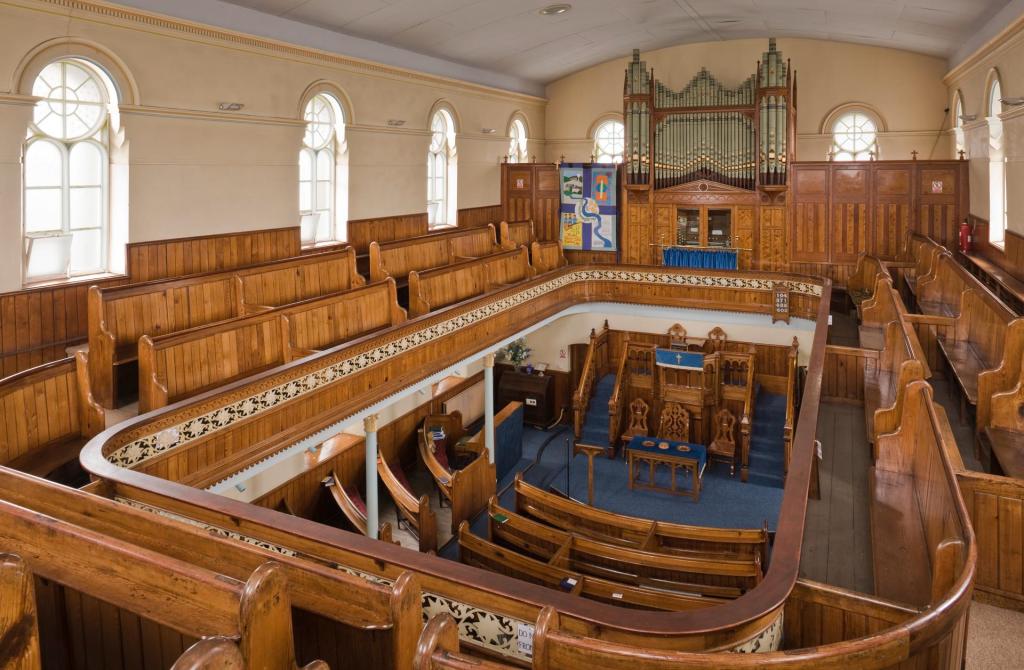
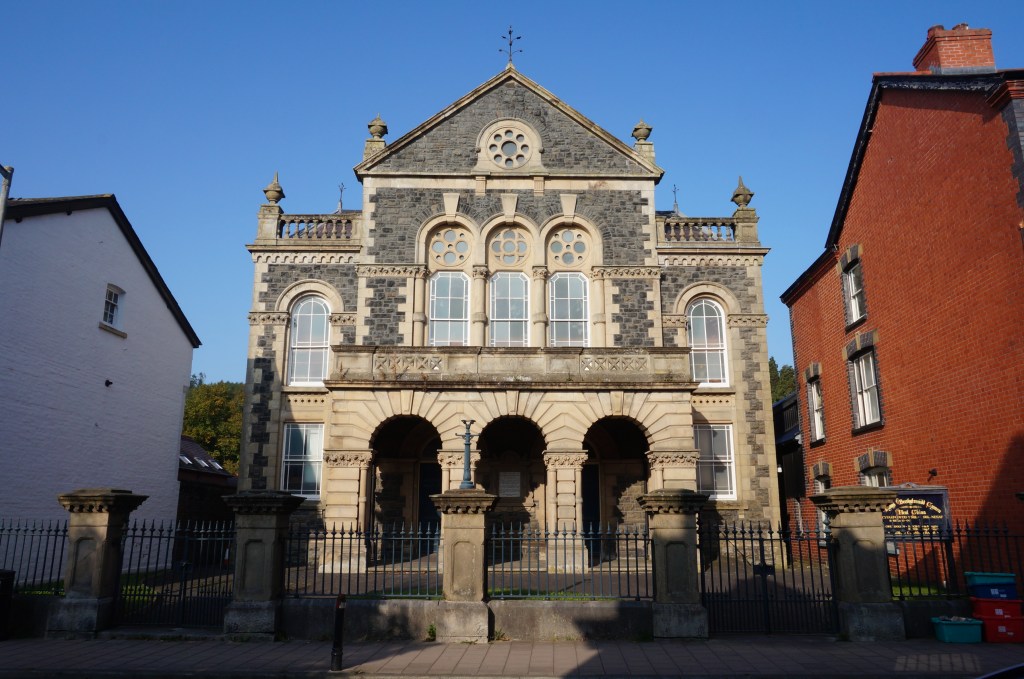


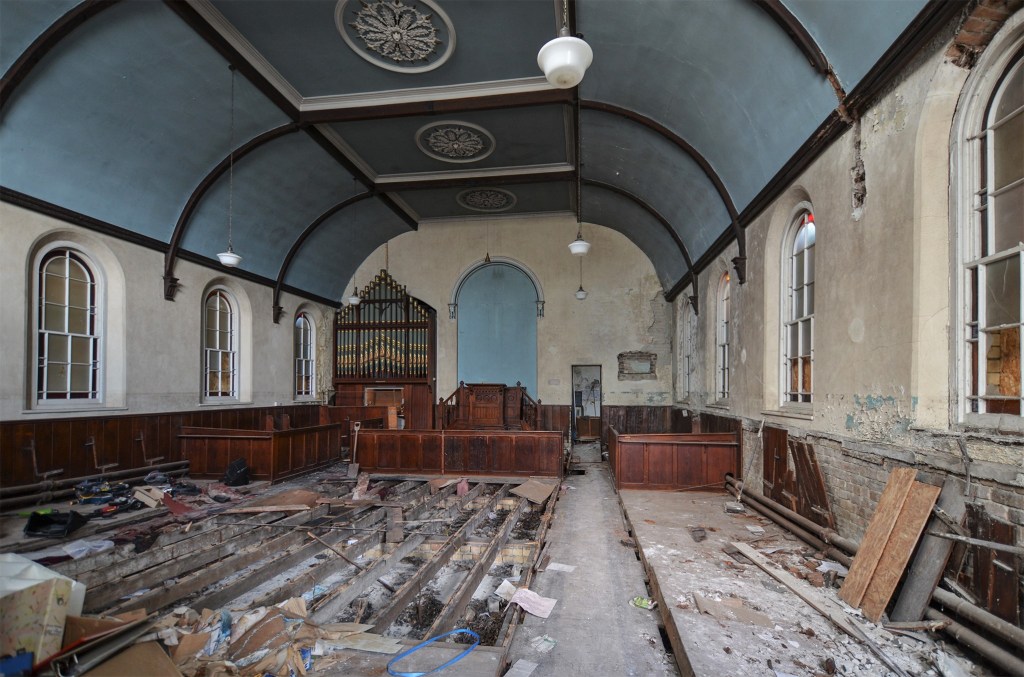


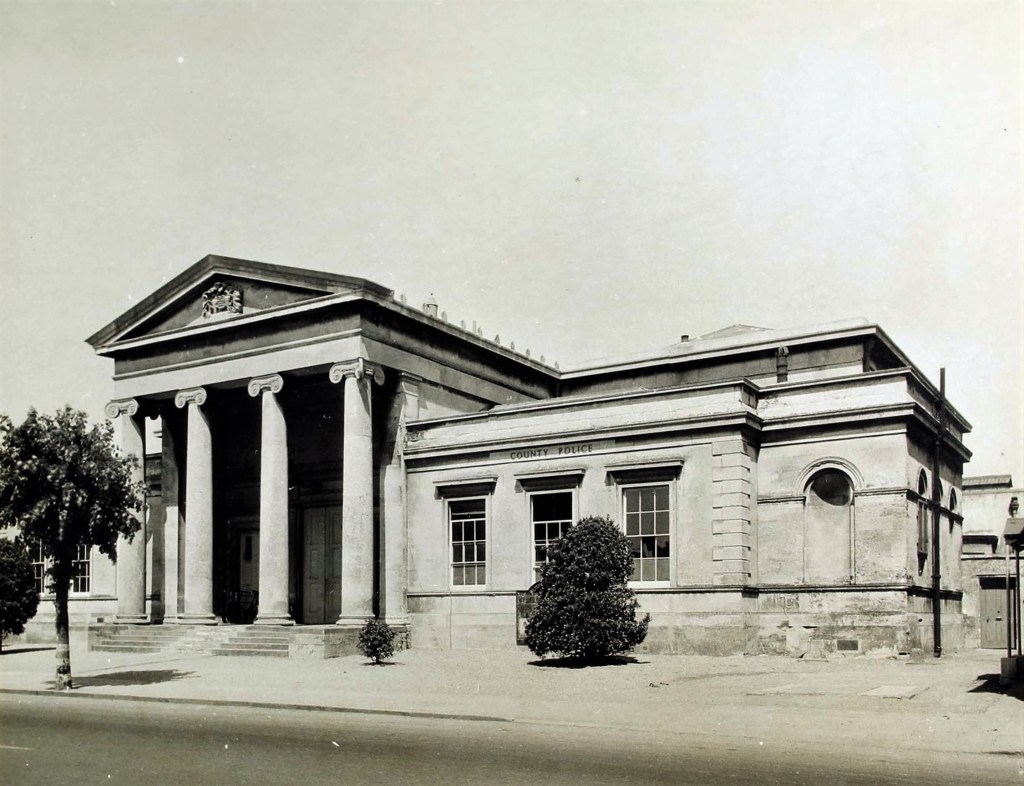

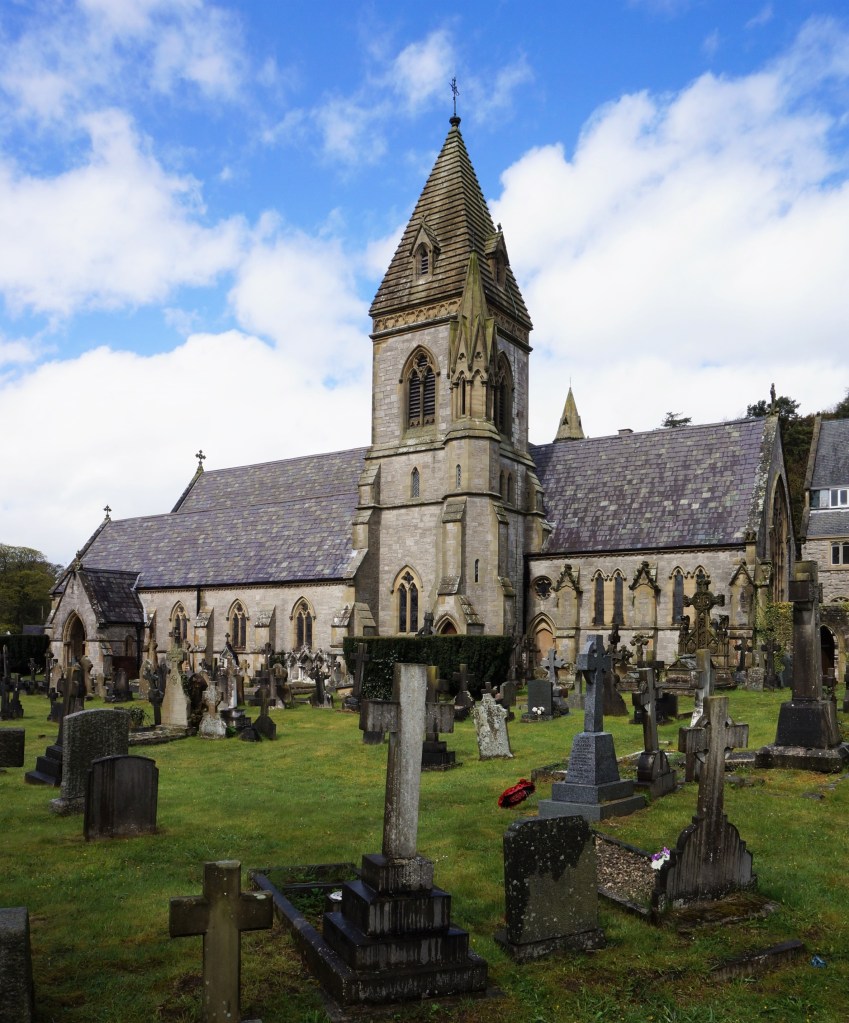

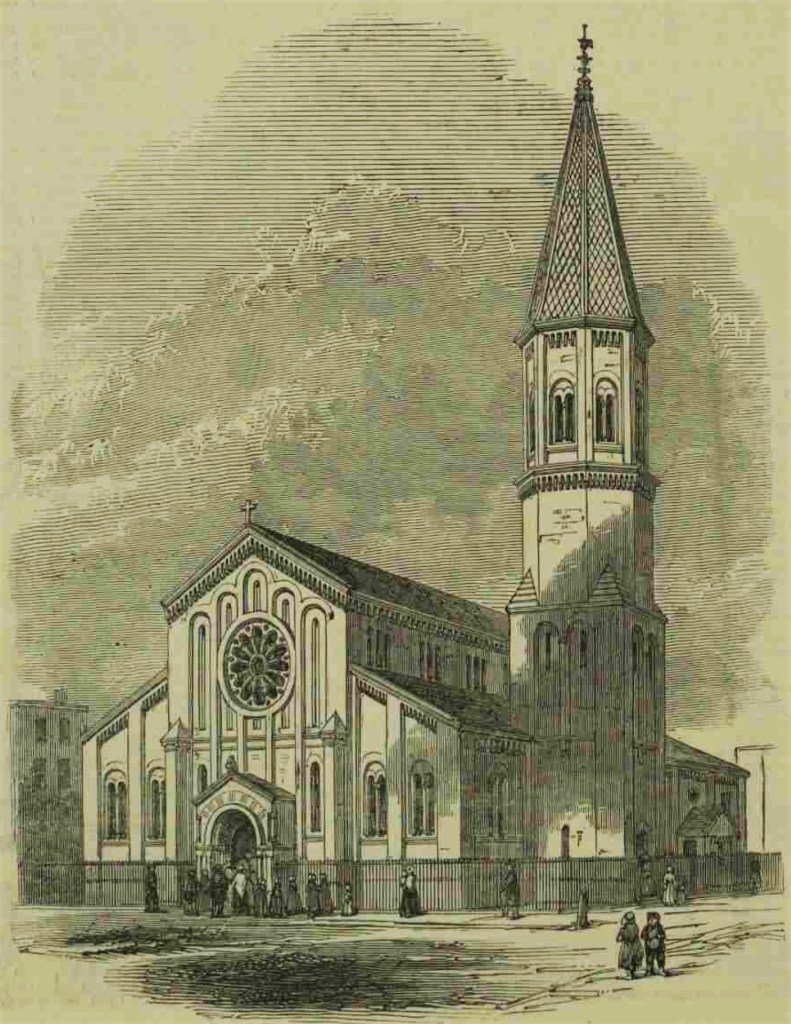


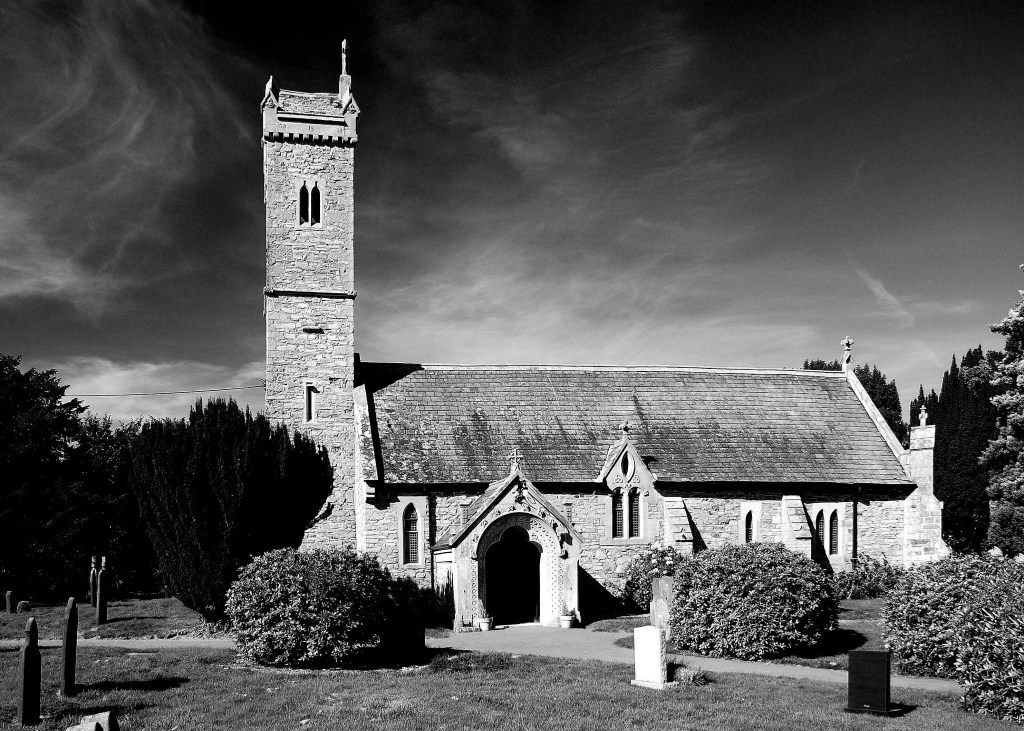

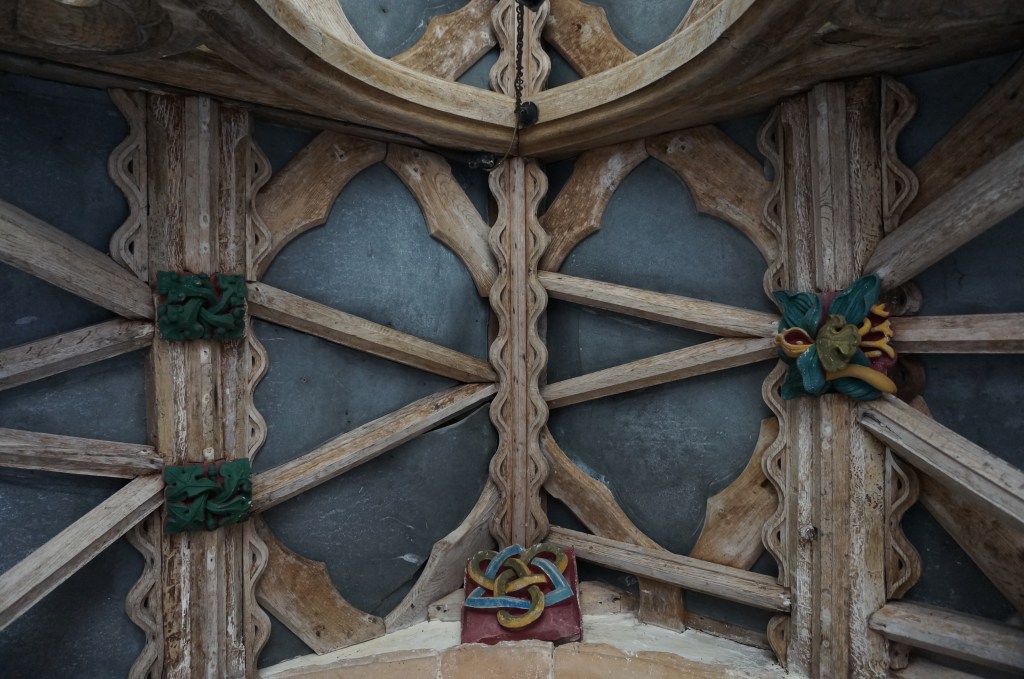
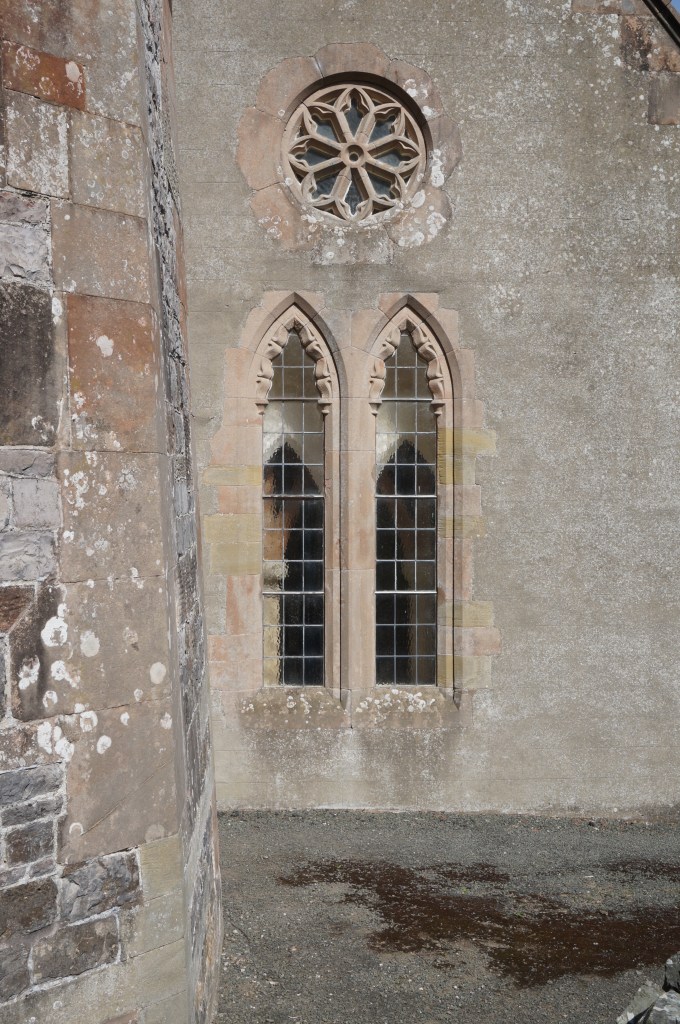

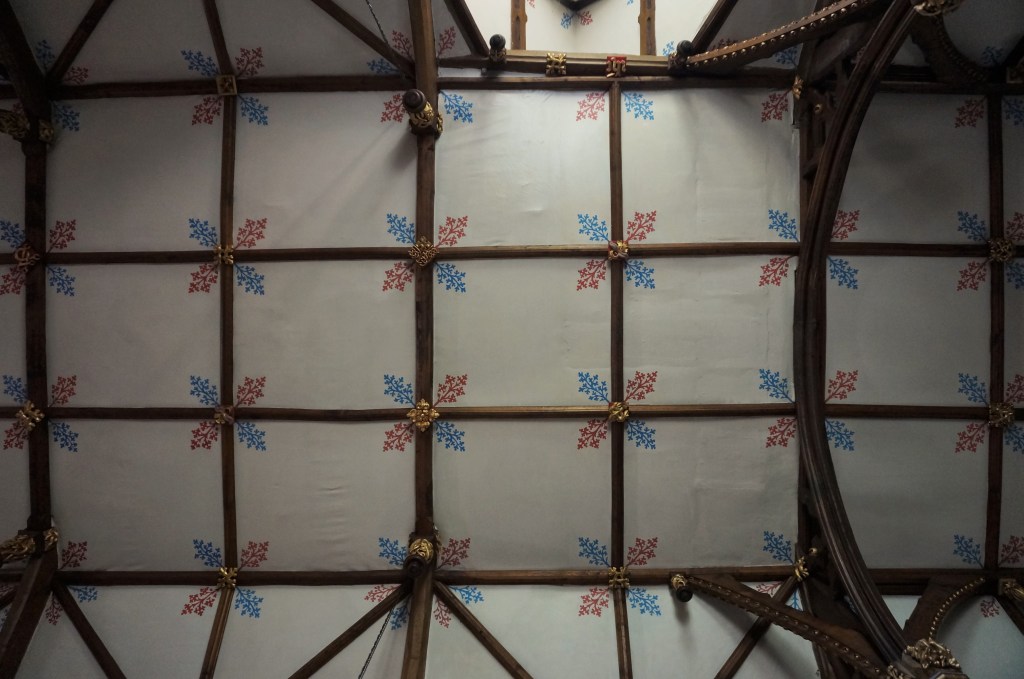

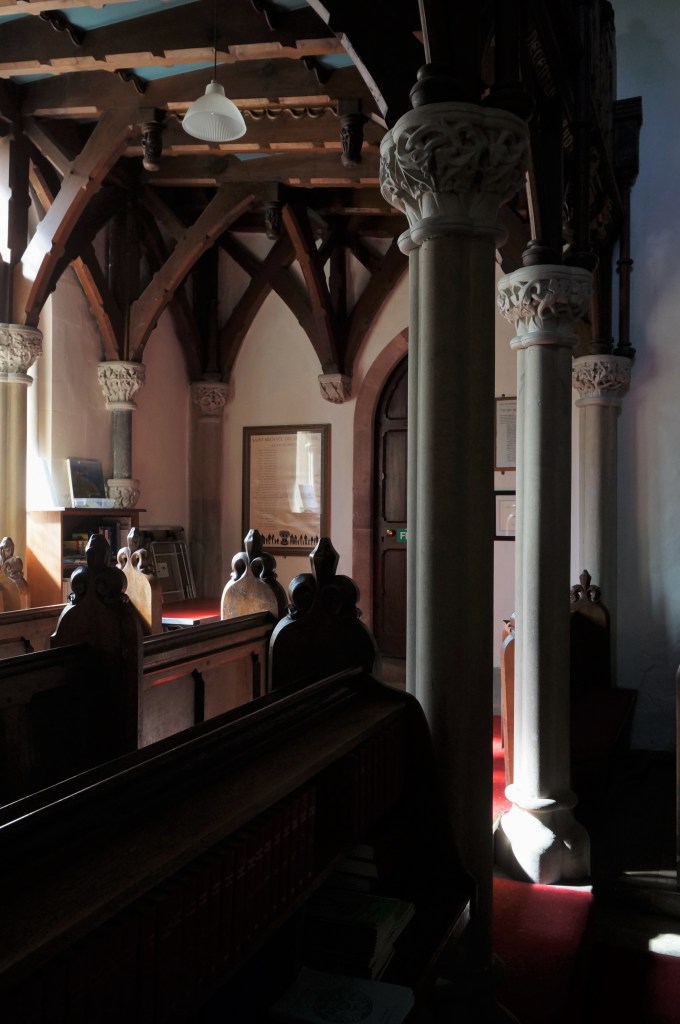

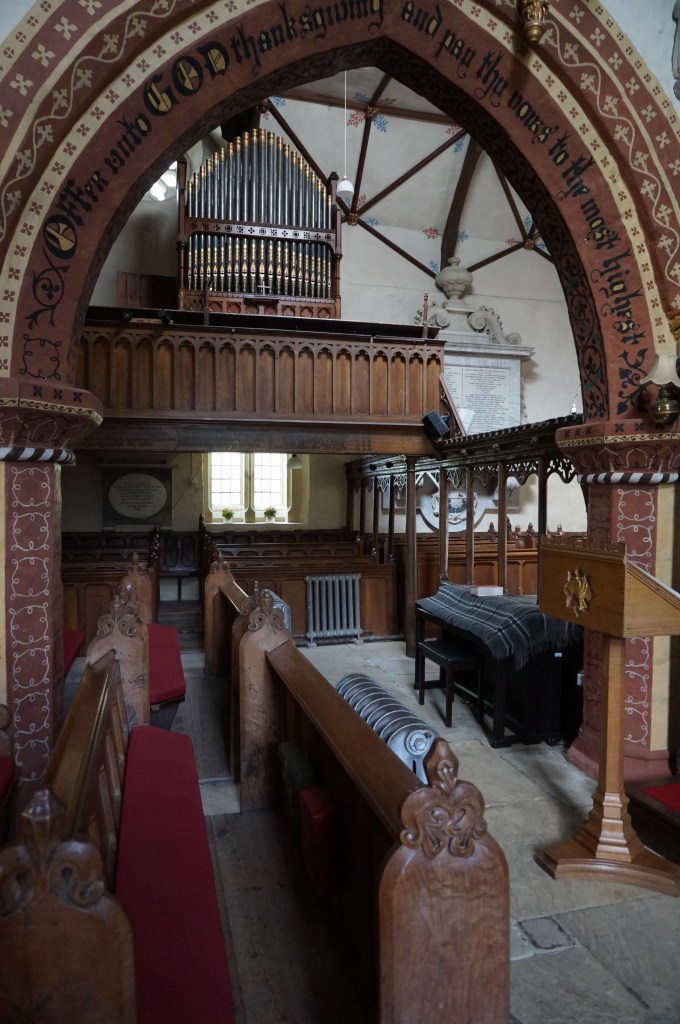

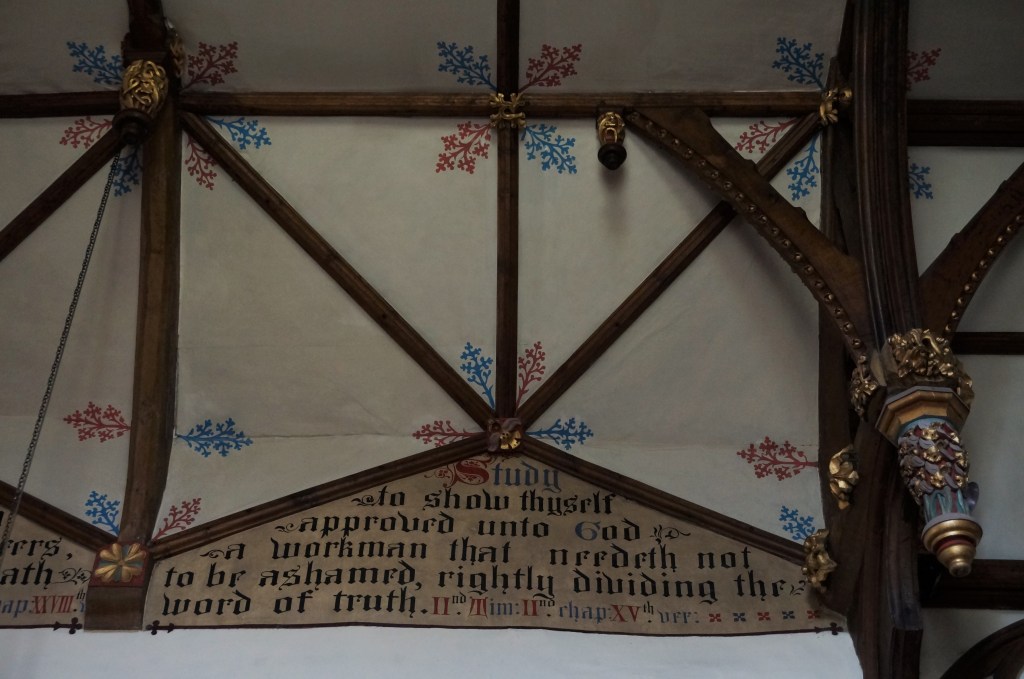


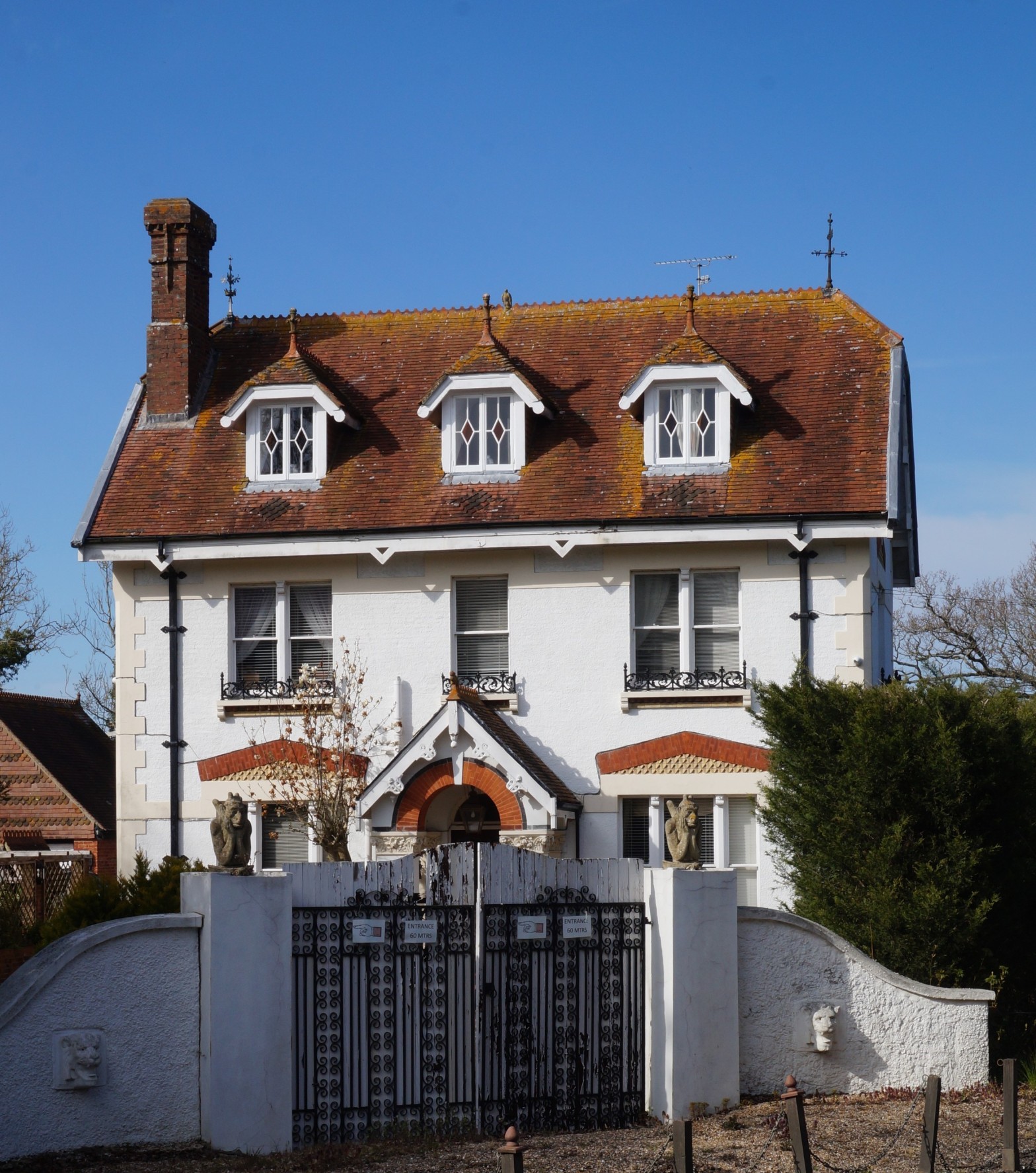

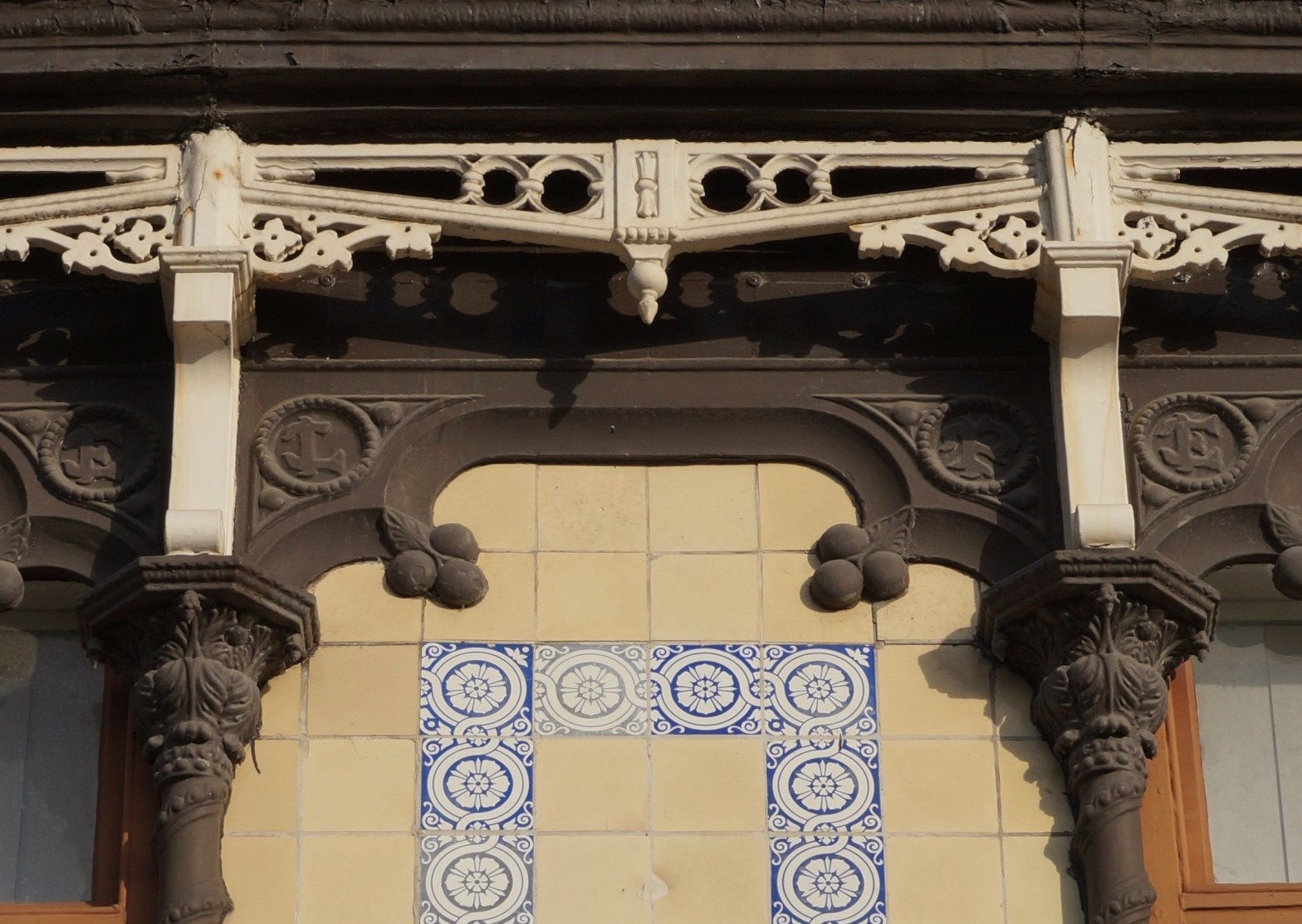
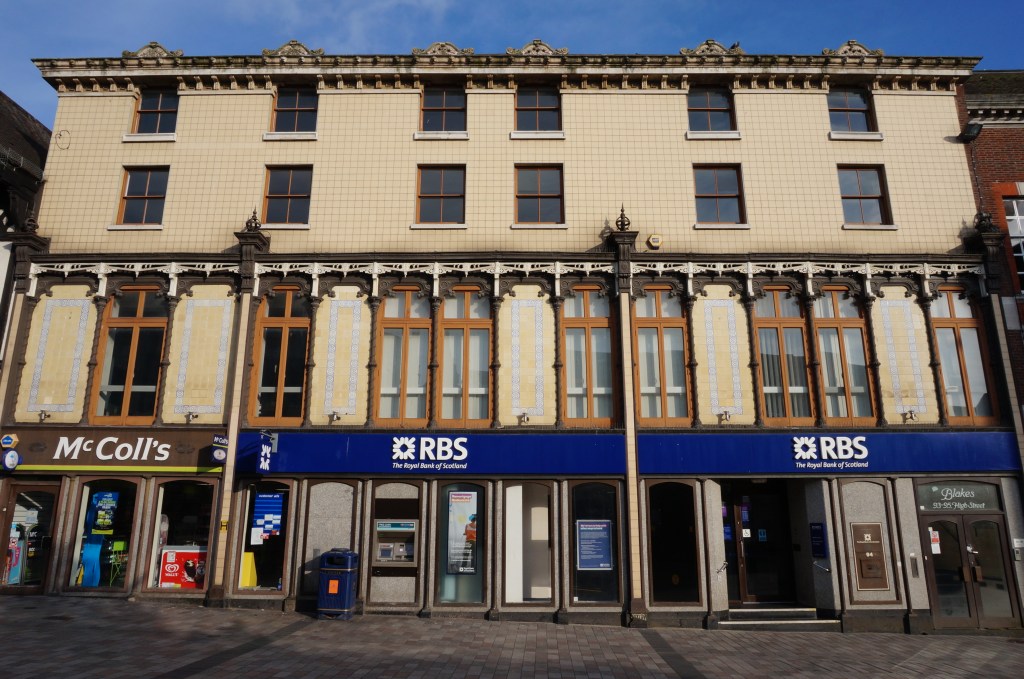
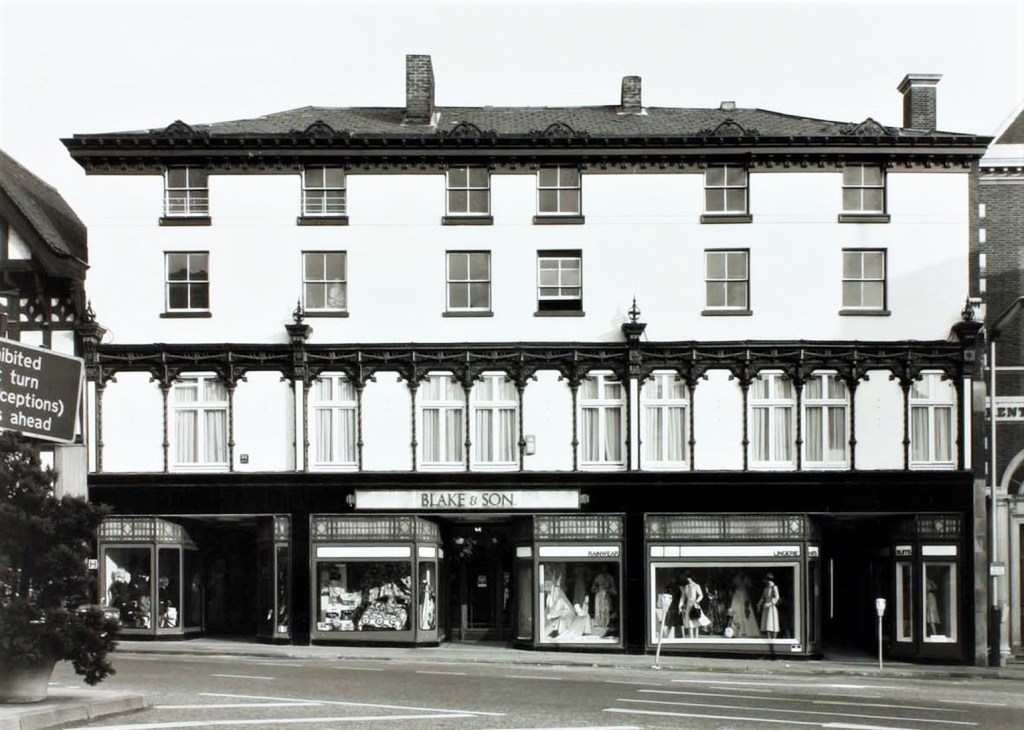
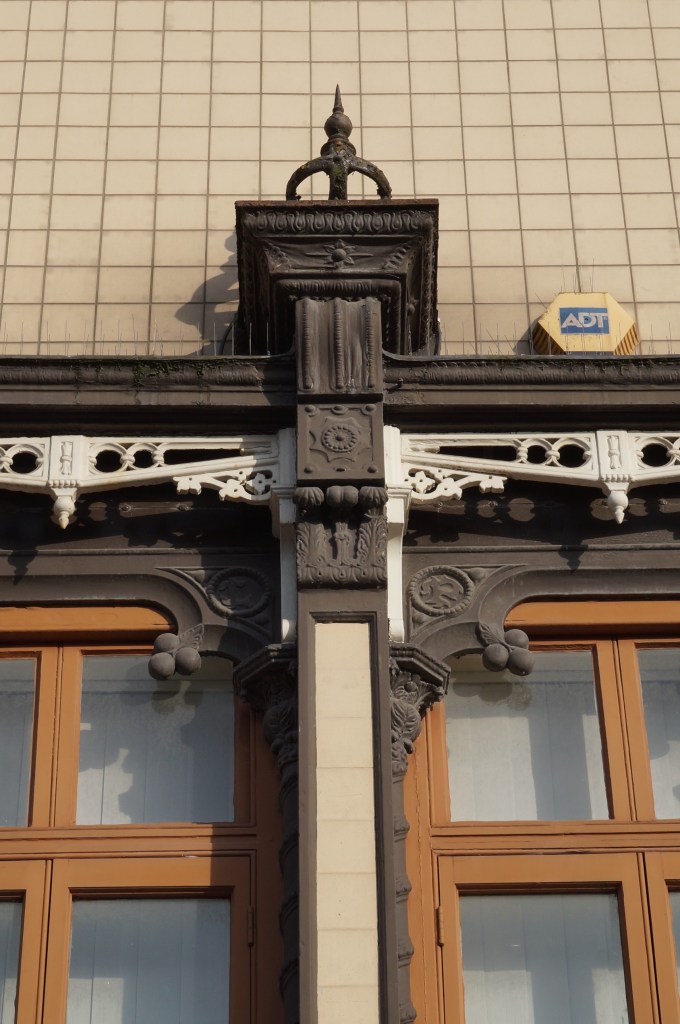


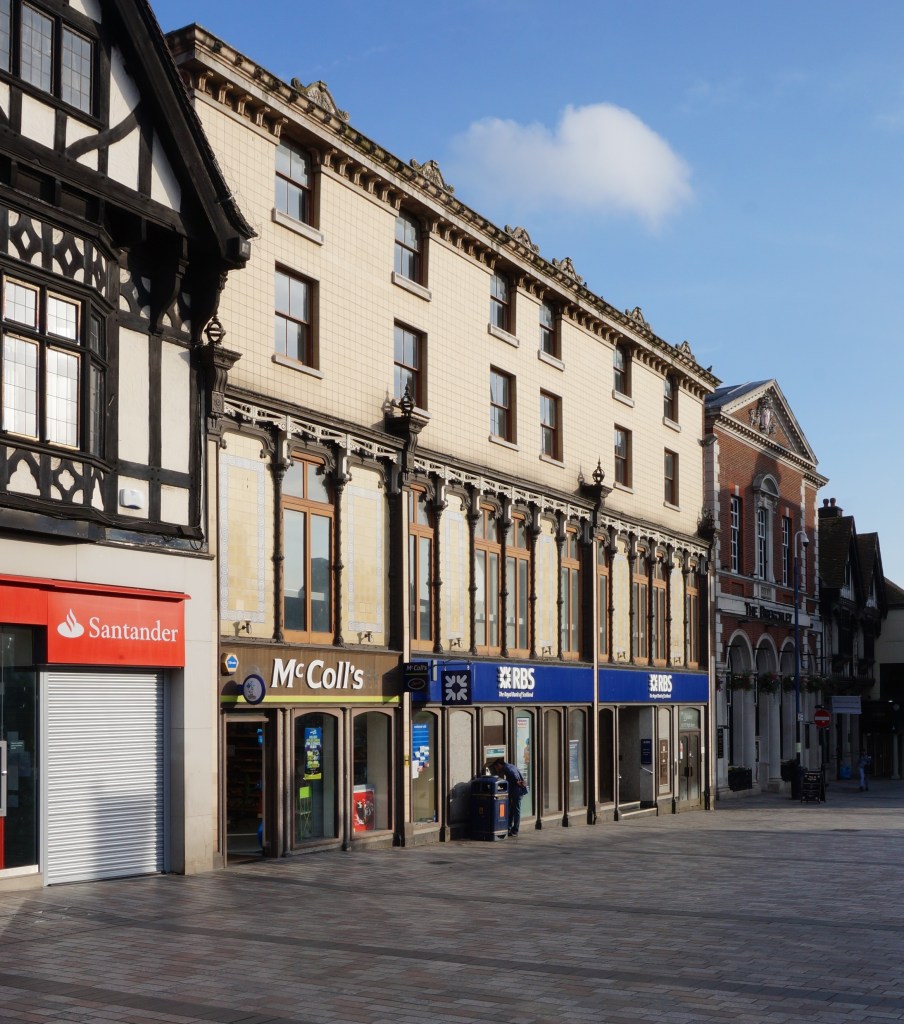

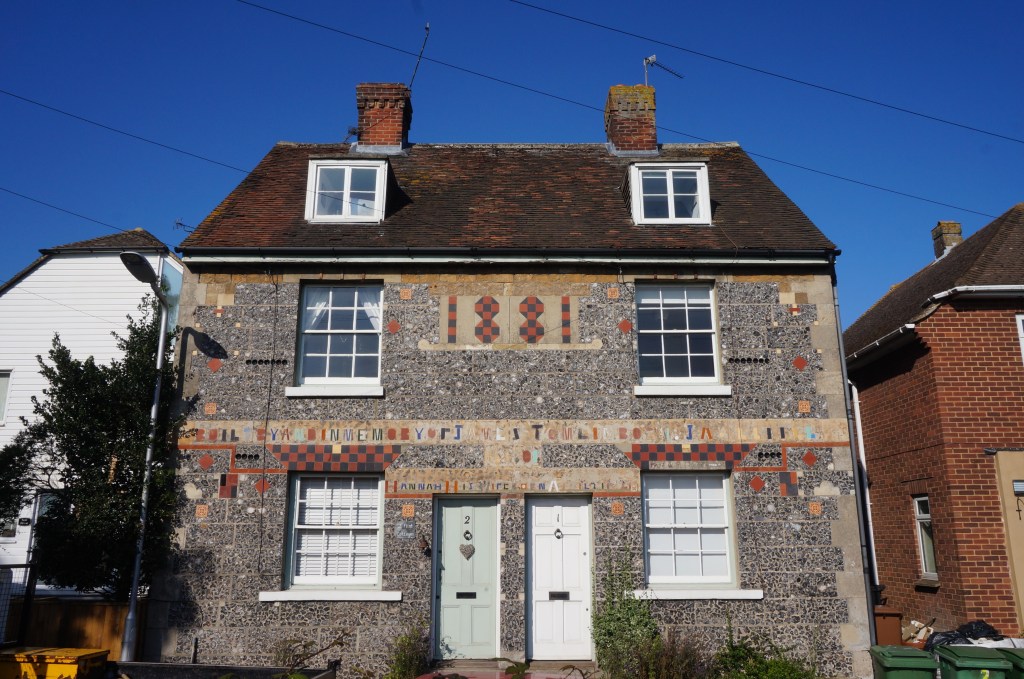
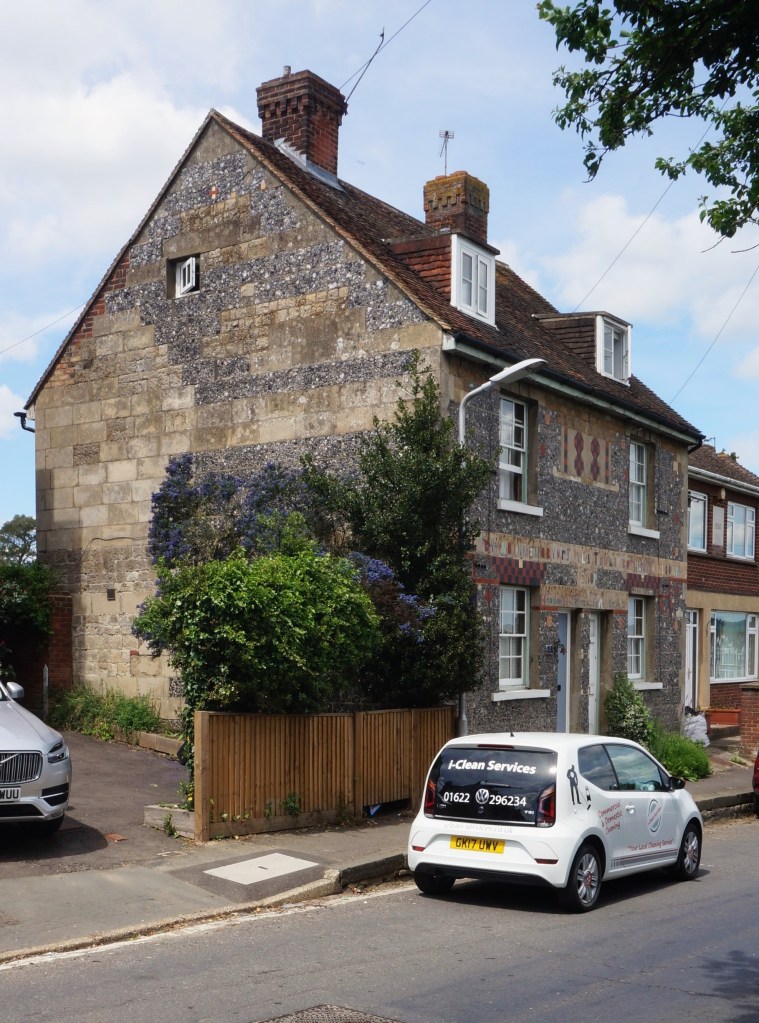


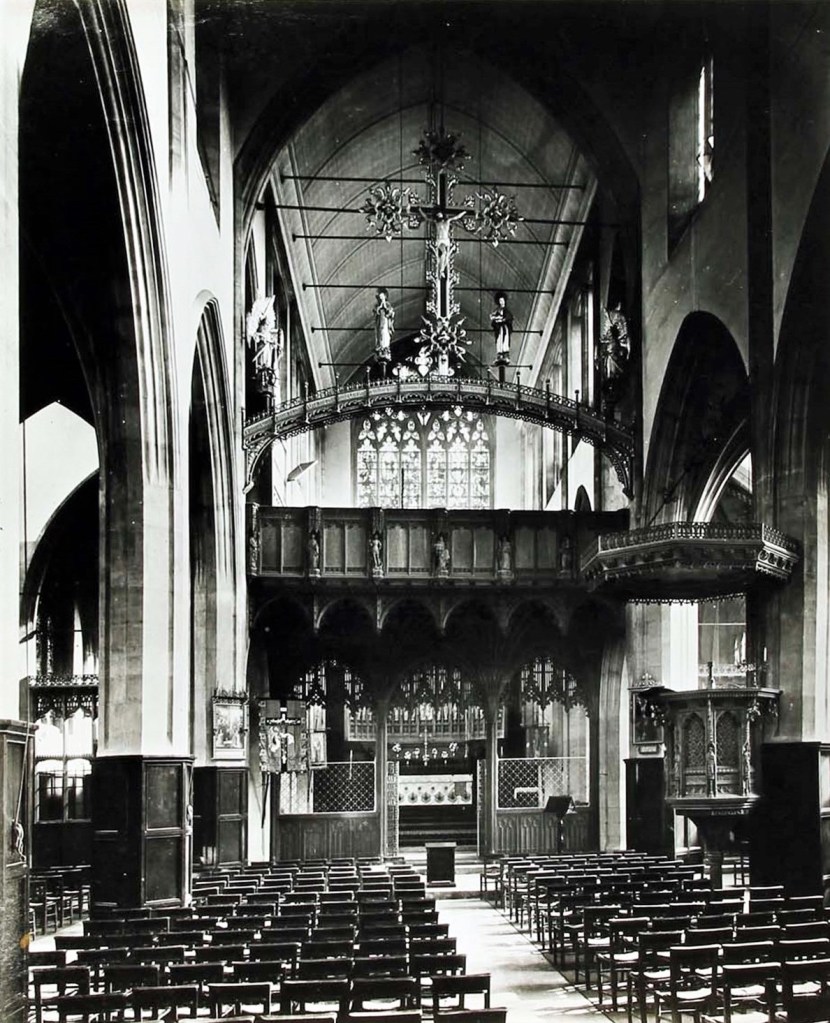
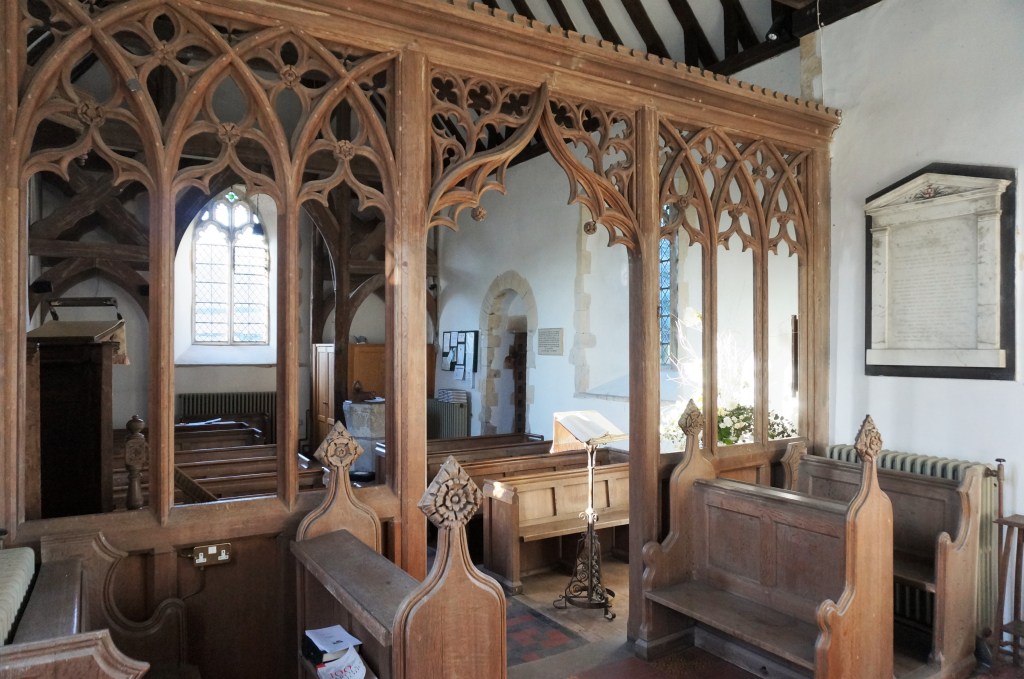

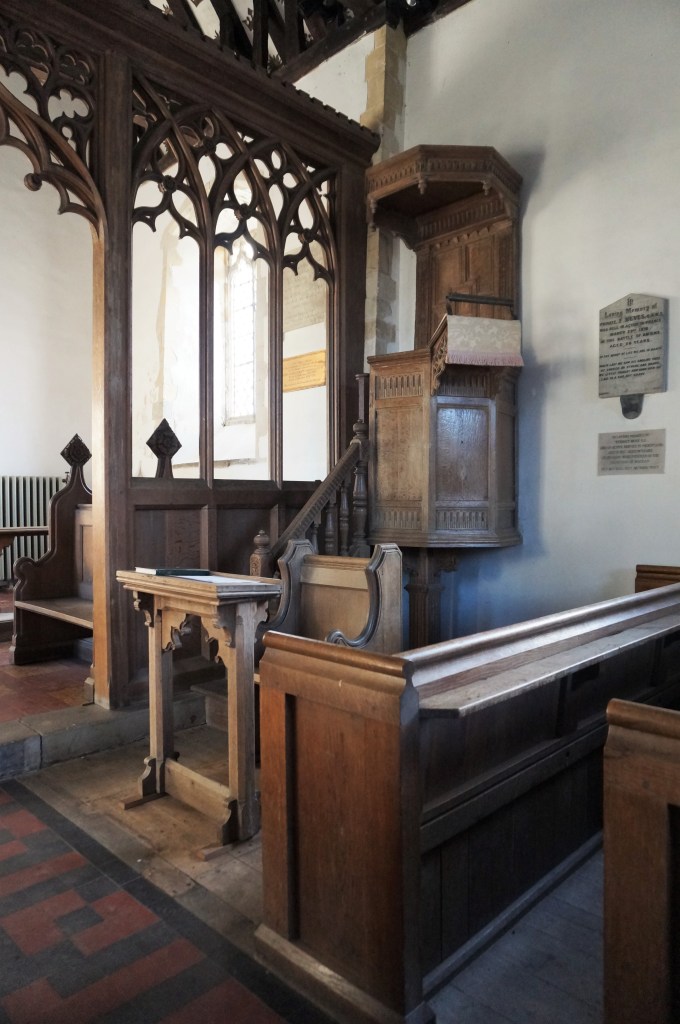


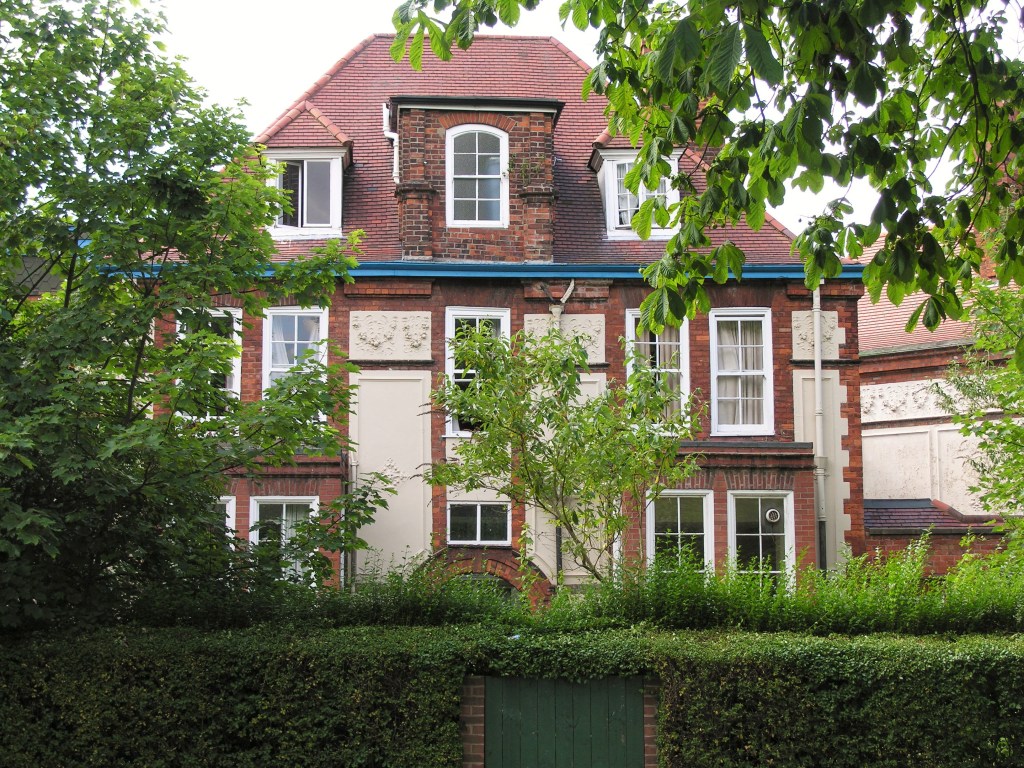


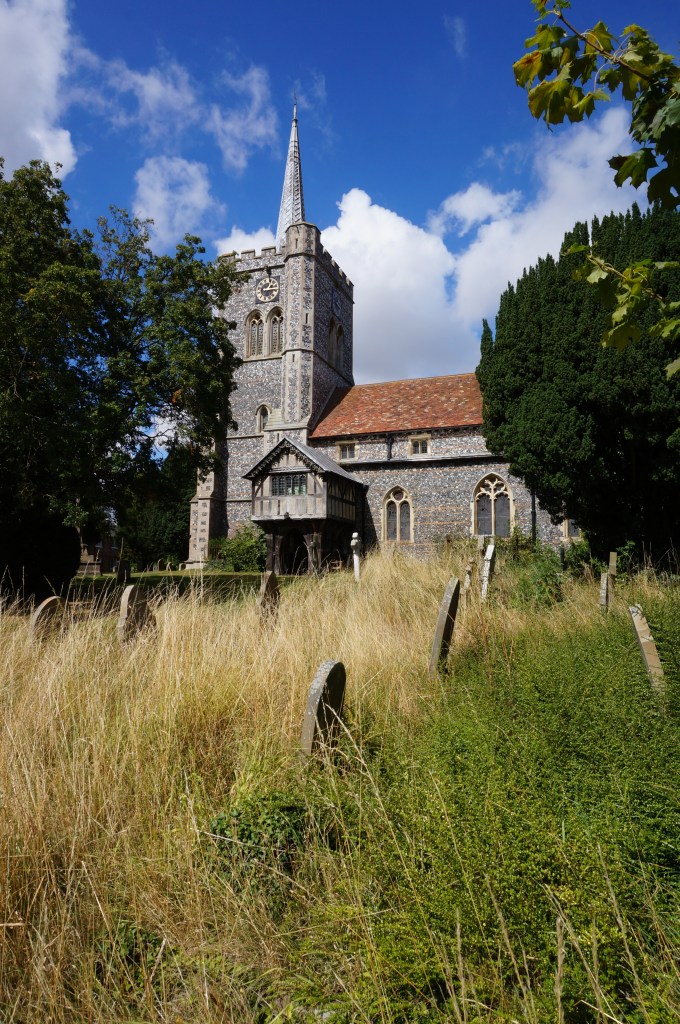
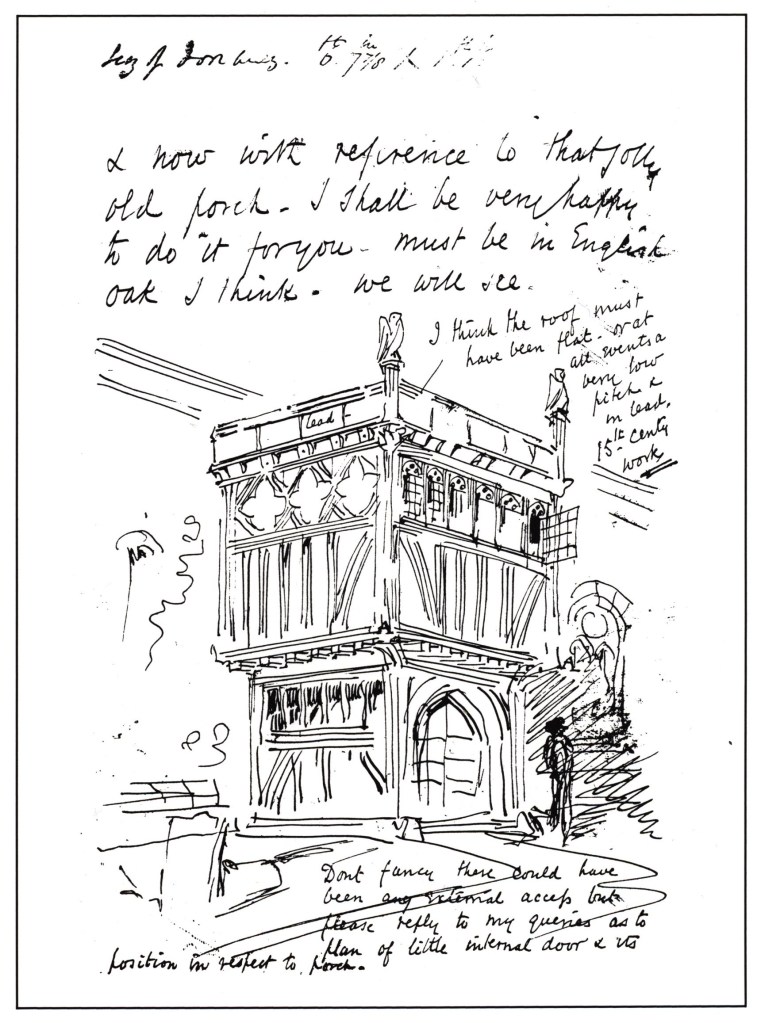
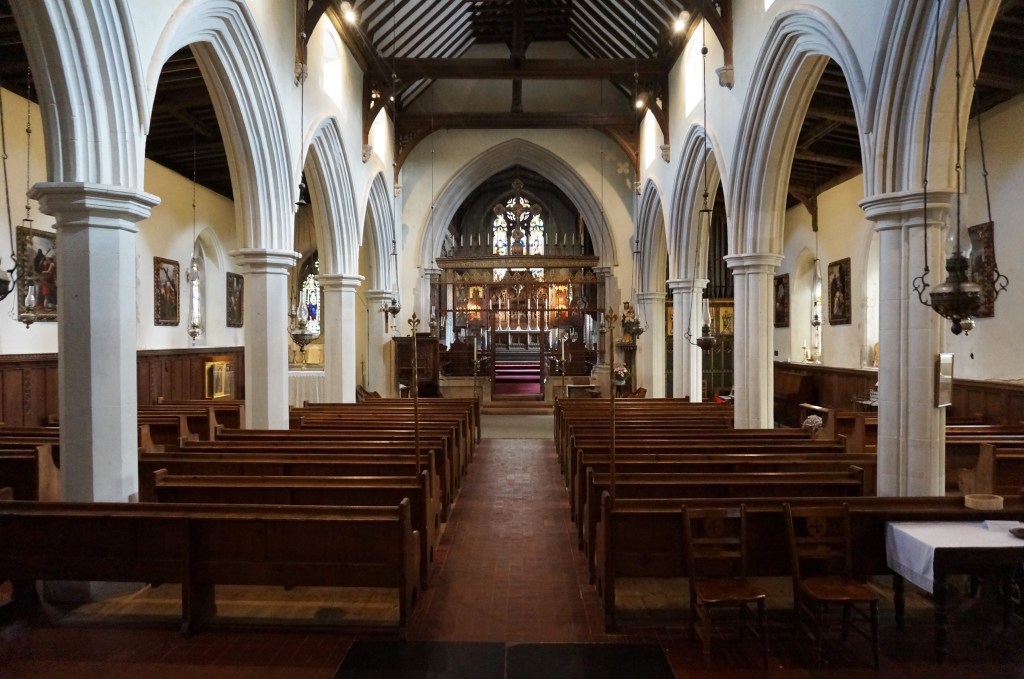


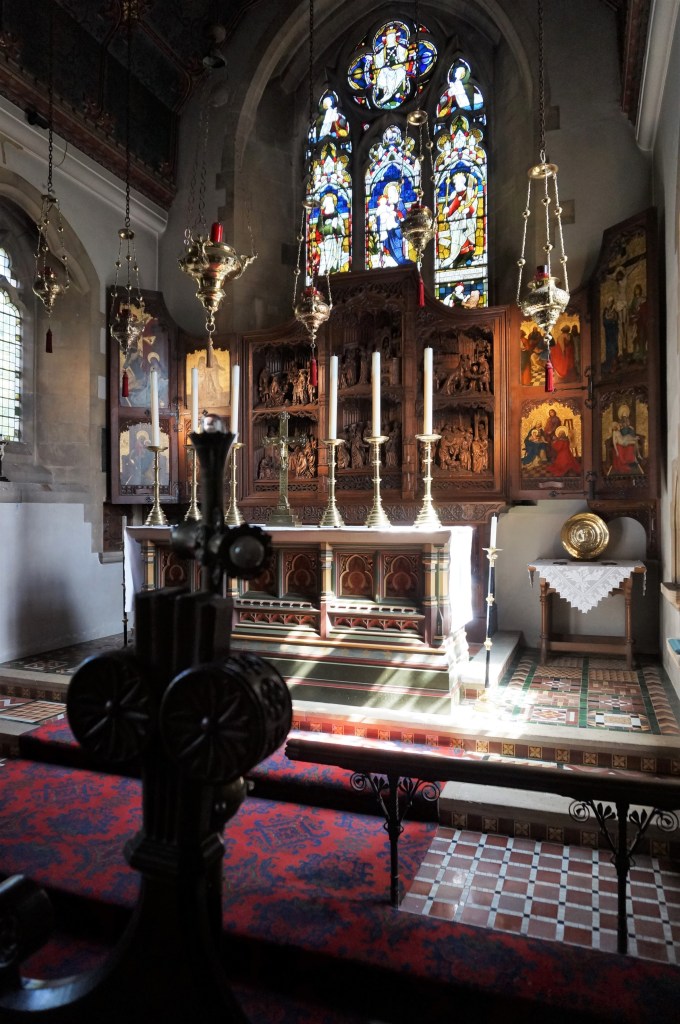
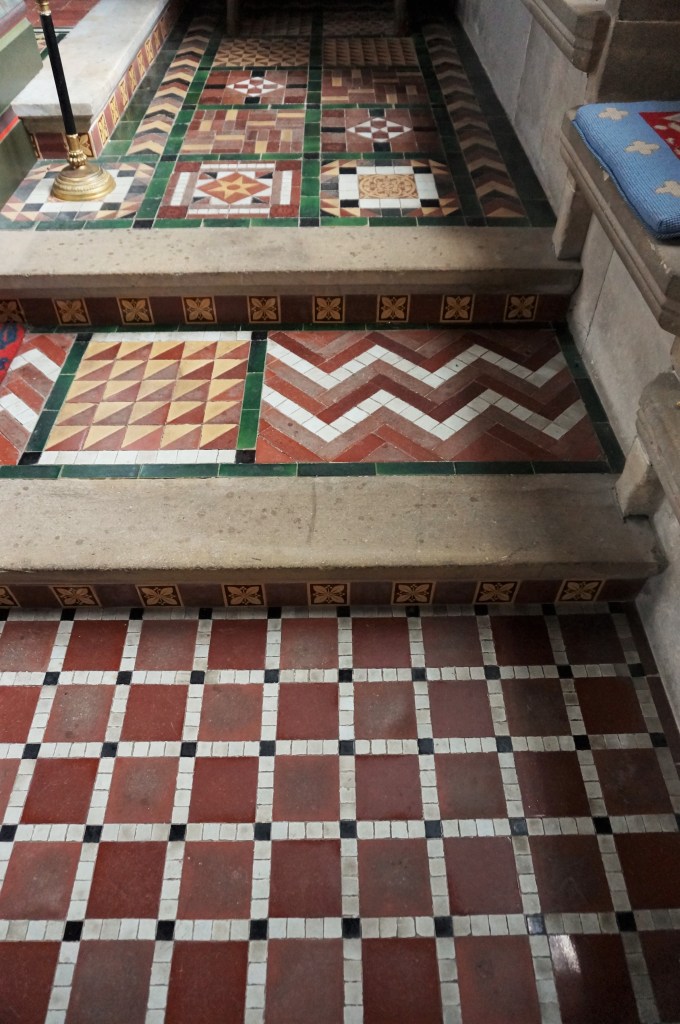

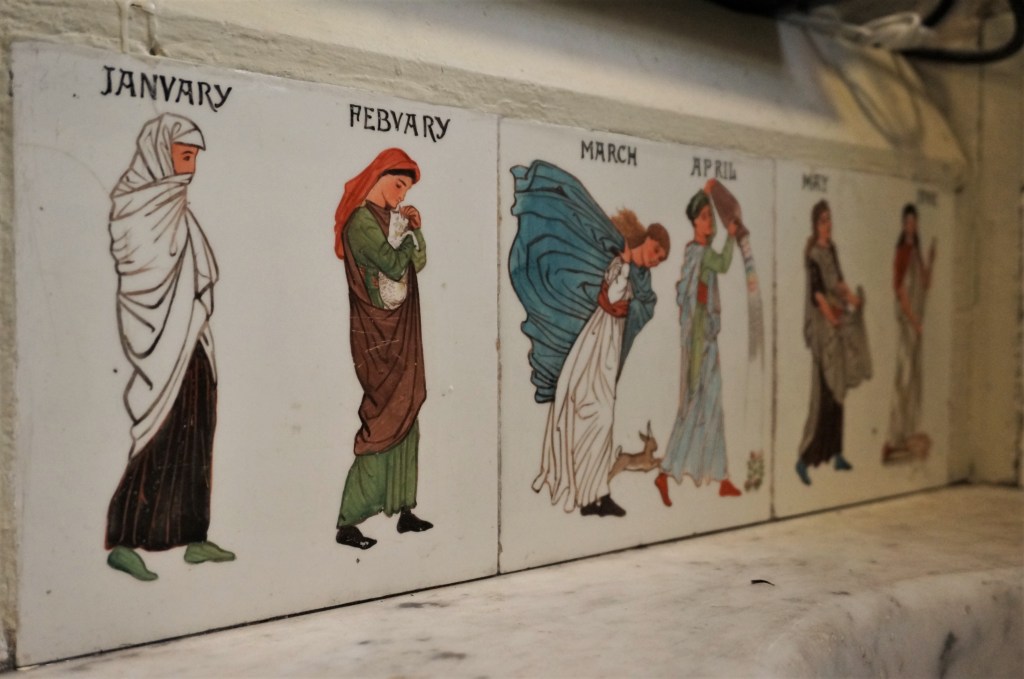
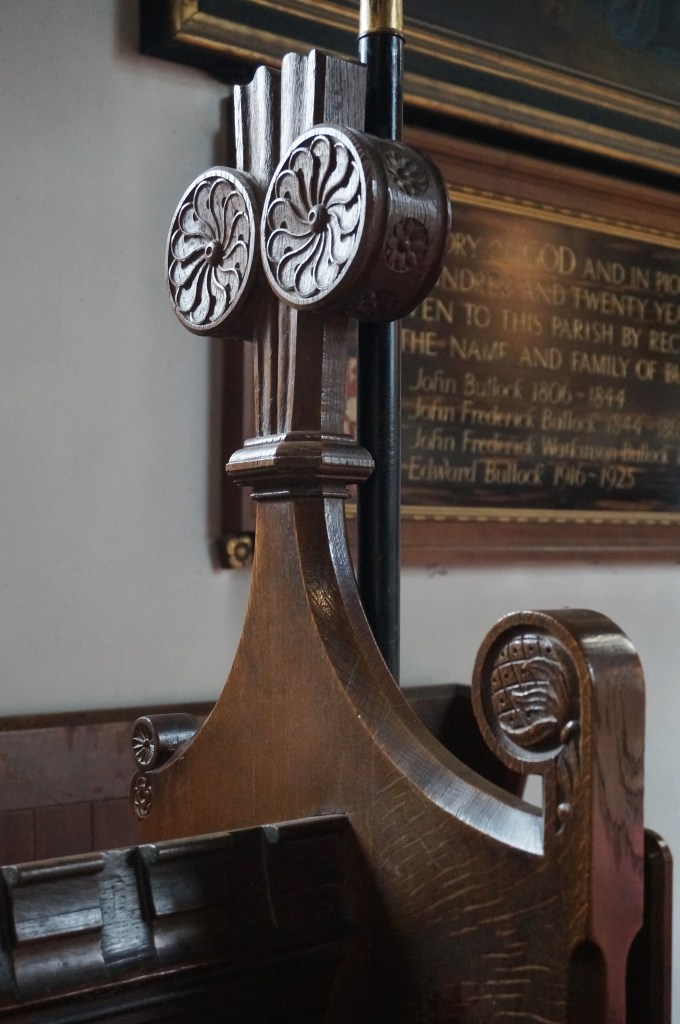


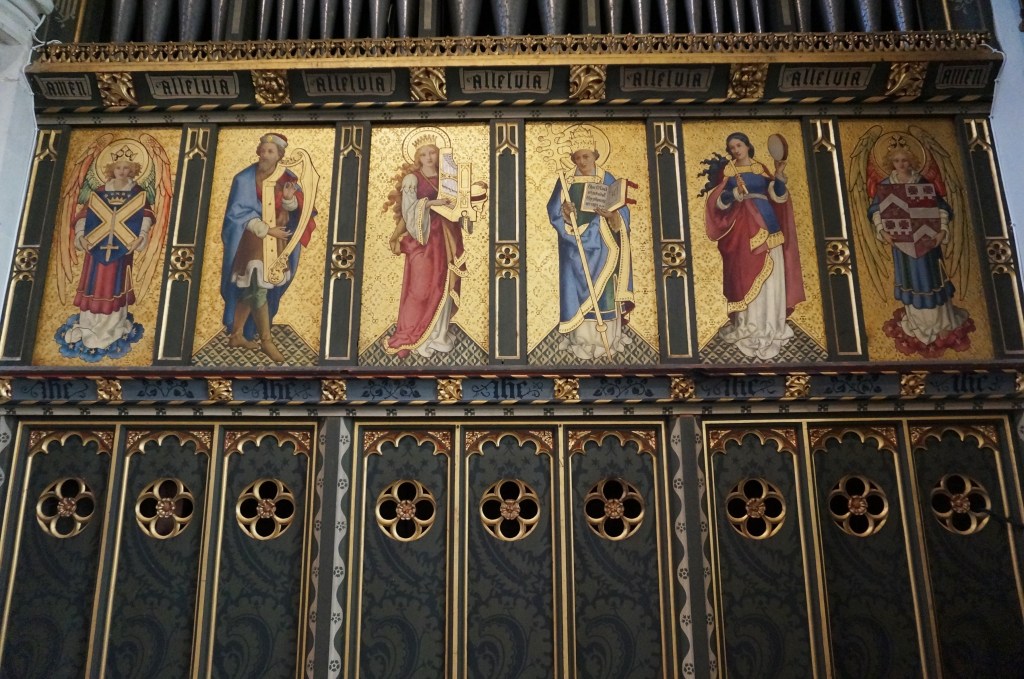

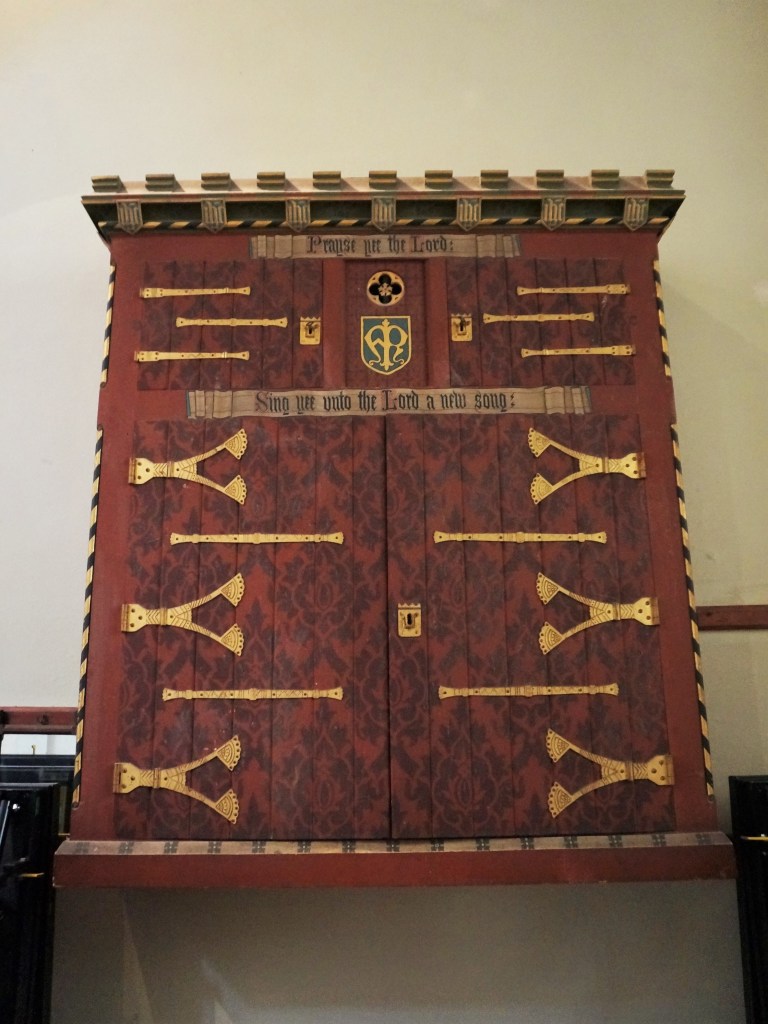
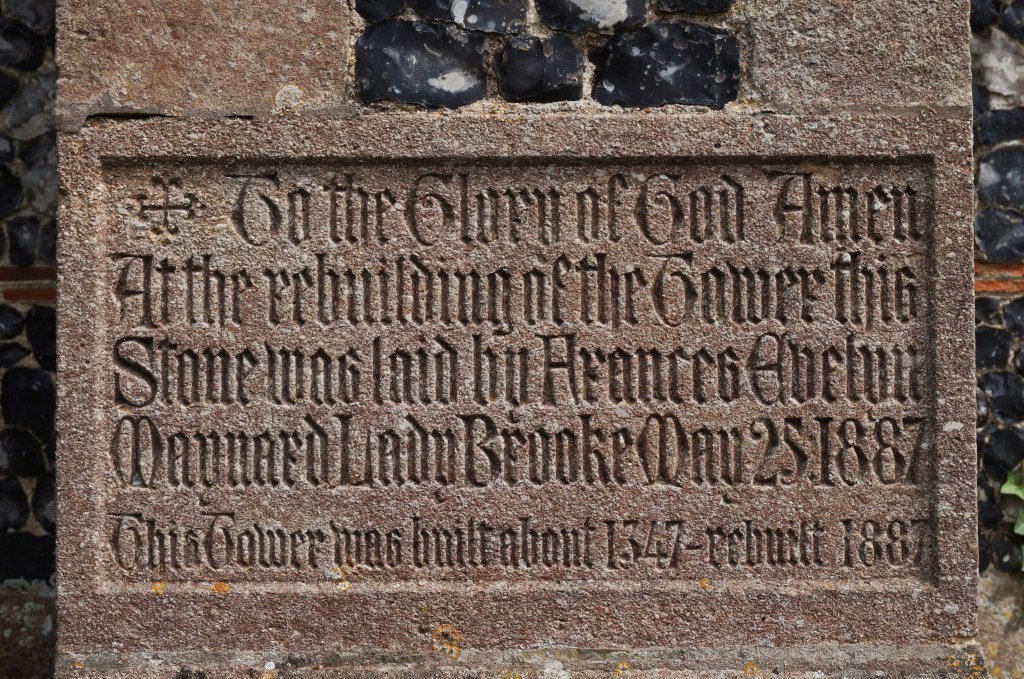

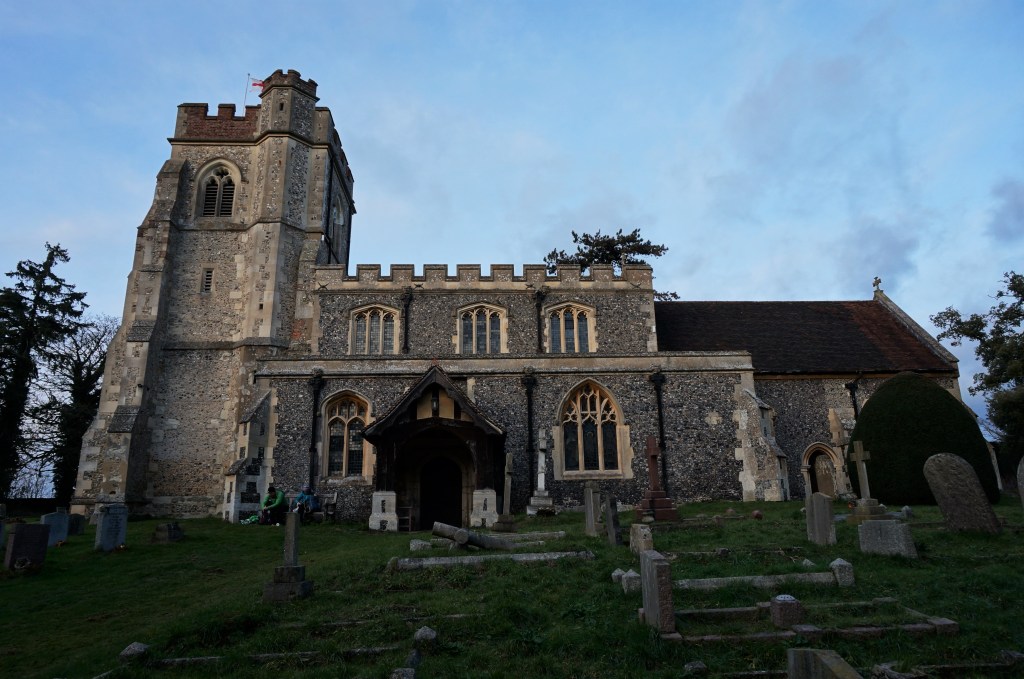

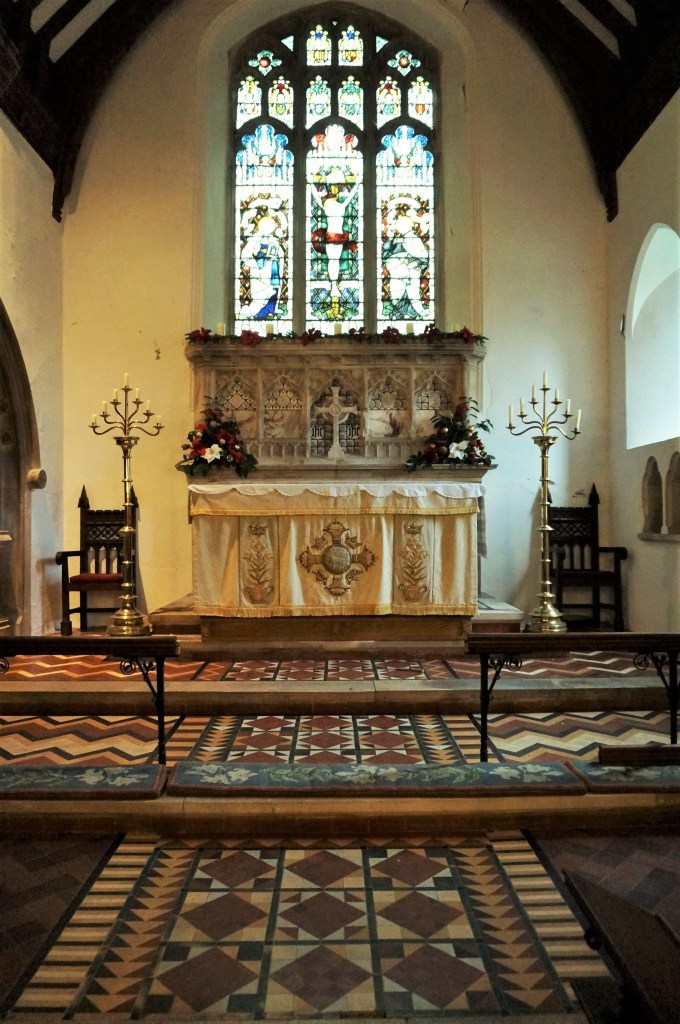


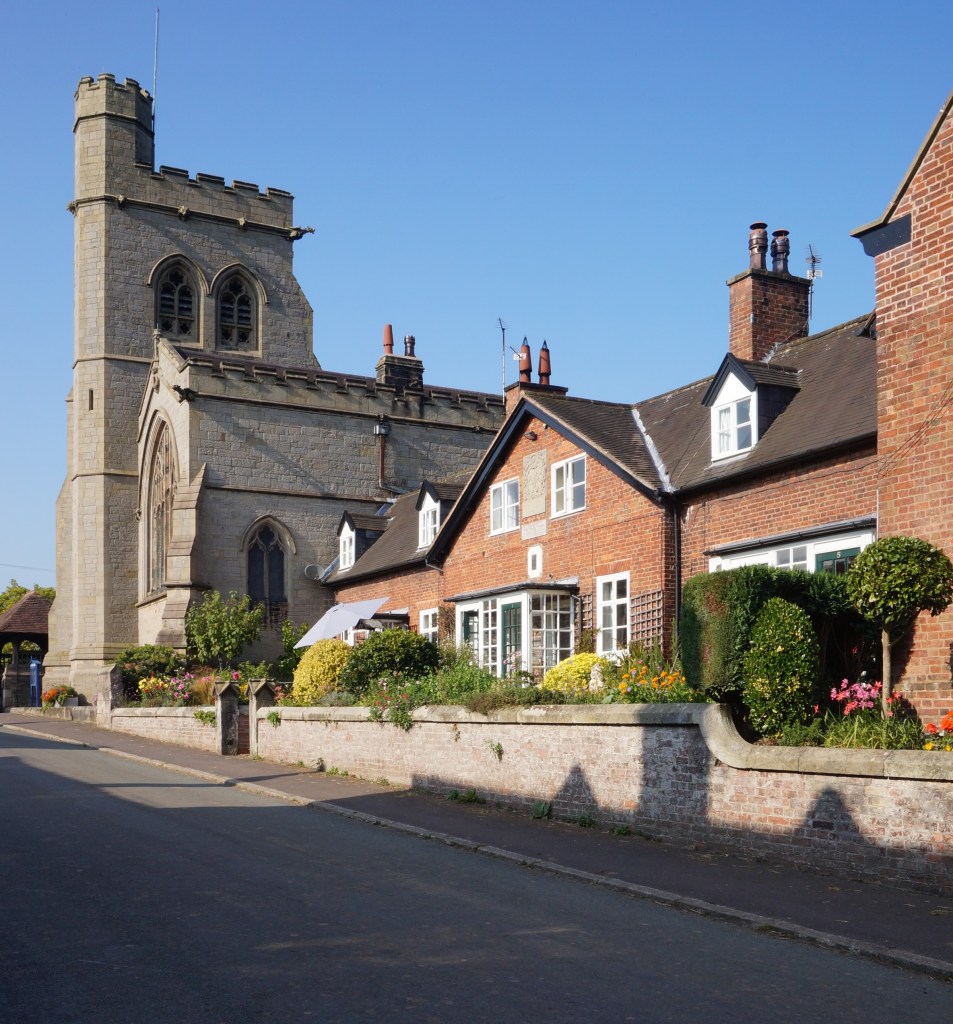

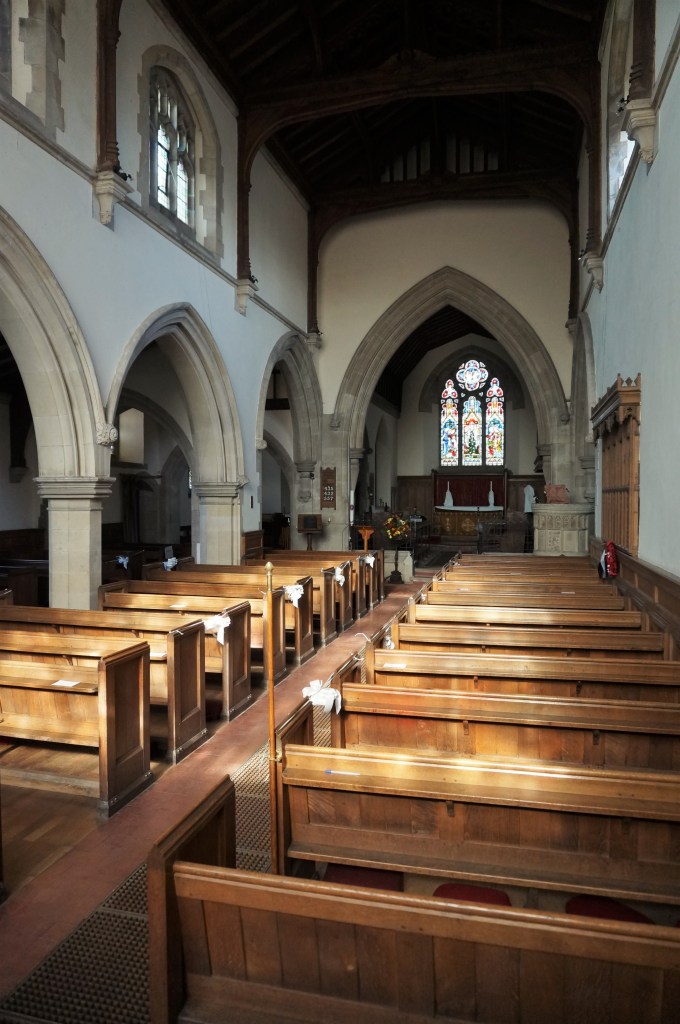
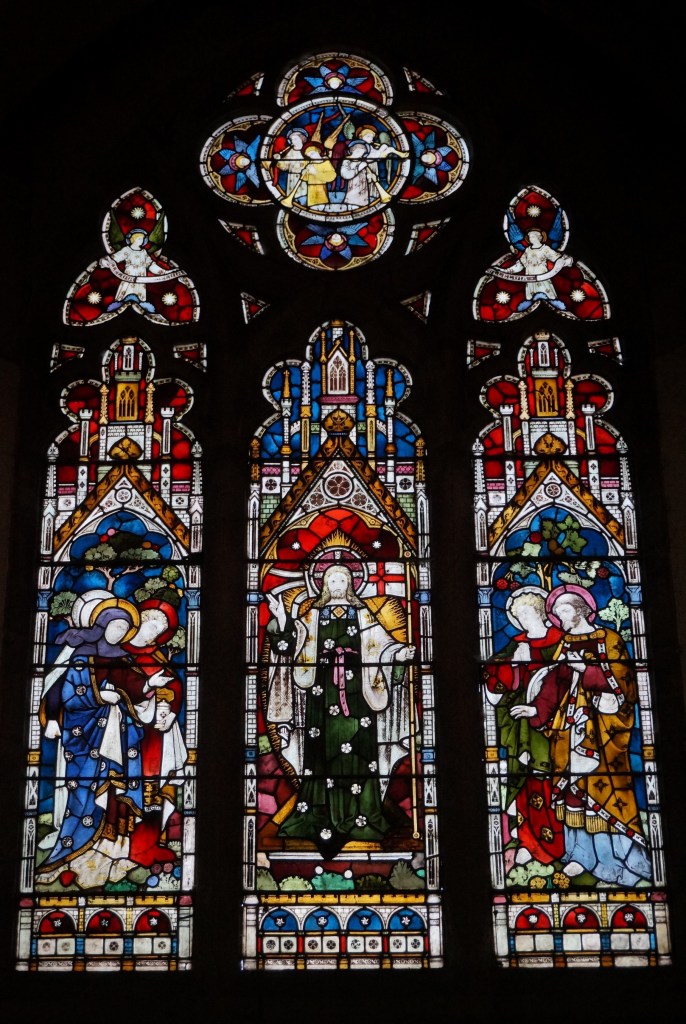


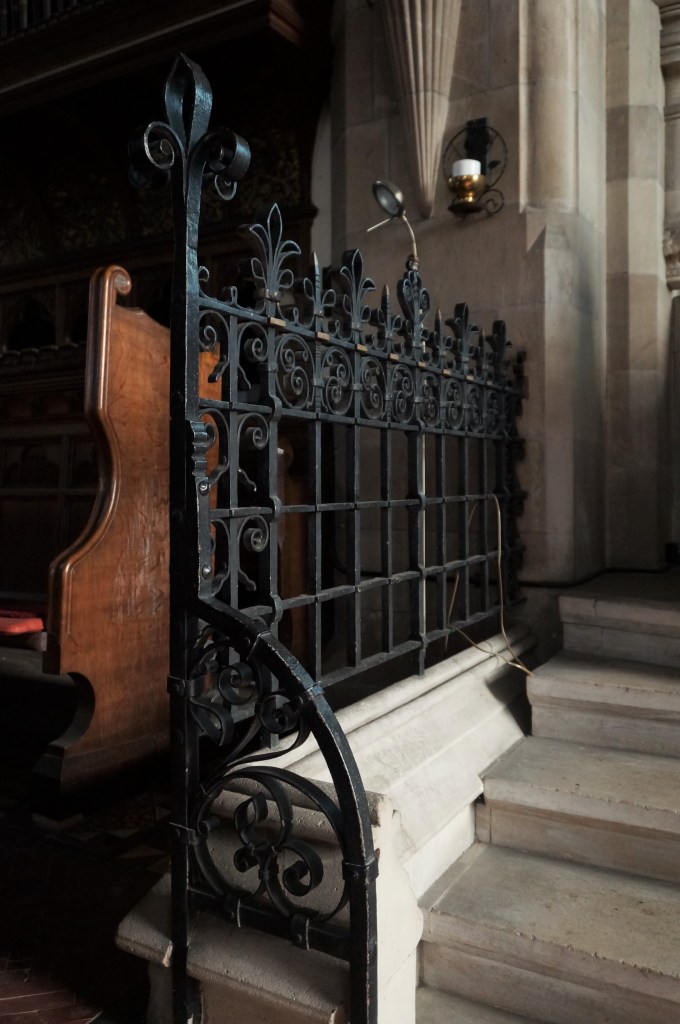


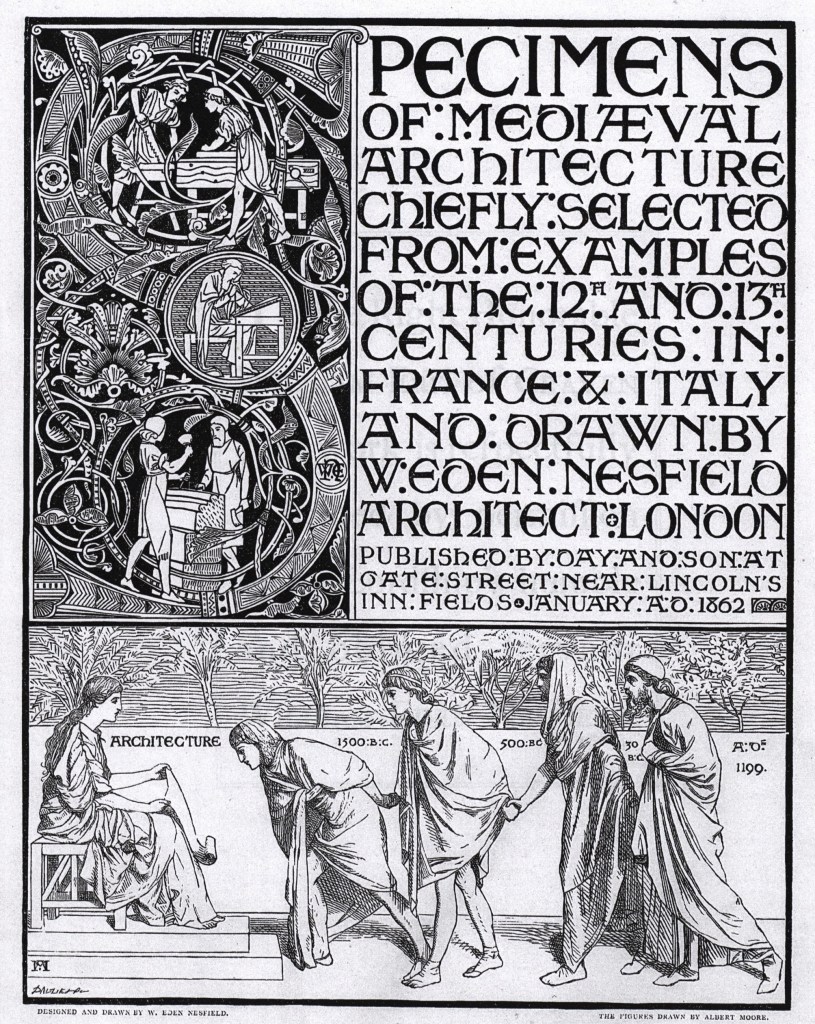

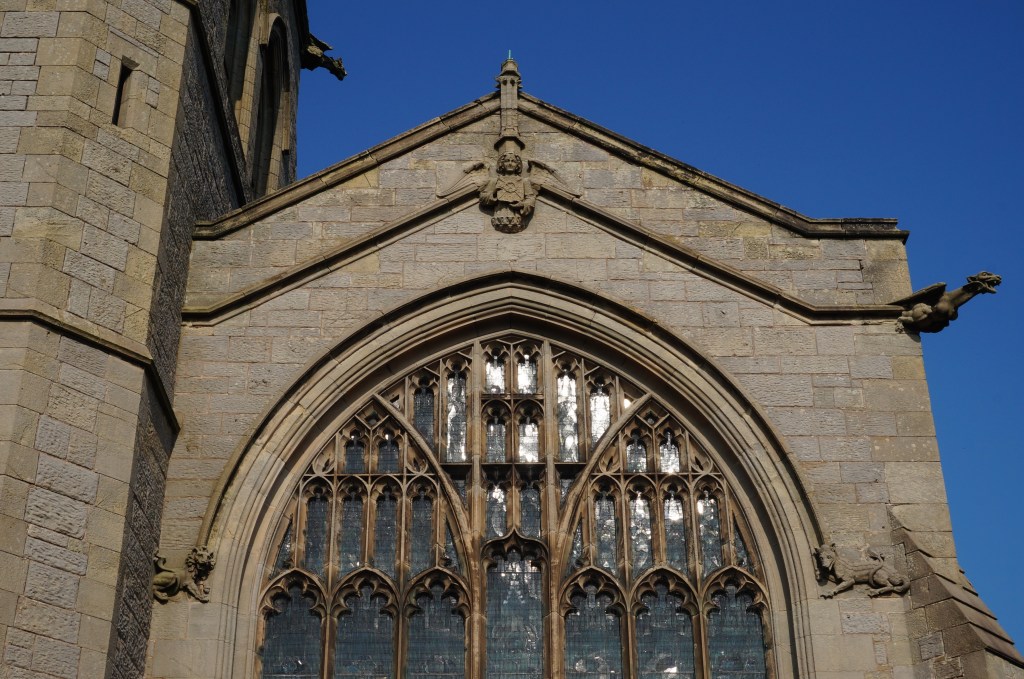
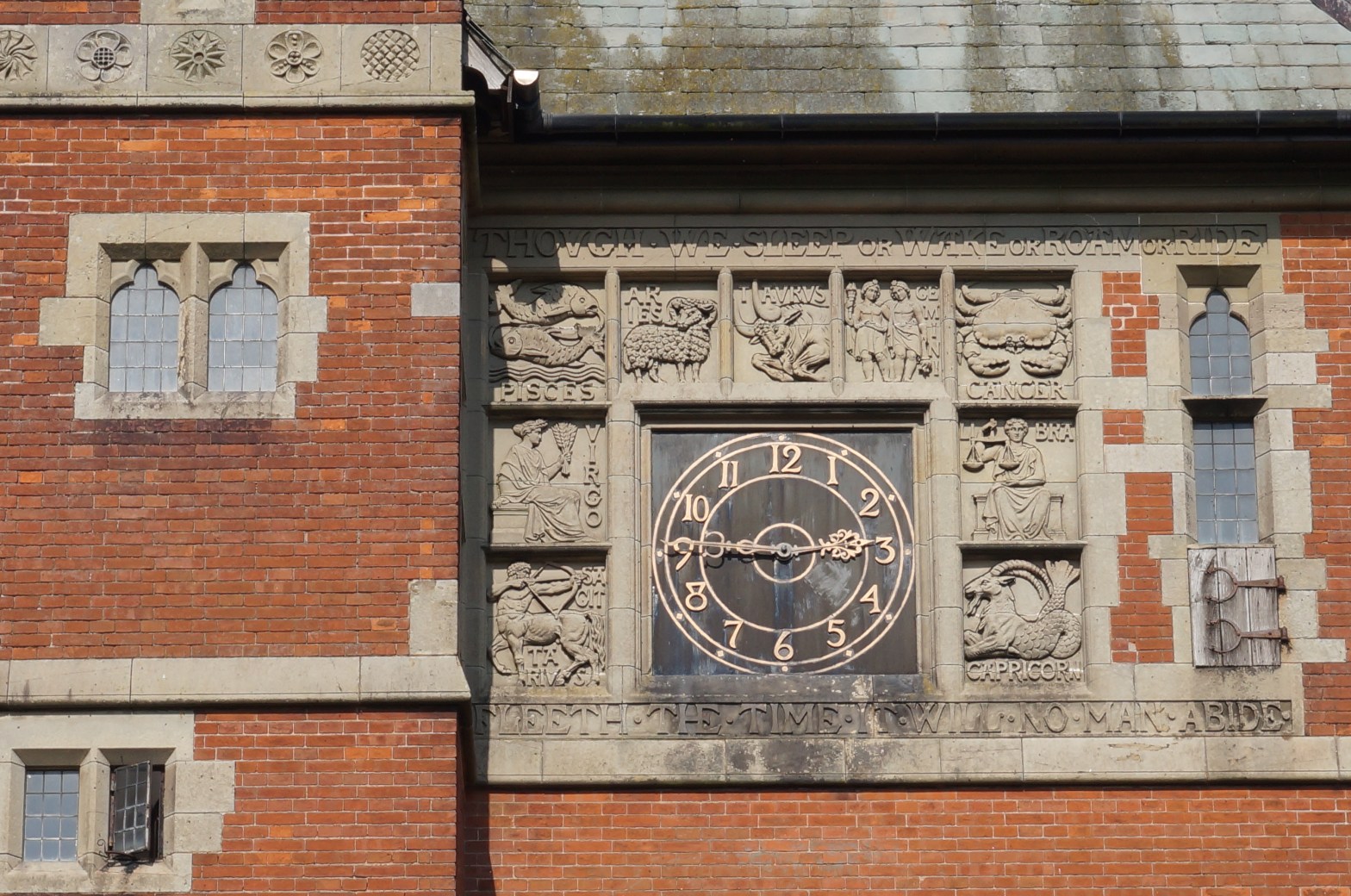

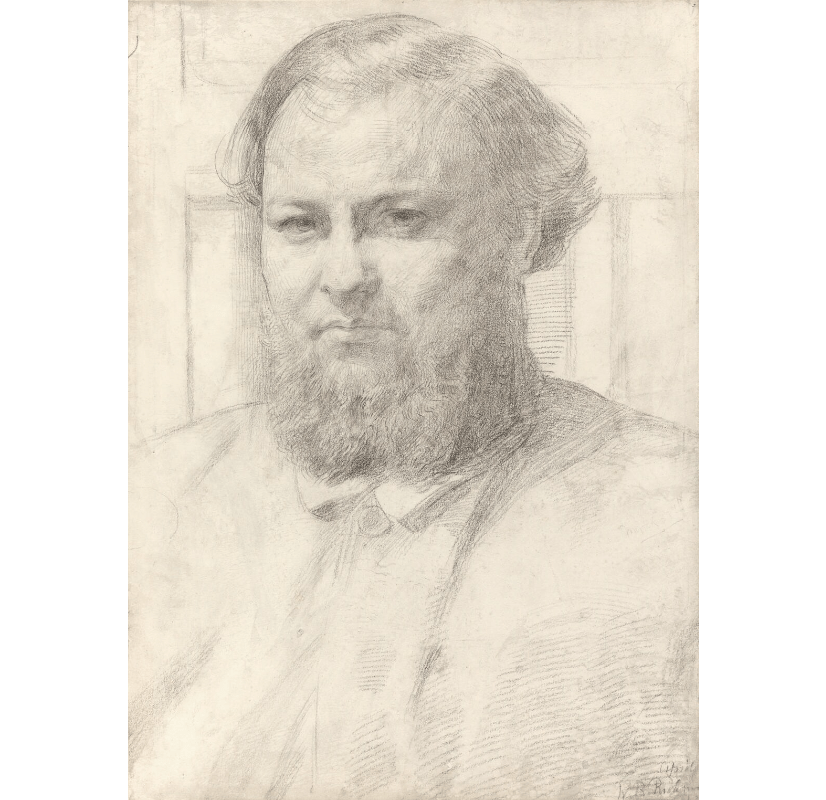
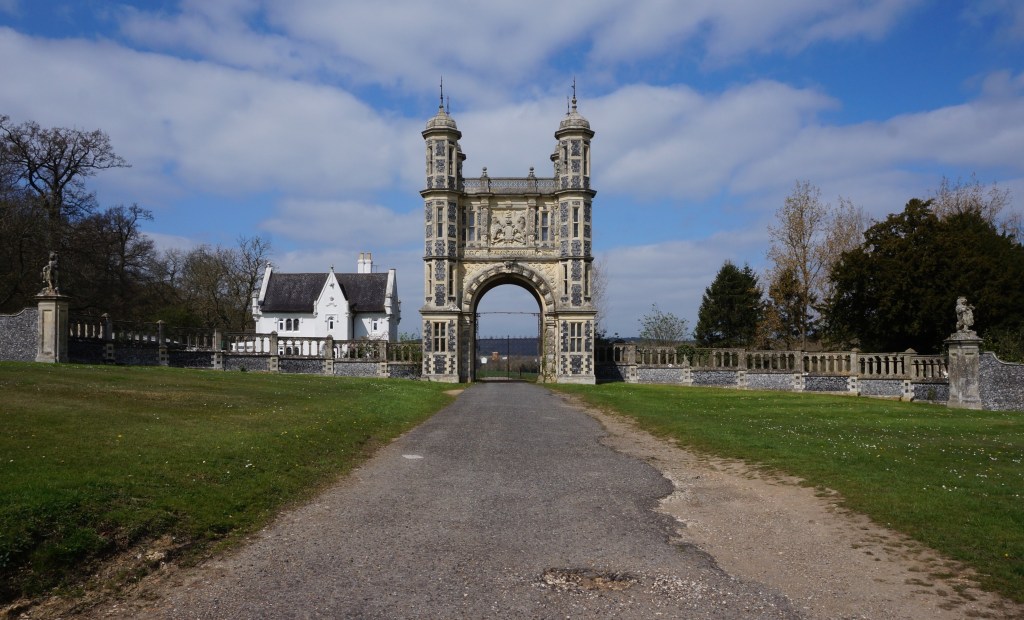
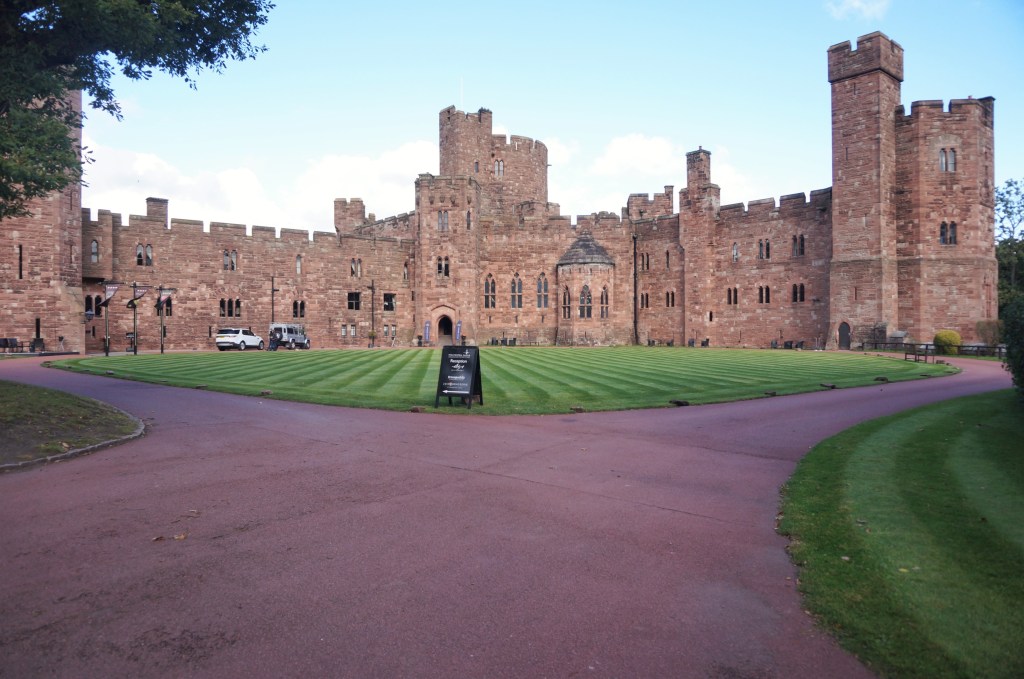


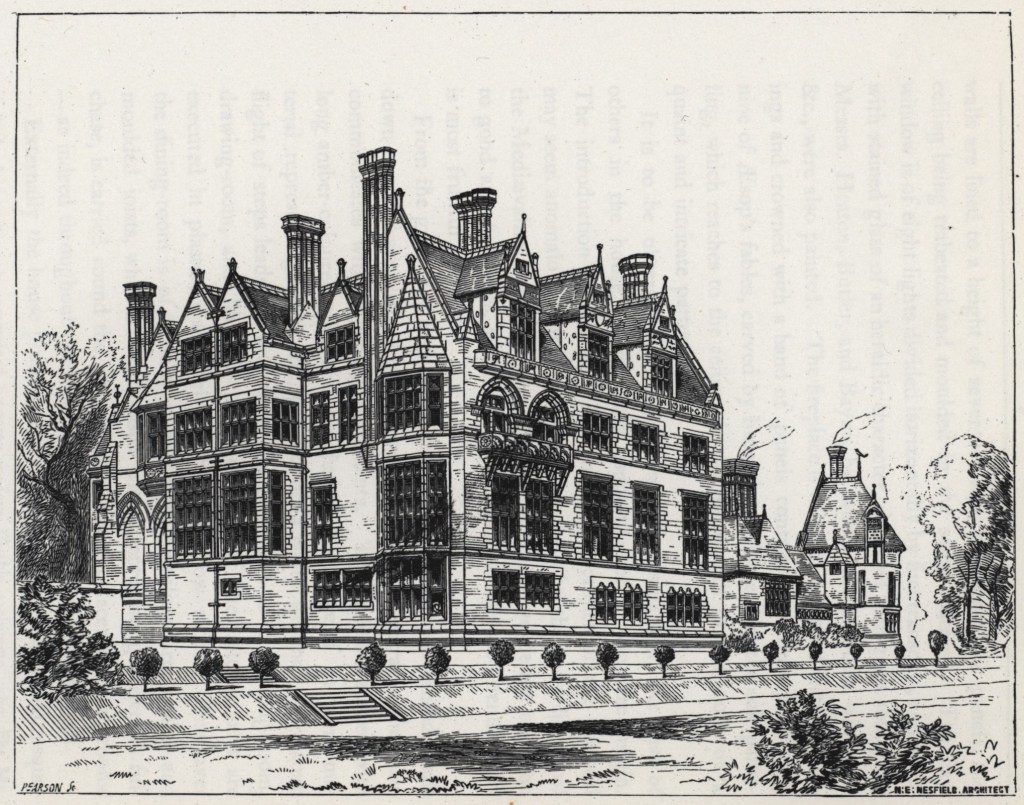


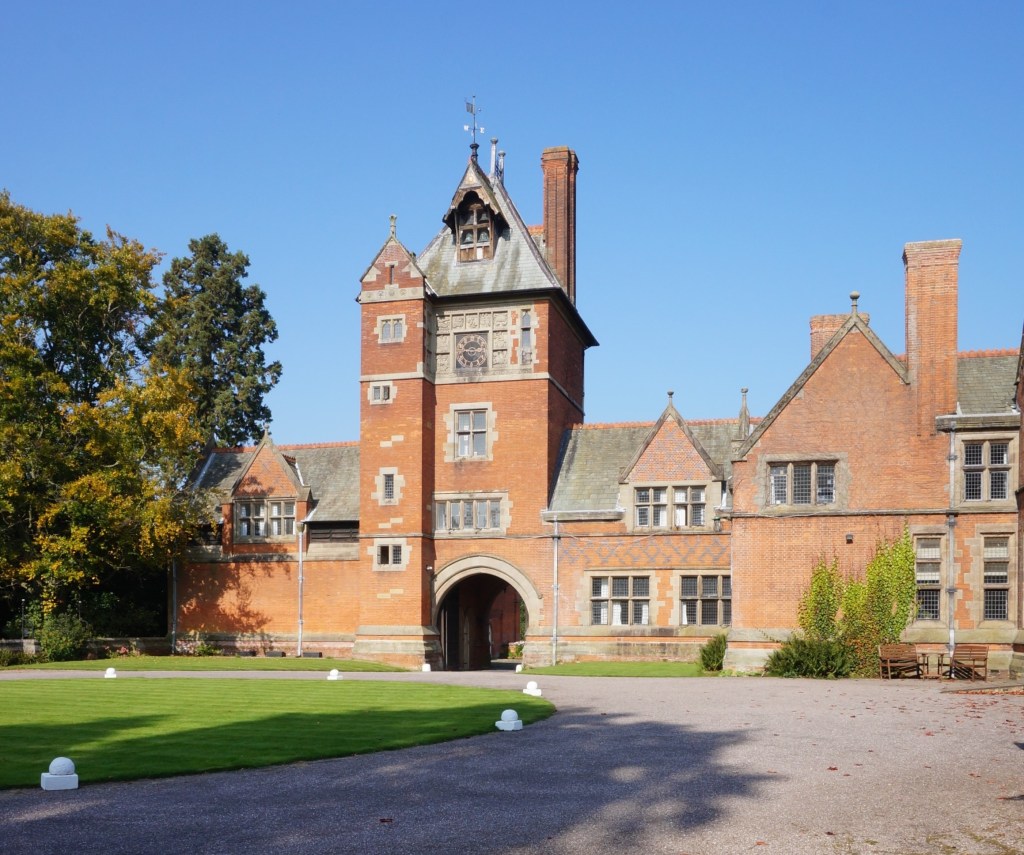

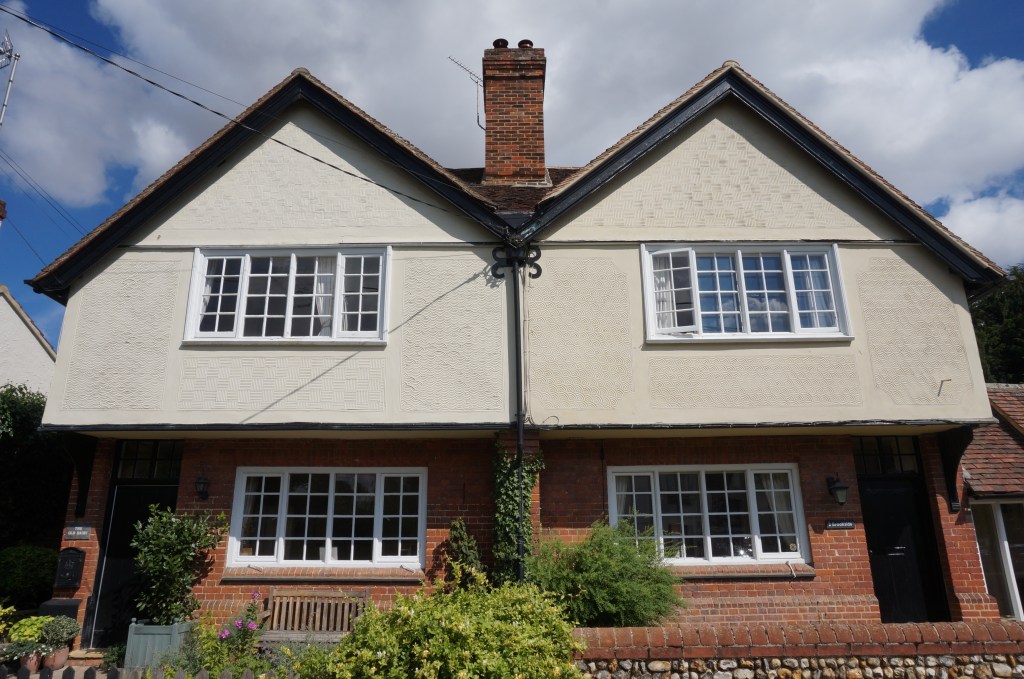
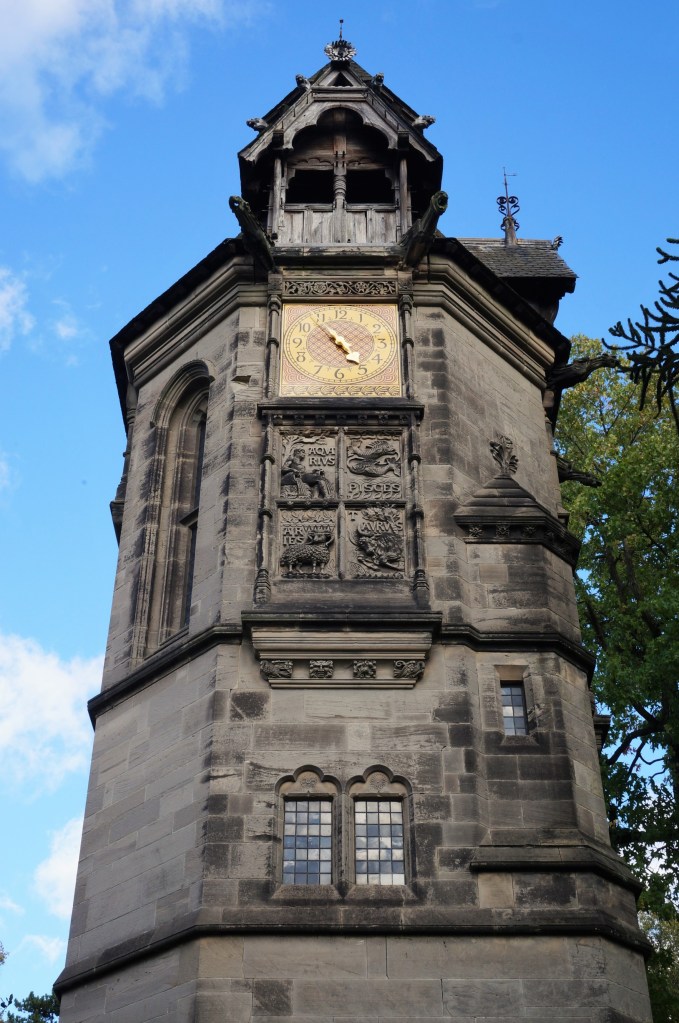
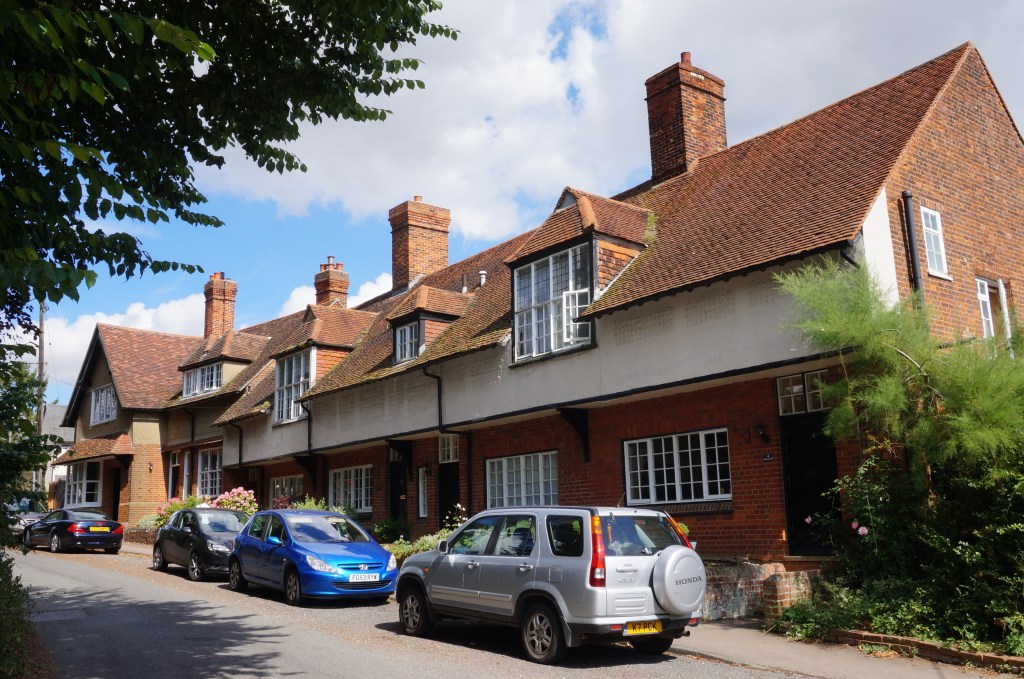

 Less Eminent Victorians