Fascinating though Victorian ecclesiastical heritage can be, I’m concerned that this blog shouldn’t get too church-heavy, so here is something completely different – a building that is every bit as colourful and exuberant as architecture already featured here, but apparently off everyone’s radar. Leeds Castle is one of Kent’s big tourist attractions – or at any rate, it was before COVID-19. The eponymous village is eminently worth a look. It is uncommonly pretty, full of historic buildings and lies in a very attractive setting with the North Downs as a distant backdrop. But by an unfortunate quirk of geography, it attracts traffic for entirely the wrong reason. It is strung out along the B2163, a useful through-route connecting several major roads, and on the narrow village street journalistic clichés about HGVs thundering through acquire genuine depths of meaning. Though no sane human being wants to see beautiful countryside carved up, it is hard not to sympathise with the calls on numerous placards displayed along the way calling for a relief road.
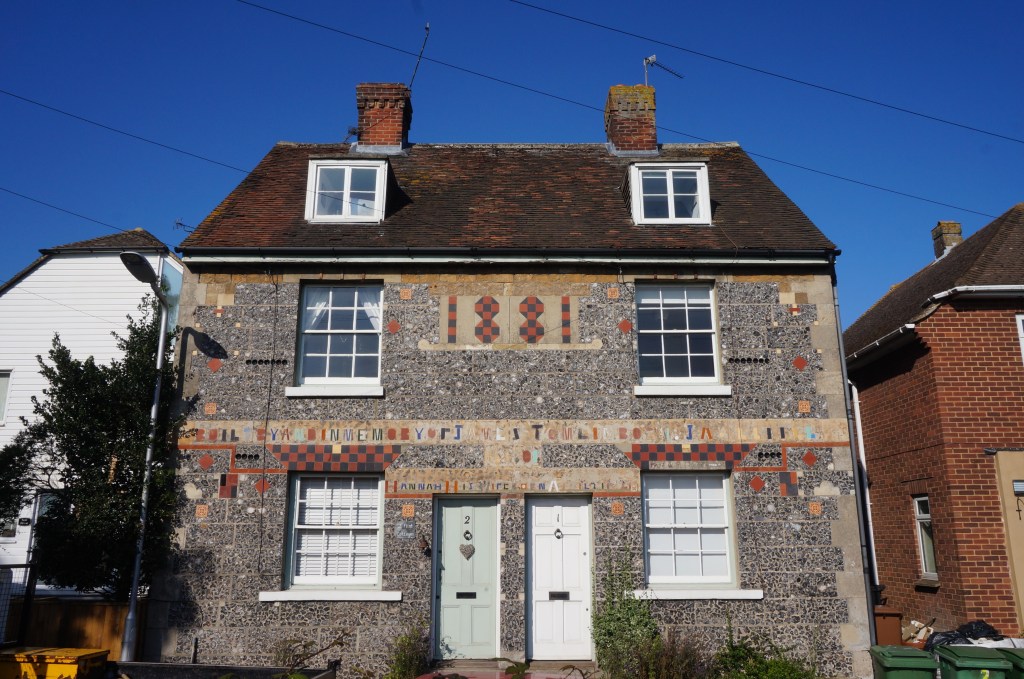
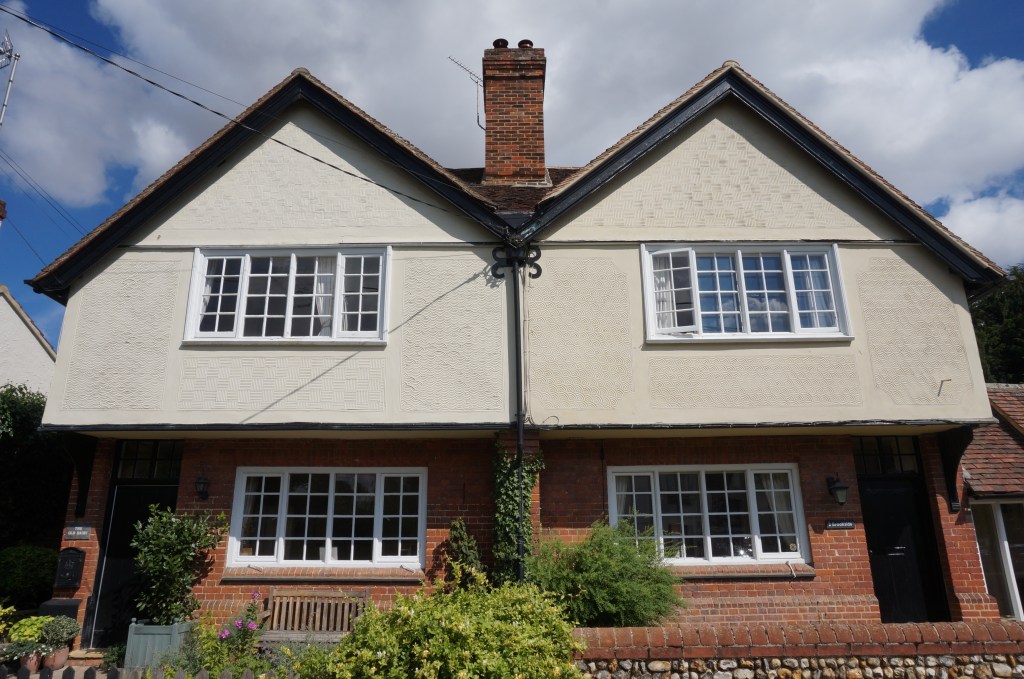
Flint Cottages: general view of the street front
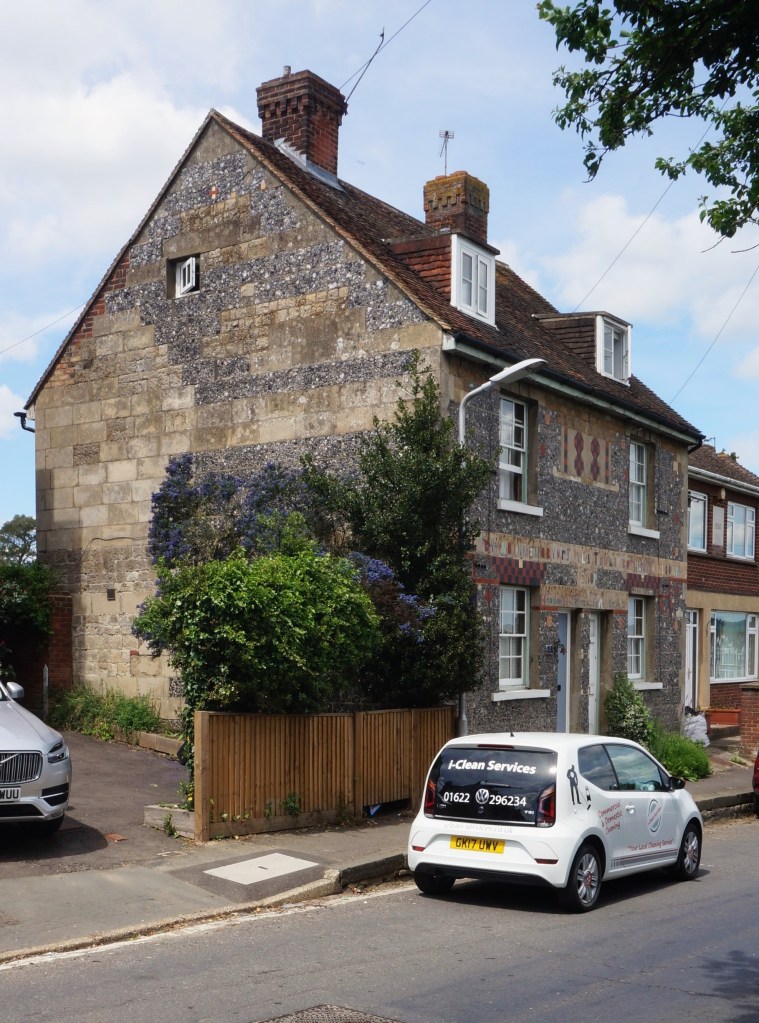
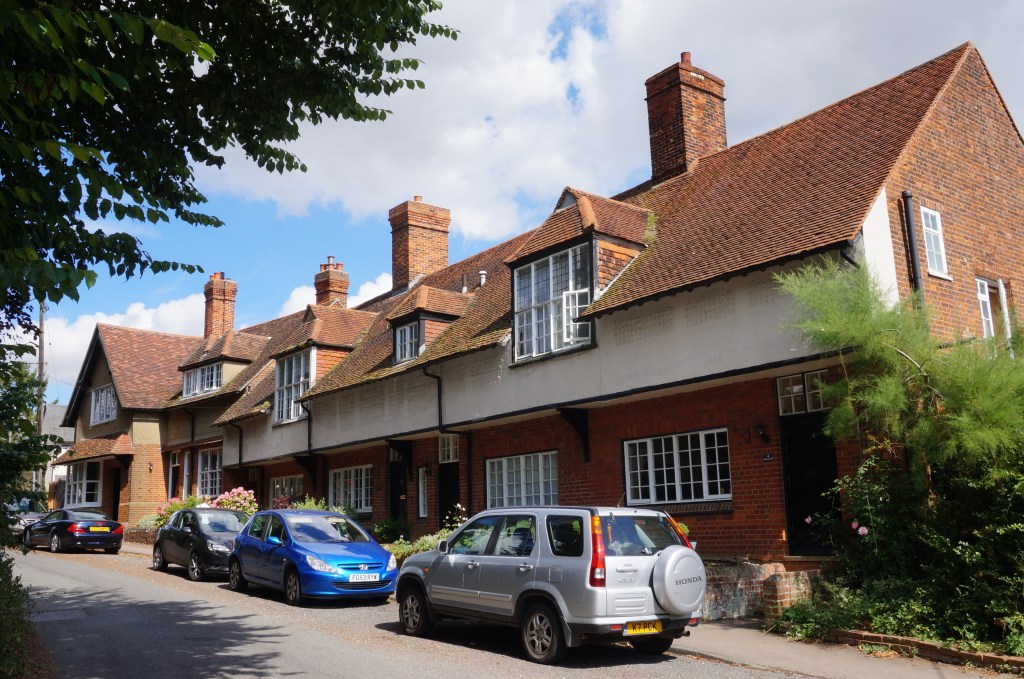
Still, were it not for that, I doubt I would ever have discovered Flint Cottage on Upper Street. It looks as though the builder went to town with the leftovers of a Victorian tile merchant’s depot. In addition to picking out the date of construction in red and black, the builder added an inscription stretching the whole width of the street front recording that the two houses were ‘Built by and in memory of James Tomlin born [date illegible/nonsensical] also of Hannah his wife born April 21 1821’. The walls seem to be built of prefabricated blocks of knapped flint, which, if really the case, represents a rather advanced bit of construction technology for the date. I have no idea when such blocks became widespread (could anybody tell me?), but my impression is that must have happened in the 20th century, when economics dictated that it was more cost-effective for flint to be set into concrete blocks at a production plant than laid in courses on site – a slow, labour-intensive process, after all. Some of them have green bottle bottoms – a favourite device of Shaw and Nesfield – set into them. The flint blocks are of the same dimensions as the stone blocks used for the quoins and for large sections of one of the end walls, which are very good quality and look like they might be spolia. The blocks of local ferruginous sandstone are smaller and less finished, but contribute extra colour and texture. These are modest houses and the design is nothing remarkable for their date of construction, but my goodness, what an enjoyable and exuberant piece of folk art this is! In a conservation area, but not separately listed, all further information gratefully received.
Flint Cottages: three-quarter view, showing the flank wall
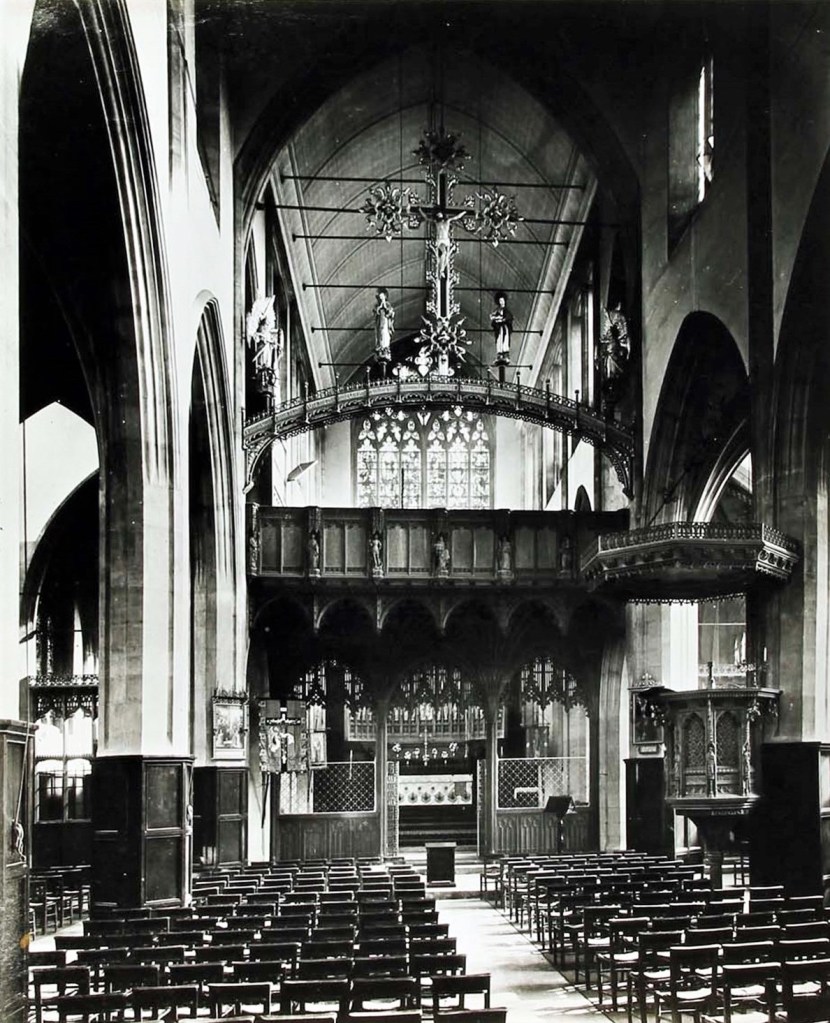
All Saints, Chillenden, Kent: the west end, showing the bellcote added by Scott The interior of G.G. Scott Junior’s lost church of St Agnes, Kennington Park (Historic England)
George Gilbert Scott Junior (1839-1897) is not an overlooked architect. At any rate, he shouldn’t be. He was recognised in his time as a hugely talented designer, yet never received his posthumous due for a number of reasons. One, inevitably, was that he was overshadowed by his more famous namesake father, but his breakdown, relatively early death and consequently limited output also contributed towards his obscurity. Two of his most celebrated churches are now known to us only from drawings and black and white photographs, since both were casualties of German bombing and post-war philistinism. All Hallows, Southwark (designed 1877, built in stages 1879-1892) was probably a hopeless case, having suffered not only blast damage in 1941, but also a hit from a flying bomb in 1944. But St Agnes, Kennington (designed 1874, consecrated 1877 but not complete until 1891) was capable of being saved, something encouraged very strongly by architect Stephen Dykes Bower (1903-1994), who recognised its exceptional significance and had prepared a scheme for the restoration – alas, in vain. The Cathedral of St John the Baptist in Norwich is, by any standard, a major achievement, but is overlooked by the many visitors to the city because it is a Victorian building in somewhere most celebrated for its medieval and Georgian architecture, and also because it is Roman Catholic (the faith to which Scott himself converted) rather than Anglican. Moreover, to appreciate the true significance of Scott’s refined and original work, one must first understand that he was reacting against the stridency of High Victorianism – something difficult to appreciate for anyone not steeped in the complex world of 19th century architectural polemic and theory.
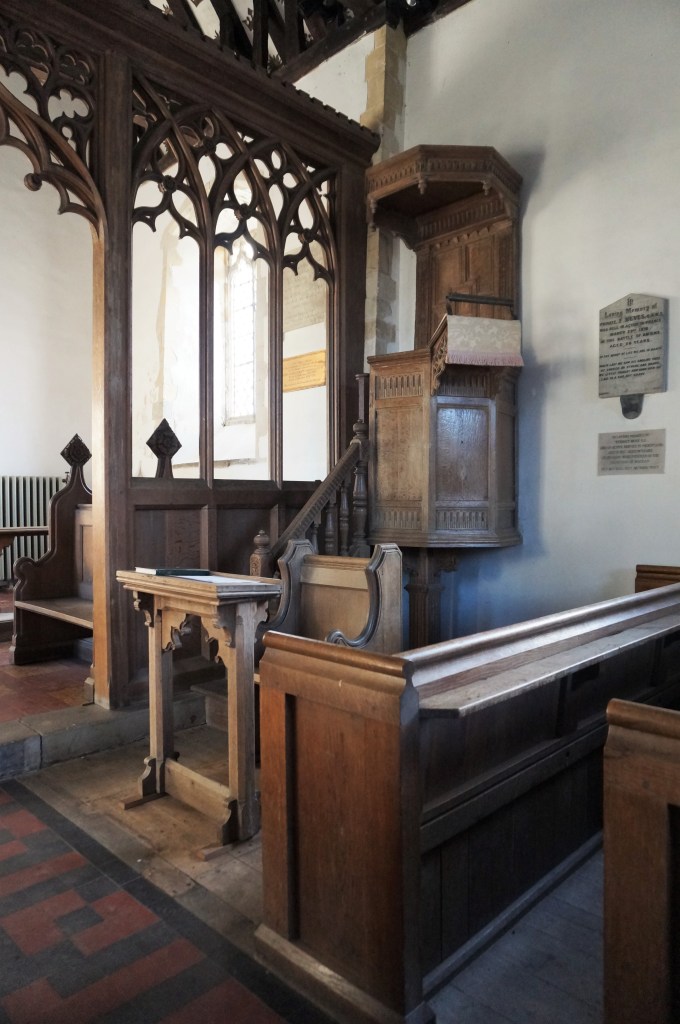
All Saints, Chillenden, Kent: general view of the interior looking west from the chancelAll Saints, Chillenden, Kent: Scott’s south porch, which shelters a Norman portal.All Saints, Chillenden, Kent: the Jacobean pulpit, which Scott seems to have set up on a new base with a new handrail and stairs. The prie-dieu and stall must also be his work.
The late and sorely missed Gavin Stamp did a huge amount to redress Scott’s obscurity by producing a splendid monograph, based on his doctoral thesis, called An Architect of Promise, George Gilbert Scott Junior (1839-1897) and the late Gothic Revival (Donington: Shaun Tyas, 2002). It is well worth having, although long out of print and consequently expensive. Like any architectural monograph worth its salt, it contains a gazetteer of its subject’s works, and, as one would expect from its author, that is meticulous and exhaustive. But there’s one commission which ought to be featured in it and isn’t. And here it is.
All Saints, Chillenden, Kent: the chancel floorAll Saints, Chillenden, Kent: stencilled patterning to the plaster surface between the roof trusses in the chancelAll Saints, Chillenden, Kent: chair in the sanctuary, perhaps also a design by Scott
In 1870-1872, a restoration was carried out on the medieval church of All Saints in Chillenden, a tiny village in a picturesque fold of rolling countryside about half way between Canterbury and Deal. Petrie’s watercolour of 1807 showing the building as it was before depicts a tiny, two-cell structure with a funny little offset bell turret. It remained a modestly-scaled building after the restoration, but hugely enriched. It was reseated throughout and gained a new floor in the chancel and sanctuary with delicately patterned encaustic tiles. The Jacobean pulpit – which, unusually, retains its sounding board – was set up on a new base with new stairs, all detailed with sympathy for such a piece that was rare at the time, even if it did slightly accentuate its already gangly proportions. Externally, the old bellcote was removed to make way for a larger, centrally-positioned replacement, covered in shingles and with an elegant spire to give the church a bit more presence in the landscape. The porch shown in Petrie’s watercolour was replaced with a new structure whose bargeboards are handsomely cusped.
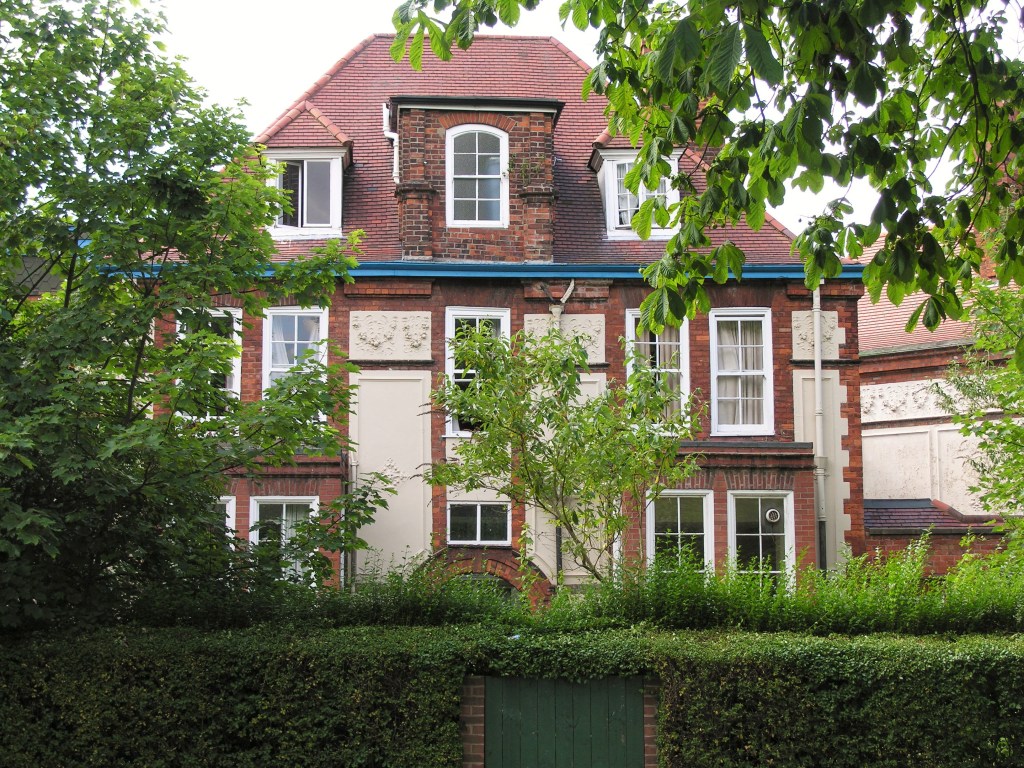
No. 96 Westbourne Avenue (now International House), Hull of 1876-1877: one of a group of Queen Anne-style houses designed by Scott for his cousin, John Spyvee Cooper, who was a solicitor and agent to the Westbourne Park estate. Rubbed red brick is used to frame panels of Portland cement incorporating ornamental detail in relief.The tower in a suave reinterpretation of West Country Perpendicular and west vestries that Scott added in c. 1872-1876 to the church of SS Peter and Paul in Cattistock, Dorset, which his father had all but rebuilt in 1855-1857. Damaged by fire in 1940, the tower was rebuilt in 1948-1951 by J.S. Brocklesby, who carried up the corner buttresses to a much higher level, reducing the impact of Scott’s innovative treatment of his historical models. Weathering has reduced the striking contrast between the Ham Hill stone used for the wall surfaces and the darker Belgian sandstone employed for the dressings, still visible clearly in this shot. (Historic England)SS Peter and Paul, Cattistock, Dorset: the interior of the baptistry in the ground-floor stage of Scott’s tower. The wall paintings were added in 1901 and were executed by W.O. and C.C. Powell imitating the style of Burlison and Grylls, who did the stained glass in the same part of the building installed at the time of construction. The towering font cover was introduced in c. 1904 and was designed by Temple Moore.
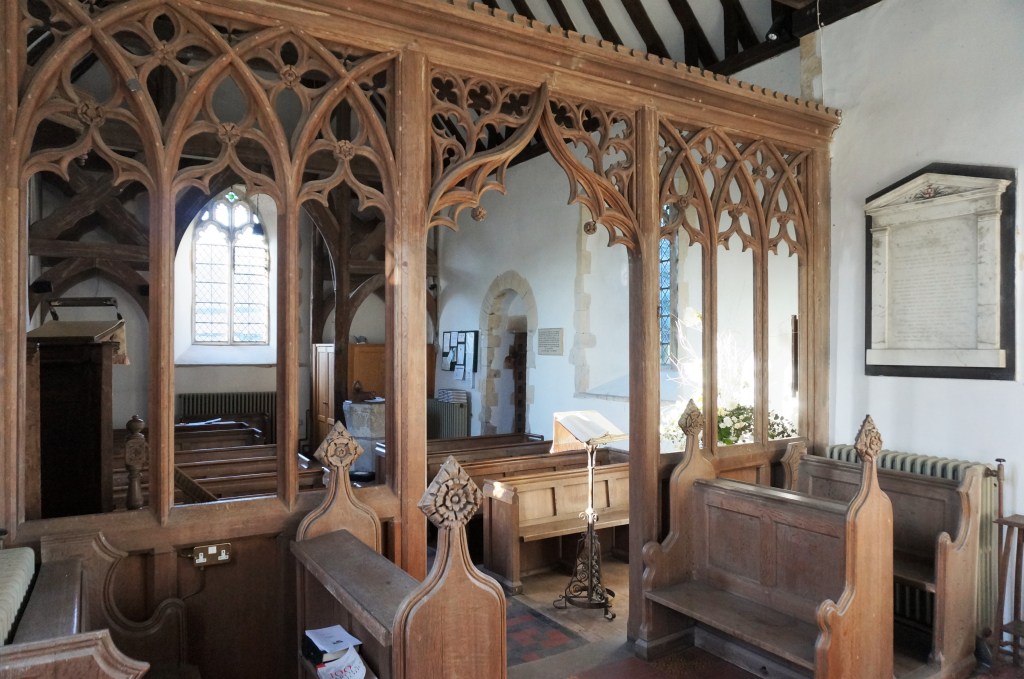
But the pièce de resistance is the chancel screen, a really exquisite design that bears all the hallmarks of Scott’s sophisticated and fluent handling of Gothic. The prototypes of the tracery are to be found in English work of the early 14th century – Geometrical Decorated on the cusp (pun intended) of going Flamboyant. But in the spandrels of the central opening, the thickets of tortuous mouchettes are already redolent of the whiplash curvature of Art Nouveau. One wouldn’t want to push the point – all that was still 30 years in the future – but the sensibility is totally different to that of the stridency and vigour of the High Victorian Gothic of the period. The ground plan in the collection of the Incorporated Church Building Society at Lambeth Palace Library is signed ‘G.G. Scott, RA, Arch’t, Spring Gardens, London’ (i.e. the older man’s office), yet Scott Jr had been in independent practice since 1863. But Gavin’s monograph states that the son carried on assisting the father for some years afterwards and his stylistic fingerprints are all over the work at Chillenden, the true authorship of which cannot be in any doubt. The attribution to the older Scott in The Buildings of England wants correction.
Scott’s chapel at Ramsgate Cemetery: the pointed arches denote the Anglican section, the square-headed ones that of the non-conformists.Ramsgate Cemetery, the gatehouse: note the chapel visible in the distance through the central arch.
Scott Junior was, in any case, active elsewhere in Kent at this period and there are two major commissions within easy reach of Chillenden that are well worth seeking out. One is the cemetery chapel in Ramsgate, probably commissioned in 1869 and opened in 1872, and untypical of what by that point was already a widespread building type. A typical formula at the time was for the two cemetery chapels – one for Anglicans, one for non-conformists – to be positioned in a symmetrically composed group either side of a gatehouse, which was sometimes combined with a bell tower. Scott’s design takes its cue from that, then fights very strongly against the underlying symmetry with the irregular placing of the fenestration and prominent stair turret and buttress to the central tower. It has all the sophistication and elegance of the work at Chillenden, even if the attempt to get pass it off as a country church slightly falls flat in its very municipal, formally planned setting. Aligned with it on the same axis is a splendid gatehouse, which looks like it ought to be opening onto the precinct of a great abbey or cathedral church.
St Dunstan, Frinsted, Kent: interior looking east, showing Scott’s chancel screen. The trecento-style Crucifixion is a recent addition. The Kingsdown Chapel is just visible through the two arches on the left-hand side of the chancel.The sanctuary at St Dunstan’s, Frinsted: the green patterning of the dado was executed on slate to protect it from damp, but the measure was apparently not entirely effective and the decorative scheme of the south wall of the chancel had to be renewed in 1999. It formerly extended across the upper part of the east wall, but here has been mostly painted out.
The other is St Dunstan’s in Frinsted, an estate village high up on the Kent Downs south of Sittingbourne. Here, Scott Junior sumptuously embellished the eastern half of an originally medieval church that had already been enlarged by R.C. Hussey in 1856-1861. The work was carried out in two phases, the first in 1867 for Lord Kingsdown, and the second in 1877 for his brother, Edward Leigh-Pemberton. The church was refurnished throughout and a sumptuously tiled floor introduced in the chancel and sanctuary. The walls and roof of the chancel and Kingsdown Chapel to the north were lavishly adorned with painted decoration and a huge chancel screen installed, reaching from floor to ceiling in a mass of intricately jagged cusping.
The interior of the Kingsdown Chapel at St Dunstan’s, Frinsted in Kent: the stalls and frontals are a recent addition from the late 1980s. The painted decoration was restored in c. 1976.Detail of one of the windows on the north side of the nave at St Dunstan’s in Frinsted: the stained glass was the work of Burlison and Grylls, who also executed the painted decoration in the Kingsdown Chapel.
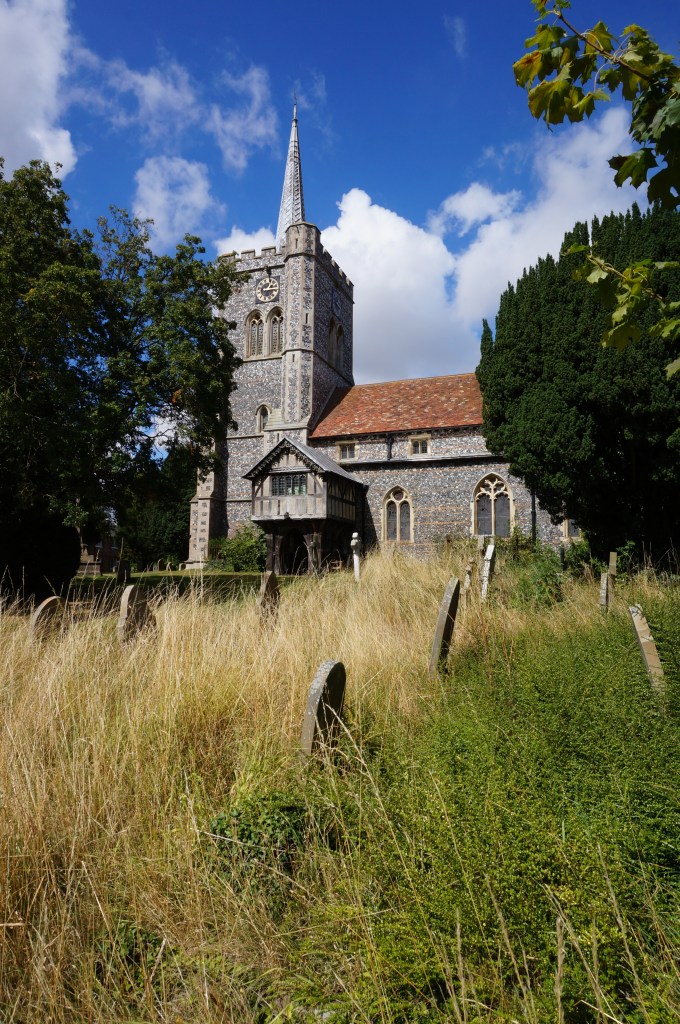
St Mary’s, Radwinter, Essex: general view from south
In my first post on W. Eden Nesfield, I described country houses and associated domestic work as the mainstay of his practice. The Saffron Walden bank is his only commercial building – indeed, only one of a tiny handful of works in an urban setting – and he made few attempts to enter the crowded lists of Victorian ecclesiastical architecture. But although his works in that field may not be numerous, they are of considerable interest and deserve to be featured here in detail. A good place to start is the restoration of the church of St Mary in Radwinter, Essex, already mentioned in connection with the Saffron Walden bank.
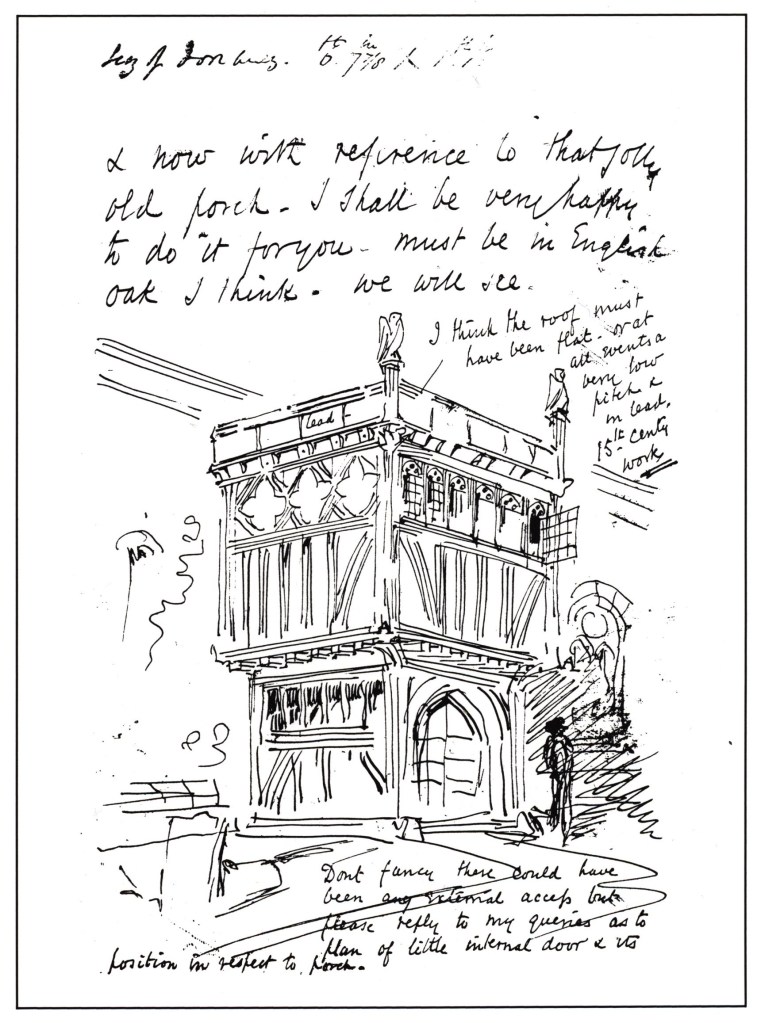
Letter from Nesfield to Bullock, probably written in early 1876, incorporating a sketch proposal for the porch. What was eventually built, visible in the photograph above, differs substantially in form, notably in the substitution of a steeply pitched and tiled roof for the flatter, lead-covered one hidden behind a parapet indicated here.General view of the interior of St Mary’s in Radwinter looking east
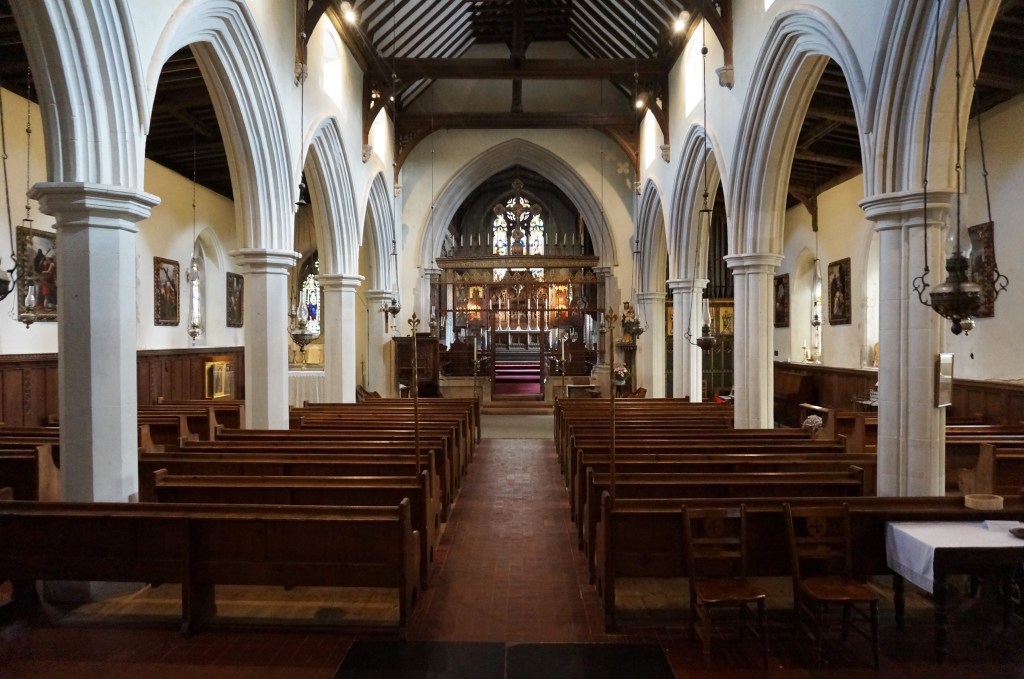
Between 1758 and 1925, the incumbency of St Mary’s was held by five members of the Bullock family consecutively. At some point during the period, it became a centre for ritualism, and the Rev’d John Frederick Watkinson Bullock – vicar from 1865 to 1916 and the fourth from that family to hold the post – embarked on a major programme of reconstruction and beautification. Bullock inherited a distinguished, if not exceptional 13th and 14th century building. What he bequeathed to future generations is almost entirely the result of a major remodelling carried out between 1868 and 1888, begun by Nesfield and completed by Temple Lushington Moore (1856-1920).
Exterior of St Mary’s in Radwinter from southeast, showing the exterior of Nesfield’s vestryThe chancel screen and pulpit at St Mary’s in Radwinter: the latter is Moore’s work and was introduced in 1892, although looks as though it must incorporate late medieval panelling of currently unknown provenance.
In the first phase of 1868-1870, Nesfield remodelled the body of the church. The nave was lengthened by one bay to the east and the aisles were rebuilt. So was the chancel, which gained an organ chamber and vestry. The reconstruction of the nave was so sensitively done that it is not immediately apparent just how much of the fabric was replaced. Nesfield reused the original chancel arch, which of course had to be resited, and much of the 14th and 16th century roof structure. He engaged a family of flint knappers from Brandon in Suffolk to do the external walling of the new aisle, with its attractive admixture of tiles laid in thin horizontal courses.
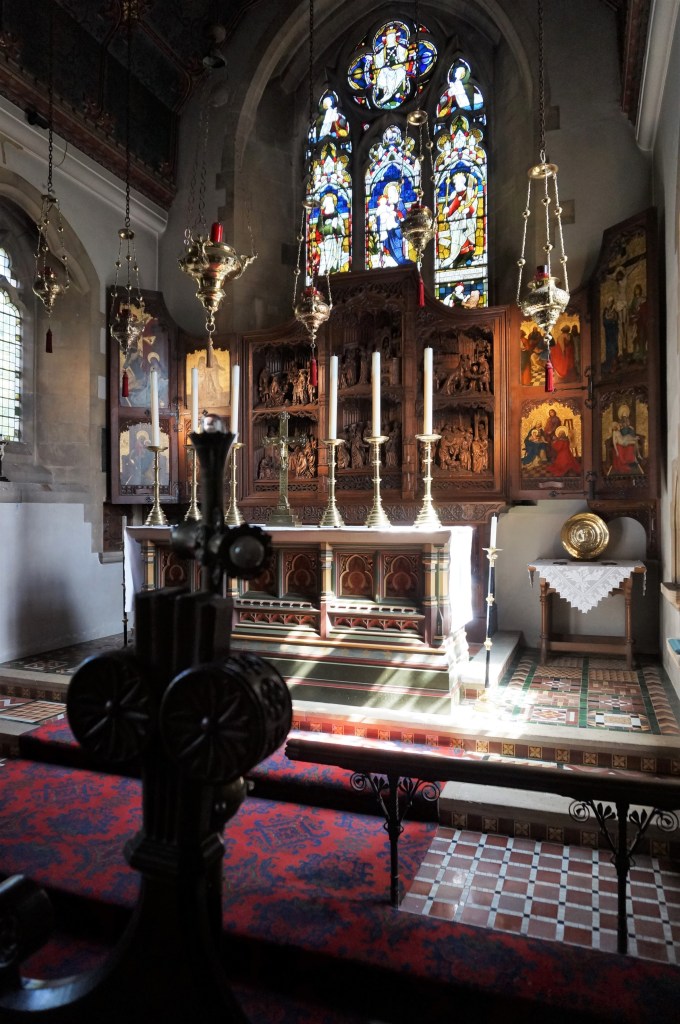
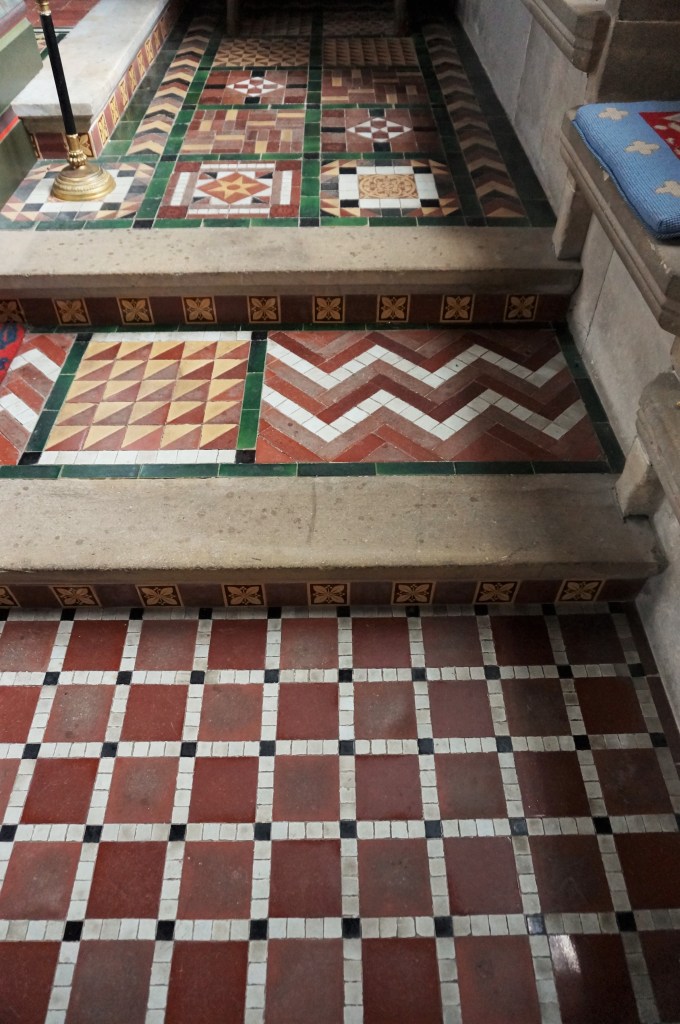
St Mary’s, Radwinter – the sanctuary, showing Nesfield’s altar and the early 16th century Flemish reredos installed in 1888 folding wings added at Bullock’s wish.St Mary’s, Radwinter: detail of the tiled floor of the sanctuary
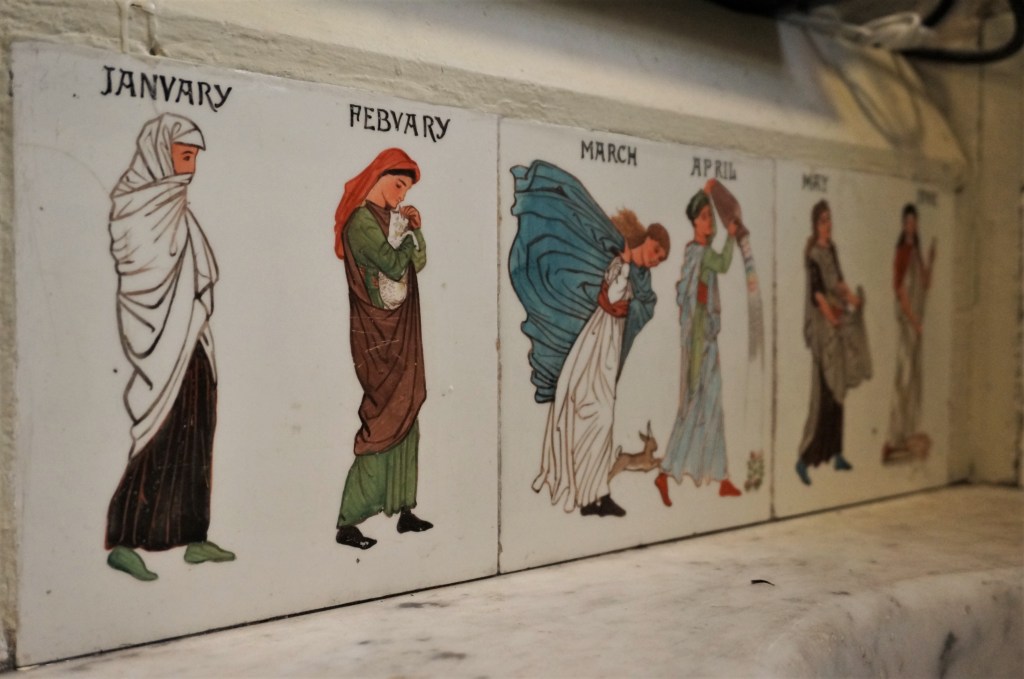
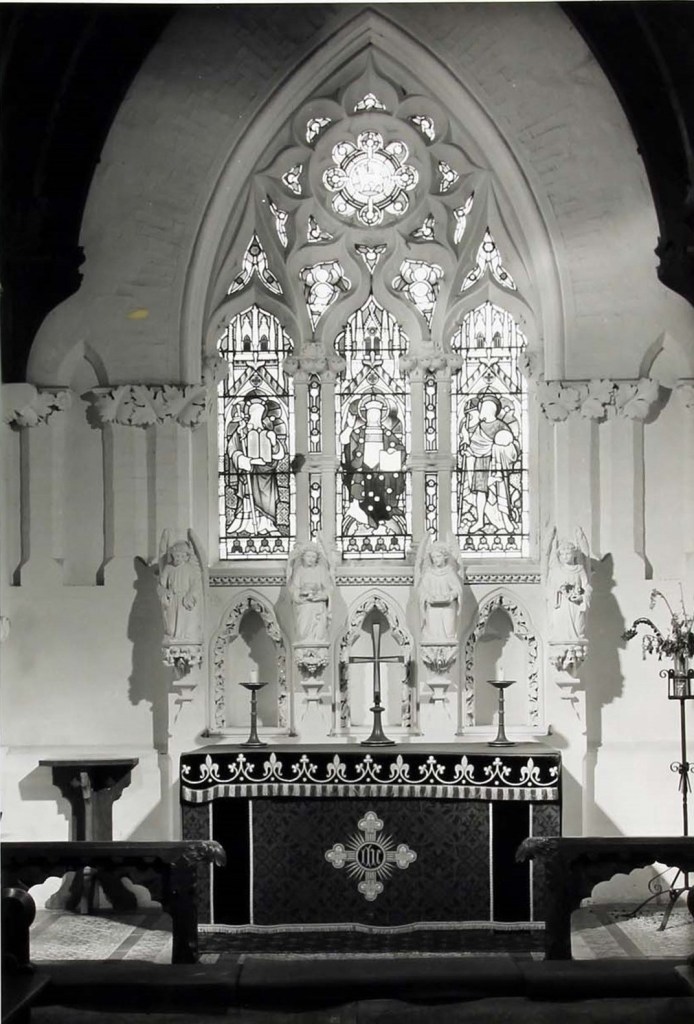
But the chancel, far taller than its predecessor, is less restrained and more obviously High Victorian, with features such as the outsize cusping of the inner arch to the large south window. The bench ends of the choir stalls have carved reliefs with birds and flowers, while the poppy heads of the stalls incorporate Nesfield’s favourite ‘Japanese pies’. There is much good tilework, such as the floor of the sanctuary and the charming splash-back in the vestry, with painted figures representing the twelve months of the year. In the vestry there is a three-light window with vividly coloured stained glass of archangels designed by Nesfield – his only known work in the medium, dated 1870. The east window was installed that same year; the windows in the nave appeared later, between 1882 and 1888. With the exception of the vestry window, the stained glass was the work of Isaac Alexander Gibbs (1849-1899) of Gibbs and Howard.
St Mary’s, Radwinter, Nesfield’s window in the vestry: a detail of the right-hand light, where the date and architect’s name appear, is reproduced at the top of this page.St Mary’s, Radwinter – splashback to the vestry sink
Radwinter came to occupy an important place in Nesfield’s career. In 1874 a serious fire destroyed most of the village centre and he was closely involved in the rebuilding. He designed a terrace of four houses and a shop, as well as a pair of semi-detached dwellings called Brookside Cottages, all of them just outside the eastern boundary of the graveyard on Church Hill and pictured in my first post on Nesfield. The street fronts are pargeted at first-floor level. Although this was a Nesfield trademark that the architect used indiscriminately in his domestic design throughout the country, it was drawn from the vernacular architecture of Essex and its neighbouring counties so here is more than just a mannerism.
St Mary’s, Radwinter: ‘Japanese pies’ adorning a poppyhead in the chancelSt Mary’s, Radwinter, the chancel ceiling – the decorative scheme is Moore’s work.
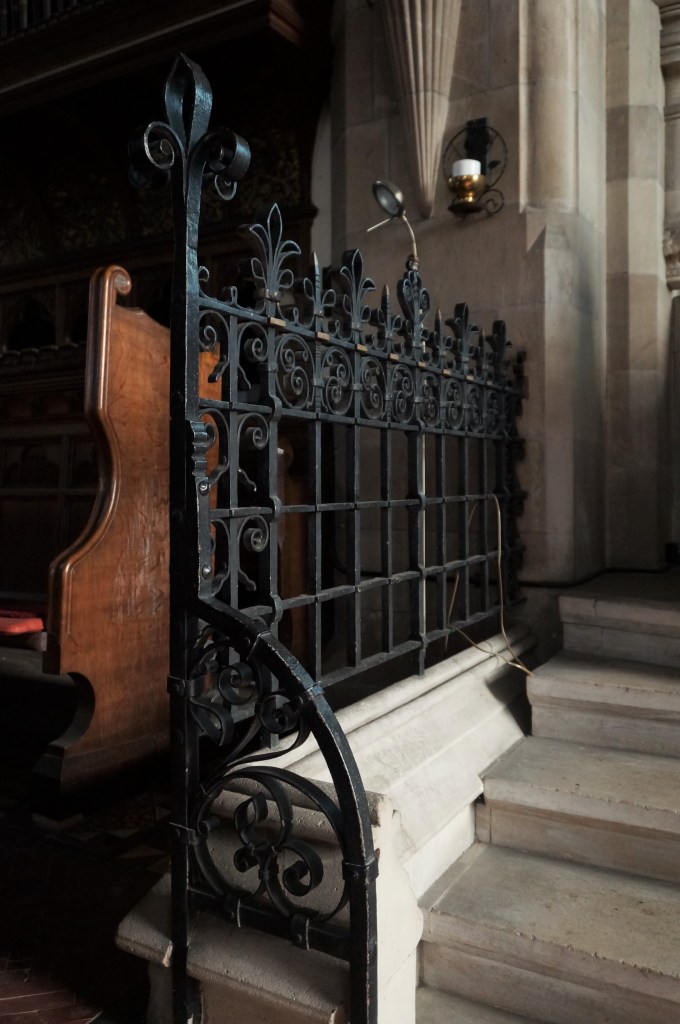
Nesfield retired from architectural practice in 1880, but Bullock’s ambitions for the church were unfulfilled and this necessitated a change of architect for the subsequent phase of the remodelling. With the benefit of hindsight, Temple Moore appears a natural choice as a successor. Aged just 24 when he was appointed, as a pupil of George Gilbert Scott Junior, whose office he had taken over when that architect became incapacitated, he was in the vanguard of stylistic developments of the time. Moore oversaw the execution of Nesfield’s design for the wrought iron chancel screen, reputedly made by a local blacksmith from Saffron Walden. He also rebuilt the upper room of the two-storey timber-framed south porch, which had been derelict since the early nineteenth century. Nesfield had planned this, and sketches for it appear in letters to Bullock of 1876 from the charming correspondence reproduced in facsimile in A Deuce of an Uproar, the detailed account of the remodelling of St Mary’s published in 1988 by the Friends of Radwinter Church.
St Mary’s, Radwinter, the organ case in the chancel: the lower part with the patterned coving would appear to be Nesfield’s work (compare with the organ case at Calverhall, pictured below), but the upper section with the pipe shades is by Moore.The front of the organ case in the south aisle added by Moore
In the first major campaign overseen by Moore in 1887-1888, the existing west tower was dismantled and completely rebuilt on a grander scale (the original bells were retained and rehung), and a second vestry was added to the north side of the nave at its west end. But Bullock was apparently still not satisfied and Moore seems to have been involved sporadically on several later occasions throughout the remainder of his incumbency. Two large, polychromed cupboards were set up in the base of the tower and in 1892 a baptistry was created at the west end of the north aisle, containing a stone font with a tall wooden cover, and the pulpit was introduced. The pipe rack of the organ facing into the chancel gained a richly painted and gilded surround with traceried pipe shades, as well as a completely new front, also gilded and painted, speaking into the south aisle. This was done to to commemorate the 48th anniversary of Bullock’s ordination, which would date it to 1911. The chancel roof was also painted and gilded at a currently unknown date.
St Mary’s, Radwinter: the baptistry at the west end of the north aisle with Moore’s font and font cover of 1892.
Moore’s work is very different in flavour to Nesfield’s. It shows greater concern with archaeological precedent – note the lead-covered ‘Herts spike’ on the tower, a nod to local traditions – and, for all its refinement, is more earnest and less playful. At this stage in his career, he was still steeped in the influence of his teacher and his own architectural personality had yet to emerge in full. In his later work, especially the large town churches, he shows greater freedom and inventiveness in his treatment of historicising motifs, planning and volume. Then again, tact was essential for the additions to Radwinter and being overly assertive with a building on which one architect had already strongly imprinted his personality could easily have impaired its coherence. Like Nesfield, Moore was involved in the rebuilding of the village, designing the charming parish hall of 1889 located almost directly opposite the church and adjacent almshouses. Like Nesfield’s buildings in the village, these are pargeted in deference to local traditions.
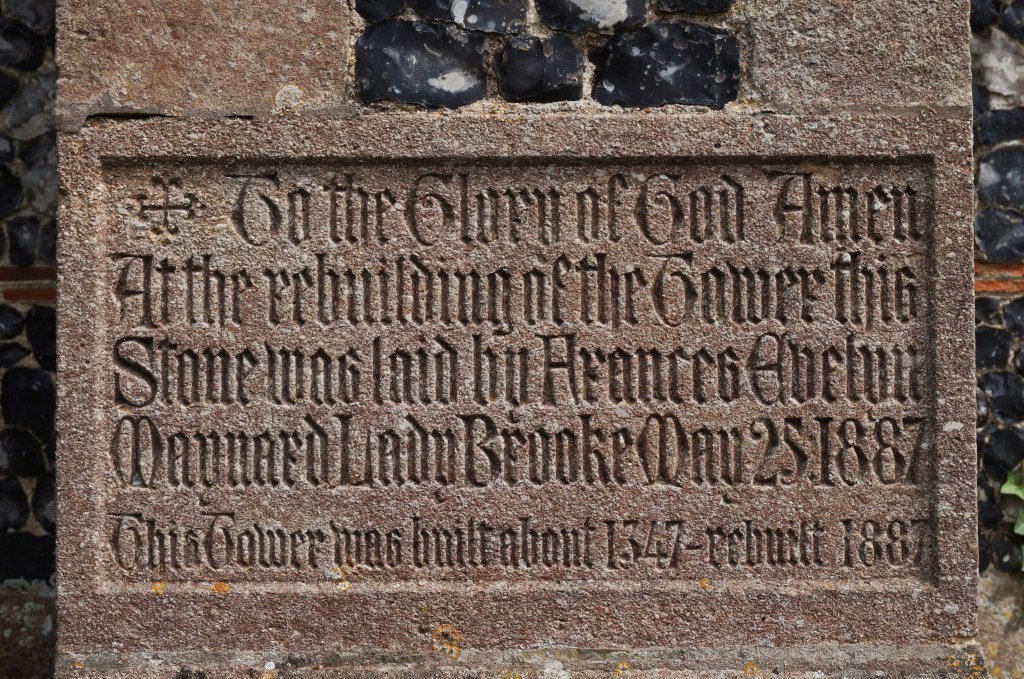
St Mary’s, Radwinter: the foundation stone of the towerTemple Moore’s village hall in Radwinter of 1889
Following Nesfield’s rebuilding of the chancel, an English altar with riddel posts and altar curtains was set up, but Bullock had greater ambitions. They were fulfilled when, by happy coincidence, during the course of Moore’s work a Brussels altarpiece of c. 1510 was put on sale by auction at the London premises of antiques dealer Julius Ichenhauser. Originally made for a church in Maaseik, it had been looted by soldiers in the Grande Armée and taken to Brussels, later being restored by sculptor François Malfait in c. 1880. Bullock’s bid was accepted and the altarpiece was in place by 1888. Moore resisted the rector’s wish to reinstate some of the lost colour and gilding on a gesso ground and instead folding wings painted with Marian scenes, complementing those of the original carved panels, were added, executed by an artist who has never been conclusively identified.
St Mary’s, Kings Walden, Hertfordshire: general view from the south, showing Nesfield’s porchSt Mary’s, Kings Walden – hopper head on the south aisle
In 1950, Stephen Dykes Bower (1903-1994), who lived not far away in Quendon, converted the hanging oil lamps in the nave and aisles to electric lighting. In the 1960s, surviving medieval painted geometrical decoration to the north arcade was painted out. More happily, part of Moore’s northwest vestry has recently been converted to a toilet and conservation work carried out on the reredos. St Mary’s is not usually kept open during the day and so can only be visited outside service times by appointment, but it is well worth the effort of making arrangements in advance – this is a hugely rewarding church and a building to savour if ever there was one.
St Mary’s, King’s Walden: the sanctuary and reredosSt Mary’s, Kings Walden – figure of King David by the vestry door
It makes one curious to see more of Nesfield’s ecclesiastical work, and the church which bears the closest comparison with Radwinter is St Mary’s in Kings Walden, Hertfordshire, a tiny village in delightful country of switchback roads between Luton and Hitchin. In 1868, the same year that he was engaged by Bullock for the scheme at Radwinter, Nesfield carried out a major restoration for the then-Lord of the Manor, Charles Cholmeley of the adjacent King’s Walden Bury. Though the structural interventions were less radical, apparently limited to a rigorous retooling of the existing fabric, he again lavished a wealth of colourful, entertaining decorative detail on the building and refurnished it throughout. Outside, note the crenellated hopper heads adorned with Japanese ‘pies’ and lively, grimacing masks discharging water into them from the gutters behind. The ‘pies’ appear also on the posts of the timber-built porch in the form of circular folk-like motifs carved in shallow relief on the uprights.
St Mary’s, King’s Walden: the pulpit and medieval chancel screen with its Victorian polychromy St Mary’s, King’s Walden: detail of the tiled floor by William de Morgan in the baptistry
Internally, one of the most striking features is the tiled floors – a bold geometrical scheme in green, white, black, ochre and terracotta in the chancel, while in the baptistry there are intricately patterned designs by William de Morgan incorporating the symbols of the Evangelists. The stone carving, reputedly by James Forsyth (1827-1910), is superlative in design and execution. The powerful geometry of the font looks beyond the Gothic Revival to the 20th century in its abstract forms. Note also the lush reliefs of the pulpit, the wonderful figure of King David with his harp by the vestry door and the splendid reredos with its incised decoration consisting of Aesthetic Movement Japonaiserie set in Gothic blind arches. The joinery is a delight, too – sumptuous foliate poppyheads to the chancel stalls and a delightful organ case with fine scrolly wrought-iron hinges to the cupboards. The pipe rack is decorated, just like the medieval chancel screen, with rich polychromy.
St Mary’s, King’s Walden: the fontHoly Trinity, Calverhall, Shropshire: general view from southwest, showing the attached almhouses of c. 1725
Wonderful though the work at Radwinter and Kings Walden is, both commissions constitute the restoration of ancient fabric which, to a greater or lesser degree, dictated the constraints within which Nesfield worked. Neither building really gives us a full sense of what he might have done if given free rein in designing a new church from scratch, and for that one must head to Holy Trinity in Calverhall, a small Shropshire village about half-way between Whitchurch and Market Drayton. Formerly an outlying hamlet in the parish of Ightfield, it is the nearest population centre to Cloverley Hall, which is located just under a mile to the southeast. This was the country seat that Nesfield rebuilt in 1864-1870 on an ambitious scale for Liverpool banker John Pemberton Heywood (1803-1877), as illustrated in my earlier post. In c. 1726, a chapel-of-ease was built in Calverhall as part of a complex including almshouses, a school room and schoolmaster’s house, arranged around an open square in a near-symmetrical composition. In 1843, what appears to have been a very plain brick structure was remodelled under the patronage of the then-owner of Cloverley Hall, John Whitehall Dod.
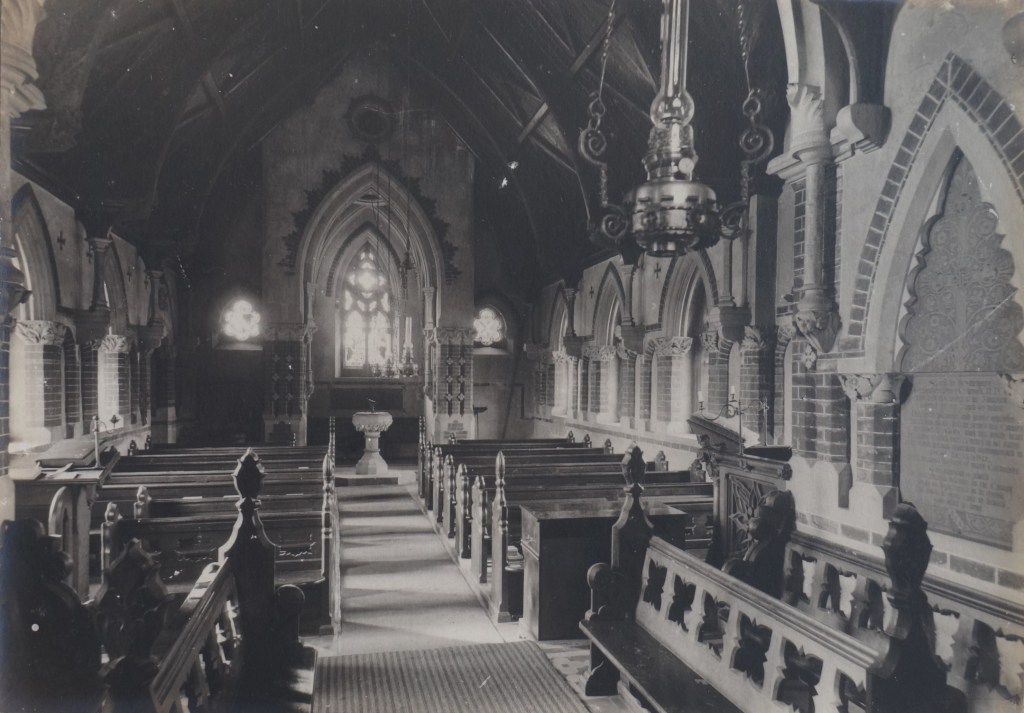
Holy Trinity, Calverhall: the main entrance to the porch in the base of the towerHoly Trinity, Calverhall: general view of the interior looking east
No image of the rebuilt chapel has yet emerged, but, given the date, one infers that the architectural treatment and liturgical arrangements soon came to fall short of mid-Victorian notions of ecclesiastical propriety. In 1872, following the completion of the main building campaign at Cloverley Hall, Heywood (who had originally been an enthusiastic Unitarian but later converted to Anglicanism) commissioned Nesfield to add a chancel to the existing chapel. The architect obliged with a design in a Geometrical Decorated Gothic style with numerous affinities to the work at Radwinter, flanked by a large vestry to the south and chapel and transept to the north.
Holy Trinity, Calverhall: the east window of 1879 by Clayton and BellHoly Trinity, Calverhall: the font at the west end of the nave and a surviving fragment of the lost tiled reredos
Following her husband’s death, Anna Maria Heywood brought back Nesfield in 1878 to remodel the remainder of the building as a memorial to him. Though just six years had passed, fashions in ecclesiastical architecture were changing rapidly and this is reflected in the marked stylistic contrast between the two phases of work. The lofty, clerestoried nave is handled in a spirited and ornate Perpendicular Gothic, something unthinkable just ten years previously, with a fine tie-beam roof based on West Country prototypes and splendid seven-light west window. A powerfully modelled tower with a prominent stair turret and rib-vaulted porch on the ground floor adjoins the nave to the north.
Holy Trinity, Calverhall: the nave roofHoly Trinity, Calverhall: the pulpit
Despite the hiatus in construction and absence at the outset of a unified concept, the interior of Holy Trinity is every bit as much as Gesamtkunstwerk as Radwinter and Kings Walden. The fittings are largely Nesfield’s work and show his delight in different materials, craft techniques and pretty ornamental detail – wrought iron for the communion rail supports, low chancel screen and main south door, high quality joinery for the choir pews, parclose screen and vestment cupboards in the vestry, even embossed leather for the coving of the organ case. The pipe rack above is stencilled with ‘Japanese pies’, which pop up again in numerous other location, even the backs to the sedilia and piscina. Within and without, the stone carving is also superlative quality: note especially the pulpit with its inlaid panels of marble, the internal hood moulds with their richly carved, slightly overscaled label stops and delightful figure carvings adorning the west gable. Some of this may have been executed by the same James Forsyth mentioned in connection with Kings Walden, whose involvement at Cloverley Hall is attested.
Holy Trinity, Calverhall: the chancel screenHoly Trinity, Calverhall: the organ case on the south side of the chancel
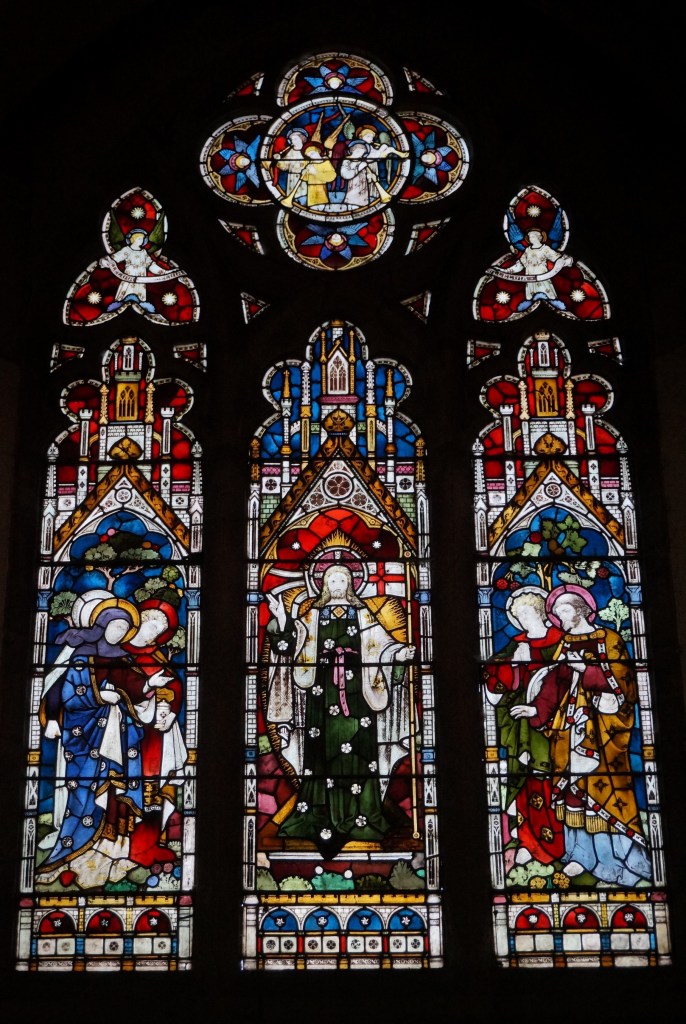
The lower part of the east wall in the sanctuary was formerly tiled, but this was lost in 1944 when it was replaced by oak panelling. A sad fragment now resting on the plinth of the font hints at what an exuberant, colourful display it must have made. The stained glass was added incrementally and does not form a unified scheme, but nonetheless includes pieces of superlative quality by leading designers of the period – Morris and Co for the south chancel window (the earliest stained glass, installed in 1875), Clayton and Bell for the east window of 1879, a design by Henry Holiday for the north chancel window by Powell’s of 1888, and elsewhere several pieces by Hardman.
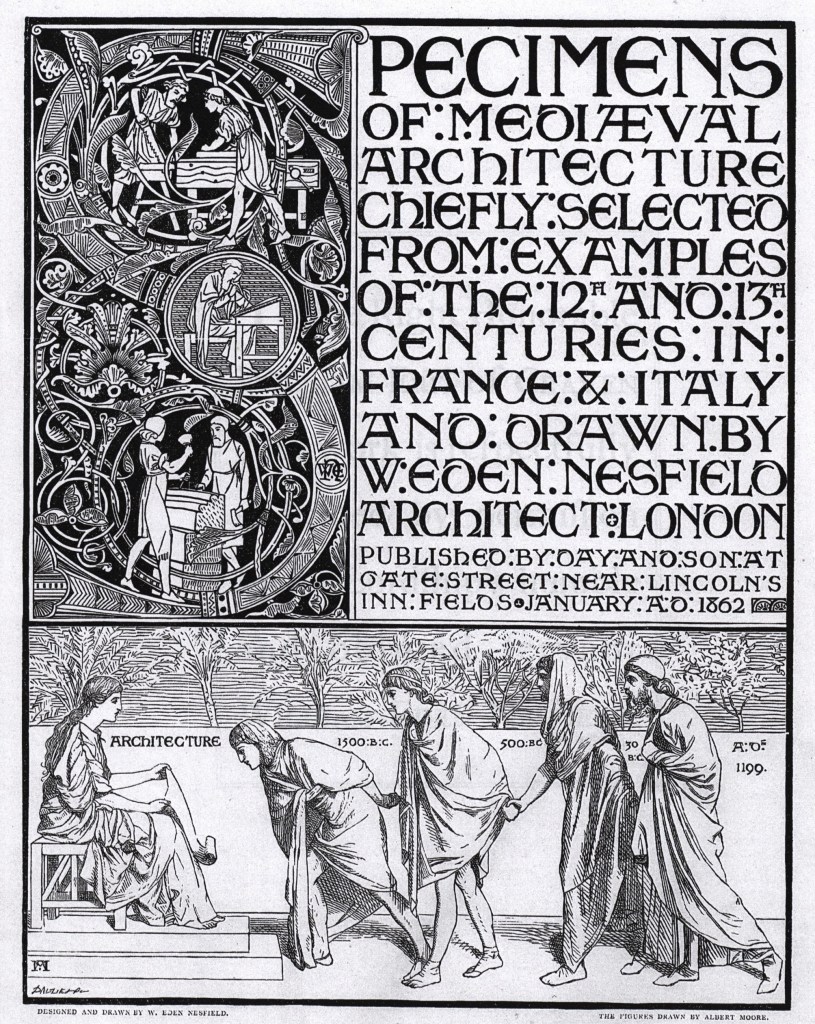
Holy Trinity, Calverhall: stained glass by Morris & Co depicting the Visitation on the south side of the chancelThe cover of Nesfield’s Specimens of Medieval Architecture: note the similarity in the drawing of the figures to those of the tiled splashback in the vestry at Radwinter.
In contrast to studies of domestic architecture of the period, Nesfield tends to fall by the wayside in surveys of mid-Victorian ecclesiastical design. Given the paucity of commissions in the field, this is hardly surprising. Yet for all that, he was no less passionate a Goth than his peers and, like so many of them, had cut his teeth as a young man with a European tour, chiefly of greater churches in France and Italy. The fruits of this emerged in his Specimens of Medieval Architecture of 1862, copiously illustrated with his exquisite drawings. Nesfield’s achievement as a church architect was to show how High Victorian Gothic could be spiced with pretty and inventive decorative detail. His aim is always to entertain, beguile and delight rather than to assail with high-minded stridency. All the qualities that make Nesfield’s houses such a delight are evident in his churches and his compelling, strongly individual personality shines through in them every bit as brightly.
Holy Trinity, Calverhall: stained glass of 1888 on the north side of the chancel depicting the Presentation of Christ in the Temple, made by James Powell to a design by Henry HolidayHoly Trinity, Calverhall, west gable of the nave – note the elaborate stops to the hood mould of the window
If one were to single out a figure who embodies all the tantalising yet exasperating complexities and lacunae of the byways of 19th century architecture, it might well be John Croft. Two works have come down to us which demonstrate an impressively fertile architectural imagination. Even by the standards of the 1860s – the high-water mark of Victorian wilfulness – they are outstanding achievements. Yet we know nothing of Croft’s training or professional practice. Indeed, certain basic facts of his biography still remain to be established. We know precious little about the remainder of his output and – unless in time evidence emerges to the contrary – we have no reason to think that he trained any pupils or led to the formation of any kind of school. In that sense, he conformed absolutely to Goodhart-Rendel’s definition of a ‘rogue architect’. Yet of Croft – and this the work of someone with a huge card index of 19th century churches – his lecture of 1949, ‘Rogue Architects of the Victorian Era’, contains not a word.
St John the Baptist, Lower Shuckburgh, Warwickshire – general view from south
St John the Baptist, Lower Shuckburgh, Warwickshire – nave roof and chancel arch
The digitalisation of censuses and parish registers now makes it possible to fill in some of the gaps which have defied architectural historians in the past, and here I am much obliged to Peter C.W. Taylor for his invaluable help. In the 1851 census, Croft is recorded at living in Hatton, a village just outside Warwick to the northwest of that town. His age is given as 50, which would imply a birth date of somewhere between 8th April 1799 and 7th April 1800, and he is recorded as being a native of Bilston in Staffordshire, a small town southeast of Wolverhampton. One surmises that Croft had moved to London as a young man and there met his wife Emma, a native of Gillingham in Kent – all seven of their children are recorded as having been born in Paddington over a period between the late 1820s and the early 1840s. His second son, Adolphus Croft (1831-1893), followed his father into the architectural profession, joining the practice of Gillow & Co. (from 1897 Waring & Gillow), for which he designed South Park in Wadhurst, East Sussex, a riotous and highly eclectic mix of Olde English, the Queen Anne style and some decidedly Rhenish touches. Completed in c. 1885, it was commissioned by a local landowner called John Bruce, but he resided there only for a short period before selling it in 1890 to the architect’s eldest brother, Arthur Croft (1828-1893/1902), a landscape artist who specialised in mountain scenery.
The former Warwick County Lunatic Asylum at Hatton, Warwickshire by F.J. Francis and James Harris, 1847-1852
South Park in Wadhurst, East Sussex, by Adolphus Croft of Gillow & Co., completed c. 1885: the inscription on this postcard dates it to after 1930, when the house became a boarding school for girls called Wadhurst College.
The Matterhorn seen from the Stockji Glacier in Zermatt, Switzerland by Arthur Croft (1878)
It is still unknown when or how the older Croft entered the architectural profession, and during the period when he was residing in Hatton he was acting as clerk of works at the Warwick County Lunatic Asylum, then under construction at a site in the parish. It was a major project, which was commenced in 1847 and not completed until 1852. The architect was Frederick John Francis (1818-1896), working on conjunction with James Harris. The latter is currently obscure, but the former was prominent among the first generation of Anglican Gothic revivalists. A pupil of Thomas Hopper (1776-1856), he designed numerous town, suburban and, sometimes, rural churches in partnership with his brother Horace (1821-1894), usually in a Middle-Pointed style and occasionally quite florid in the details. For the Warwick County Asylum, Francis and Harris produced a design in the neo-Jacobean style commonly used during the period for institutional buildings. It was a grand, spreading, symmetrical composition, with a three-storey central block housing the main entrance and rising to a clock tower, with long wings extending out and then forward either side. The complex was much augmented over the course of the following decades, although some of the later additions were demolished after it closed in 1995 and the site was redeveloped for housing.
St John the Baptist, Lower Shuckburgh, Warwickshire – exterior from west
St John the Baptist, Lower Shuckburgh, Warwickshire – detail of the gable and window of the organ chamber
By 1861, Croft and his family were living at No. 26 Wellington Street in Islington. But he seems to have maintained links with Warwickshire, which brought about the commission to rebuild the church of St John the Baptist in Lower Shuckburgh, a pretty estate village in rolling country on the A425 between Daventry and Leamington Spa. Built in 1863-1864, it is among the most outlandish and bizarrely original churches that Victorian England produced, which is saying a lot. Here is Romanticism writ as large as it can be, for this is architecture intended to appeal primarily to the emotions and the senses. It is a sumptuous, mind-bogglingly varied feast of colours, textures and forms. Externally, the constructional polychromy is achieved by mixing local blue lias and ironstone, all picturesquely rubble-coursed, with even purple gravel used for the infill of some of the gables. The south elevation, which forms its principal aspect, is a self-consciously picturesque assembly of highly varied forms with steeply pitched gables, used even for the ingenious hexagonal tower. The tracery resembles paper cut-outs, flush with the wall surface yet chamfered to within an inch of its life and with the glazing deeply recessed.
St John the Baptist, Lower Shuckburgh, Warwickshire – the porch in the base of the bell tower
St John the Baptist, Lower Shuckburgh, Warwickshire – general view of the interior looking east
Entry is through a hexagonal porch in the base of the tower. This functions as a kind of visual overture, rehearsing and bringing together what will be seen to be the main themes of the interior – serrated and acutely pointed brick arches, vault webs formed of hexagonal clay pots. What lies beyond is sheer phantasmagoria, spectacular visual display and such a wealth of spatial and formal invention that it is difficult to know where to rest one’s gaze. Croft’s imagination never flags, his creative energy vivifying features that his peers might well have accorded fairly cursory treatment: note the complex carpentry of the roof with its outsize cusping and the doily-like forms on the end of the hammerbeams, also the grotesque, fantastical bench ends like exotic blooms.
St John the Baptist, Lower Shuckburgh – bench end in the nave
St John the Baptist, Lower Shuckburgh, Warwickshire – nave looking west: the piers of the arcade are not, in fact, tuck pointed brickwork as the appearance suggests, but hollow constructions composed of terracotta blocks and the joints purely cosmetic, achieved by runnning lime putty into shallow incisions across the surface.
‘This is the local Gaudí’ is a familiar cliché. But for once it might be warranted, not merely for the exuberance and eccentricity, but for devices that are genuinely redolent of the Catalan master’s works, such as the Güell Palace in Barcelona of 1886-1889 – specifically, the dome faced in hexagonal tiles over the entrance and staircase hall. A yearning for the exotic is as important a component of Romanticism as a direct appeal to emotion, and there is reason to think that the evocation of architecture far beyond rural Warwickshire is more than coincidental. The church was commissioned by Sir George Shuckburgh (1829-1884) of Shuckburgh Hall, who had taken part in the Crimean War and reputedly wished to evoke what he had seen there. But what was source of inspiration? A place with a long and diverse history, Crimea is a rich seam of possible influences, from the Byzantine church in Kerch to Genoese fortifications in Sudak to the palace of the Crimean Tatar khan in Bakhchisarai. Without more research, it is difficult to know what was taken from that and thrown into this heady mix.
St John the Baptist, Lower Shuckburgh, Warwickshire – vault of the chancel: the tie rods were inserted in 1906, possibly an indication that Croft’s architectural imagination had outstripped his knowledge of construction. The clay pots were made to order by a local brickmaker called John Tomlin, and a total of 5,530 were used in the construction of the building.
St John the Baptist, Lower Shuckburgh, Warwickshire – east end and reredos
Shuckburgh’s purported influence begs the question of whether Croft was capable of such originality of his own accord or propelled towards it at his client’s instigation. One of his other known works supports such an assessment, while the other would seem to disprove it. Over a protracted period (the work began in 1861, but did not finish until 1873), Croft remodelled the fairly humble medieval church of St Laurence in Seale, a Surrey village just off the Hog’s Back to the southwest of Guildford. The exterior is good value for money: ‘shaggily picturesque’, Ian Nairn called it in the Surrey volume of The Buildings of England, and that sums it up well. The churchyard is entered through a lychgate with an overscaled hipped roof and cusped framework, wholly characteristic of Croft, and the central tower of brown Bargate stone with its pyramidal roof is a very effective accent in the landscape. But the interior is a disappointment: well crafted, touches of originality in the chamfered forms of the piers of the nave arcade and crossing, some nicely carved foliate label stops, but nothing especially memorable, nothing that was not done more interestingly or better elsewhere.
St Laurence, Seale, Surrey – general view from southwestSt Laurence, Seale, Surrey – general view of the interior looking east
So the earliest work is a disappointment. And yet the third building by Croft shows a substantial increase in his powers. In 1863, Commodore Peter Cracroft rebuilt the medieval church of All Saints in Cold Hanworth, a tiny village to the northeast of Lincoln, as a monument to his father. How Croft won the commission is currently a mystery, but Cracroft must have had deep pockets and his architect rose to the occasion. In plan, it is a simple enough building – a nave of three bays with a bell turret at the west end and a chancel of two. Yet again, Croft lavishes a wealth of highly imaginative detailing on diminutive forms.
St Laurence, Seale, Surrey – the lychgateAll Saints, Cold Hanworth, Lincolnshire – the exterior as it appears today. The building is now a private house and this photograph was taken with the owner’s permission.
There is the same delight as at Lower Shuckburgh in varied textures and the interplay between rustication and ashlar masonry, which extends all the way to the top of the spire of the stumpy octagonal bell turret, its form echoing that of the polygonal vestry on the opposite side. Round the belfry stage, louvered windows alternative with blind, vesica-like openings, the jambs and arrises bitten away, notched and chamfered in bewildering array. Gothic tracery is taken apart, reassembled and contorted with writhing curved forms that prefigure Art Nouveau, especially in the outrageous west window. From the south side of the nave – placed off-centre above the porch for good measure – rises an extraordinarily intricate sculptural form that must have once been a chimney for a boiler or stove. There is no fall-off in the treatment of the equally intricate lychgate with its outsize voussoirs and roof with deep eaves supported on brackets borne on outsize gablets, supported on squashed foliate capitals which rest on chamfered shafts rising out of steeply battered set-offs. Even the piers of the churchyard wall are turned into vivid sculptural forms.
Exterior from southeast of All Saints, Cold Hanworth, Lincolnshire – date unknown, but probably early 20th century (Croft family archive)All Saints, Cold Hanworth – north side of nave
Unfortunately, Croft’s interior is now impossible to appreciate since the church was made redundant in 1980 – a predictable consequence of its location in a sparsely populated rural area – and subsequently converted to a private house, which entailed much subdivision. It could and should have been vested in the Redundant Churches Fund or Friends of Friendless Churches. But its appearance does at least survive in archive photographs, which confirm that it fulfilled all the expectations engendered by the exterior. One of the constants in the work of the ‘rogues’ is a love of baroque complexity for its own sake, of never using one word when 10 will do, of cramming the maximum amount of architectural effect into the minimum of space, and it is clear that that was the guiding principle in this instance.
All Saints, Cold Hanworth, Lincolnshire – commemorative plaque inside the building (Historic England) All Saints, Cold Hanworth, Lincolnshire – the lychgate
In such a small building, one of Croft’s peers might well have contented himself with using corbels to support the trusses of the nave roof. But here the corbels are pulled down to the level of the springing of the arches of the nave windows, the trusses instead resting on spindly colonettes, square in section and twisted by 45 degrees for good measure (primarily an aesthetic conceit, perhaps, since most of the weight of the roof structure is probably transferred to the wall plate instead). This impression, at once toylike and slightly claustrophobic, reached fever pitch in the tiny, vaulted baptistery occupying the lowermost stage of the west tower. There is a love of hypertrophied devices, such as the overscaled statues of angels adorning the reredos. The lotus flower-like motif encountered at Lower Shuckburgh is tried out here for the first time, used not only for the bench ends of the pews, but also for the tracery of the east window with its strange, bifurcated mullions. Bizarre, jagged foliate carving is deployed liberally for capitals and corbels, in a manner that sometimes oversteps the bounds of architectural logic.
General view looking east of the interior of All Saints, Cold Hanworth, Lincolnshire – date unknown, but probably early 20th century. Compare the outlandish forms of the bench ends with those pictured above at Lower Shuckburgh. (Croft family archive)
The reredos and east window at All Saints, Cold Hanworth, Lincolnshire, probably 1960s – note that by this point the constructional polychromy visible in the illustration above had been whitewashed over. (Historic England)
By the time he came to design the churches at Cold Hanworth and Lower Shuckburgh, Croft was not a young man. How much longer he lived after their completion is unknown. He crops up in the 1871 census at No. (?)154 (the number is not wholly legible) Alexandra Road in Hampstead, the home of his son Arthur. Whether he was permanently resident there or simply happened to be visiting on the night the census was taken is unclear, and the trail goes cold after that. His places of death and burial have yet to be discovered. So too does the remainder of his architectural career. Research for this blog – for which I am again indebted to Peter Taylor – has brought to light only three more buildings, all in his known domain of activity in Warwickshire. At Haseley, barely a mile to the northwest of the County Asylum in Hatton, in 1855 Croft remodelled the (now former) rectory of 1825, adding a complex of outbuildings, now much altered. In 1858-1859 he was involved at Shuckburgh Hall, where is apparently remodelled the entrance hall as part of a grand scheme of works begun by Henry Kendall Junior (1805-1885), who in 1844 had remodelled the entrance front. Access to the hall (which is still the private residence of the Shuckburgh family) is difficult to obtain and even the entry for the revision of the revised Warwickshire volume of The Buildings of England, published in 2016, had to be made on the basis of a cursory inspection.
Detail of the bases of the trusses of the nave roof and colonettes supporting them at All Saints, Cold Hanworth, Lincolnshire (Historic England)General view looking west of the interior of All Saints, Cold Hanworth, Lincolnshire – date unknown, but probably early 20th century (Croft family archive)
But fleeting views of Croft’s work are available from a surprising source – series 12 of the television programme Salvage Hunters, in which the presenters visit the house and linger briefly in the entrance hall before going to inspect items of furniture being offered for disposal. Much of what can be made out seems in spirit to have a distinct kinship with Croft’s rogue gothic. There is an enormous neo-Jacobean fireplace incorporating an overmantel with stocky pilasters and an extraordinary fretted pediment and antefixae, which is treated very similarly to the adjacent doorcases. The geometrical patterning of the plaster ceiling is a free reinterpretation of early 17th century prototypes. Any such subjective conjecture made on the basis of inadequate visual information must, of course, be advanced with extreme caution. All that can be said for the moment, until the opportunity arises to study in depth the interior of Shuckburgh Hall, is that none of this has anything to do with the comparatively chaste free Renaissance of Kendall’s entrance front.
In 1860-1861, Croft restored the nave and transepts of the medieval church of St Lawrence in Napton on the Hill west of Lower Shuckburgh, adding a clerestory and reseating the western arm of the building. There are one or two wilful touches and the pulpit is clearly by his hand, but in most other respects it seems to have been a fairly workaday job. Perhaps there are papers detailing Croft’s life and work still waiting to be unearthed, which might help us understand how the extraordinary buildings at Cold Hanworth and Lower Shuckburgh came to be and why they look as they do. Perhaps there are even lost masterpieces and unexecuted designs awaiting discovery.
St Lawrence, Napton on the Hill, Warwickshire – the pulpit (Jean McCreanor)The garden front of the rectory at Haseley, Warwickshire
Or perhaps not. When we chance upon a work by a clearly original and distinctive artist, we want to believe that we are entering a new world. Such talent implies a will to create – it is a natural human impulse to want to find a lasting outlet for such ability, after all, therefore we want to believe that this is not a one-off. When we find that there is, in fact, no substantial oeuvre awaiting recognition and acclaim, or else what exists turns out not to rise to our expectations, we feel disappointed, even short-changed, and we seek an explanation. There are plenty of tales of thwarted potential in all the arts, of careers curtailed by ill luck and circumstances. But there are also individuals whose contribution to their field might well have been wholly unremarkable – architects who shunned the limelight and contented themselves with minor commissions – but for a rare handful of occasions when the stars aligned correctly and unlocked a powerful, yet limited reserve of creative energy. Perhaps that is what we are dealing with here. At any rate, Cold Hanworth and Lower Shuckburgh are such inspired works as to yield ideas for dozens more buildings, and that is more than enough.
St John the Baptist, Lower Shuckburgh, Warwickshire – window on the north side of the nave
St John the Baptist, Lower Shuckburgh, Warwickshire – the chancel looking northeast
The subject of my first post is someone who, if not exactly obscure, nonetheless is very much a connoisseur’s architect. W. Eden Nesfield (as he tended to call himself) was born into an affluent old Durham family. His father, William Andrews Nesfield (1793-1881), was a veteran of the Peninsula War who subsequently became a water colourist and landscape garden designer, working in the latter capacity for numerous prestigious clients – the terraces at Holkham Hall, for instance, are partly his work.
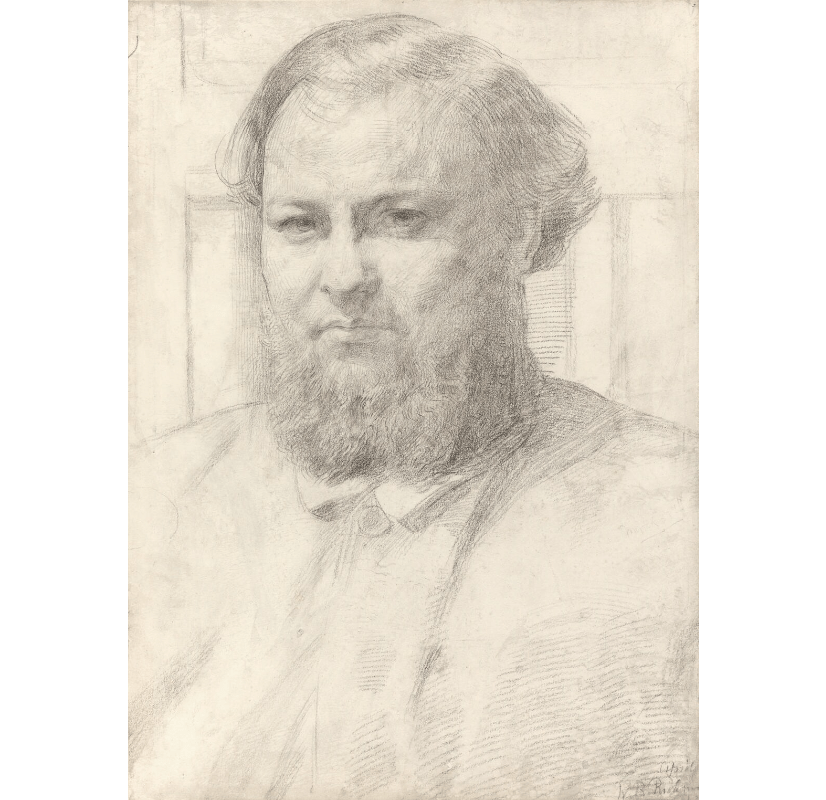
Barclays Bank (originally Gibson, Tuke and Gibson, now Barclays) on the east side of Market Place, Saffron Walden, 1873-1874William Eden Nesfield, portait by Sir William Blake Richmond (1842-1921), pencil and chalk, c. 1865 (National Portrait Gallery)
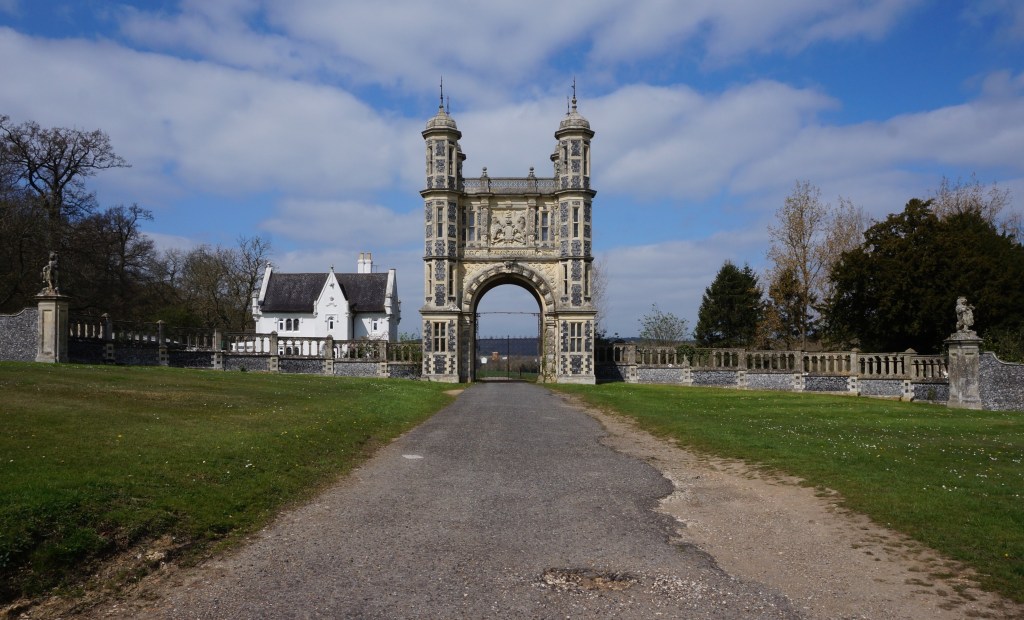
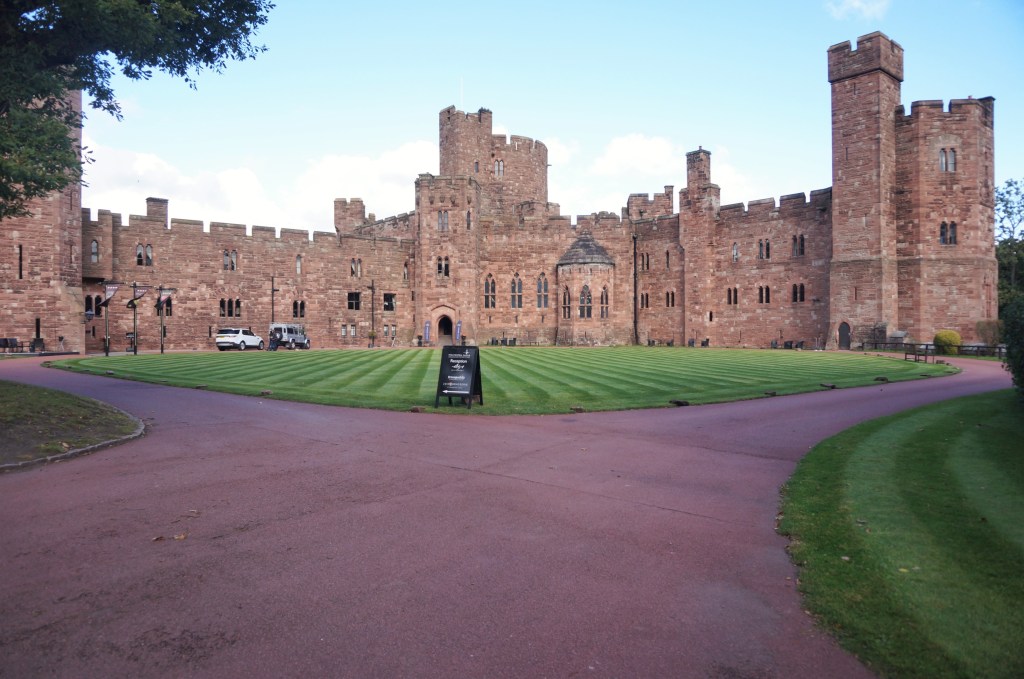
William Nesfield the younger was sent to Eton and then at the age of 15 articled to William Burn (1789-1870), a prolific architect active throughout England, Scotland and Ireland, who specialised in country houses. One of this most spectacular surviving works, the amazing Jacobean gatehouse of Eastwell, is only a short drive from Canterbury. Though it gave him a useful professional grounding, the pupillage was not a success and, after two years, Nesfield left Burn’s office for that of Anthony Salvin (1799-1881), the husband of his paternal aunt. He, too, was a prolific designer of country houses and was responsible for the astonishing Peckforton Castle in Cheshire, built in 1844-1852 in hilly country outside Chester and a vivid evocation of the Edwardian castles further to the west along the north Wales coast.
Tower Lodge of Eastwell in Kent by William Burn, 1848Peckforton Castle, Cheshire by Anthony Salvin, 1844-1852
Though the period in Burn’s office may have been unhappy, it had a major bearing on Nesfield’s career by bringing him into contact with another pupil there, Richard Norman Shaw (1831-1912), with whom he travelled extensively. They were both eager to see for themselves the most celebrated new works of the Gothic Revival – predictably enough, but their interests developed in a less expected direction in that they were no less taken by the vernacular architecture of southeast England, which they sketched extensively.
Plas Dinam in Llandinam, Powys, Wales, 1873-1874: detail of the entrance frontThe lodge and main drive at Cloverley Hall in Shropshire: one of Nesfield’s most important commissions, this house was built in 1864-1870 for the Liverpool millionnaire banker John Pemberton Heywood.
Tudorbethan piles with fake timbering and leaded lights are so much part of the architectural currency of the 20th and, indeed, early 21st centuries, that it now takes an effort of imagination to appreciate how radical a departure it was back then for architects to turn to such sources for inspiration. In the mid-19th century a country house might take any kind of a wide range of stylistic garb. It might be neo-Jacobean, Scottish baronial, a Gothic castle, an Italianate villa, a classical mansion, might even have touches of something exotic and orientalising, but not vernacular. That was the stuff of the cottage orné, a picturesque accent to be admired in a carefully composed view from the Big House, but not actually inhabited. As Andrew Saint writes in his overview of the architect’s life in A Deuce of an Uproar, ‘If we knew nothing of Nesfield’s life and had only his buildings, he would still rank in the forefront of Victorian architects, as a consummate designer, draughtsman and ornamentalist, and as one of three or four individuals who transformed the whole feeling and destiny of the larger English house in the ‘60s and ‘70s of the [nineteenth] century’.
Plas Dinam in Llandinam, Powys, Wales, 1873-1874: the garden frontThe tower that formerly housed the dovecote, game larder and gun room at Cloverley Hall in Shropshire: the extensive service range survived largely unscathed the drastic reduction in size and remodelling of the main house in 1926-1927. As pointed out in the Shropshire volume of The Buildings of England, the design of this tower is cribbed from an illustration in a study by Viollet-le-Duc of medieval castles.The garden front at Cloverley Hall as pictured in A History of the Gothic Revival by Charles Eastlake, who said of it, ‘To describe a modern building by the general remark that its style can be properly referred to no precise period in the history of styles, would, not many years ago, have been equivalent to pronouncing its condemnation, and even at the present time there are but few designers who can depart from recognised canons of taste without arriving at a result more original than satisfactory. But in this admirable work Mr. Nesfield has succeeded in realising the true spirit of old-world art, without hampering himself by those nice considerations of date and stereotyped conditions of form which in the last generation were sometimes valued more highly than the display of inventive power’. Note the tower of the service court illustrated in the picture above visible to the right of the main building.
For a while, Nesfield and Shaw worked closely together and in 1866-1869 were in formal partnership. But by the end of the decade, they were starting to drift apart. Shaw was a shrewd businessman, ambitious, industrious, clever at self-promotion and establishing and cultivating relations with clients. Though country houses loomed large in his output, he handled a very diverse range of commissions, taking office buildings, schools, garden suburbs and new churches in his stride. He ran a large practice and shaped numerous protégés who in turn shaped the Arts and Crafts architecture of the next generation. Nesfield, by contrast, ran a small office, seems to have disliked the exigencies of professional practice, did not actively seek commissions in the same way and, when eventually able to do so, gave up architecture at the age of 46 to concentrate on painting until, four years later, a lifetime of heavy drinking caught up with him.
Magnolia Cottage and Stowford Cottage on the Crewe Hall Estate in Cheshire, 1865Detail of the Golden Lodge to Kinmel Park on the North Wales coast in Clwyd, built in 1868 as part of a grand scheme of works that culminated in the remodelling of the main house in the first half of the 1870s. The ‘H’s stand for Hugh Robert Hughes, then-owner of the estate and heir to a copper-mining fortune, who engaged Nesfield to carry out the work. Note the trademark ‘Japanese pies’ and potted sunflowers.
As Andrew Saint asks, ‘Whose was this extraordinary, proud, quixotic, witty and melancholic temperament? […] Nesfield was an enigma. We know enough about him to discern ability amounting practically to genius, a career only half-fulfilled and a personality fraught with contradictions: high spirits vying with depression; bouts of industry alternating with lethargy; a strong sensuality coupled with lofty, snobbish standards of honour and behaviour; and a dedication to his calling as architect at seeming odds with his disdain for publicity or professional advancement. More knowledge might, or might not, help us to explain all this. The facts are that Nesfield had in extreme form the qualities of a certain type of mid-Victorian ‘art-architect’, coupled with the advantages and drawbacks or having been born with at least half of a silver spoon in his mouth’.
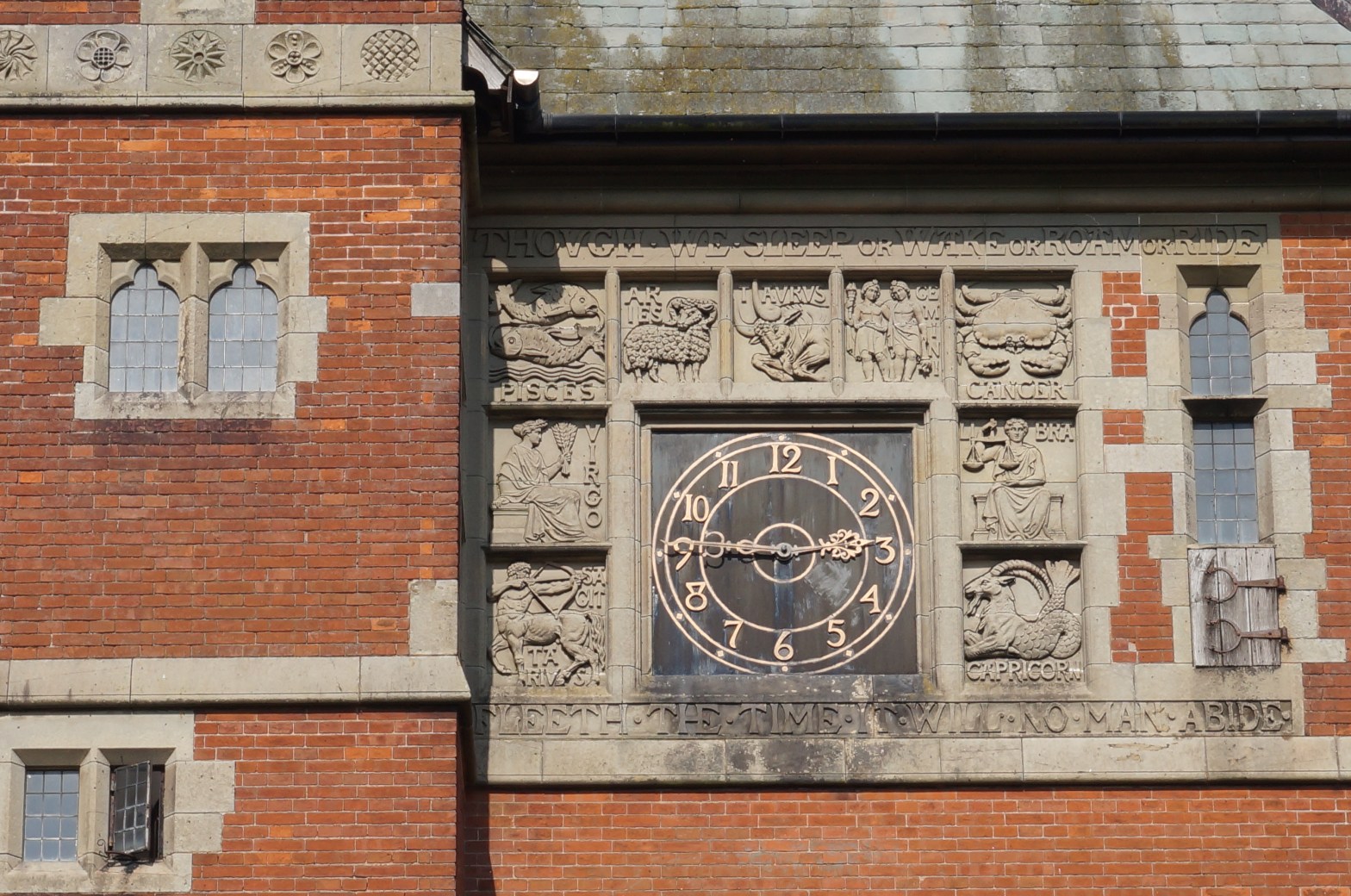
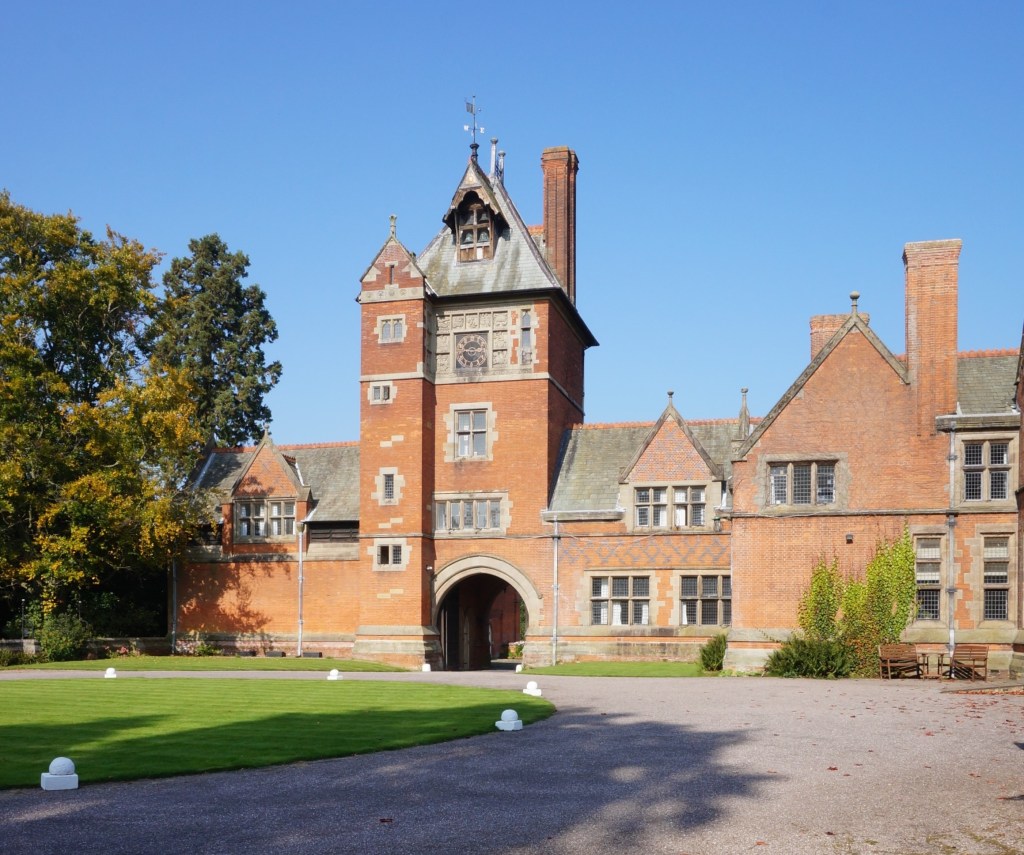
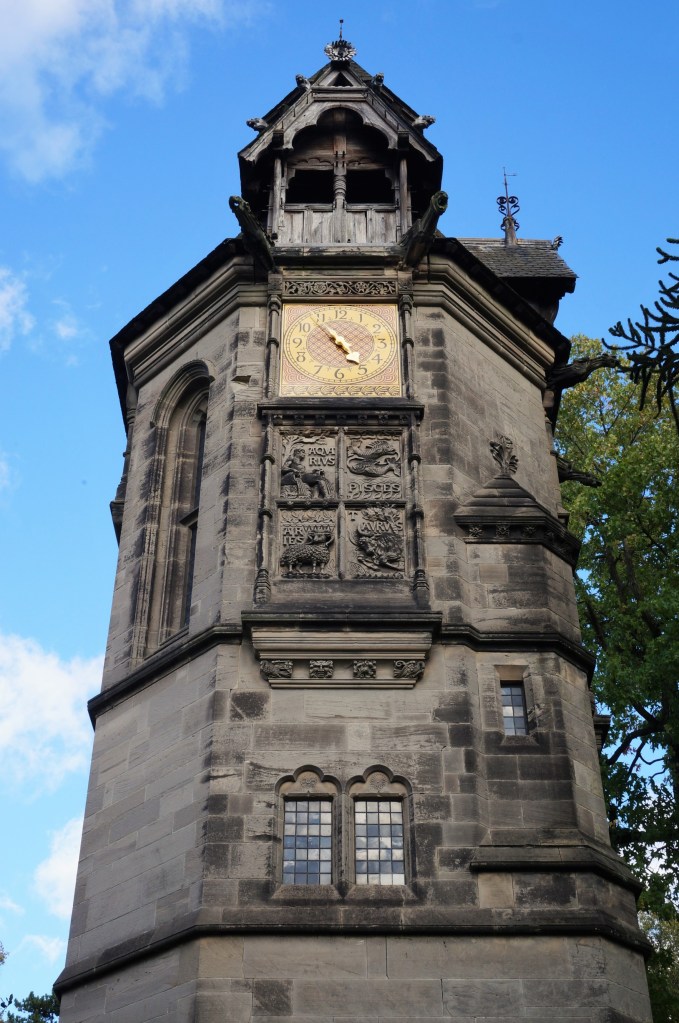
The clock tower and entrance to the service court and stable block at Cloverley Hall, Shropshire: the panels in relief surrounding the clock face and depicting the Signs of the Zodiac are shown in detail in the featured photograph at the top of this post.The entrance front of Cloverley Hall, date unknown, but probably early 20th century: note the surviving clock tower over the gateway to the stables and service court visible to the left. (Historic England) Brookside Cottages on Church Hill in Radwinter, Essex, one of a number of buildings by Nesfield put up in the village as part of a rebuilding effort following a devastating fire in 1874.
The mainstay of Nesfield’s practice was country house and associated domestic work – somewhat unfortunately for us, since many of his most important buildings fell victim to the downturn in the fortunes of large estates and the reaction against High Victorian taste after World War I. What survives has to be sought out and is not always readily accessible. The subject of this post is a rare exception – the bank that Nesfield built in 1873-1874 originally for the firm of Gibson, Tuke and Gibson on the east side of the Market Place in Saffron Walden. In 1868-1870, Nesfield had remodelled the medieval church at Radwinter (one of his few major ecclesiastical commissions) for the Rev’d John Frederick Watkinson Bullock, squire-parson there from 1865 to 1916, whose introductions appear to have broadened Nesfield’s range and given us one of his very few public secular buildings.
The clock tower of the service range at Hampton Manor, Hampton-in-Arden, Warwickshire, added by Nesfield in 1872 as part of his remodelling of an older house.Cottages at the top of Church Hill in Radwinter, Essex – like Brookside Cottages pictured above, this range forms part of the rebuilding campaign initiated after the fire of 1874.
It is a commanding location and the massing of the bank, with its thick-set, tower-like proportions and expressive skyline, makes the best of it. But this is architecture intended to delight at close range as well as impress from a distance. As Saint notes, ‘It is the decoration of Nesfield’s architecture which is generally most startling. None of his building depends on ornament… [but] whenever he had the chance (and he must have had a silver tongue with his rich clients) he loved to break out into ornament; stamped leadwork, carved and moulded brickwork, stained glass, wrought iron finials, incised plasterwork, and even green bottle-bottoms stuck into external plastering. Among other Gothic Revivalists, only William Burges was as ornamental as Nesfield and Burges’s range of effects was stiffer and more limited. Where Nesfield got his ideas would take an essay to explore’. Note here the lovely bas-relief carvings of storks (Gibson’s emblem) in the spandrels of the main entrance, the crenellated hopper head, the leadwork parapet embossed with ‘pies’ (a favoured motif borrowed from the Japonaiserie of the Aesthetic Movement) and splendid wrought iron finial with its wind vane.
Detail of the entrance front at Bodrhyddan, Clwyd in Wales, added by Nesfield when he remodelled this originally largely Stuart house in 1874-1875.











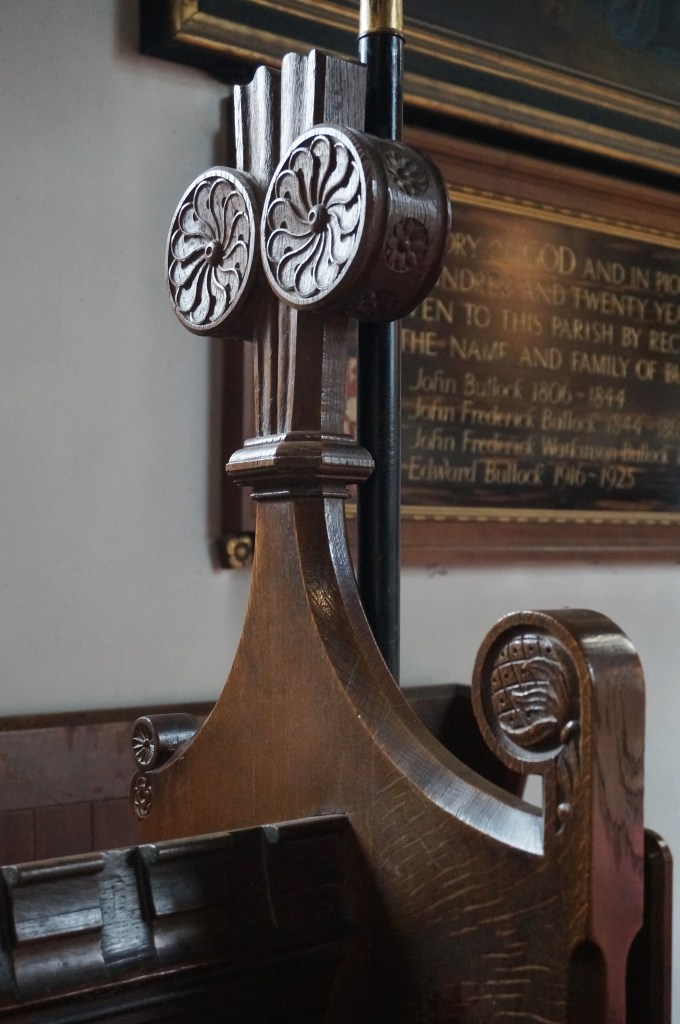


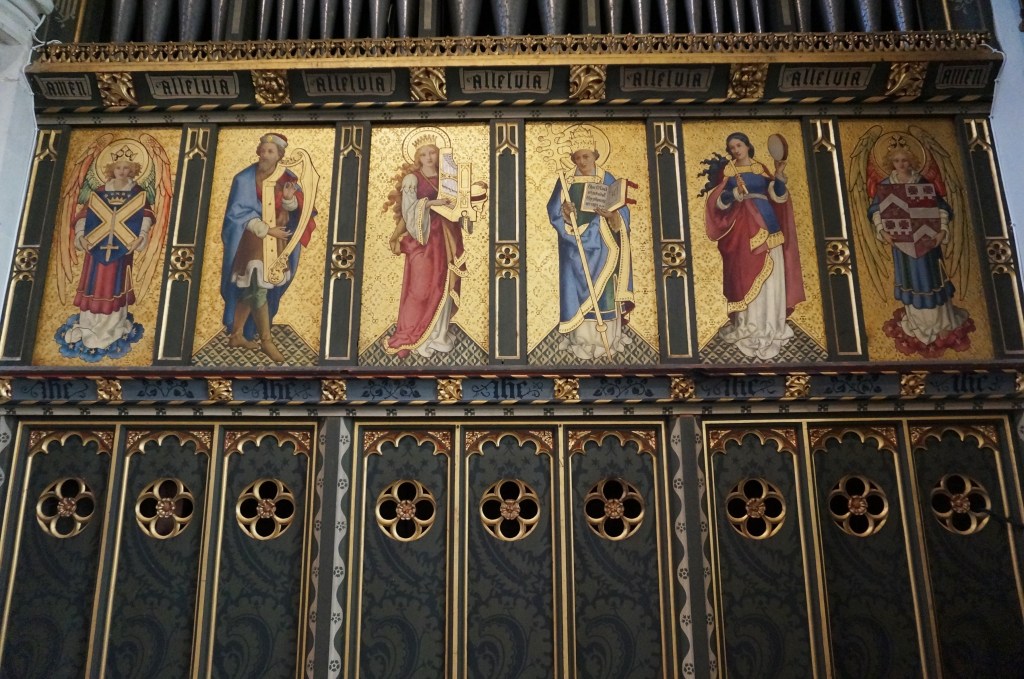

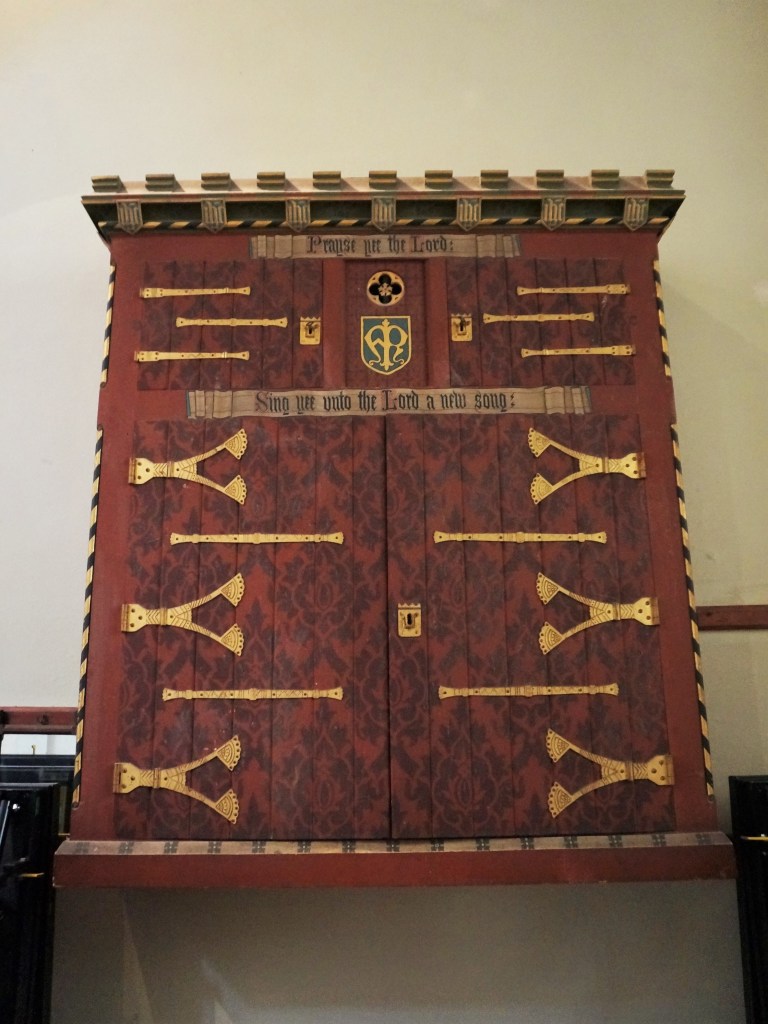




























 Less Eminent Victorians